CHAPTER 9 ยท ANTIANGINAL DRUGS
Section 1
Mechanism of Action
All calcium channel blockers share one molecular target, but tissue selectivity splits the class into two clinically distinct subgroups.

Calcium channel blockers are unique among antianginal drugs: they carry a first-line indication across all three angina subtypes covered in Module 1. Their effects come from blocking a single channel type that happens to be important in two very different tissues.

The L-Type Calcium Channel

Voltage-gated L-type calcium channels are the main route of calcium entry into both vascular smooth muscle cells and cardiac pacemaker and conduction tissue. In vascular smooth muscle, calcium entry triggers the contraction that maintains vascular tone; blocking the channel causes the muscle to relax, producing vasodilation. In the sinoatrial and atrioventricular nodes, calcium entry drives the pacemaker depolarization that generates and conducts the heartbeat; blocking the channel here slows heart rate and slows conduction through the atrioventricular node. In ventricular muscle, calcium entry also contributes to the force of contraction, so channel blockade can reduce contractility as well.

Tissue Selectivity: Why Two Subclasses Behave So Differently

Although all calcium channel blockers act on the same channel, individual drugs differ markedly in how selectively they target vascular tissue versus cardiac tissue. Dihydropyridines are highly vascular-selective: their dominant effect is peripheral and coronary vasodilation, with minimal direct effect on heart rate or contractility at usual doses. Non-dihydropyridines, which include verapamil and diltiazem, have much more balanced effects on both vascular and cardiac tissue, producing vasodilation alongside meaningful heart rate and conduction slowing.

This single distinction in tissue selectivity explains nearly everything that differs between the two subclasses clinically: which hemodynamic lever each one pulls, which combinations are safe, and which adverse effects are most likely.
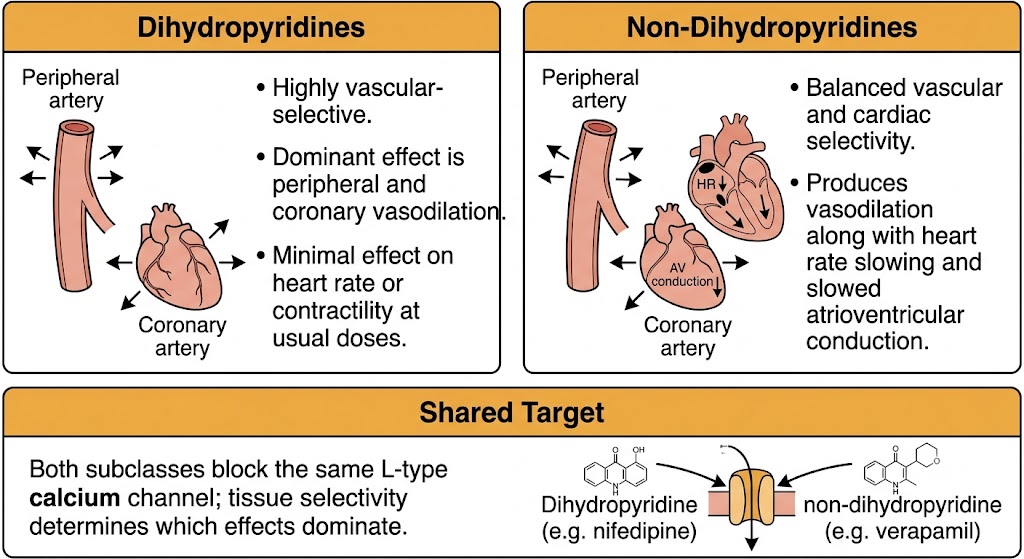
A two-panel diagram comparing dihydropyridine calcium channel blockers, which are vascular-selective, against non-dihydropyridines, which have balanced vascular and cardiac effects, both acting on the same L-type calcium channel.
Dihydropyridines versus non-dihydropyridines: tissue selectivity.

Section 2
Dihydropyridines in Angina
Amlodipine is the prototype: slow, sustained vasodilation without significant reflex tachycardia.

Amlodipine is the preferred dihydropyridine for chronic angina management, and the reason illustrates an important general principle about vasodilator safety.

Why Amlodipine Is Preferred

Amlodipine binds to and releases from the calcium channel very slowly, which produces a gradual onset of vasodilation and a long duration of action that supports convenient once-daily dosing. Because the blood pressure fall happens slowly rather than abruptly, the baroreceptor reflex is not triggered to the degree it would be with a faster-acting vasodilator, so amlodipine causes little to no reflex tachycardia at usual doses.

Anti-ischemic benefit comes from two sources: afterload reduction through peripheral arterial dilation, and direct coronary vasodilation, which is particularly valuable in vasospastic angina.

Why Short-Acting Dihydropyridines Are Avoided

Immediate-release nifedipine produces a much faster drop in blood pressure than amlodipine. This rapid fall strongly activates the baroreceptor reflex, producing pronounced reflex tachycardia and sympathetic activation that increases myocardial oxygen demand and can negate or even reverse the drug's intended anti-ischemic benefit. For this reason, immediate-release nifedipine is not used for chronic angina management; long-acting dihydropyridines like amlodipine have fully replaced it.

Clinical Use

In stable exertional angina, dihydropyridines are useful as monotherapy when beta-blockers are contraindicated or not tolerated, and they are a preferred combination partner with beta-blockers when monotherapy is insufficient. In vasospastic angina, dihydropyridines are first-line therapy, since direct coronary smooth muscle relaxation prevents and reverses spasm. They have no bronchoconstrictive effect, making them a useful alternative when beta-blockers are contraindicated by significant respiratory disease.


Section 3
Non-Dihydropyridines in Angina
Verapamil and diltiazem combine vasodilation with cardiac rate-slowing in a single agent.

Verapamil and diltiazem are the two non-dihydropyridine calcium channel blockers used in angina. Because they act on both vascular and cardiac tissue, they produce a hemodynamic profile that differs meaningfully from the dihydropyridines.

Shared Hemodynamic Profile

Both verapamil and diltiazem produce peripheral and coronary vasodilation alongside negative chronotropy, or heart rate slowing, and negative dromotropy, or slowed conduction through the atrioventricular node. Because vasodilation and heart rate reduction happen together rather than separately, these agents do not produce the reflex tachycardia seen with short-acting dihydropyridines: heart rate tends to fall or stay unchanged rather than rise.

Verapamil versus Diltiazem

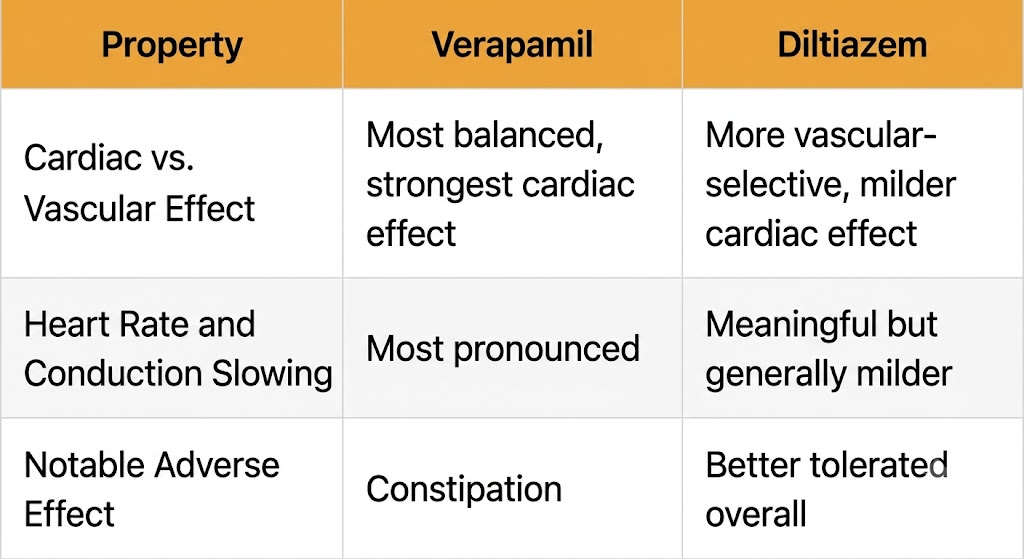
Verapamil has the most balanced vascular and cardiac effects of the two agents, producing the most pronounced heart rate and conduction slowing as well as a clinically significant reduction in contractility. Constipation is common with verapamil, resulting from the same calcium channel blockade acting on intestinal smooth muscle. Diltiazem is somewhat more vascular-selective than verapamil, producing meaningful but generally milder cardiac rate-limiting effects and is better tolerated overall.

Both agents are metabolized through the same hepatic enzyme pathway responsible for metabolizing many other commonly used drugs, so both carry potential for clinically relevant drug interactions that should be considered when either is added to a patient's regimen.

A reference table comparing verapamil and diltiazem on cardiac versus vascular effect, heart rate and conduction slowing, and notable adverse effects.
Verapamil versus diltiazem.

Section 4
The Beta-Blocker Combination Rule
One calcium channel blocker subclass pairs well with beta-blockers; the other does not.

Because calcium channel blocker subclasses differ so much in their cardiac effects, whether a beta-blocker can be safely combined with a given calcium channel blocker depends entirely on which subclass is involved.

Complementary Mechanisms
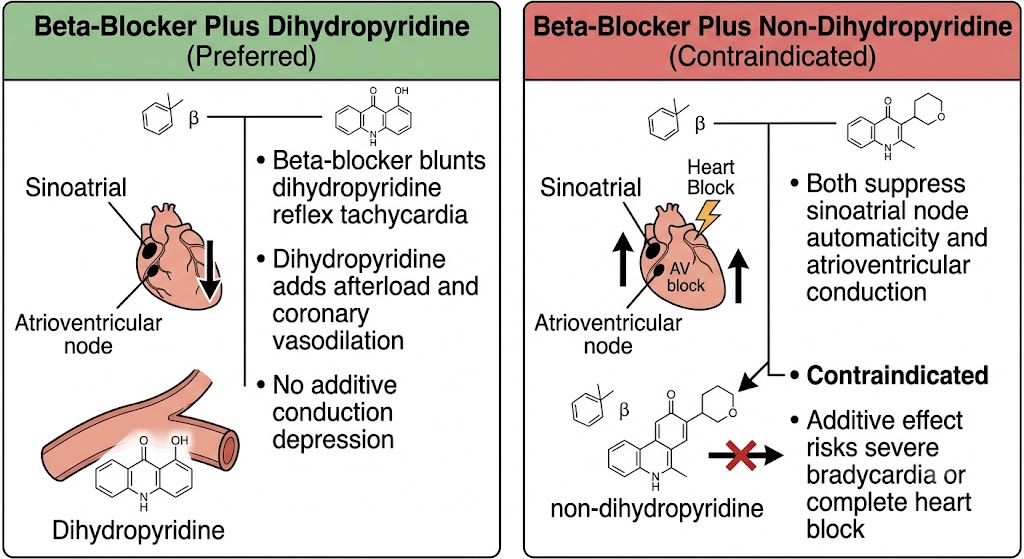
Beta-Blocker + Dihydropyridine
  • Preferred combination
  • Beta-blocker blunts dihydropyridine reflex tachycardia
  • No additive conduction depression
Additive Suppression
Beta-Blocker + Non-Dihydropyridine
  • Contraindicated in routine practice
  • Both suppress the same conduction system
  • Risk of severe bradycardia, complete heart block
Why the Difference Exists

A beta-blocker paired with a dihydropyridine works well because the two drugs act on complementary targets: the beta-blocker reduces heart rate and contractility while blocking the reflex tachycardia that dihydropyridine-induced vasodilation would otherwise trigger, and the dihydropyridine contributes afterload and coronary vasodilation without adding to atrioventricular conduction depression.

A beta-blocker paired with a non-dihydropyridine is dangerous for the opposite reason: both drug classes independently suppress sinoatrial node automaticity and atrioventricular nodal conduction. Combining them produces additive, and potentially severe, suppression of the heart's own conduction system, risking profound bradycardia or complete heart block. This combination is avoided in routine practice regardless of which specific agents are involved.

A two-panel diagram contrasting the preferred combination of a beta-blocker with a dihydropyridine against the contraindicated combination of a beta-blocker with a non-dihydropyridine, with the mechanism for each.
Preferred versus contraindicated beta-blocker combinations.

Section 5
Adverse Effects and Contraindications
The most important adverse effects and contraindications follow directly from each subclass's tissue selectivity.
Dihydropyridines: Peripheral Edema

Peripheral edema, typically affecting the ankles, is the most common adverse effect of dihydropyridines. The mechanism is purely hemodynamic: arteriolar dilation occurs without a matching degree of venodilation, raising pressure in the capillary bed and pushing fluid into the surrounding tissue. This is not caused by sodium or fluid retention, which is an important distinction from edema due to heart failure or kidney disease, and it does not respond to a diuretic in the way fluid-overload edema would.

Non-Dihydropyridines: Negative Inotropy and Heart Failure

Because verapamil and diltiazem meaningfully reduce contractility, both are contraindicated in heart failure with reduced ejection fraction: reducing the calcium available for contraction further impairs a heart muscle that is already failing. Amlodipine, by contrast, has minimal effect on contractility at therapeutic doses and is considered safe in this same population. This is a direct, testable consequence of the tissue-selectivity principle introduced in Section 1.

Other Notable Effects

Suggested References
Author / Organization Title Source
Nissen SE, Tuzcu EM, Libby P, et al.Effect of antihypertensive agents on cardiovascular events in patients with coronary disease and normal blood pressure (CAMELOT study)JAMA, 2004
Poole-Wilson PA, Lubsen J, Kirwan BA, et al.Effect of long-acting nifedipine on mortality and cardiovascular morbidity in patients with stable angina requiring treatment (ACTION trial)Lancet, 2004
Knuuti J, Wijns W, Saraste A, et al.2019 ESC Guidelines for the diagnosis and management of chronic coronary syndromesEuropean Heart Journal, 2020
Fihn SD, Gardin JM, Abrams J, et al.2012 ACCF/AHA Guideline for the diagnosis and management of patients with stable ischemic heart diseaseJournal of the American College of Cardiology, 2012
Beltrame JF, Crea F, Kaski JC, et al.International standardization of diagnostic criteria for vasospastic anginaEuropean Heart Journal, 2017
Packer M, O'Connor CM, Ghali JK, et al.Effect of amlodipine on morbidity and mortality in severe chronic heart failure (PRAISE-1)New England Journal of Medicine, 1996
Pitt B, Byington RP, Furberg CD, et al.Effect of amlodipine on the progression of atherosclerosis and the occurrence of clinical events (PREVENT trial)Circulation, 2000
Jamerson K, Weber MA, Bakris GL, et al.Benazepril plus amlodipine or hydrochlorothiazide for hypertension in high-risk patients (ACCOMPLISH)New England Journal of Medicine, 2008
Crea F, Bairey Merz CN, Beltrame JF, et al.The parallel tales of microvascular angina and heart failure with preserved ejection fractionEuropean Heart Journal, 2017
Opie LH, Yusuf S, Kubler W.Current status of safety and efficacy of calcium channel blockers in cardiovascular diseasesProgress in Cardiovascular Diseases, 2000
Abernethy DR, Schwartz JB.Calcium-antagonist drugsNew England Journal of Medicine, 1999