The beta-lactam ring, penicillin-binding proteins, and the structural basis of bactericidal activity
All beta-lactam antibiotics share a core four-membered lactam ring whose chemical reactivity is both the source of their antibacterial power and the target of the most important bacterial resistance strategy. Understanding how the beta-lactam ring works at the molecular level—and why bacteria can neutralize it—is the conceptual foundation for every clinical decision in this drug class.
The beta-lactam ring is a four-membered cyclic amide under significant ring strain. This strain makes the carbonyl carbon highly reactive toward nucleophilic attack—exactly the property that allows the drug to bind and inactivate bacterial enzymes. In penicillins, the beta-lactam ring is fused to a five-membered thiazolidine ring, creating the penam scaffold. In cephalosporins, it is fused to a six-membered dihydrothiazine ring, creating the cephem scaffold. The side chains attached to these cores determine each drug's spectrum, stability to enzymatic degradation, and pharmacokinetic profile.
Bacteria maintain structural integrity through a peptidoglycan layer—a mesh of glycan strands cross-linked by short peptide bridges. The final cross-linking step is carried out by transpeptidase enzymes: they form peptide bonds between adjacent stem peptides, converting loose glycan strands into a rigid, load-bearing cell wall. This cross-linking reaction is the pharmacological target of all beta-lactam antibiotics.
Gram-positive bacteria have a thick, multilayered peptidoglycan wall exposed directly to the environment. Gram-negative bacteria have a thinner peptidoglycan layer sandwiched between an inner cytoplasmic membrane and an outer membrane containing lipopolysaccharide, which limits permeability and forces beta-lactams to enter through water-filled porin channels. This outer membrane is a major determinant of the narrower gram-negative spectrum of early penicillins.
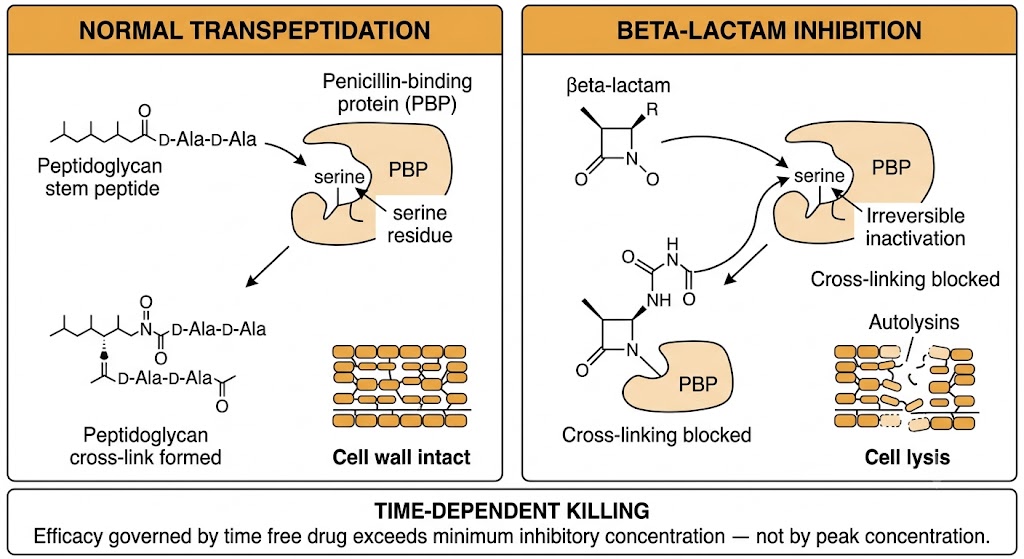
The transpeptidases and related cell wall synthesis enzymes are collectively called penicillin-binding proteins. Each bacterial species expresses a characteristic set of these proteins. Beta-lactam antibiotics bind covalently to the active site of penicillin-binding proteins, permanently inactivating the transpeptidase function responsible for cross-linking the peptidoglycan layer. The result is progressive cell wall weakening during ongoing bacterial growth.
Beta-lactams covalently inactivate penicillin-binding proteins, blocking peptidoglycan cross-linking. As bacteria continue to grow in the presence of the drug, peptidoglycan-degrading autolysins keep working while new cross-links cannot form. The result is progressive weakening of the cell wall, osmotic stress, and bactericidal cell lysis.
Killing is time-dependent: what matters is how long free drug concentration stays above the minimum inhibitory concentration during the dosing interval, not how high the peak concentration reaches. Extended or continuous infusion strategies exploit this property to maximize bactericidal effect against organisms with elevated minimum inhibitory concentrations.
Natural penicillins, aminopenicillins, antistaphylococcal penicillins, and extended-spectrum agents
The penicillin family is best understood by spectrum rather than by history. Each subclass occupies a distinct clinical niche defined by its gram-positive and gram-negative coverage, oral availability, and resistance to enzymatic inactivation. Knowing which subclass to reach for—and why—is the core clinical skill for this drug class.
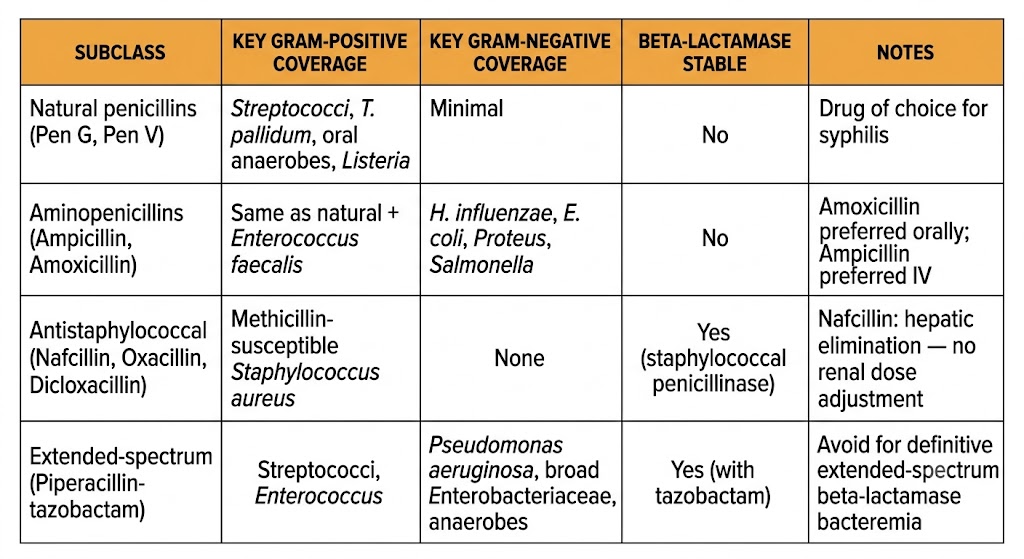
Penicillin G (parenteral) and penicillin V (oral) retain the original narrow-spectrum profile. They have excellent activity against streptococci, Treponema pallidum, Neisseria meningitidis, most oral anaerobes, Clostridium species, and Listeria monocytogenes. Neither agent has useful activity against gram-negative enteric bacteria, staphylococci (due to near-universal beta-lactamase production), or Pseudomonas aeruginosa.
Penicillin G is the drug of choice for syphilis at all stages—Treponema pallidum has never developed penicillin resistance. Penicillin V is acid-stable and orally bioavailable, making it suitable for outpatient treatment of streptococcal pharyngitis and skin infections caused by susceptible streptococci.
Adding an amino group to the acyl side chain extends gram-negative coverage to include Haemophilus influenzae (non-beta-lactamase-producing strains), Escherichia coli (community-acquired, susceptible strains), Proteus mirabilis, Salmonella, and Enterococcus faecalis, while preserving the gram-positive activity of natural penicillins.
Amoxicillin has substantially better oral bioavailability than ampicillin and is the preferred oral agent for outpatient indications including acute otitis media and community-acquired pneumonia. Ampicillin is preferred parenterally—for Listeria meningitis and enterococcal endocarditis, for example. Both agents are susceptible to beta-lactamase inactivation and have no useful activity against Klebsiella pneumoniae, Pseudomonas aeruginosa, or methicillin-resistant Staphylococcus aureus.
Nafcillin, oxacillin, and dicloxacillin were developed specifically to resist hydrolysis by staphylococcal beta-lactamase. A bulky acyl side chain provides steric protection of the beta-lactam ring, making these agents stable against the penicillinase that renders other penicillins ineffective against Staphylococcus aureus. They have no activity against methicillin-resistant Staphylococcus aureus, because that resistance arises through an entirely different mechanism—a low-affinity penicillin-binding protein, not an enzyme.
Nafcillin and oxacillin are parenteral agents used for methicillin-susceptible Staphylococcus aureus infections and outperform vancomycin for serious methicillin-susceptible Staphylococcus aureus infections including bacteremia and endocarditis. Nafcillin is hepatically eliminated and does not require dose adjustment in renal failure—an important advantage in patients with kidney disease. Dicloxacillin is the oral agent and should be taken on an empty stomach because food substantially reduces absorption.
Piperacillin is the current standard extended-spectrum penicillin. It covers Pseudomonas aeruginosa, many Enterobacteriaceae, anaerobes, and retains streptococcal and enterococcal activity. Piperacillin is always used in combination with tazobactam (a beta-lactamase inhibitor) to restore activity against beta-lactamase-producing organisms. The combination piperacillin-tazobactam is a workhorse broad-spectrum agent for hospital-acquired infections.
Piperacillin-tazobactam shows in vitro activity against many extended-spectrum beta-lactamase-producing organisms, but clinical outcomes data suggest it should not be used as definitive therapy for extended-spectrum beta-lactamase-producing bacteremia even when susceptibility testing reports the isolate as susceptible—a high bacterial burden can overwhelm the inhibitor. Carbapenems are preferred for serious extended-spectrum beta-lactamase infections.
Predicting coverage from drug class, distribution, and clinically relevant pharmacokinetics
The spectrum of any penicillin is determined by three intersecting properties: intrinsic affinity for the target organism's penicillin-binding proteins, ability to penetrate to those proteins (limited by the outer membrane in gram-negative bacteria), and susceptibility to enzymatic inactivation along the way. These properties combine with pharmacokinetics to determine whether the drug reaches therapeutic concentrations at the site of infection.
All penicillins retain strong intrinsic affinity for the penicillin-binding proteins of most gram-positive organisms. Streptococcus pyogenes remains universally susceptible to penicillin G and V—no acquired resistance has emerged in this species despite decades of use. Among Streptococcus pneumoniae, susceptibility has declined because some strains have acquired altered penicillin-binding protein variants with reduced beta-lactam affinity. For pneumococcal meningitis, high-dose intravenous penicillin or a third-generation cephalosporin is required to achieve adequate central nervous system concentrations.
Enterococcus faecalis is susceptible to ampicillin and penicillin G, but the killing is bacteriostatic rather than bactericidal. For enterococcal endocarditis, an aminoglycoside must be added to achieve bactericidal synergy.
Gram-negative bacteria present an additional barrier: their outer membrane is largely impermeable to hydrophobic molecules, and beta-lactams must traverse it through water-filled porin channels. The size and charge of the beta-lactam molecule determines how efficiently it crosses. Smaller, more hydrophilic molecules traverse more readily, which is why ampicillin achieves better gram-negative penetration than the bulkier antistaphylococcal penicillins.
Once inside the periplasmic space, beta-lactams encounter another threat: beta-lactamases secreted into this compartment can inactivate the drug before it reaches the penicillin-binding protein targets on the inner membrane surface. Loss or downregulation of specific porin channels is an additional resistance mechanism in Pseudomonas aeruginosa and Klebsiella pneumoniae.
Penicillins are variably protein-bound; only free, unbound drug is pharmacologically active. Central nervous system penetration is low under normal conditions because of active drug efflux at the blood-brain barrier. When the meninges are inflamed, penetration increases substantially, which is what permits high-dose intravenous penicillin or ampicillin to be used for meningitis caused by susceptible organisms.
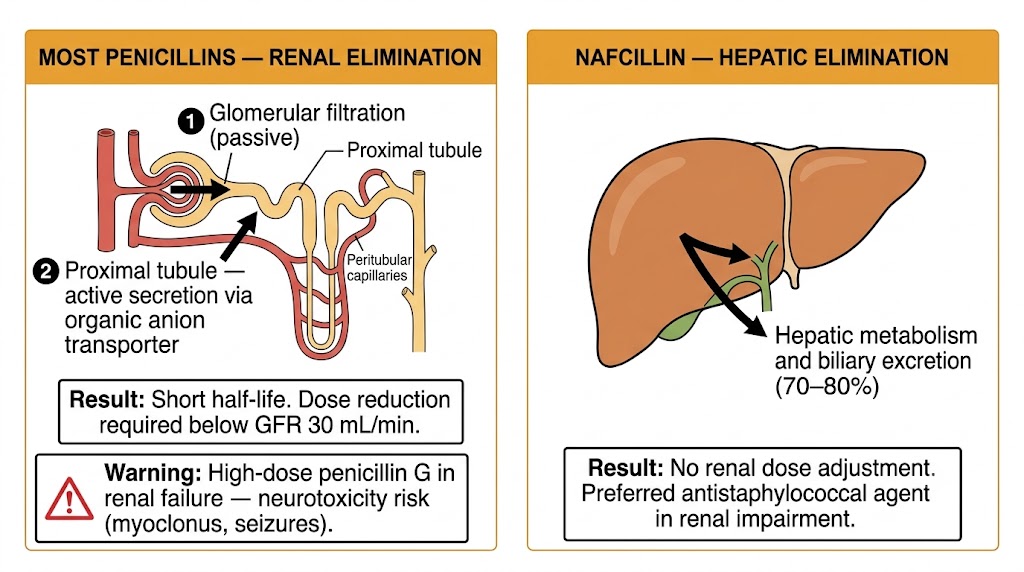
Most penicillins are eliminated predominantly by renal excretion through glomerular filtration and active tubular secretion. This active secretion is responsible for their short half-lives. Dose reduction or interval extension is required in significant renal impairment to prevent accumulation. In severe renal failure, high-dose penicillin G can accumulate to cause neurotoxicity manifesting as myoclonus and seizures.
Nafcillin is the important exception: it is predominantly hepatically eliminated and does not require dose adjustment in renal failure, making it the preferred antistaphylococcal penicillin in patients with kidney disease.
Beta-lactamases, altered penicillin-binding proteins, efflux pumps, and reduced permeability
Resistance to penicillins—and to all beta-lactam antibiotics—arises through four principal mechanisms. These mechanisms are mechanistically distinct, clinically important, and frequently coexist within a single organism. Understanding them explains both which drugs fail and which combinations work.
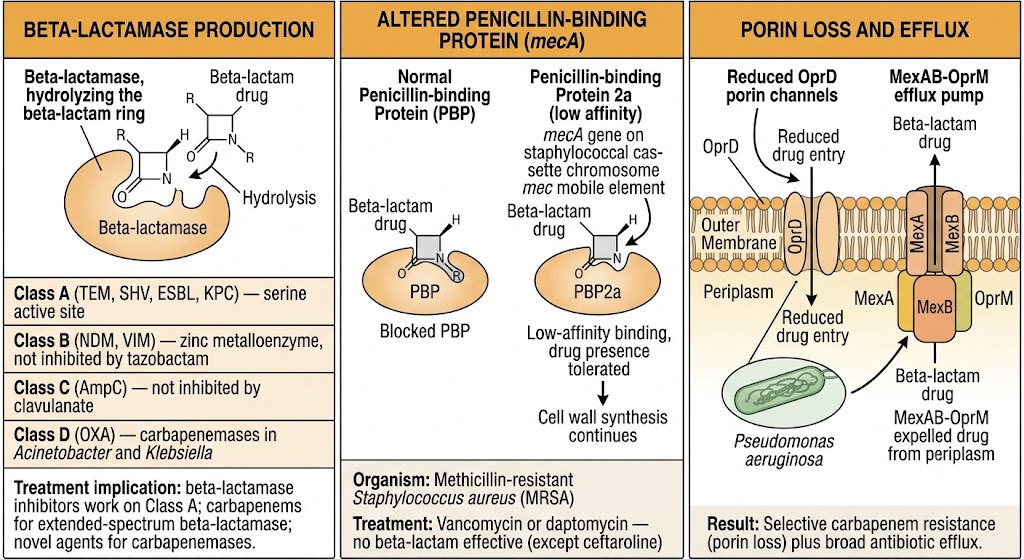
Beta-lactamases hydrolyze the beta-lactam ring, destroying the drug before it reaches its target. They are the most important and widespread resistance mechanism.
Extended-spectrum beta-lactamase-producing organisms are typically resistant to all penicillins and most cephalosporins. Carbapenems are the preferred treatment for serious infections. Extended-spectrum beta-lactamase-encoding genes spread readily on mobile genetic elements between species.
Extended-spectrum beta-lactamases are inhibited in vitro by clavulanate and tazobactam, which is why susceptibility testing sometimes reports piperacillin-tazobactam as active against these organisms. However, the high bacterial burden present in bloodstream infections can overwhelm the inhibitor—a phenomenon called the inoculum effect—making piperacillin-tazobactam unreliable as definitive therapy for extended-spectrum beta-lactamase-producing bacteremia even when in vitro susceptibility is reported.
Methicillin-resistant Staphylococcus aureus resistance to beta-lactams is mediated by the mecA gene, which encodes an altered penicillin-binding protein called penicillin-binding protein 2a. This variant transpeptidase has an extremely low affinity for all beta-lactam antibiotics due to structural changes in its active site. It retains the ability to carry out cell wall cross-linking even when beta-lactam concentrations far exceed clinically achievable levels, so the organism continues to grow despite full antibiotic exposure.
No conventional beta-lactam is effective against methicillin-resistant Staphylococcus aureus. The only beta-lactam exception is ceftaroline, a fifth-generation cephalosporin with sufficient affinity for penicillin-binding protein 2a to be active against methicillin-resistant Staphylococcus aureus.
In gram-negative bacteria, active efflux systems export beta-lactams from the periplasmic space before they reach their targets. In Pseudomonas aeruginosa, these efflux systems contribute to intrinsic resistance to multiple antibiotic classes. Outer membrane permeability can be further reduced by loss of specific porin channels, creating selective carbapenem resistance in Pseudomonas while preserving susceptibility to other classes. In organisms producing carbapenemase enzymes, the combination of enzymatic inactivation, porin loss, and efflux pump upregulation produces high-level, pan-resistant phenotypes.
Extended-spectrum beta-lactamase producers are resistant to most penicillins and cephalosporins but may appear susceptible to piperacillin-tazobactam on testing. Use carbapenems for serious infections regardless of piperacillin-tazobactam susceptibility results.
AmpC producers are resistant to first- through third-generation cephalosporins and are not inhibited by clavulanate. Carbapenems are the treatment of choice.
Carbapenemase-producing Klebsiella organisms resist carbapenems. Novel combinations including ceftazidime-avibactam and meropenem-vaborbactam are active against Klebsiella pneumoniae carbapenemase producers but not against metallo-beta-lactamases.
| Author / Organization | Title | Source |
|---|---|---|
| Tipper DJ, Strominger JL | Mechanism of action of penicillins: a proposal based on their structural similarity to acyl-D-alanyl-D-alanine | Proc Natl Acad Sci USA. 1965;54(4):1133-1141 |
| Spratt BG | Penicillin-binding proteins and the future of beta-lactam antibiotics | J Gen Microbiol. 1983;129(5):1247-1260 |
| Harris PNA, Tambyah PA, Lye DC, et al. | Effect of piperacillin-tazobactam vs meropenem on 30-day mortality for patients with E coli or Klebsiella pneumoniae bloodstream infection and ceftriaxone resistance: a randomized clinical trial | JAMA. 2018;320(10):984-994 |
| Wright AJ | The penicillins | Mayo Clin Proc. 1999;74(3):290-307 |
| Bush K, Bradford PA | Beta-lactams and beta-lactamase inhibitors: an overview | Cold Spring Harb Perspect Med. 2016;6(8):a025247 |
| Pitout JD, Laupland KB | Extended-spectrum beta-lactamase-producing Enterobacteriaceae: an emerging public-health concern | Lancet Infect Dis. 2008;8(3):159-166 |
| Lakhundi S, Zhang K | Methicillin-resistant Staphylococcus aureus: molecular characterization, evolution, and epidemiology | Clin Microbiol Rev. 2018;31(4):e00020-18 |
| Craig WA | Pharmacokinetic/pharmacodynamic parameters: rationale for antibacterial dosing of mice and men | Clin Infect Dis. 1998;26(1):1-12 |