CHAPTER 17  ·  ANTIDEPRESSANT DRUGS
Section 1

The Monoamine Hypothesis of Depression

How deficiency in serotonin, norepinephrine, and dopamine became the foundation for understanding antidepressant drug action

The monoamine hypothesis remains the most widely taught framework for understanding antidepressant pharmacology. It proposes that major depressive disorder results from a functional deficiency of one or more monoamine neurotransmitters in the brain — principally serotonin, norepinephrine, and to a lesser degree dopamine — and that antidepressants work by correcting this deficiency.

Origins of the Hypothesis

The hypothesis emerged in the 1960s from two accidental clinical observations. First, reserpine — a drug used at the time to treat hypertension — depletes vesicular stores of serotonin, norepinephrine, and dopamine and was found to cause depression in a significant proportion of patients who received it. Second, the first antidepressants discovered (the monoamine oxidase inhibitors and the tricyclic antidepressants) were both found to increase synaptic availability of monoamines, either by blocking their enzymatic breakdown or by blocking their reuptake transporters.

Together these findings pointed toward the same conclusion: low monoamine activity at synapses is associated with depression, and raising monoamine activity produces antidepressant effects. This reuptake blockade model remains the mechanistic basis for most antidepressants in clinical use today.

The Three Monoamines and Their Roles

Serotonin is the primary target of the most widely prescribed antidepressants. Serotonergic neurons projecting from the dorsal raphe nucleus to the limbic system and prefrontal cortex regulate mood, anxiety, sleep, and appetite. Deficiency in this projection is linked to the core emotional symptoms of depression — low mood, anhedonia, and anxiety.

Norepinephrine projecting from the locus coeruleus modulates attention, arousal, and the stress response. Norepinephrine deficiency contributes to the fatigue, poor concentration, and psychomotor retardation seen in depression. The dual reuptake inhibitors — the serotonin-norepinephrine reuptake inhibitors and the tricyclic antidepressants — target both transporters and are particularly effective for depression with prominent fatigue and pain.

Dopamine, projecting through the mesolimbic and mesocortical pathways, governs motivation and reward. Dopamine deficiency underlies the anhedonia that is a hallmark of severe depression. Bupropion, which selectively blocks the dopamine and norepinephrine transporters without affecting serotonin, demonstrates that dopaminergic enhancement alone can be antidepressant.
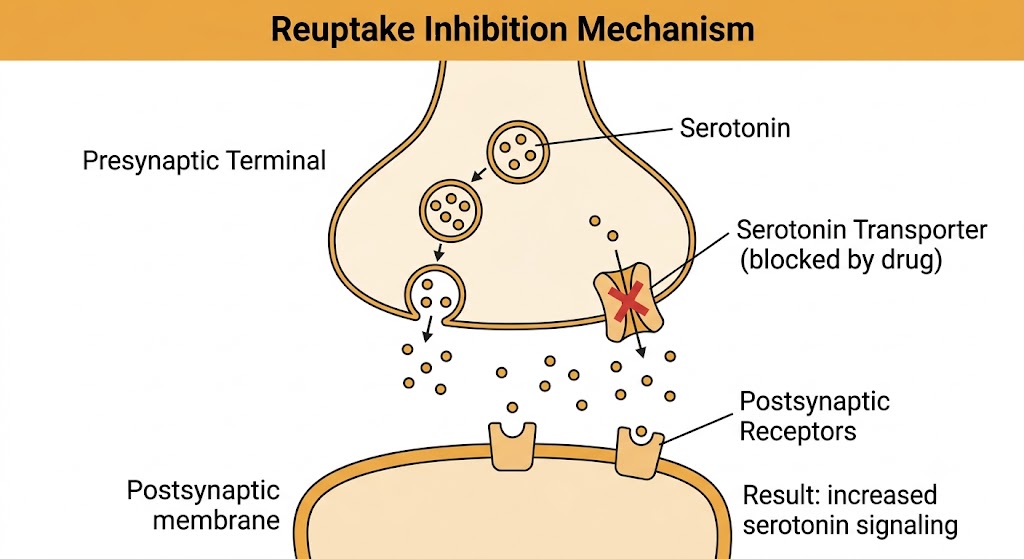
Diagram of a serotonergic synapse showing the serotonin transporter on the presynaptic membrane blocked by a drug, with serotonin accumulating in the synaptic cleft and activating postsynaptic receptors.
Reuptake transporter blockade — the primary mechanism of action for most antidepressants. Serotonin accumulates in the synaptic cleft when the serotonin reuptake transporter is blocked, increasing postsynaptic receptor activation. Figure generated by Gemini AI.
Limitations of the Monoamine Hypothesis

The monoamine hypothesis is useful as a pharmacological target model, but it is incomplete as a disease explanation. Several observations challenge it as a full account of depression. Reuptake blockade occurs within hours of the first dose, yet antidepressant benefit requires two to four weeks — a mismatch that the hypothesis alone cannot explain. Additionally, not all patients with depression respond to monoaminergic drugs, and some treatments with no monoaminergic mechanism (such as electroconvulsive therapy and ketamine) are highly effective. The hypothesis should be understood as identifying where most antidepressants act, not why depression occurs.

Step 1 Anchor

The monoamine hypothesis explains the pharmacological target — the reuptake transporter — not the root cause of depression. For Step 1, know that most antidepressants act by blocking serotonin, norepinephrine, or dopamine reuptake transporters, and understand which classes block which transporters.

Section 2

Why Antidepressants Take Weeks to Work

The receptor adaptations that explain the therapeutic lag between starting an antidepressant and experiencing clinical benefit

One of the most practically important features of antidepressant pharmacology is the two-to-four-week delay between starting treatment and experiencing meaningful clinical improvement. This lag applies across all major drug classes and is not shortened by increasing the dose. Understanding why this lag exists helps students counsel patients correctly and avoid premature drug switching.

Autoreceptor Desensitization

When a selective serotonin reuptake inhibitor acutely blocks the serotonin reuptake transporter, synaptic serotonin rises — but the neurons sense this immediately. Presynaptic serotonin-1A autoreceptors on the cell bodies of serotonergic neurons in the dorsal raphe nucleus detect the increased serotonin and respond by reducing neuronal firing. Presynaptic terminal autoreceptors reduce serotonin release at synaptic terminals. The net effect is that the neuron partly counteracts the drug, keeping serotonin output near baseline in the early treatment period.

With sustained drug exposure over two to four weeks, these autoreceptors downregulate and desensitize. The inhibitory feedback is removed, serotonergic firing recovers, and serotonin output into the limbic system and prefrontal cortex rises substantially. This timeline of autoreceptor desensitization corresponds to the onset of clinical antidepressant response.

Postsynaptic Receptor Downregulation

Sustained elevation of synaptic serotonin also leads to downregulation of postsynaptic serotonin-2A receptors over several weeks. This downstream receptor adaptation is produced by structurally diverse antidepressant classes — selective serotonin reuptake inhibitors, tricyclic antidepressants, and monoamine oxidase inhibitors all share this effect despite different primary mechanisms. The convergence on the same downstream change after weeks of treatment suggests that postsynaptic receptor remodeling is closely linked to therapeutic response.

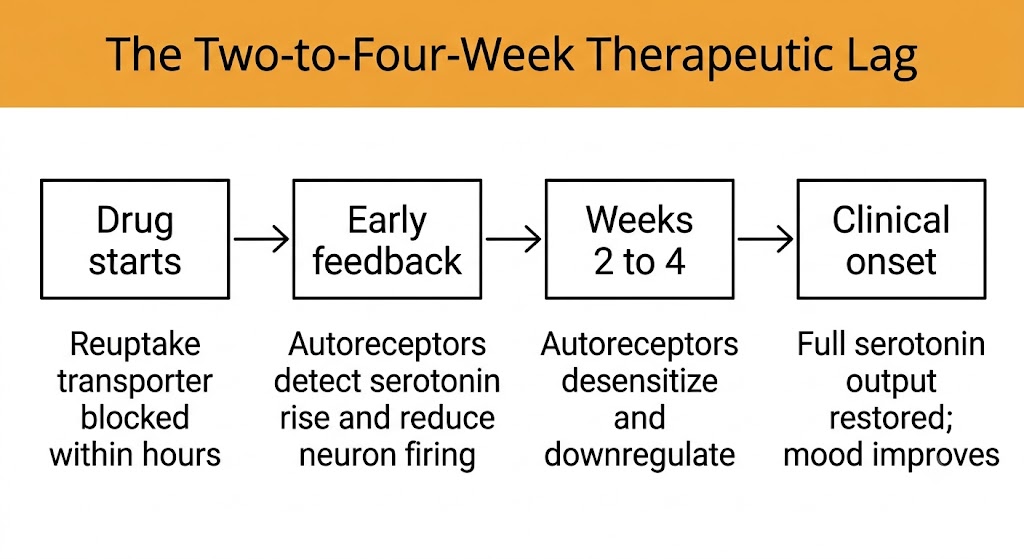
Flow diagram showing four sequential stages of antidepressant action: drug starts with transporter blockade, early autoreceptor feedback reduces serotonin output, autoreceptors desensitize over weeks 2 to 4, and clinical onset occurs when full serotonin output is restored.
The two-to-four-week therapeutic lag explained: autoreceptor feedback initially counteracts reuptake blockade; clinical benefit emerges only after autoreceptors desensitize. Figure generated by Gemini AI.
Clinical Implications of the Therapeutic Lag

The therapeutic lag has direct consequences for patient counseling and clinical decision-making. Patients starting an antidepressant should be told explicitly to expect no mood improvement in the first one to two weeks, and that early side effects may appear before any benefit. This expectation-setting reduces dropout during the period when discontinuation rates are highest.

An adequate antidepressant trial is defined as four to six weeks at a therapeutic dose. Switching to a different agent before this window has closed risks abandoning a potentially effective treatment. Dose escalation in the first two weeks does not accelerate the onset of response and increases adverse effect burden without therapeutic benefit.

Mechanism Summary

The two-to-four-week lag results from presynaptic autoreceptor desensitization and postsynaptic receptor remodeling — not from slow drug absorption. The drug reaches the synapse within hours. The neurons require weeks to adapt. An adequate trial is four to six weeks at therapeutic dose before concluding a drug has failed.


Section 3

Antidepressant Drug Classes — Overview

Classification by primary mechanism, with the transporter targets and key distinguishing features that separate one class from another

Antidepressants are classified by mechanism of action rather than by chemical structure. Each class targets monoamine signaling through a different molecular strategy, producing overlapping but distinct pharmacological and adverse effect profiles. The six major classes are presented here as a framework for the drug-specific modules that follow.

Class 1
Selective Serotonin Reuptake Inhibitors
  • Block the serotonin reuptake transporter selectively
  • First-line for depression and most anxiety disorders
  • Agents: fluoxetine, sertraline, paroxetine, escitalopram, citalopram, fluvoxamine
  • Adverse effects: sexual dysfunction, nausea, insomnia
Class 2
Serotonin-Norepinephrine Reuptake Inhibitors
  • Block both serotonin and norepinephrine reuptake transporters
  • First-line; added benefit in neuropathic pain and fibromyalgia
  • Agents: venlafaxine, duloxetine, desvenlafaxine, levomilnacipran
  • Adverse effects: hypertension at high doses (venlafaxine), nausea
Class 3
Tricyclic Antidepressants
  • Block serotonin and norepinephrine reuptake plus muscarinic, histamine, and alpha-1 receptors
  • Broad receptor binding produces significant adverse effect burden
  • Agents: amitriptyline, nortriptyline, imipramine, desipramine, clomipramine
  • Lethal in overdose — cardiac sodium channel blockade
Class 4
Monoamine Oxidase Inhibitors
  • Block monoamine oxidase A and B, preventing breakdown of serotonin, norepinephrine, and dopamine
  • Reserved for refractory and atypical depression
  • Agents: phenelzine, tranylcypromine, isocarboxazid, selegiline patch
  • Dangerous tyramine and drug interactions — strict dietary restrictions
Class 5
Atypical Antidepressants
  • Mechanistically diverse — do not fit neatly into the four classes above
  • Bupropion: blocks dopamine and norepinephrine transporters; no serotonin effect
  • Mirtazapine: alpha-2 antagonist; increases norepinephrine and serotonin release
  • Trazodone, vilazodone, vortioxetine: serotonin-modulating mechanisms
Class 6
Glutamate Receptor Antagonists
  • Esketamine: blocks the N-methyl-D-aspartate glutamate receptor
  • Rapid onset — hours rather than weeks
  • Approved for treatment-resistant depression and acute suicidality
  • Non-monoaminergic mechanism — distinct from all other classes

Section 4

Indications Beyond Depression

The broad clinical utility of antidepressants across anxiety disorders, pain syndromes, and other conditions

The term "antidepressant" is a misnomer in clinical practice. These drugs are first-line treatments for several anxiety disorders, are used routinely in neuropathic pain management, and have established roles in obsessive-compulsive disorder, post-traumatic stress disorder, and other conditions. For Step 1, knowing which drug class treats which condition — and why — is high-yield.

Anxiety Disorders

Selective serotonin reuptake inhibitors and serotonin-norepinephrine reuptake inhibitors are the first-line pharmacological treatment for generalized anxiety disorder, panic disorder, social anxiety disorder, and post-traumatic stress disorder. They are preferred over benzodiazepines for long-term management because they lack addiction potential and treat comorbid depression simultaneously. The anxiolytic effect also requires two to four weeks to develop and is mediated by the same receptor adaptations that underlie antidepressant response.

Obsessive-Compulsive Disorder

Selective serotonin reuptake inhibitors are first-line for obsessive-compulsive disorder, typically at higher doses than those used for depression. Clomipramine, a tricyclic antidepressant with especially strong serotonin reuptake inhibition, is the most efficacious pharmacological treatment for obsessive-compulsive disorder but is reserved for refractory cases because of its adverse effect burden. Fluvoxamine, among the selective serotonin reuptake inhibitors, has a primary indication in obsessive-compulsive disorder.

Neuropathic Pain and Fibromyalgia

Serotonin-norepinephrine reuptake inhibitors — particularly duloxetine — are approved for diabetic peripheral neuropathy and fibromyalgia. The norepinephrine component is believed to be central to the analgesic effect, since norepinephrine modulates descending pain inhibition in the spinal cord. Tricyclic antidepressants (amitriptyline and nortriptyline) are widely used for neuropathic pain and migraine prophylaxis, also through norepinephrine-mediated mechanisms, though their use is limited by tolerability.

Other Established Uses

Bupropion is approved for smoking cessation under the brand name Zyban and is used off-label for attention-deficit/hyperactivity disorder, exploiting its dopaminergic activity. Premenstrual dysphoric disorder responds to selective serotonin reuptake inhibitors, which can be given continuously or only during the luteal phase. Imipramine (a tricyclic antidepressant) is used for nocturnal enuresis in children. Duloxetine is approved for stress urinary incontinence in some countries and for chronic musculoskeletal pain.

High-Yield Indications Summary

Selective serotonin reuptake inhibitors and serotonin-norepinephrine reuptake inhibitors: depression, all major anxiety disorders, obsessive-compulsive disorder, post-traumatic stress disorder, premenstrual dysphoric disorder. Duloxetine specifically: diabetic peripheral neuropathy, fibromyalgia. Bupropion specifically: smoking cessation. Clomipramine and fluvoxamine specifically: obsessive-compulsive disorder. Tricyclic antidepressants: neuropathic pain, migraine prophylaxis, imipramine for enuresis.


Section 5

Pharmacokinetic Principles Common to the Class

Hepatic metabolism, cytochrome P450 interactions, active metabolites, and half-life — the pharmacokinetic features that shape antidepressant prescribing decisions

Most antidepressants share a common pharmacokinetic profile: oral administration, extensive hepatic metabolism by the cytochrome P450 system, high lipophilicity with wide tissue distribution, and elimination half-lives that range from hours to days. These shared features generate shared clinical concerns — particularly around drug interactions and discontinuation.

Hepatic Metabolism and Cytochrome P450 Interactions

Virtually all antidepressants are eliminated primarily by hepatic metabolism through the cytochrome P450 enzyme system. The most clinically relevant isoforms are cytochrome P450 2D6, cytochrome P450 3A4, cytochrome P450 2C19, and cytochrome P450 1A2. Drug interactions arise in two directions: antidepressants as substrates of these enzymes (their metabolism is affected by inhibitors and inducers), and antidepressants as inhibitors of these enzymes (they raise plasma levels of other drugs metabolized by the same isoform).

Among the selective serotonin reuptake inhibitors, fluoxetine and paroxetine are potent inhibitors of cytochrome P450 2D6 — clinically significant because cytochrome P450 2D6 metabolizes many commonly prescribed drugs including antipsychotics, opioids, and beta-blockers. Fluvoxamine is a potent cytochrome P450 1A2 inhibitor. Escitalopram and sertraline have the cleanest inhibition profiles among the selective serotonin reuptake inhibitors, making them preferred when polypharmacy is a concern. Cytochrome P450 2D6 also shows clinically significant genetic polymorphism — roughly 7 to 10 percent of individuals of European ancestry are poor metabolizers who achieve substantially higher plasma levels of cytochrome P450 2D6-metabolized drugs at standard doses.

Active Metabolites

Several antidepressants produce pharmacologically active metabolites that carry significant clinical consequences. Fluoxetine is converted to norfluoxetine, which has a half-life of one to two weeks and inhibits the serotonin reuptake transporter with similar potency to the parent drug. This active metabolite makes fluoxetine functionally self-tapering — abrupt discontinuation causes minimal discontinuation syndrome — and it requires a five-week washout before initiating a monoamine oxidase inhibitor (versus two weeks for other selective serotonin reuptake inhibitors).

Venlafaxine is metabolized to desvenlafaxine (O-desmethylvenlafaxine), which has been developed and approved as a separate antidepressant. Amitriptyline and imipramine are demethylated to nortriptyline and desipramine respectively — each of which is an approved antidepressant with a somewhat different pharmacological profile than the parent compound.

Half-Life and Discontinuation Syndrome Risk

Half-life is the most clinically relevant pharmacokinetic parameter for antidepressants in practice. It governs the time to steady state after dose changes (approximately five half-lives), the risk of discontinuation syndrome upon abrupt cessation, and the washout period required before starting a monoamine oxidase inhibitor.

Antidepressants with short half-lives — particularly paroxetine and venlafaxine immediate-release — carry the highest risk of discontinuation syndrome and require gradual tapering when stopping. Fluoxetine, with its long-acting active metabolite norfluoxetine, carries the lowest discontinuation syndrome risk among the selective serotonin reuptake inhibitors. The discontinuation syndrome itself and monoamine oxidase inhibitor washout periods are covered in detail in Module 7.

Pharmacokinetic High-Yield Points

Fluoxetine: long half-life due to active metabolite norfluoxetine — five-week monoamine oxidase inhibitor washout, minimal discontinuation syndrome. Paroxetine: short half-life, potent cytochrome P450 2D6 inhibitor, worst discontinuation syndrome among selective serotonin reuptake inhibitors. Escitalopram: cleanest cytochrome P450 profile — preferred when drug interactions are a concern. Duloxetine: avoid in liver disease — hepatotoxicity risk. Venlafaxine active metabolite = desvenlafaxine (a separate drug).


Suggested References
Author / Organization Title Source
Schildkraut JJ The catecholamine hypothesis of affective disorders: a review of supporting evidence Am J Psychiatry. 1965;122(5):509–522
Delgado PL, Charney DS, Price LH, et al. Serotonin function and the mechanism of antidepressant action. Reversal of antidepressant-induced remission by rapid depletion of plasma tryptophan Arch Gen Psychiatry. 1990;47(5):411–418
Blier P, de Montigny C Current advances and trends in the treatment of depression Trends Pharmacol Sci. 1994;15(7):220–226
McEwen BS, Chattarji S, Diamond DM, et al. The neurobiological properties of tianeptine (Stablon): from monoamine hypothesis to glutamatergic modulation Mol Psychiatry. 2010;15(3):237–249
Castrén E, Rantamäki T The role of BDNF and its receptors in depression and antidepressant drug action: reactivation of developmental plasticity Dev Neurobiol. 2010;70(5):289–297
Casarotto PC, Girych M, Fred SM, et al. Antidepressant drugs act by directly binding to TRKB neurotrophin receptors Cell. 2021;184(5):1299–1313
Holsboer F The corticosteroid receptor hypothesis of depression Neuropsychopharmacology. 2000;23(5):477–501
Raison CL, Rutherford RE, Woolwine BJ, et al. A randomized controlled trial of the tumor necrosis factor antagonist infliximab for treatment-resistant depression JAMA Psychiatry. 2013;70(1):31–41
American Psychiatric Association Practice Guideline for the Treatment of Patients with Major Depressive Disorder, 3rd ed. American Psychiatric Publishing; 2010
Stahl SM Stahl's Essential Psychopharmacology: Neuroscientific Basis and Practical Applications, 5th ed. Cambridge University Press; 2021. Chapters 7–9
Ingelman-Sundberg M Genetic polymorphisms of cytochrome P450 2D6 (CYP2D6): clinical consequences, evolutionary aspects and functional diversity Pharmacogenomics J. 2005;5(1):6–13
Kroenke K, Spitzer RL, Williams JB The PHQ-9: validity of a brief depression severity measure J Gen Intern Med. 2001;16(9):606–613
Montgomery SA, Asberg M A new depression scale designed to be sensitive to change Br J Psychiatry. 1979;134:382–389
Rush AJ, Trivedi MH, Wisniewski SR, et al. Acute and longer-term outcomes in depressed outpatients requiring one or several treatment steps: a STAR*D report Am J Psychiatry. 2006;163(11):1905–1917
Hamilton M A rating scale for depression J Neurol Neurosurg Psychiatry. 1960;23(1):56–62