CHAPTER 5 · ADRENERGIC PHARMACOLOGY

Section 1

Phenylephrine — Pure Alpha-1 Agonist

Selective vasoconstriction without cardiac stimulation, reflex bradycardia, vasopressor uses, nasal decongestant, and ophthalmic applications

Phenylephrine is defined by what it does not do as much as by what it does. Unlike epinephrine and norepinephrine, it has no meaningful beta-adrenergic activity at clinical doses. This selective alpha-1 profile makes it pharmacologically predictable: pure vasoconstriction, reliable blood pressure support, and no direct cardiac stimulation — at the cost of a compensatory reflex bradycardia and no ability to augment cardiac output.

Mechanism and Reflex Bradycardia

Phenylephrine activates alpha-1 receptors on vascular smooth muscle, engaging the Gq/phospholipase C/IP3/calcium pathway to produce arteriolar and venous vasoconstriction. Systemic vascular resistance rises, blood pressure increases, and because there is no beta-1-mediated tachycardia to offset the baroreceptor response, the rise in arterial pressure triggers a compensatory reflex bradycardia through increased vagal tone. This reflex bradycardia is a defining clinical characteristic of phenylephrine and distinguishes it from norepinephrine, which also raises pressure but whose beta-1 activity partially blunts the baroreceptor response.

The absence of beta-1 activity is both an advantage and a limitation. The advantage: no arrhythmogenicity, no increase in myocardial oxygen demand. The limitation: phenylephrine cannot augment cardiac output, and in patients with already reduced cardiac output, the combination of increased afterload and reflex bradycardia can further reduce cardiac output. It should be avoided when low cardiac output is the primary hemodynamic problem.
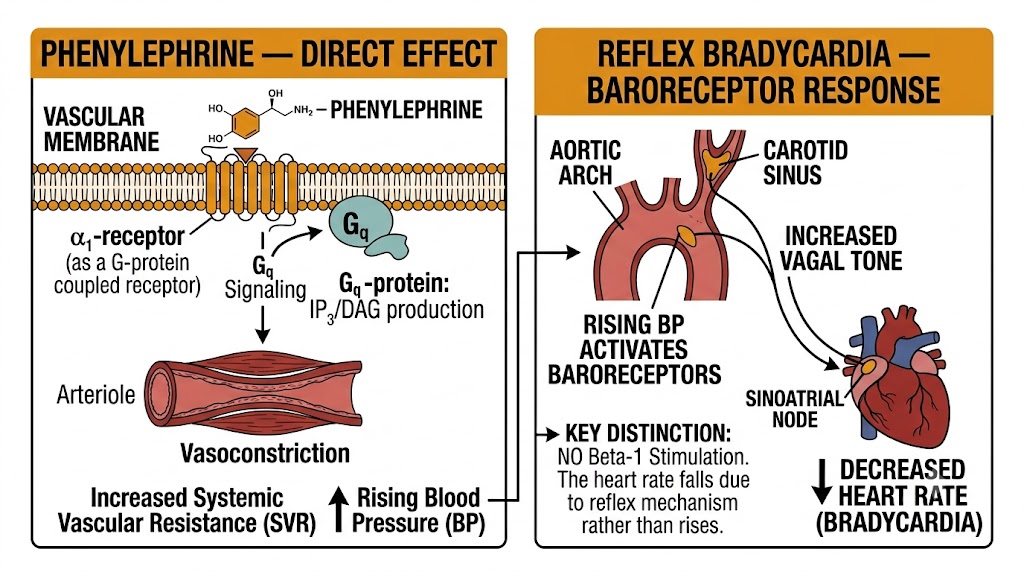
Two-panel diagram showing phenylephrine producing alpha-1-mediated vasoconstriction and rising blood pressure, and baroreceptor-mediated reflex bradycardia, with the note that absence of beta-1 activity means no compensatory tachycardia.
Phenylephrine direct effect (alpha-1 vasoconstriction, rising blood pressure) and reflex bradycardia via baroreceptor activation — no beta-1 stimulation means heart rate falls rather than rises. Source: Gemini AI, generated for educational use.
Vasopressor Applications

Phenylephrine's pure alpha-1 profile makes it the vasopressor of choice in specific contexts. In spinal anesthesia-induced hypotension — one of the most common indications in obstetric anesthesia — phenylephrine is preferred because it raises maternal blood pressure without the tachycardia associated with ephedrine, and is associated with better fetal acid-base outcomes. Standard practice in obstetric spinal anesthesia is a prophylactic phenylephrine infusion initiated at the time of spinal injection.

Phenylephrine is also the preferred vasopressor in patients with hypertrophic obstructive cardiomyopathy who develop hypotension during anesthesia. In this condition, tachycardia and reduced afterload both worsen the dynamic outflow obstruction — phenylephrine raises afterload and allows reflex bradycardia, both of which reduce obstruction severity. Beta-1-stimulating agents are contraindicated in this setting.

Nasal Decongestant and Ophthalmic Uses

Topical intranasal phenylephrine constricts nasal mucosal vessels via alpha-1 receptors, reliably reducing congestion. Oral phenylephrine at the marketed over-the-counter dose of 10 milligrams is not effective as a nasal decongestant — the drug undergoes extensive first-pass metabolism in the gut wall before reaching systemic circulation, resulting in plasma concentrations too low to produce nasal vasoconstriction. Topical and intranasal preparations bypass this problem and remain effective.

Ophthalmic phenylephrine drops (2.5% or 10%) produce mydriasis by contracting the iris dilator muscle via alpha-1 receptors. Unlike anticholinergic mydriatics such as tropicamide, phenylephrine does not cause cycloplegia — it dilates the pupil without impairing accommodation, because the ciliary muscle is controlled by muscarinic receptors, not alpha-1 receptors.
Section 2

Clonidine and Dexmedetomidine — Central Alpha-2 Agonists

Locus coeruleus mechanism of antihypertensive and sedative effects, clinical applications, and the withdrawal syndrome

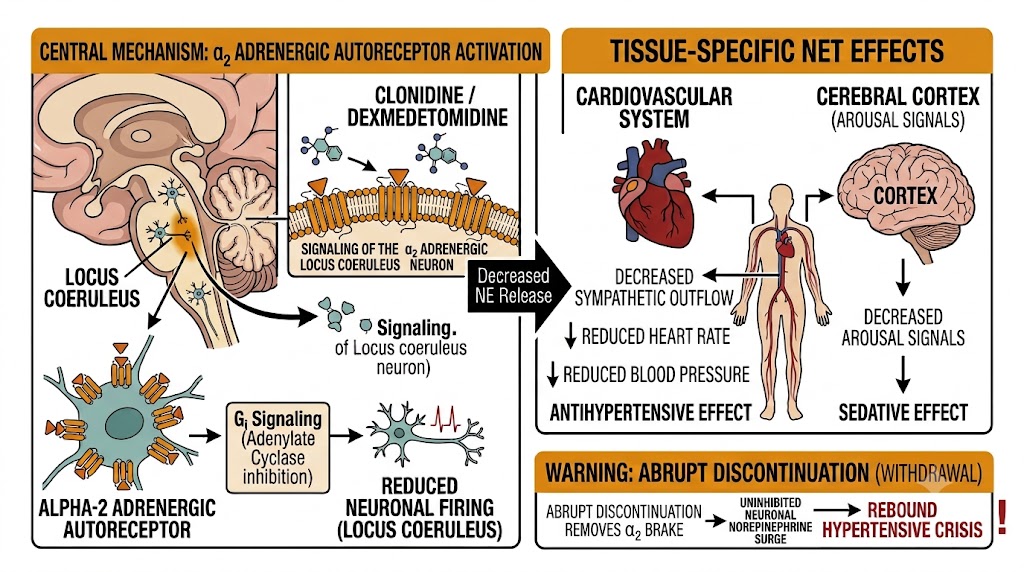
Clonidine and dexmedetomidine reduce sympathetic outflow by activating alpha-2 autoreceptors in the locus coeruleus — the brainstem's principal noradrenergic nucleus. The same central mechanism that lowers blood pressure also produces sedation, which accounts for why these drugs have clinical utility in two apparently unrelated settings: hypertension management and intensive care unit sedation.

Diagram showing clonidine and dexmedetomidine activating alpha-2 adrenergic autoreceptors in the locus coeruleus, reducing norepinephrine outflow to produce antihypertensive and sedative effects, with a withdrawal syndrome box showing rebound hypertension on abrupt discontinuation.
Central alpha-2 adrenergic autoreceptor activation by clonidine and dexmedetomidine: locus coeruleus mechanism producing antihypertensive and sedative effects, with rebound hypertensive crisis on abrupt discontinuation. Source: Gemini AI, generated for educational use.
Shared Mechanism — Locus Coeruleus Alpha-2 Activation

Both drugs act on alpha-2A receptors in the locus coeruleus to reduce neuronal firing and decrease sympathetic outflow to the cardiovascular system. The resulting fall in norepinephrine concentrations lowers heart rate, cardiac contractility, and arteriolar tone — reducing blood pressure through a centrally mediated mechanism rather than through direct vascular blockade. The same reduction in locus coeruleus firing decreases the noradrenergic arousal signal to the cortex, producing sedation that resembles natural sleep with preserved arousability. Patients sedated with dexmedetomidine can be easily awakened, follow commands, and return to sleep without distress — a property that distinguishes it from benzodiazepines and propofol.

Clonidine — Clinical Applications

Clonidine is available orally and as a transdermal patch, making it suitable for outpatient use. Its clinical applications at second-year level include hypertension (particularly useful when other agents are not tolerated), attention deficit hyperactivity disorder in children (where its sympatholytic effect reduces hyperarousal), and opioid and nicotine withdrawal (where it blunts the sympathetic hyperactivity — tachycardia, hypertension, diaphoresis, and anxiety — that drives withdrawal symptoms). Clonidine also has a role in epidural pain management, though this is a specialist application.

Dexmedetomidine — Intensive Care Unit Sedation

Dexmedetomidine is formulated for intravenous infusion and is used primarily for sedation in mechanically ventilated intensive care unit patients and for procedural sedation. Its key advantage over benzodiazepines is cooperative sedation without respiratory depression — patients remain spontaneously ventilating and can be extubated without waiting for drug offset. It is also associated with reduced rates of delirium compared with benzodiazepine-based sedation. Adverse effects include bradycardia and hypotension, particularly during initial dosing or bolus administration.

Clonidine Withdrawal Syndrome — Mechanism and Management

Chronic alpha-2 agonist therapy suppresses sympathetic outflow. Over time, the adrenergic system compensates by upregulating postsynaptic adrenergic receptors. When the drug is abruptly discontinued, the alpha-2 brake is suddenly removed, and norepinephrine surges onto a hypersensitive receptor population. The clinical syndrome — developing 12 to 24 hours after the last dose — includes severe hypertension (occasionally a hypertensive emergency), tachycardia, anxiety, tremor, and diaphoresis. In patients with coronary artery disease, this catecholamine surge can precipitate myocardial infarction. Management: reintroduce clonidine and taper gradually over one to two weeks. Never stop abruptly after chronic use.


Section 3

Beta-2 Selective Agonists

Albuterol and the long-acting agents — selectivity rationale, short-acting versus long-acting clinical roles, adverse effects, and the mandatory inhaled corticosteroid co-prescription rule

Beta-2 selective bronchodilators represent one of the most successful applications of receptor selectivity in clinical pharmacology. By engineering agents with high beta-2 to beta-1 selectivity ratios and delivering them by inhalation, the systemic cardiovascular burden of bronchodilator therapy was dramatically reduced while maintaining airway efficacy. The key clinical distinction within this class is between short-acting agents used for rescue and long-acting agents used for maintenance — a distinction with direct safety implications.

Basis of Beta-2 Selectivity and Its Limits

Beta-2 selectivity is relative, not absolute. At therapeutic inhaled doses, the selectivity is clinically meaningful. At high doses or when significant drug is absorbed systemically, all beta-2 selective agonists produce beta-1-mediated cardiac effects including tachycardia, increased contractility, and arrhythmias. The inhaled route limits systemic absorption and is therefore essential to the safety profile of this drug class — oral formulations of the same drugs produce substantially more cardiovascular adverse effects.

Albuterol — Short-Acting Beta-2 Agonist

Albuterol is the prototype short-acting beta-2 agonist and the most widely used rescue bronchodilator worldwide. After inhalation, onset of bronchodilation occurs within 5 to 15 minutes, peak effect at 30 to 60 minutes, and duration of 4 to 6 hours. It is the first-line rescue medication for acute asthma symptoms and acute exacerbations of chronic obstructive pulmonary disease.

Systemic adverse effects at standard inhaled doses include skeletal muscle tremor (beta-2-mediated sodium-potassium-adenosine triphosphatase activation in skeletal muscle), tachycardia (from residual beta-1 activity and reflex response to vasodilation), and hypokalemia (intracellular potassium shift via sodium-potassium-adenosine triphosphatase). With high-dose nebulized albuterol used in severe acute asthma, these effects — particularly hypokalemia and tachycardia — can be clinically significant and require monitoring.

A critical prescribing rule: albuterol use more than twice per week for symptom relief indicates inadequate asthma control and signals the need for escalation to controller therapy, not simply more albuterol. Chronic overuse drives beta-2 receptor downregulation, reducing bronchodilatory response over time.

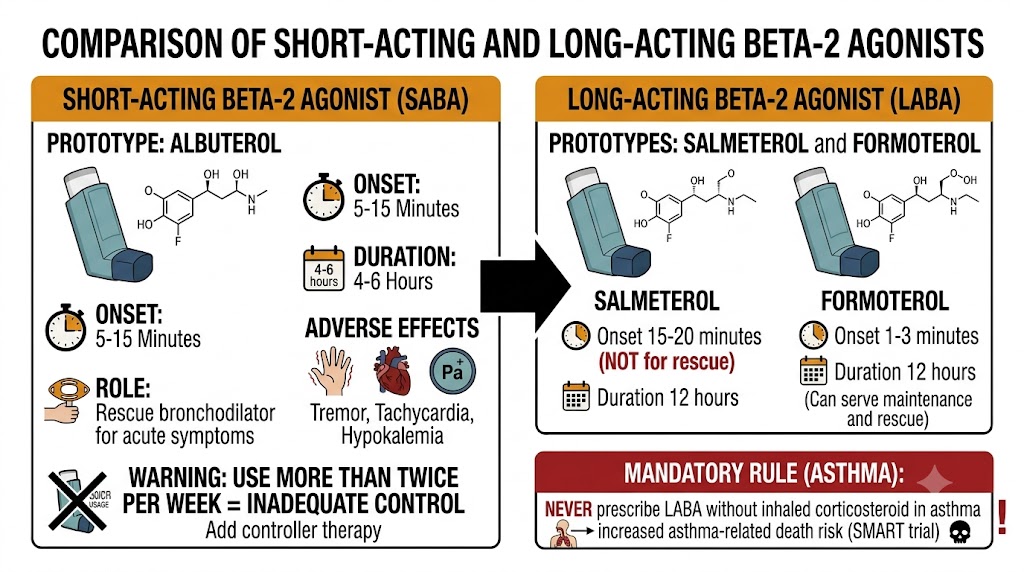
Side-by-side comparison of short-acting beta-2 agonists (albuterol: 5-15 minute onset, rescue use, overuse warning) and long-acting beta-2 agonists (salmeterol: slow onset not for rescue; formoterol: rapid onset; both require inhaled corticosteroid in asthma per SMART trial mandatory rule).
Comparison of short-acting beta-2 agonists (albuterol) and long-acting beta-2 agonists (salmeterol, formoterol) showing onset, duration, clinical role, and the mandatory rule against prescribing long-acting agents without inhaled corticosteroid in asthma. Source: Gemini AI, generated for educational use.
Long-Acting Beta-2 Agonists — Salmeterol and Formoterol

Long-acting beta-2 agonists provide 12 hours of bronchodilation per dose and are used for maintenance therapy in persistent asthma and chronic obstructive pulmonary disease. Salmeterol has a slow onset of 15 to 20 minutes — it cannot be used for acute rescue. Formoterol has a rapid onset of 1 to 3 minutes despite its 12-hour duration, which allows it to serve both maintenance and rescue functions in some clinical protocols.

The critical safety rule for long-acting beta-2 agonists in asthma: they must never be prescribed without an inhaled corticosteroid. The Salmeterol Multicenter Asthma Research Trial (SMART, 2006) found a small but statistically significant increase in asthma-related deaths in patients randomized to salmeterol without adequate inhaled corticosteroid coverage. The current standard of care is fixed-dose inhaled corticosteroid/long-acting beta-2 agonist combination inhalers for persistent asthma requiring maintenance therapy. In chronic obstructive pulmonary disease, where the inflammatory mechanism differs, long-acting beta-2 agonist monotherapy is approved and widely used.

Short-Acting vs. Long-Acting Beta-2 Agonists — Clinical Role Summary

Albuterol (short-acting): Onset 5 to 15 minutes; duration 4 to 6 hours. Rescue bronchodilator only. Use more than twice per week for symptoms = inadequate control; add controller therapy. Monitor potassium and heart rate with high-dose nebulized use.

Salmeterol (long-acting): Onset 15 to 20 minutes — NOT for rescue. Duration 12 hours. Use only with inhaled corticosteroid in asthma.

Formoterol (long-acting): Onset 1 to 3 minutes + 12-hour duration. May serve maintenance and rescue in some protocols. Use only with inhaled corticosteroid in asthma.

Rule: Never prescribe a long-acting beta-2 agonist without an inhaled corticosteroid in asthma — increased asthma-related death risk (SMART trial, 2006).


Section 4

Midodrine, Fludrocortisone, Isoproterenol, and Terbutaline

Orthostatic hypotension management, non-selective beta agonism, and tocolysis with regulatory constraints

Four additional synthetic adrenergic agents occupy defined clinical niches. Midodrine and fludrocortisone treat orthostatic hypotension through complementary mechanisms. Isoproterenol provides non-selective beta stimulation for specific arrhythmia indications. Terbutaline produces uterine relaxation as a tocolytic agent, but with important regulatory constraints on its use.

Midodrine — Alpha-1 Agonist Prodrug for Orthostatic Hypotension

Midodrine is an oral prodrug converted in the liver and plasma to its active metabolite desglymidodrine, a selective alpha-1 agonist. Desglymidodrine activates alpha-1 receptors on arterioles and veins, increasing systemic vascular resistance and reducing venous pooling in dependent veins in the upright position. The improved venous return raises standing blood pressure without meaningfully affecting the lying blood pressure at correctly timed doses. Midodrine does not cross the blood-brain barrier, so it produces no central nervous system effects.

The critical dosing rule: the last dose of the day must be taken at least four hours before bedtime. When the patient lies down, the drug's vasoconstrictive effect raises supine blood pressure, which can be dangerously elevated if the patient is recumbent with drug still active. Patients should also sleep with the head of the bed elevated to reduce overnight blood pressure. Adverse effects include scalp tingling, piloerection (goosebumps), and urinary retention from alpha-1-mediated contraction of the internal urethral sphincter.

Fludrocortisone — Mineralocorticoid for Volume Expansion

Fludrocortisone is a synthetic corticosteroid with potent mineralocorticoid and minimal glucocorticoid activity. It acts on the mineralocorticoid receptor in the renal collecting duct to increase sodium and water reabsorption, expanding intravascular volume and improving preload in the upright position. It also sensitizes peripheral vessels to catecholamines. Adverse effects include supine hypertension, hypokalemia (potassium monitoring and supplementation are required), and peripheral edema. Midodrine and fludrocortisone are frequently combined in patients with severe orthostatic hypotension, as they address the problem through complementary mechanisms — one through vasoconstriction, the other through volume expansion.

Isoproterenol — Non-Selective Beta Agonist

Isoproterenol is a non-selective beta-1 and beta-2 agonist with no alpha-adrenergic activity. Beta-1 stimulation increases heart rate, contractility, and atrioventricular node conduction velocity. Beta-2 stimulation causes peripheral vasodilation, reducing systemic vascular resistance and diastolic blood pressure. The net hemodynamic effect is a rise in pulse pressure with mean arterial pressure often unchanged — distinguishing it from norepinephrine (which raises both systolic and diastolic pressure) and from dobutamine (which is primarily beta-1).

Current clinical applications are narrow. Isoproterenol is used as a temporary bridge in high-degree atrioventricular block while awaiting transvenous pacing, by increasing ventricular escape rate through beta-1 stimulation. In cardiac electrophysiology laboratories it is used to induce arrhythmias for diagnostic purposes. It is also used to increase heart rate and shorten the QT interval in torsades de pointes associated with bradycardia-dependent long QT syndrome.

Terbutaline — Beta-2 Tocolytic

Terbutaline is a beta-2 selective agonist used in obstetrics as a uterine relaxant (tocolytic). Beta-2 receptor activation in uterine smooth muscle raises cyclic adenosine monophosphate and activates protein kinase A, which phosphorylates and inactivates myosin light-chain kinase — preventing smooth muscle contraction and inhibiting uterine contractions. The mechanism is directly analogous to beta-2-mediated bronchodilation, applied to a different smooth muscle target.

Terbutaline Tocolysis — Food and Drug Administration Black Box Warning

Injectable terbutaline is NOT approved for prolonged tocolysis beyond 48 to 72 hours. Serious maternal cardiac arrhythmias, pulmonary edema, and deaths have been reported with extended infusions.

Oral terbutaline is NOT approved for tocolysis at any duration.

Acceptable use: Subcutaneous terbutaline for short-term acute tocolysis (up to 48 to 72 hours) to allow corticosteroid administration for fetal lung maturation between 24 and 34 weeks gestation, with hemodynamic monitoring.

Contraindications: Cardiac disease, poorly controlled diabetes mellitus, thyrotoxicosis, placenta previa.

Maternal adverse effects from beta-2 activity include palpitations, tachycardia, tremor, hypokalemia, and hyperglycemia. Fetal tachycardia may occur through indirect maternal cardiovascular effects.


Section 5

Drug Interactions

Non-selective beta-blockers opposing beta-2 agonists, additive hypokalemia in acute asthma, and the clonidine withdrawal amplification by monoamine oxidase inhibitors

The synthetic adrenergic agonists interact with several important drug classes. Most interactions follow directly from the receptor pharmacology — blocking or amplifying the same pathways that the agonists engage. Two interactions carry direct patient safety implications at second-year level.

Non-Selective Beta-Blockers Oppose Beta-2 Agonist Bronchodilation

Non-selective beta-blockers (propranolol, nadolol, carvedilol, timolol) block beta-2 receptors in airway smooth muscle, directly opposing the bronchodilatory effect of albuterol, salmeterol, and terbutaline. In a patient with asthma or reactive airway disease who is taking a non-selective beta-blocker, beta-2 agonist bronchodilators may be partially or completely ineffective during acute bronchospasm — a potentially life-threatening situation. This interaction requires either avoiding non-selective beta-blockers in patients with reactive airways (using cardioselective agents — metoprolol, atenolol — which have far less beta-2 blockade at standard doses) or accepting that very high doses of nebulized albuterol may be required to overcome the partial blockade.

This interaction is the same mechanism responsible for the failure of epinephrine to produce bronchodilation in anaphylaxis in patients on non-selective beta-blockers — the glucagon rescue strategy described in Module 2 applies in that context.

Additive Hypokalemia — Beta-2 Agonists and Corticosteroids

Beta-2 agonists lower serum potassium by activating the sodium-potassium-adenosine triphosphatase pump in skeletal muscle, shifting potassium intracellularly. Systemic corticosteroids — frequently co-administered during management of severe acute asthma — promote renal potassium excretion through their mineralocorticoid activity. When high-dose nebulized beta-2 agonists and systemic corticosteroids are used together in severe acute asthma, the hypokalemic effects are additive, potentially lowering serum potassium below 3.0 milliequivalents per liter. This degree of hypokalemia increases the risk of cardiac arrhythmias, particularly in patients with underlying cardiac disease. Serum potassium should be monitored during treatment of severe acute asthma and replaced as needed.

Monoamine Oxidase Inhibitors and Clonidine Withdrawal

When a patient taking a monoamine oxidase inhibitor discontinues clonidine abruptly, the combination produces an amplified withdrawal crisis. Abrupt clonidine discontinuation already causes a norepinephrine surge through the upregulation-and-rebound mechanism described in Section 2. In a patient also taking a monoamine oxidase inhibitor, the enzymes responsible for catabolizing that norepinephrine surge are inhibited, so the excess norepinephrine persists far longer and at higher concentrations than in a patient without the inhibitor. The result is a substantially more severe and prolonged hypertensive crisis. This combination should generally be avoided; if both drugs are present, any dose reduction of clonidine must be gradual and performed under close monitoring.

Key Interactions — Module 3 Summary

Non-selective beta-blockers + beta-2 agonists: Beta-2 blockade opposes bronchodilation. Use cardioselective agents (metoprolol, atenolol) in patients with reactive airways who require beta-blockade.

Beta-2 agonists + corticosteroids in acute asthma: Additive hypokalemia. Monitor serum potassium during high-dose nebulized therapy combined with systemic corticosteroids.

Monoamine oxidase inhibitors + clonidine withdrawal: Amplified rebound hypertensive crisis from uninhibited norepinephrine accumulation. Avoid the combination; never stop clonidine abruptly in a patient on a monoamine oxidase inhibitor.

Long-acting beta-2 agonists without inhaled corticosteroid in asthma: Increased asthma-related death risk. Always co-prescribe inhaled corticosteroid.


Suggested References
Author / Organization Title Source
Westfall TC, Westfall DP Adrenergic agonists and antagonists. In: Brunton LL, et al., eds. Goodman & Gilman’s: The Pharmacological Basis of Therapeutics, 13th ed. McGraw-Hill; 2018:191–224
Heesen M, Kolhr S, Rossaint R, Straube S Prophylactic phenylephrine for caesarean section under spinal anaesthesia: systematic review and meta-analysis Anaesthesia. 2014;69(2):143–165
Kollar C, Schneider H, Waksman J, Krusinska E Meta-analysis of the efficacy of a single oral dose of phenylephrine 10 mg compared with placebo in adults with acute nasal congestion due to the common cold Clin Ther. 2007;29(6):1057–1070
Kamibayashi T, Maze M Clinical uses of alpha2-adrenergic agonists Anesthesiology. 2000;93(5):1345–1349
Giovannitti JA Jr, Thoms SM, Crawford JJ Alpha-2 adrenergic receptor agonists: a review of current clinical applications Anesth Prog. 2015;62(1):31–39
Pandharipande PP, Patel MB, Barr J Management of pain, agitation, and delirium in critically ill patients Pol Arch Med Wewn. 2014;124(3):114–123
Low PA, Gilden JL, Freeman R, Sheng KN, McElligott MA Efficacy of midodrine vs placebo in neurogenic orthostatic hypotension: a randomized, double-blind multicenter study JAMA. 1997;277(13):1046–1051
Lahrmann H, Cortelli P, Hilz M, Mathias CJ, Struhal W, Tassinari M EFNS guidelines on the diagnosis and management of orthostatic hypotension Eur J Neurol. 2006;13(9):930–936
Johnson M Molecular mechanisms of beta2-adrenergic receptor function, response, and regulation J Allergy Clin Immunol. 2006;117(1):18–24
Global Initiative for Asthma (GINA) Global Strategy for Asthma Management and Prevention Updated 2024. Available at: https://ginasthma.org
Nelson HS, Weiss ST, Bleecker ER, Yancey SW, Dorinsky PM; SMART Study Group The Salmeterol Multicenter Asthma Research Trial: a comparison of usual pharmacotherapy for asthma or usual pharmacotherapy plus salmeterol Chest. 2006;129(1):15–26
Zimetbaum P Antiarrhythmic drug therapy for atrial fibrillation Circulation. 2012;125(2):381–389
Gyetvai K, Hannah ME, Hodnett ED, Ohlsson A Tocolytics for preterm labor: a systematic review Obstet Gynecol. 1999;94(5 Pt 2):869–877
American College of Obstetricians and Gynecologists Practice Bulletin No. 171: Management of preterm labor Obstet Gynecol. 2016;128(4):e155–e164
Salpeter SR, Ormiston TM, Salpeter EE Cardioselective beta-blockers for chronic obstructive pulmonary disease Cochrane Database Syst Rev. 2005;(4):CD003566