CHAPTER 37  ·  ANTIFUNGAL AGENTS
Section 1

Mechanism of Action — Glucan Synthase Inhibition

A cell wall target unique to fungi, and why it produces fungicidal rather than fungistatic activity against Candida

The echinocandins represent the third major class of antifungal agents and the first with a genuinely new mechanism: inhibition of fungal cell wall synthesis rather than membrane targeting. This novel target confers excellent tolerability, a favorable drug interaction profile compared to azoles, and fungicidal activity against Candida species that gives the class a decisive therapeutic advantage in invasive candidiasis.

The Cell Wall Target

Fungi possess a rigid cell wall composed primarily of beta-1,3-d-glucan, chitin, and mannoproteins. Beta-1,3-d-glucan is an essential structural polymer providing tensile strength and maintaining cell shape and osmotic integrity. Its synthesis is carried out by the enzyme complex beta-1,3-d-glucan synthase (GS), encoded by the FKS1 (glucan synthase subunit 1) and FKS2 (glucan synthase subunit 2) genes in Candida species. The echinocandins are cyclic lipopeptides that act as non-competitive inhibitors of this enzyme, binding to the Fks subunit at the inner leaflet of the plasma membrane and blocking glucan chain elongation. Because mammalian cells lack a cell wall and do not synthesize beta-1,3-d-glucan, the glucan synthase target is exquisitely fungal-specific, which accounts for the excellent tolerability profile of the class.

Fungicidal vs. Fungistatic Activity

Echinocandins are fungicidal against most Candida species, which is their principal pharmacodynamic advantage over azoles in invasive candidiasis. Disruption of beta-1,3-d-glucan synthesis destabilizes the cell wall, leading to osmotic lysis and rapid cell death through a concentration-dependent mechanism. The pharmacodynamic index driving echinocandin efficacy is the ratio of the area under the concentration-time curve (AUC) to the minimum inhibitory concentration (MIC), indicating that total drug exposure over time — not just the time above MIC — is the key determinant of effect.

Against Aspergillus species, echinocandins are fungistatic rather than fungicidal: they inhibit glucan synthesis at hyphal tips, producing swollen, abnormally branched hyphae, but do not kill existing hyphae. This distinction explains why echinocandin monotherapy is not first-line for invasive aspergillosis despite the class's otherwise strong record in invasive fungal disease.

Shared Class Pharmacokinetics

All three echinocandins are large lipopeptide molecules not absorbed from the gastrointestinal (GI) tract, requiring intravenous (IV) administration for all therapeutic indications. Once administered, all are highly protein-bound (above 97 percent, primarily to albumin), achieve high concentrations in liver, spleen, lung, and kidney, and penetrate poorly into the central nervous system (CNS) and vitreous humor of the eye. This poor CNS and ocular penetration is a class limitation for Candida endophthalmitis and CNS candidiasis, conditions that require alternative or adjunctive therapy. None of the three echinocandins is significantly metabolized by cytochrome P450 (CYP) enzymes, which largely eliminates the CYP-mediated drug interaction burden that complicates azole use.

Class Summary

Target: beta-1,3-d-glucan synthase (Fks subunit) — cell wall-specific, absent from mammalian cells. Activity: fungicidal against most Candida (AUC/MIC-driven); fungistatic against Aspergillus. Administration: IV only (all three). No CYP metabolism — low drug interaction burden. Poor CNS and ocular penetration. Dose adjustment: caspofungin requires reduction for hepatic impairment; micafungin and anidulafungin do not.


Section 2

Individual Agent Pharmacology

Caspofungin, micafungin, and anidulafungin — how they differ in elimination, dosing, and drug interactions

All three echinocandins share the class mechanism and fungicidal activity against Candida but differ in their elimination pathways, interaction profiles, and dosing in ways that are clinically meaningful in specific patient populations — particularly those with hepatic impairment, renal insufficiency, or complex polypharmacy.

Caspofungin

Caspofungin, the first echinocandin approved, undergoes slow spontaneous chemical degradation and N-acetylation in plasma, with metabolites excreted in bile and urine. It is not a CYP substrate, but it interacts with certain drugs through induction of drug transporters. The standard adult dosing is a 70 mg loading dose on day one followed by 50 mg once daily. The loading dose is essential to rapidly achieve steady-state concentrations given the long terminal half-life; omitting it delays therapeutic exposure by approximately two weeks. For patients weighing above 80 kg, the maintenance dose is increased to 70 mg once daily. Dose adjustment is required for moderate to severe hepatic impairment (Child-Pugh score 7 to 9): reduce the maintenance dose to 35 mg once daily, retaining the 70 mg loading dose. No renal dose adjustment is needed.

The most clinically important caspofungin interaction is with strong CYP inducers — rifampin, efavirenz, phenytoin, carbamazepine, dexamethasone — which reduce caspofungin trough concentrations by approximately 30 percent; when any of these are co-administered, increase the caspofungin maintenance dose to 70 mg once daily. Cyclosporine increases caspofungin area under the concentration-time curve (AUC) by approximately 35 percent with associated liver enzyme elevations; many prescribers avoid this combination when alternatives exist. Caspofungin modestly reduces tacrolimus concentrations and requires therapeutic drug monitoring (TDM).

Micafungin

Micafungin is metabolized in the liver by arylsulfatase and catechol-O-methyltransferase (COMT), with biliary excretion of metabolites. Because renal elimination is negligible and hepatic metabolism does not depend significantly on CYP enzymes, no dose adjustment is required for renal impairment or mild-to-moderate hepatic impairment. The standard adult dose for candidemia and invasive candidiasis is 100 mg IV once daily without a loading dose — the pharmacokinetic profile allows therapeutic trough concentrations within one to two days of standard dosing. For esophageal candidiasis the dose is 150 mg IV once daily; for prophylaxis of Candida infections in hematopoietic stem cell transplant (HSCT) recipients, 50 mg IV once daily is approved. Micafungin has minimal clinically significant CYP-mediated interactions; the most notable is a modest increase in sirolimus and nifedipine exposure through weak CYP3A4 inhibition, generally manageable with monitoring rather than avoidance.

Anidulafungin

Anidulafungin is distinguished by a unique elimination mechanism: it undergoes slow chemical degradation at physiological temperature and pH to an open-ring peptide product, which is excreted in bile. This non-enzymatic, non-hepatic degradation means that anidulafungin pharmacokinetics are unaffected by hepatic function, renal function, or CYP enzyme activity, making it the echinocandin with the fewest potential drug interactions and the most straightforward dosing across all levels of organ dysfunction. No dose adjustment is required for any degree of hepatic or renal impairment. The dosing regimen for candidemia and invasive candidiasis is a 200 mg loading dose on day one followed by 100 mg IV once daily — a 2:1 loading-to-maintenance ratio reflecting the longer half-life of approximately 24 to 27 hours and the need to achieve therapeutic exposure promptly.
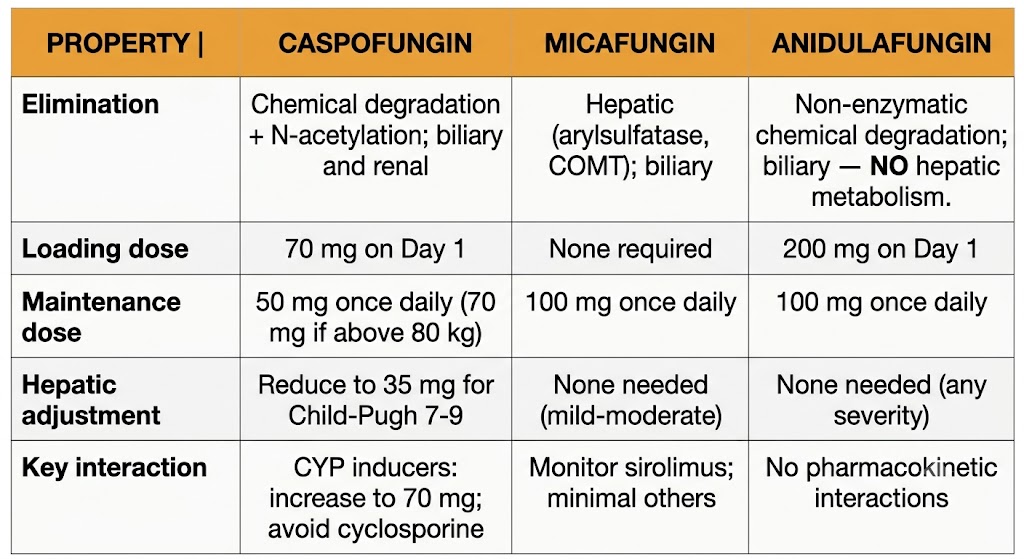
Reference table comparing caspofungin, micafungin, and anidulafungin across five properties: elimination pathway, loading dose, maintenance dose, hepatic dose adjustment, and key drug interaction. Anidulafungin uniquely shows no hepatic metabolism and no pharmacokinetic interactions.
Echinocandin comparison: elimination, dosing, hepatic adjustment, and drug interactions for caspofungin, micafungin, and anidulafungin. Gemini-generated figure.
Choosing Among the Three Echinocandins

Caspofungin: increase maintenance to 70 mg with strong CYP inducers; reduce to 35 mg for hepatic impairment (Child-Pugh 7 to 9); avoid with cyclosporine if possible; monitor tacrolimus. Micafungin: no routine adjustments; check sirolimus concentration; caution in severe hepatic impairment. Anidulafungin: no pharmacokinetic interactions; no organ-based dose adjustments — simplest profile of the three; preferred when polypharmacy or organ dysfunction is the primary concern.

Section 3

Antifungal Spectrum and Resistance

Candida and Aspergillus coverage, intrinsic gaps, FKS hot spot mutations, and Candida auris

The echinocandin spectrum is defined by excellent fungicidal activity against most Candida species and fungistatic activity against Aspergillus, with important gaps for Cryptococcus, the Mucorales, and several less common pathogens. Resistance mediated by mutations in the FKS genes has emerged as a clinical problem, particularly in Candida glabrata.

Candida Spectrum

Echinocandins are active and fungicidal against the major Candida species: Candida albicans, Candida glabrata, Candida tropicalis, Candida parapsilosis, Candida krusei, and Candida dubliniensis. The critical advantage over fluconazole is retained activity against fluconazole-resistant Candida glabrata and intrinsically fluconazole-resistant Candida krusei. Against Candida parapsilosis and Candida guilliermondii, minimum inhibitory concentrations (MICs) are naturally higher than against other Candida species, reflecting intrinsically reduced glucan synthase inhibitor susceptibility. Clinical outcomes with echinocandin therapy for Candida parapsilosis are generally acceptable, but some guidelines recommend fluconazole as a preferred agent when the isolate is confirmed fluconazole-susceptible. Candida auris, the multidrug-resistant emerging pathogen, is typically echinocandin-susceptible and echinocandins are the drug of choice for Candida auris infections pending susceptibility data.

Spectrum Gaps

Echinocandins lack activity against Cryptococcus neoformans, which has minimal beta-1,3-d-glucan in its cell wall. They have no activity against the Mucorales, Fusarium species, or most hyalohyphomycetes other than Aspergillus. Against Aspergillus, activity is fungistatic and restricted to actively growing hyphal tips; established invasive aspergillosis requires a triazole or polyene as primary therapy.

FKS Mutations and Resistance

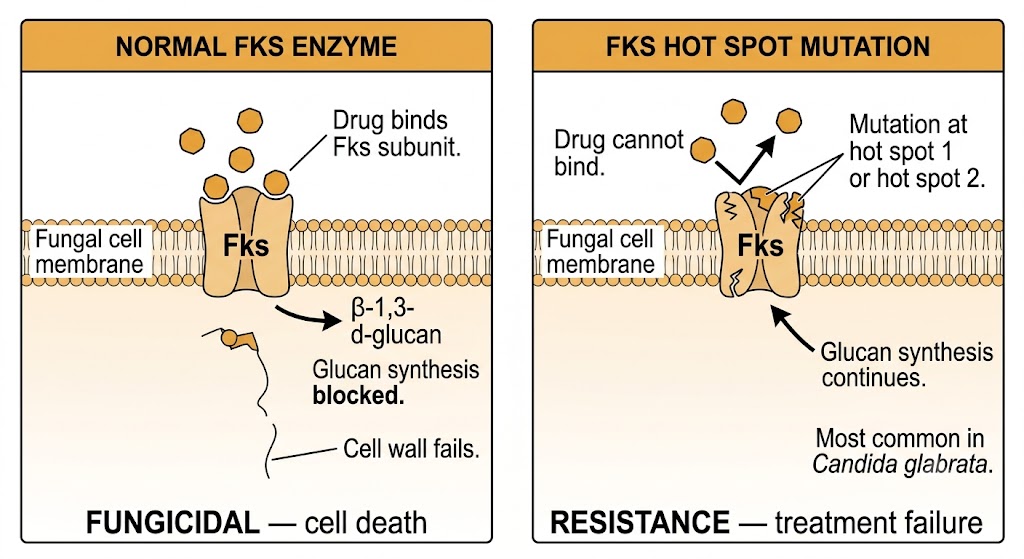
The primary mechanism of acquired echinocandin resistance is mutation in the hot spot (HS) regions of the FKS1 or FKS2 genes encoding the Fks glucan synthase subunit. Two hot spot regions have been characterized: hot spot 1 spanning amino acids 641 to 649 and hot spot 2 spanning amino acids 1345 to 1365. Mutations at specific positions within these hot spots — most commonly serine-to-leucine or serine-to-phenylalanine substitutions — reduce echinocandin binding affinity for the Fks enzyme by several orders of magnitude.

Candida glabrata has the highest rates of acquired echinocandin resistance, with resistance rates of 5 to 13 percent reported in some centers following widespread echinocandin use. FKS mutations should be suspected in patients who have breakthrough candidemia while receiving echinocandin therapy, who have a history of prolonged echinocandin exposure, or whose isolates show rising MICs on repeat testing. Cross-resistance among all three echinocandins for FKS-mediated resistance is expected because all three target the same Fks hot spot regions. For suspected echinocandin resistance, liposomal amphotericin B is the standard alternative because azole resistance may co-exist in heavily pre-treated Candida glabrata isolates.

Two-panel mechanism diagram showing FKS glucan synthase resistance. Left panel shows normal Fks enzyme with echinocandin drug binding to the Fks subunit, blocking beta-1,3-d-glucan synthesis causing cell wall failure and fungicidal cell death. Right panel shows FKS hot spot mutation where the drug cannot bind, glucan synthesis continues, and resistance results in treatment failure. Most common in Candida glabrata.
FKS hot spot mutation mechanism of echinocandin resistance: normal drug binding (left) versus mutated Fks with failed drug binding and continued glucan synthesis (right). Gemini-generated figure.
When to Suspect FKS Resistance

Suspect FKS resistance in: breakthrough candidemia on echinocandin therapy; prior prolonged echinocandin exposure, especially in Candida glabrata; isolates with rising MICs on repeat testing. Action: send isolate for formal susceptibility testing; consider FKS hot spot molecular testing if available; switch to liposomal amphotericin B empirically if clinical deterioration occurs. Cross-resistance among all three echinocandins is expected — do not switch within the class for suspected FKS resistance.


Section 4

Tolerability, Interactions, and Monitoring

Class-wide tolerability advantages, infusion considerations, and laboratory monitoring parameters

The echinocandin class has a favorable tolerability profile compared to both the polyenes and the azoles, which is a primary reason for its preferred status in invasive candidiasis guidelines.

Common Adverse Effects

Infusion-related reactions — fever, rash, flushing, pruritus — occur in approximately two to five percent of patients and are attributed to histamine release rather than immunoglobulin E-mediated allergy; slowing the infusion rate typically resolves or prevents these reactions. Liver enzyme elevations occur in five to 15 percent of patients, are usually mild and reversible, and uncommonly require drug discontinuation. Hypokalemia occurs with sufficient frequency to warrant monitoring, particularly in seriously ill patients receiving concurrent diuretics. Echinocandins lack the nephrotoxicity of amphotericin B and the CYP-mediated toxicities of azoles, making them particularly suitable for patients with renal impairment or complex polypharmacy. All three require careful attention to infusion rate: caspofungin over 60 minutes, micafungin over 60 minutes, anidulafungin at a rate not exceeding 1.1 mg per minute (translating to approximately 90 minutes for the 100 mg maintenance dose).

Laboratory Monitoring

Baseline and periodic monitoring of liver function tests — alanine aminotransferase (ALT), aspartate aminotransferase (AST), alkaline phosphatase, and total bilirubin — is recommended for all patients on echinocandin therapy. Serum potassium and magnesium should be monitored, particularly in severely ill patients or those on concurrent medications causing electrolyte wasting. Renal function monitoring is appropriate for the underlying condition or co-administered nephrotoxins, not for echinocandin nephrotoxicity concerns. Therapeutic drug monitoring of echinocandin plasma concentrations is not routinely performed in clinical practice; standard dosing achieves adequate exposure in most adult patients, though extreme body weight, pharmacokinetic drug interactions, or refractory infection may warrant consideration of monitoring in specialized settings.


Section 5

Clinical Positioning

First-line candidemia, oral step-down strategy, aspergillosis salvage, and agent selection in special populations

Echinocandins occupy the first-line position for invasive candidiasis in current guidelines, displacing fluconazole from that role except in specific low-risk scenarios. The step-down strategy to oral fluconazole once the organism is identified and the patient is stable is an equally important part of echinocandin management.

First-Line for Invasive Candidiasis

The 2016 Infectious Diseases Society of America (IDSA) guidelines recommend an echinocandin as preferred initial therapy for most patients with candidemia and invasive candidiasis, regardless of species. The shift from fluconazole reflects the increasing prevalence of fluconazole-resistant Candida glabrata, the superior fungicidal activity of echinocandins, and evidence of lower mortality with echinocandin initial therapy. Fluconazole remains acceptable for less severely ill patients with no prior azole exposure in settings where Candida glabrata or Candida krusei is unlikely, and it is the preferred step-down agent for oral de-escalation once susceptibility is confirmed and the patient is clinically stable. The recommended duration for uncomplicated candidemia is 14 days from the last positive blood culture in a patient with no deep-seated infection and documented removal of the intravascular catheter.

Oral Step-Down to Fluconazole

Transition to oral fluconazole after echinocandin induction is appropriate when all of the following criteria are met: clinical improvement with defervescence and hemodynamic stability, the patient is tolerating oral medications, blood cultures are documented negative, the species is confirmed fluconazole-susceptible, neutropenia has resolved if present, and there is no evidence of deep-seated infection requiring prolonged IV therapy. Patients with Candida glabrata and confirmed fluconazole susceptibility can step down to fluconazole; if azole resistance is documented, echinocandin therapy must continue for the full treatment course. Oral voriconazole is an alternative step-down for Candida krusei or azole-resistant isolates where susceptibility permits.

Special Populations

Among patients with significant hepatic impairment, anidulafungin or micafungin is preferred over caspofungin because neither requires dose adjustment for hepatic dysfunction. In solid organ transplant recipients receiving calcineurin inhibitors, micafungin or anidulafungin is preferred to avoid the caspofungin-cyclosporine alanine aminotransferase (ALT) elevation interaction and the caspofungin-tacrolimus pharmacokinetic interaction. In patients on rifampin-based tuberculosis regimens, caspofungin requires dose escalation to 70 mg once daily, or anidulafungin or micafungin can be used without adjustment. In the intensive care unit (ICU) with polypharmacy and multiorgan dysfunction, anidulafungin is an attractive choice because of its uniquely simple pharmacokinetic profile and absence of any drug interactions or organ-based dose adjustments.

Step-Down Criteria — Echinocandin to Oral Fluconazole

All of the following must be met before stepping down: clinical improvement (defervescent, hemodynamically stable), tolerating oral medications, blood cultures documented negative, species confirmed fluconazole-susceptible, neutropenia resolved, no deep-seated infection requiring prolonged IV therapy. If Candida glabrata or Candida krusei: do not step down to fluconazole regardless of clinical stability — echinocandin or alternative based on susceptibility data.

Suggested References
Author / Organization Title Source
Denning DW Echinocandin antifungal drugs Lancet. 2003;362(9390):1142-1151
Dodds Ashley ES, Lewis R, Lewis JS, Martin C, Andes D Pharmacology of systemic antifungal agents Clin Infect Dis. 2006;43(Suppl 1):S28-S39
Andes D, Pascual A, Marchetti O Antifungal therapeutic drug monitoring: established and emerging indications Antimicrob Agents Chemother. 2009;53(1):24-34
Keating GM, Figgitt DP Caspofungin: a review of its use in oesophageal candidiasis, invasive candidiasis and invasive aspergillosis Drugs. 2003;63(20):2235-2263
Kuse ER, Chetchotisakd P, da Cunha CA, et al. Micafungin versus liposomal amphotericin B for candidaemia and invasive candidosis: a phase III randomised double-blind trial Lancet. 2007;369(9572):1519-1527
Krause DS, Simjee AE, van Rensburg C, et al. A randomized, double-blind trial of anidulafungin versus fluconazole for the treatment of esophageal candidiasis Clin Infect Dis. 2004;39(6):770-775
Pappas PG, Kauffman CA, Andes DR, et al. Clinical practice guideline for the management of candidiasis: 2016 update by the Infectious Diseases Society of America Clin Infect Dis. 2016;62(4):e1-e50
Perlin DS Resistance to echinocandin-class antifungal drugs Drug Resist Updat. 2007;10(3):121-130
Perlin DS, Rautemaa-Richardson R, Alastruey-Izquierdo A The global problem of antifungal resistance: prevalence, mechanisms, and management Lancet Infect Dis. 2017;17(12):e383-e392
Kullberg BJ, Arendrup MC Invasive fungal disease in the patient with cancer N Engl J Med. 2015;373(15):1445-1456