Chapter 11  ·  Antilipidemic Drugs

Section 1

Familial Hypercholesterolemia

The most common monogenic cardiovascular disease and a pharmacological challenge

Familial hypercholesterolemia is the most pharmacologically consequential genetic lipid disorder, affecting approximately one in 250 people in its heterozygous form. It produces severely elevated low-density lipoprotein cholesterol from birth, accelerating atherosclerosis decades earlier than in the general population. Recognizing it, treating it aggressively, and understanding why standard drugs have reduced efficacy in the homozygous form are core clinical competencies.
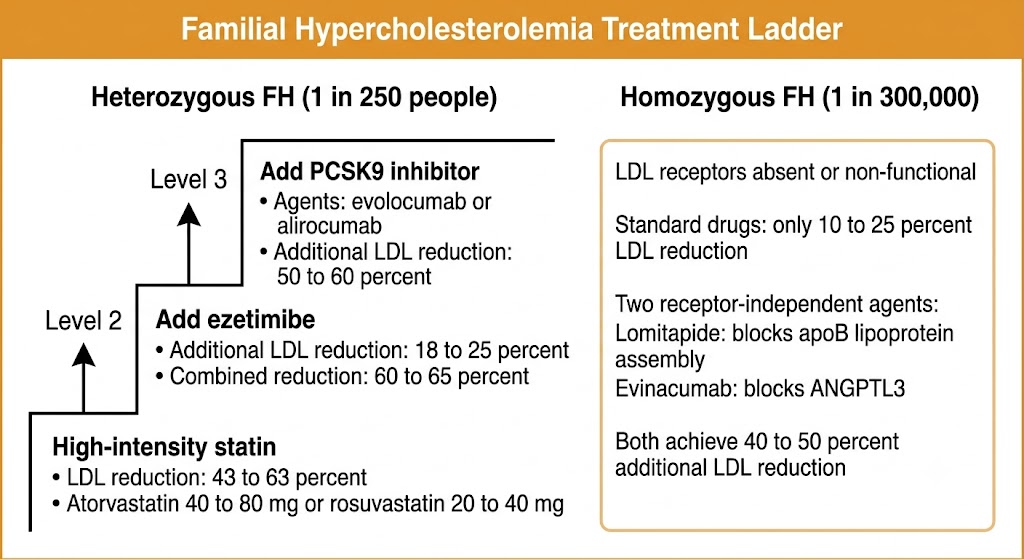
Familial hypercholesterolemia treatment ladder showing heterozygous FH escalation from high-intensity statin step 1 (LDL reduction 43 to 63 percent) through add ezetimibe step 2 (additional 18 to 25 percent, combined 60 to 65 percent) to add PCSK9 inhibitor step 3 (additional 50 to 60 percent); separate homozygous FH box showing LDL receptors absent or non-functional, standard drugs only 10 to 25 percent reduction, lomitapide blocks apoB lipoprotein assembly and evinacumab blocks ANGPTL3 via receptor-independent pathways achieving 40 to 50 percent additional reduction.
Treatment escalation ladder for familial hypercholesterolemia showing standard therapy for heterozygous FH and the receptor-independent agents required for homozygous FH. Figure generated by Gemini AI.

Heterozygous Familial Hypercholesterolemia — Definition and Treatment

Familial hypercholesterolemia is caused primarily by loss-of-function mutations in the low-density lipoprotein receptor gene, accounting for about 85 to 90 percent of genetically confirmed cases. Less common causes include gain-of-function mutations in proprotein convertase subtilisin/kexin type 9 and loss-of-function mutations in apolipoprotein B. The heterozygous form produces untreated low-density lipoprotein cholesterol typically in the range of 190 to 400 milligrams per deciliter, with cardiovascular events often occurring in the fourth and fifth decades of life if untreated.

Clinical features that should trigger consideration of familial hypercholesterolemia include: low-density lipoprotein cholesterol persistently above 190 milligrams per deciliter in an adult; tendon xanthomas (firm cholesterol deposits in the Achilles or hand tendons); premature atherosclerotic cardiovascular disease in a first-degree relative (men below 55 years, women below 60 years); and a family history of elevated cholesterol. A practical clinical rule is that any adult with untreated low-density lipoprotein cholesterol above 190 milligrams per deciliter should be evaluated for familial hypercholesterolemia before starting therapy. Genetic testing confirms the diagnosis and enables cascade screening of first-degree relatives — identifying at-risk family members before cardiovascular events occur is the single most cost-effective intervention in familial hypercholesterolemia management.

All patients with heterozygous familial hypercholesterolemia require high-intensity statin therapy, initiated as early as childhood in affected patients (from around age 8 to 10 years). Because even high-intensity statin rarely achieves adequate low-density lipoprotein cholesterol reduction from a starting point of 250 to 350 milligrams per deciliter, most heterozygous familial hypercholesterolemia patients require combination therapy. The standard escalation is: high-intensity statin, then add ezetimibe, then add a proprotein convertase subtilisin/kexin type 9 inhibitor (evolocumab or alirocumab) if still not at target. This triple combination can reduce low-density lipoprotein cholesterol by 70 to 85 percent from untreated baseline.

Homozygous Familial Hypercholesterolemia — Why Standard Drugs Have Limited Effect

Homozygous familial hypercholesterolemia is rare (approximately one in 300,000 to one million individuals) but severe. Untreated low-density lipoprotein cholesterol is typically 400 to 1,000 milligrams per deciliter, with xanthomas, corneal arcus, and aortic stenosis often appearing in childhood. Without aggressive treatment, coronary atherosclerosis can produce fatal events in the second or third decade of life.

Statins and ezetimibe work primarily by upregulating low-density lipoprotein receptor expression. In homozygous familial hypercholesterolemia, patients carry two mutant low-density lipoprotein receptor alleles with severely reduced or absent receptor function, so these drugs produce only 10 to 25 percent low-density lipoprotein cholesterol reduction rather than the 60 to 65 percent seen in patients with normal receptors. Proprotein convertase subtilisin/kexin type 9 inhibitors prevent degradation of low-density lipoprotein receptors — but if the receptors are absent or non-functional, there is nothing to protect. Monoclonal antibody proprotein convertase subtilisin/kexin type 9 inhibitors have markedly attenuated efficacy in true receptor-negative homozygous familial hypercholesterolemia.

Two agents approved specifically for homozygous familial hypercholesterolemia work through low-density lipoprotein receptor-independent pathways. Lomitapide blocks the assembly of apolipoprotein B-containing lipoproteins in the liver and intestine before they are secreted into the bloodstream, reducing low-density lipoprotein cholesterol production regardless of receptor status. Evinacumab is a monoclonal antibody targeting angiopoietin-like protein 3, an inhibitor of lipoprotein lipase; blocking it enhances triglyceride-rich lipoprotein clearance through a receptor-independent pathway. Both agents produce approximately 40 to 50 percent additional low-density lipoprotein cholesterol reduction in homozygous familial hypercholesterolemia patients on maximal background therapy, including those with no functional low-density lipoprotein receptors.

Clinical Recognition Rule

Any adult presenting with untreated low-density lipoprotein cholesterol above 190 milligrams per deciliter should be evaluated for familial hypercholesterolemia before therapy is initiated. Tendon xanthomas are pathognomonic when present. Cascade screening of first-degree relatives after a diagnosis is confirmed is the highest-yield intervention in familial hypercholesterolemia management.
Section 2

Post-Acute Coronary Syndrome and Heart Failure

Maximum intensity after acute coronary syndrome; the statin paradox in heart failure

Two high-prevalence cardiovascular conditions require specific lipid management thinking: the post-acute coronary syndrome period demands the most aggressive lipid lowering available, while chronic heart failure presents the paradox of a condition where aggressive lipid lowering has not reduced mortality despite its established benefit in atherosclerotic cardiovascular disease.

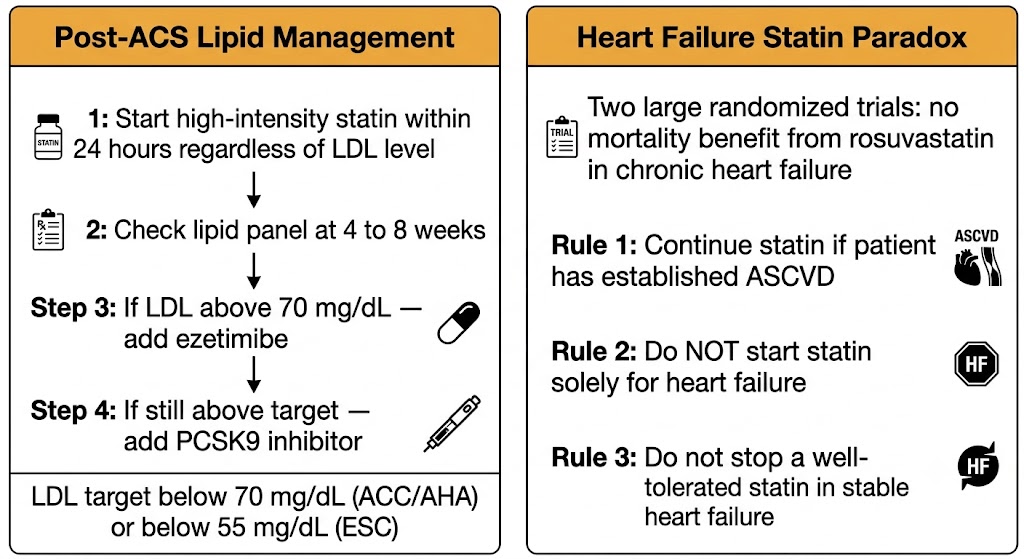
Two-panel diagram showing post-ACS lipid management on the left (high-intensity statin within 24 hours, lipid panel at 4 to 8 weeks, add ezetimibe if LDL above 70 mg/dL, add PCSK9 inhibitor if still above target, LDL targets below 70 ACC/AHA or below 55 ESC) and heart failure statin paradox on the right (two large trials no mortality benefit from rosuvastatin; Rule 1 continue if established ASCVD; Rule 2 do not start solely for heart failure; Rule 3 do not stop well-tolerated statin in stable heart failure).
Post-acute coronary syndrome lipid management algorithm alongside the heart failure statin paradox and its three clinical rules. Figure generated by Gemini AI.

Post-Acute Coronary Syndrome — The Highest-Priority Window

The weeks and months after an acute coronary syndrome represent the highest-risk period for recurrent atherosclerotic cardiovascular disease events. High-intensity statin therapy should be initiated within the first 24 hours of an acute coronary syndrome presentation in all patients, regardless of the baseline low-density lipoprotein cholesterol level. The immediate benefit comes not from low-density lipoprotein cholesterol lowering — which takes weeks to develop — but from the pleiotropic effects of statins on plaque stabilization, endothelial function, and inflammation that begin within days.

The low-density lipoprotein cholesterol target in post-acute coronary syndrome patients is below 70 milligrams per deciliter (American College of Cardiology/American Heart Association) or below 55 milligrams per deciliter (European Society of Cardiology). A fasting lipid panel should be obtained within 24 to 72 hours of presentation to establish the true baseline, then repeated at four to eight weeks post-discharge to guide add-on therapy decisions.

The sequential add-on approach applies as in other very-high-risk patients: add ezetimibe if the low-density lipoprotein cholesterol target is not met on maximally tolerated high-intensity statin, then add a proprotein convertase subtilisin/kexin type 9 inhibitor if the target remains unmet on statin plus ezetimibe. In patients presenting with very high baseline low-density lipoprotein cholesterol (above 100 milligrams per deciliter), early consideration of proprotein convertase subtilisin/kexin type 9 inhibitor initiation without first trying ezetimibe is clinically appropriate given the demonstrated mortality benefit of early aggressive lowering in this subgroup.

Heart Failure — The Statin Paradox

In chronic heart failure, statins have not reduced mortality in dedicated randomized trials despite their robust benefit in other atherosclerotic cardiovascular disease contexts. Two large trials — one in ischemic heart failure with reduced ejection fraction, one in heart failure of any cause — both found that rosuvastatin produced no significant reduction in all-cause mortality or the primary cardiovascular composite, despite reducing low-density lipoprotein cholesterol and inflammatory markers substantially.

Several mechanisms may explain this statin paradox. In advanced heart failure, deaths occur predominantly from pump failure and arrhythmia rather than from atherothrombotic events that lipid lowering prevents. Very low circulating lipoproteins in advanced heart failure may reflect malnutrition and cardiac cachexia rather than a modifiable risk factor. And further lowering of already-depleted lipoproteins by statins may not produce the same benefit as lowering in patients with elevated baseline levels.

The practical clinical rules: continue statin therapy in heart failure patients who have established atherosclerotic cardiovascular disease — the secondary prevention benefit applies and the heart failure does not negate it. Do not initiate statins de novo in heart failure patients solely to treat the heart failure itself, as there is no evidence of mortality benefit. Do not discontinue a well-tolerated statin in a stable heart failure patient currently taking one.

Heart Failure Statin Rule

Continue statins in heart failure if the patient has atherosclerotic cardiovascular disease. Do not start statins solely for heart failure — no mortality benefit has been demonstrated. Do not stop a well-tolerated statin in a stable patient. The statin paradox in heart failure is one of the clearest examples of evidence from a specific population overriding extrapolation from general cardiovascular data.


Section 3

Hypertriglyceridemia and Diabetes

Stratifying triglyceride management and addressing combined dyslipidemia in diabetes

Hypertriglyceridemia and diabetic dyslipidemia are closely linked and require a treatment approach that distinguishes between the goal of cardiovascular event reduction and the separate goal of pancreatitis prevention. These goals require different agents at different triglyceride thresholds.

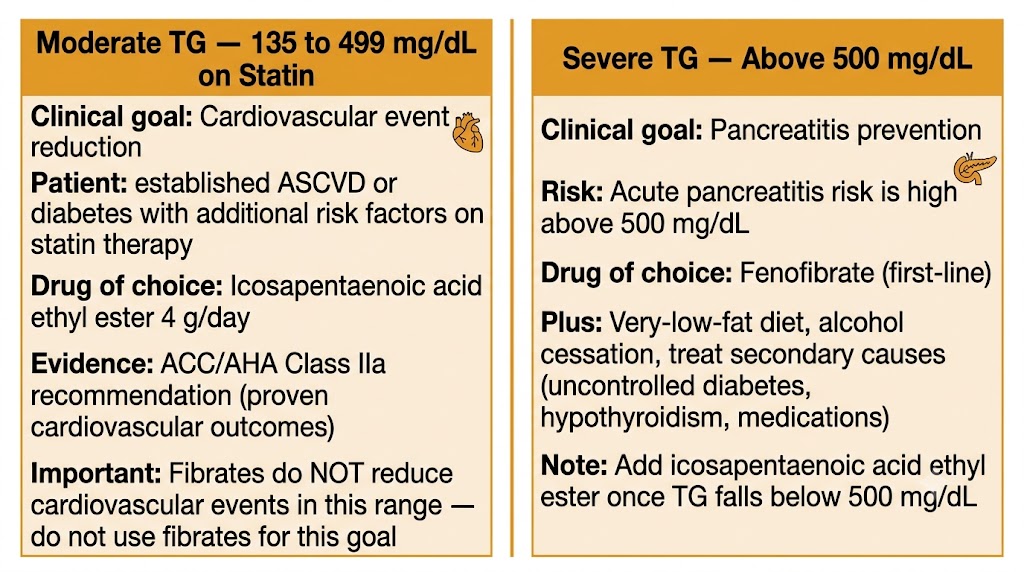
Two-panel triglyceride stratification diagram showing moderate TG 135 to 499 mg/dL on statin on the left (clinical goal cardiovascular event reduction, drug of choice icosapentaenoic acid ethyl ester 4 g/day, ACC/AHA Class IIa, fibrates do not reduce cardiovascular events in this range) and severe TG above 500 mg/dL on the right (clinical goal pancreatitis prevention, drug of choice fenofibrate first-line, plus very-low-fat diet and treat secondary causes including uncontrolled diabetes, hypothyroidism, and medications, add icosapentaenoic acid ethyl ester once TG falls below 500 mg/dL).
Triglyceride management stratified by level showing different therapeutic goals and drug choices for moderate versus severe hypertriglyceridemia. Figure generated by Gemini AI.

Hypertriglyceridemia — Two Different Clinical Problems

The clinical approach to elevated triglycerides depends on the absolute level, because the therapeutic goal changes at different thresholds.

For moderate hypertriglyceridemia (135 to 499 milligrams per deciliter) in patients already on statin therapy with established atherosclerotic cardiovascular disease or diabetes with additional risk factors, the therapeutic goal is cardiovascular event reduction. Icosapentaenoic acid ethyl ester 4 grams per day is the agent of choice in this range, with an American College of Cardiology/American Heart Association Class IIa recommendation based on proven cardiovascular outcomes. Fibrates do not reduce cardiovascular events in this triglyceride range on background statin and are not indicated for this goal.

For severe hypertriglyceridemia (above 500 milligrams per deciliter), the primary goal shifts to pancreatitis prevention. At levels above 1,000 milligrams per deciliter, the risk of acute pancreatitis is substantial and immediate. First-line management is fenofibrate combined with a very-low-fat diet, alcohol cessation, and correction of secondary causes (uncontrolled diabetes, hypothyroidism, medications including corticosteroids and oral estrogens). Icosapentaenoic acid ethyl ester may be added once triglycerides fall below 500 milligrams per deciliter.

Diabetic Dyslipidemia — The Characteristic Triad

Type 2 diabetes produces a characteristic dyslipidemia triad driven by insulin resistance: elevated triglycerides, low high-density lipoprotein cholesterol, and a predominance of small dense low-density lipoprotein particles. The measured low-density lipoprotein cholesterol may be normal or only modestly elevated while atherogenic particle burden (measured by apolipoprotein B or non-high-density lipoprotein cholesterol) is substantially higher than the low-density lipoprotein cholesterol number suggests. This makes non-high-density lipoprotein cholesterol and apolipoprotein B more relevant treatment targets than low-density lipoprotein cholesterol alone in diabetic patients.

Statin therapy is the foundation of lipid management in all patients with type 2 diabetes aged 40 to 75. At least moderate-intensity statin is indicated for all; high-intensity statin is appropriate for those with established atherosclerotic cardiovascular disease or a high ten-year risk. The statin-associated new-onset diabetes risk discussed in Module 3 is not a contraindication in patients who already have diabetes.

For diabetic patients with residual triglyceride elevation on statin therapy (135 to 499 milligrams per deciliter), icosapentaenoic acid ethyl ester 4 grams per day is appropriate given the American College of Cardiology/American Heart Association Class IIa indication for this population. Glucagon-like peptide-1 receptor agonists (such as semaglutide) and sodium-glucose cotransporter-2 inhibitors (such as empagliflozin) also modestly reduce triglycerides through improved insulin sensitivity and have established cardiovascular outcome benefits in diabetes.

Key Rule — Two Triglyceride Goals, Two Different Drugs

Moderate hypertriglyceridemia on statin (135 to 499 mg/dL) with atherosclerotic cardiovascular disease or diabetes: goal is cardiovascular event reduction — use icosapentaenoic acid ethyl ester 4 g/day.

Severe hypertriglyceridemia (above 500 mg/dL): goal is pancreatitis prevention — use fenofibrate plus very-low-fat diet and treat secondary causes. These are different clinical problems requiring different agents.


Section 4

Elderly Patients and Deprescribing

Secondary prevention benefit is preserved; primary prevention requires individualization

Statin prescribing in patients aged 75 and older requires individualized decision-making. The secondary prevention benefit is well-established and should be continued without an upper age cutoff. Primary prevention in the very elderly is less certain, and deprescribing has emerged as an evidence-supported option in selected patients.

Secondary Prevention — Continue High-Intensity Statin

Patients aged 75 and older with established atherosclerotic cardiovascular disease derive the greatest absolute benefit from statin therapy because their absolute baseline cardiovascular risk is highest. High-intensity statin is appropriate for secondary prevention in this age group without an upper age cutoff. Both American College of Cardiology/American Heart Association and European Society of Cardiology guidelines endorse statin therapy for secondary prevention in older adults, with shared decision-making about high versus moderate intensity in frail patients.

Primary Prevention — Individualize

For primary prevention in patients aged 75 and older without established atherosclerotic cardiovascular disease, the evidence is less certain. A large randomized trial of rosuvastatin versus placebo in adults aged 70 and older without established cardiovascular disease or diabetes found no significant reduction in the primary composite of disability-free survival, introducing meaningful uncertainty about primary prevention benefit of high-intensity statin in this age group.

The decision to initiate or continue statin therapy for primary prevention in patients aged 75 and older should incorporate: estimated life expectancy compared to the time-to-benefit horizon of statin therapy (generally two to five years); comorbidity burden and frailty; polypharmacy and drug interaction risk; and patient preferences. Moderate-intensity statin rather than high-intensity is the more appropriate default in primary prevention elderly patients given increased muscle toxicity susceptibility and altered pharmacokinetics.

Deprescribing — An Evidence-Based Option in Selected Patients

Deprescribing of statins is an evidence-supported clinical option in patients with limited life expectancy, advanced frailty, significant polypharmacy, or terminal illness where the long-term cardiovascular benefit is unlikely to be realized within the patient's expected lifespan. A cluster-randomized trial of statin discontinuation in patients aged 75 and older with limited life expectancy on primary prevention statins demonstrated that discontinuation was safe, reduced pill burden, and improved quality-of-life measures without excess cardiovascular events over twelve months.

Deprescribing is not appropriate in secondary prevention patients with established atherosclerotic cardiovascular disease and reasonable life expectancy. The framework for deprescribing decisions includes: whether the indication is primary or secondary prevention; estimated life expectancy versus time-to-benefit; frailty and functional status; current tolerability; and the patient's values regarding pill burden and cardiovascular risk.

Elderly Statin Rules in Brief

Secondary prevention (established atherosclerotic cardiovascular disease): continue high-intensity statin, no upper age limit. Primary prevention, age 75 and older: individualize based on life expectancy, frailty, and patient preferences; moderate intensity preferred. Terminal illness or very limited life expectancy on primary prevention: deprescribing is evidence-supported and reduces pill burden without excess events.


Section 5

Chronic Kidney Disease

Statins reduce cardiovascular events in pre-dialysis chronic kidney disease but not in dialysis patients

Chronic kidney disease is one of the strongest independent cardiovascular risk enhancers recognized in current guidelines. The evidence for lipid-lowering therapy in this population has a critical distinction: benefit is established in pre-dialysis patients but not in prevalent dialysis patients.

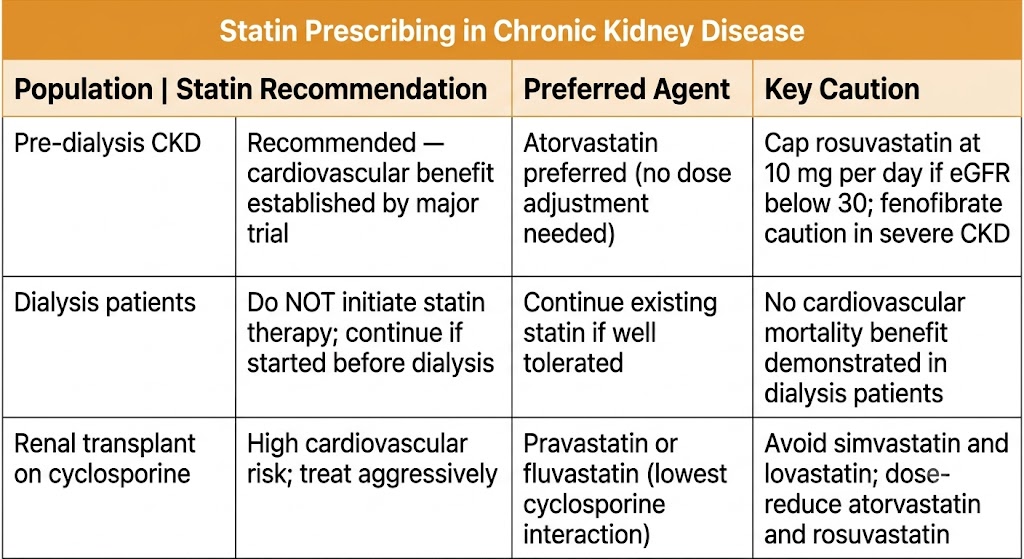
Reference table showing statin prescribing in chronic kidney disease: pre-dialysis CKD row (recommended, cardiovascular benefit established, atorvastatin preferred no dose adjustment, cap rosuvastatin at 10 mg if eGFR below 30, fenofibrate caution), dialysis patients row (do not initiate, continue if started before dialysis, no cardiovascular mortality benefit demonstrated), renal transplant on cyclosporine row (high cardiovascular risk treat aggressively, pravastatin or fluvastatin lowest interaction, avoid simvastatin and lovastatin, dose-reduce atorvastatin and rosuvastatin).
Statin prescribing guidance in chronic kidney disease populations showing different recommendations for pre-dialysis CKD, dialysis patients, and renal transplant recipients on cyclosporine. Figure generated by Gemini AI.

The Evidence Base

Chronic kidney disease produces a distinctive dyslipidemia with elevated triglycerides, low high-density lipoprotein cholesterol, and a predominance of small dense low-density lipoprotein particles, resulting in substantially elevated cardiovascular risk at any given low-density lipoprotein cholesterol level. The definitive randomized trial enrolled over nine thousand patients with chronic kidney disease and demonstrated that statin plus ezetimibe reduced major atherosclerotic events by approximately 17 percent in pre-dialysis patients over five years. The benefit was not seen in the dialysis subgroup, consistent with findings from two prior dedicated dialysis trials that also found no cardiovascular event reduction.

The likely explanation for the dialysis paradox mirrors the heart failure statin paradox: in end-stage kidney disease on dialysis, cardiovascular deaths occur predominantly from uremic cardiomyopathy, arrhythmia, and sudden cardiac death rather than from atherosclerotic plaque rupture — mechanisms not prevented by lipid lowering.

Practical Prescribing in Chronic Kidney Disease

Atorvastatin is generally the preferred high-intensity statin in chronic kidney disease because it undergoes minimal renal excretion (less than two percent of drug is excreted unchanged in urine) and does not require dose adjustment. Rosuvastatin undergoes proportionally greater renal excretion and accumulates in severe chronic kidney disease; the dose should be capped at 10 milligrams per day when estimated glomerular filtration rate falls below 30 milliliters per minute per 1.73 square meters.

Ezetimibe requires no dose adjustment in chronic kidney disease and is an appropriate add-on agent at any stage. Proprotein convertase subtilisin/kexin type 9 inhibitors also require no dose adjustment and have been shown to be effective and safe in chronic kidney disease patients enrolled in the major outcomes trials.

Fenofibrate should be used cautiously in chronic kidney disease. It causes a reversible rise in serum creatinine through reduced tubular secretion (not nephrotoxicity), which can confuse monitoring. More importantly, fenofibrate accumulates in severe chronic kidney disease, increasing myopathy risk. It should be avoided when estimated glomerular filtration rate is below 30 milliliters per minute per 1.73 square meters and used at reduced doses when estimated glomerular filtration rate is 30 to 60 milliliters per minute per 1.73 square meters.

Population Statin Recommendation Preferred Agent Key Caution
Pre-dialysis chronic kidney disease Recommended — cardiovascular benefit established Atorvastatin (no dose adjustment needed) Cap rosuvastatin at 10 mg/day if eGFR <30
Dialysis patients Do not initiate; continue if started before dialysis Continue existing statin if tolerated No new-start benefit demonstrated in dialysis
Renal transplant on cyclosporine High cardiovascular risk — treat aggressively Pravastatin or fluvastatin (least interaction) Avoid simvastatin/lovastatin; dose-reduce atorvastatin/rosuvastatin

The Dialysis Rule

Do not initiate statin therapy in patients already on dialysis — no cardiovascular mortality benefit has been demonstrated in this population. If a patient was on a statin before starting dialysis and tolerates it well, continuing is reasonable. The pattern of cardiovascular death in end-stage kidney disease on dialysis differs fundamentally from that in earlier-stage kidney disease, explaining why lipid lowering does not help.


Suggested References
Author / Organization Title Source
Nordestgaard BG, Chapman MJ, Humphries SE, et al; European Atherosclerosis Society Consensus Panel. Familial hypercholesterolaemia is underdiagnosed and undertreated in the general population: guidance for clinicians to prevent coronary heart disease. Eur Heart J. 2013;34(45):3478–3490
Cuchel M, Bruckert E, Ginsberg HN, et al; European Atherosclerosis Society Consensus Panel on Familial Hypercholesterolaemia. Homozygous familial hypercholesterolaemia: new insights and guidance for clinicians to improve detection and clinical management. Eur Heart J. 2014;35(32):2146–2157
Cannon CP, Braunwald E, McCabe CH, et al; PROVE IT–TIMI 22 Investigators. Intensive versus moderate lipid lowering with statins after acute coronary syndromes. N Engl J Med. 2004;350(15):1495–1504
Schwartz GG, Steg PG, Szarek M, et al; ODYSSEY OUTCOMES Committees and Investigators. Alirocumab and cardiovascular outcomes after acute coronary syndrome. N Engl J Med. 2018;379(22):2097–2107
Kjekshus J, Apetrei E, Barrios V, et al; CORONA Group. Rosuvastatin in older patients with systolic heart failure. N Engl J Med. 2007;357(22):2248–2261
Ginsberg HN, Packard CJ, Chapman MJ, et al. Triglyceride-rich lipoproteins and their remnants: metabolic insights, role in atherosclerotic cardiovascular disease, and emerging therapeutic strategies. Eur Heart J. 2021;42(47):4791–4806
Mach F, Baigent C, Catapano AL, et al. 2019 ESC/EAS Guidelines for the management of dyslipidaemias. Eur Heart J. 2020;41(1):111–188
Giral P, Neumann A, Weill A, Coste J. Cardiovascular effect of discontinuing statins for primary prevention at the age of 75 years: a nationwide population-based cohort study in France. Eur Heart J. 2019;40(43):3516–3525
Grundy SM, Stone NJ, Bailey AL, et al. 2018 AHA/ACC Guideline on the Management of Blood Cholesterol. J Am Coll Cardiol. 2019;73(24):e285–e350
Bhatt DL, Steg PG, Miller M, et al; REDUCE-IT Investigators. Cardiovascular risk reduction with icosapent ethyl for hypertriglyceridemia. N Engl J Med. 2019;380(1):11–22
Ganda OP, Bhatt DL, Mason RP, Miller M, Boden WE. Unmet need for adjunctive dyslipidemia therapy in hypertriglyceridemia management. J Am Coll Cardiol. 2018;72(3):330–343