CHAPTER 14  ·  GENERAL ANESTHESIA

Section 1

Introduction

Intravenous agents serve as the pharmacological backbone of induction, sedation, and total intravenous anesthesia

Module 1 provided an overview of the major intravenous anesthetic agents. This module goes deeper on each agent — covering mechanism, key pharmacokinetic principles, distinguishing adverse effects, and the clinical scenarios that favor each drug. It closes with the principles of total intravenous anesthesia, including when it is preferred over inhalational maintenance and how remifentanil's unique pharmacokinetics make it the opioid partner of choice for propofol-based total intravenous anesthesia.


Section 2

Propofol

The most widely used intravenous anesthetic worldwide — rapid onset, smooth emergence, antiemetic, but with important adverse effects at high doses

Mechanism and Pharmacokinetics

Propofol (2,6-diisopropylphenol) produces anesthesia through positive allosteric modulation of the gamma-aminobutyric acid type A receptor, enhancing chloride conductance and prolonging channel opening time. At clinical concentrations it can also directly activate the receptor in the absence of gamma-aminobutyric acid. Onset is within 30 to 60 seconds of an induction bolus. The initial offset after a single dose (5 to 10 minutes) is driven by redistribution from the brain to muscle — not by elimination. Hepatic glucuronidation and sulfation are the primary elimination pathways.

For infusion-based anesthesia, the clinically relevant parameter is the context-sensitive half-time: the time for plasma concentration to fall 50% after stopping a continuous infusion. Propofol's context-sensitive half-time rises modestly with infusion duration (approximately 10 minutes after 1 hour; approximately 40 minutes after 8 hours), making it suitable for prolonged total intravenous anesthesia with reasonably predictable emergence.

Key Properties and Adverse Effects

Propofol reduces cerebral metabolic rate and cerebral blood flow without cerebral vasodilation, preserving cerebrovascular coupling — making it favorable for neuroanesthetic applications and superior to volatile agents in patients with elevated intracranial pressure. It also produces antiemetic effects (through serotonin type 3 receptor antagonism and dopaminergic inhibition at the chemoreceptor trigger zone), contributing to its preference over volatile agents in high-risk postoperative nausea and vomiting patients.

Propofol causes dose-dependent hypotension through peripheral vasodilation and modest myocardial depression, without the compensatory reflex tachycardia seen with isoflurane. Elderly, hypovolemic, and patients with impaired cardiac function require substantially reduced induction doses. Propofol is a potent respiratory depressant — apnea is common after induction doses.

Propofol Infusion Syndrome

Propofol infusion syndrome is a rare but potentially fatal complication of high-dose prolonged infusion, characterized by metabolic acidosis (high anion gap), rhabdomyolysis, cardiac arrhythmias, and acute kidney injury. The mechanism involves impairment of mitochondrial respiratory chain function and inhibition of fatty acid beta-oxidation, causing cellular energy failure. Risk factors: infusion rates above 4 to 5 mg/kg/hr for more than 48 hours, severe illness, pediatric intensive care unit patients. Propofol is contraindicated for long-term sedation of pediatric patients in the intensive care unit.


Section 3

Etomidate

Hemodynamic stability is the defining advantage; adrenocortical suppression is the defining limitation

Mechanism and Clinical Role

Etomidate is a carboxylated imidazole that produces anesthesia through gamma-aminobutyric acid type A receptor potentiation, binding to beta subunits. Its clinical niche rests on a single property: exceptional hemodynamic stability. Unlike propofol, thiopental, or ketamine (in catecholamine-depleted patients), etomidate causes minimal change in cardiac output, heart rate, systemic vascular resistance, or mean arterial pressure. It is the preferred induction agent when cardiovascular reserve is severely compromised — cardiogenic shock, severe aortic stenosis, cardiac tamponade, right heart failure.

Adrenocortical Suppression

Etomidate blocks 11-beta-hydroxylase (the enzyme that converts 11-deoxycortisol to cortisol in the final step of cortisol synthesis) and also inhibits aldosterone synthase. A single induction dose suppresses cortisol production for 6 to 24 hours in most patients. In healthy elective surgical patients this transient suppression is clinically insignificant. In patients with septic shock — where adrenal reserve may already be compromised — even brief adrenal suppression from a single dose may worsen outcomes. Many centers therefore avoid etomidate in septic shock patients and use ketamine as the hemodynamically stable alternative.

Etomidate is not used for maintenance infusion because cumulative adrenal suppression becomes clinically significant with prolonged use.

Other Adverse Effects

Myoclonus on induction occurs in 30 to 70% of patients not premedicated with an opioid or benzodiazepine. It is a cortical disinhibition phenomenon, not seizure activity, and is substantially reduced by fentanyl or midazolam pretreatment. Postoperative nausea and vomiting incidence is higher with etomidate than with propofol. Pain on injection occurs in approximately 20% of patients.


Section 4

Ketamine

The only induction agent that increases blood pressure and heart rate — uniquely suited to hemodynamic instability and bronchospasm

Mechanism: Dissociative Anesthesia

Ketamine is a phencyclidine derivative whose primary mechanism is non-competitive antagonism of the N-methyl-D-aspartate receptor, blocking the ion channel pore in a use-dependent fashion and preventing calcium influx through glutamate-mediated excitatory neurotransmission. The resulting state — dissociative anesthesia — is unlike any produced by other anesthetic agents: the patient may appear awake (eyes may be open, corneal and cough reflexes preserved) but is disconnected from the environment, unresponsive to pain, with profound analgesia and anterograde amnesia. At subanesthetic doses (0.1 to 0.5 mg/kg intravenously), ketamine provides potent analgesia without loss of consciousness, making it an important component of opioid-sparing multimodal analgesia protocols.
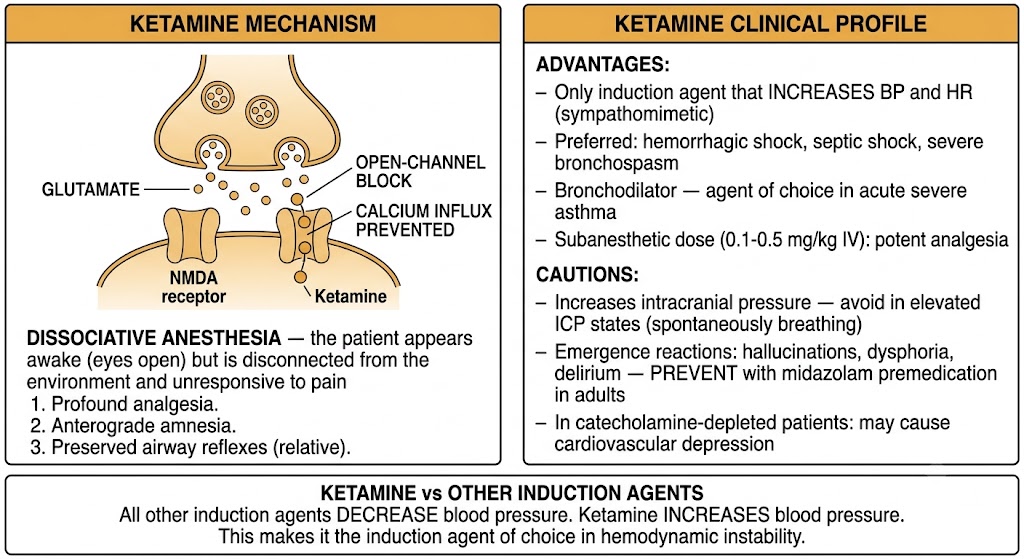
Two-panel diagram of ketamine's mechanism and clinical profile. Left panel shows a synapse with glutamate binding the NMDA receptor, ketamine producing open-channel block and preventing calcium influx, resulting in dissociative anesthesia with profound analgesia, anterograde amnesia, and relatively preserved airway reflexes. Right panel summarizes advantages (only induction agent that increases blood pressure and heart rate, preferred in shock and bronchospasm, bronchodilator, subanesthetic analgesia) and cautions (increases intracranial pressure, emergence reactions prevented by midazolam premedication, cardiovascular depression in catecholamine-depleted patients). Shared rule box states all other induction agents decrease blood pressure while ketamine increases it.
Ketamine: N-methyl-D-aspartate receptor open-channel block mechanism and clinical profile. Figure generated by Gemini AI.
Cardiovascular Effects

Ketamine is the only induction agent that reliably increases rather than decreases blood pressure and heart rate. It stimulates the sympathetic nervous system centrally and causes release of endogenous catecholamines, raising heart rate, systemic vascular resistance, cardiac output, and myocardial oxygen consumption. Mean arterial pressure typically rises 20 to 30% after an induction dose. This sympathomimetic profile makes ketamine the agent of choice for induction in hemodynamically unstable patients — trauma with hemorrhagic shock, septic shock without catecholamine depletion, and patients with severe bronchospasm requiring emergency intubation.

An important exception: in patients who have depleted their catecholamine stores through prolonged severe illness, the sympathomimetic effect may be absent or reversed, and the direct negative inotropic properties of ketamine (masked by sympathetic stimulation in intact patients) may become apparent, causing unexpected cardiovascular depression.

Bronchodilation and Airway Effects

Ketamine is a potent bronchodilator through sympathomimetic mechanisms and possibly direct smooth muscle relaxation. It is the induction agent of choice for emergency airway management in patients with acute severe asthma or status asthmaticus requiring intubation. Pharyngeal and laryngeal tone are better preserved with ketamine than with other induction agents — upper airway reflexes are attenuated but not abolished. This is relative, not absolute protection: aspiration can still occur.

Intracranial Pressure and Emergence Reactions

Ketamine increases cerebral blood flow, cerebral metabolic rate, and intracranial pressure through sympathomimetic and direct cerebral vasodilatory effects. In spontaneously breathing patients with known elevated intracranial pressure, ketamine is traditionally avoided. In mechanically ventilated patients with controlled ventilation (preventing hypercapnia that amplifies cerebral effects), the intracranial pressure increase appears more modest and ketamine may be used for sedation.

Emergence reactions — vivid and often disturbing hallucinations, delirium, feelings of depersonalization — occur in 5 to 30% of adults. They are more common at higher doses, in adults (particularly women), and in those with prior psychiatric history. Benzodiazepine premedication (midazolam 1 to 2 mg intravenously) substantially reduces incidence and should be administered prophylactically when ketamine is used for induction in adults.

Section 5

Thiopental

The ultra-short-acting barbiturate largely replaced by propofol but with unique indications in porphyria-free patients

Thiopental is an ultra-short-acting thiobarbiturate that produces anesthesia through gamma-aminobutyric acid type A receptor potentiation (barbiturate-type — prolonging chloride channel opening time, and at high concentrations directly activating the receptor). Induction occurs in approximately 30 seconds. Offset after a single bolus (5 to 10 minutes) is driven entirely by redistribution from brain to muscle and fat — not by elimination. The elimination half-life is 6 to 12 hours, and repeated dosing leads to progressive fat accumulation and unpredictably prolonged emergence, making thiopental unsuitable for maintenance infusion.

Thiopental is a potent cerebral metabolic suppressant, reducing cerebral metabolic rate and cerebral blood flow down to burst suppression and isoelectric electroencephalography at high doses — a property historically exploited for cerebral protection during neurosurgical procedures and for refractory elevated intracranial pressure.

Thiopental: Key Contraindication and Hazard

Porphyria: thiopental is absolutely contraindicated in patients with acute intermittent porphyria, variegate porphyria, or hereditary coproporphyria. Barbiturates induce delta-aminolevulinic acid synthase, precipitating a potentially life-threatening acute porphyric crisis.

Intraarterial injection: thiopental solution is highly alkaline (pH approximately 10.5). Inadvertent intraarterial injection causes intense burning, arterial spasm, and potentially limb-threatening ischemia requiring immediate treatment.


Section 6

Benzodiazepines as Anesthetic Adjuncts

Midazolam is the perioperative standard; flumazenil provides specific reversal

Mechanism

Benzodiazepines are positive allosteric modulators of the gamma-aminobutyric acid type A receptor, binding at the alpha-gamma subunit interface and increasing the frequency of chloride channel opening in response to gamma-aminobutyric acid. Unlike barbiturates and propofol, they do not directly activate the receptor in the absence of gamma-aminobutyric acid. They cannot reliably produce surgical anesthesia as sole agents at standard doses. Their clinical value in anesthesia is as adjuncts: anxiolysis, anterograde amnesia, anticonvulsant activity, and reduction of volatile agent minimum alveolar concentration.

Midazolam

Midazolam is water-soluble at its formulation pH but becomes lipid-soluble at physiological pH after injection, allowing rapid central nervous system penetration (onset 2 to 3 minutes intravenously). It is metabolized by cytochrome P450 3A4 to 1-hydroxymidazolam, an active metabolite. In renal failure, metabolite accumulation can prolong sedation unexpectedly.

Perioperative uses of midazolam: premedication (1 to 2 mg intravenously — anxiolysis and reliable anterograde amnesia within 5 minutes); co-induction with propofol (reduces propofol induction dose by 25 to 30%); prevention of ketamine emergence reactions (substantially reduces incidence of hallucinations and dysphoria in adults); and supplemental sedation during regional or monitored anesthesia care.

Flumazenil — Reversal Agent

Flumazenil is a competitive benzodiazepine receptor antagonist. Reversal onset is 1 to 2 minutes intravenously. Its duration (30 to 60 minutes) is considerably shorter than most benzodiazepines, so resedation can occur — patients require monitoring for at least 60 to 120 minutes after flumazenil administration. Flumazenil can precipitate acute withdrawal seizures in patients physically dependent on benzodiazepines and should be used with caution in this population.


Section 7

Dexmedetomidine

Arousable sedation without respiratory depression — a unique profile filling clinical niches no other agent can

Mechanism

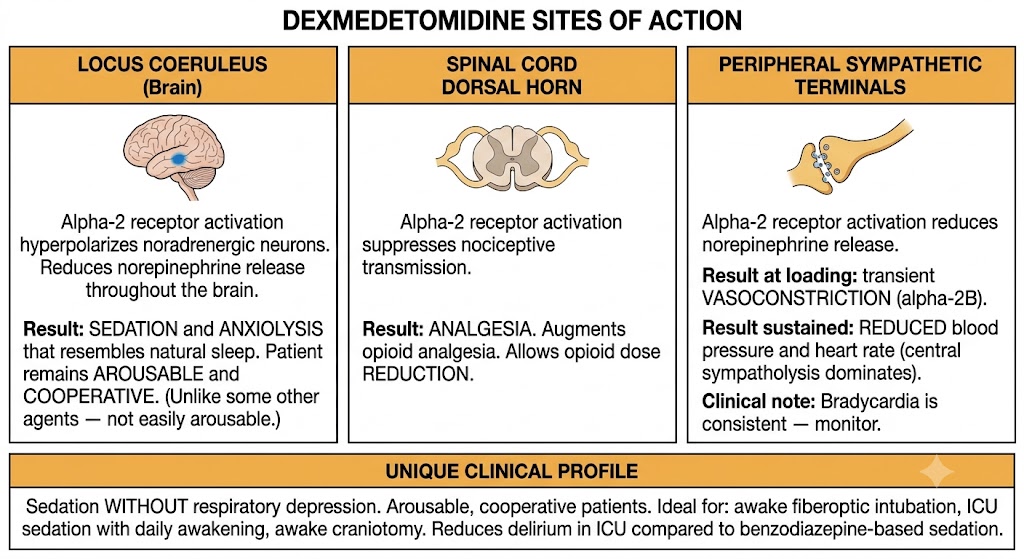
Dexmedetomidine is a highly selective alpha-2 adrenergic receptor agonist. It acts at three principal sites. In the locus coeruleus — the primary noradrenergic nucleus in the brainstem — alpha-2 receptor activation hyperpolarizes neurons and reduces norepinephrine release throughout the brain, producing sedation that resembles natural sleep and from which patients are readily arousable. In the spinal cord dorsal horn, alpha-2 receptor activation suppresses nociceptive transmission, providing analgesia that complements and reduces opioid requirements. At peripheral sympathetic nerve terminals, alpha-2 activation reduces norepinephrine release, contributing to the sympatholytic cardiovascular effects.

This mechanism is entirely distinct from the gamma-aminobutyric acid type A-mediated mechanisms of propofol, benzodiazepines, and barbiturates, which explains why dexmedetomidine-sedated patients — unlike propofol-sedated patients — remain arousable and responsive to verbal commands.

Three-panel diagram of dexmedetomidine sites of action. Left panel shows locus coeruleus: alpha-2 receptor activation hyperpolarizes noradrenergic neurons, reducing norepinephrine release and producing arousable sedation and anxiolysis resembling natural sleep. Center panel shows spinal cord dorsal horn: alpha-2 activation suppresses nociceptive transmission, producing analgesia and allowing opioid dose reduction. Right panel shows peripheral sympathetic terminals: transient vasoconstriction at loading via alpha-2B receptors followed by sustained blood pressure and heart rate reduction from central sympatholysis, with consistent bradycardia requiring monitoring. Shared rule box summarizes the unique clinical profile: sedation without respiratory depression, arousable cooperative patients, ideal for awake intubation and intensive care unit sedation.
Dexmedetomidine: three anatomical sites of action (locus coeruleus, spinal cord dorsal horn, peripheral sympathetic terminals) and clinical profile. Figure generated by Gemini AI.
Pharmacokinetics and Hemodynamics

Dexmedetomidine is administered by intravenous infusion only — not by bolus. A loading infusion over 10 minutes achieves therapeutic concentrations, followed by maintenance infusion. The elimination half-life is approximately 2 hours; hepatic metabolism via glucuronidation produces inactive metabolites.

The cardiovascular profile is biphasic: the loading infusion transiently increases blood pressure through peripheral alpha-2B receptor-mediated vasoconstriction, followed by a sustained reduction in blood pressure and heart rate from central sympatholysis as drug reaches the locus coeruleus. Bradycardia is consistent and can be clinically significant, occasionally requiring atropine, particularly in patients with pre-existing conduction abnormalities.

Clinical Applications

Dexmedetomidine's unique combination of arousable sedation, analgesia, and preserved respiratory drive creates clinical niches that no other agent fills. In the intensive care unit, it is used for light sedation where daily awakening and neurological assessment are priorities; compared to midazolam-based sedation, it reduces delirium incidence and facilitates ventilator weaning. In the operating room, it enables awake procedures requiring patient cooperation — awake fiberoptic intubation in anticipated difficult airways, awake craniotomy, ophthalmic procedures under regional anesthesia. It reduces minimum alveolar concentration of volatile agents and reduces opioid requirements as part of multimodal analgesia protocols.


Section 8

Total Intravenous Anesthesia: Principles

When and why total intravenous anesthesia is preferred over volatile agent maintenance

The Propofol-Remifentanil Combination

Total intravenous anesthesia uses intravenous agents exclusively — no inhalational agents. The standard combination is propofol (hypnotic) plus remifentanil (analgesic). Remifentanil is a mu-opioid receptor agonist with a pharmacokinetic property unique among clinical opioids: its ester linkage makes it susceptible to hydrolysis by nonspecific esterases in plasma and tissues, producing a pharmacologically inactive metabolite. This metabolism is independent of hepatic and renal function, yielding an ultrashort context-sensitive half-time of approximately 3 to 5 minutes regardless of infusion duration. Remifentanil can be infused for 8 hours and will still clear within minutes of stopping — making analgesia precisely titratable and emergence rapid.

Because remifentanil provides no residual postoperative analgesia, transition to longer-acting analgesia must be planned and initiated before or immediately at emergence to prevent an analgesic gap. This is the primary practical challenge of remifentanil-based total intravenous anesthesia.

Indications: When Total Intravenous Anesthesia is Preferred

Absolute Indication

Malignant Hyperthermia Susceptibility

  • All volatile halogenated agents are triggering agents — contraindicated
  • Total intravenous anesthesia with propofol, opioids, and nondepolarizing agents is obligatory
  • Nitrous oxide is permitted

Strong Indication

High Postoperative Nausea and Vomiting Risk

  • Apfel score 3 to 4 (high risk)
  • Propofol-based total intravenous anesthesia reduces postoperative nausea and vomiting by approximately 25 to 30% vs volatile maintenance, independent of antiemetic prophylaxis
  • Combined with multimodal antiemetic strategy

Strong Indication

Motor Evoked Potential Monitoring

  • Volatile agents suppress motor evoked potential amplitude prohibitively at clinical concentrations
  • Total intravenous anesthesia with propofol and remifentanil is required for reliable motor evoked potential monitoring during spine, cerebrovascular, and tumor resection surgery

Strong Indication

One-Lung Ventilation (Thoracic Surgery)

  • Propofol does not inhibit hypoxic pulmonary vasoconstriction
  • Volatile agents inhibit hypoxic pulmonary vasoconstriction dose-dependently, worsening oxygenation during lung isolation
  • Total intravenous anesthesia preferred when preoperative oxygenation is marginal
Depth of Anesthesia Monitoring

The principal challenge of total intravenous anesthesia relative to volatile agents is the absence of end-tidal gas concentration as a real-time surrogate for anesthetic depth. With volatile agents, the end-tidal concentration provides a continuous, reliable pharmacodynamic measure. With total intravenous anesthesia, plasma propofol concentration can be estimated by pharmacokinetic models but cannot be measured at the bedside, and model predictions may diverge 20 to 30% from true concentrations in individual patients. Processed electroencephalography monitors (such as bispectral index) provide an objective measure of cortical activity reflecting anesthetic depth and are considered standard of care for total intravenous anesthesia in many centers, reducing the risk of intraoperative awareness.


Suggested References
Author / Organization Title Source
Miller RD, ed. Miller's Anesthesia, 8th ed. Chapters 24, 25, 26 Philadelphia: Elsevier; 2015
Franks NP Molecular targets underlying general anaesthesia Br J Pharmacol. 2006;147(Suppl 1):S72–S81
Absalom AR, et al. Target-controlled infusion: a mature technology Anesth Analg. 2016;122(1):70–78
Vinclair M, et al. Duration of adrenal inhibition following a single dose of etomidate in critically ill patients Intensive Care Med. 2008;34(4):714–719
Kurdi MS, et al. Ketamine: current applications in anesthesia, pain, and critical care Anesth Essays Res. 2014;8(3):283–290
Dundee JW, Wyant GM Intravenous Anaesthesia, 2nd ed. Edinburgh: Churchill Livingstone; 1988
Olkkola KT, Ahonen J Midazolam and other benzodiazepines Handb Exp Pharmacol. 2008;(182):335–360
Weerink MAS, et al. Clinical pharmacokinetics and pharmacodynamics of dexmedetomidine Clin Pharmacokinet. 2017;56(8):893–913
Avidan MS, et al. Prevention of intraoperative awareness in a high-risk surgical population N Engl J Med. 2011;365(7):591–600
Flood P, Rathmell JP, Shafer SL, eds. Stoelting's Pharmacology and Physiology in Anesthetic Practice, 5th ed. Philadelphia: Wolters Kluwer; 2015