CHAPTER 16  ·  ANTIPSYCHOTIC DRUGS

Section 1

The Neurobiological Basis of Psychosis

The dopamine hypothesis: why dopamine dysregulation remains the central framework for understanding antipsychotic drug action

Antipsychotic drugs share one fundamental pharmacological property: they all reduce dopamine activity in the brain. Understanding why this works requires understanding the dopamine hypothesis of schizophrenia, which explains how abnormal dopamine signaling in different brain regions produces the distinct symptom dimensions of psychotic illness.

The Core Hypothesis

The dopamine hypothesis proposes that schizophrenia results from dysregulated dopamine neurotransmission, and that antipsychotics work by correcting this dysregulation through dopamine receptor blockade. This hypothesis has remained productive for over six decades because it explains both why antipsychotics work and why they produce their characteristic side effects.

Two early observations gave rise to the hypothesis. Drugs that reduce dopamine activity — including the first antipsychotic, chlorpromazine, and the antihypertensive drug reserpine — were found to reduce psychotic symptoms. Conversely, drugs that increase dopamine activity, such as amphetamine, can produce paranoid psychosis in otherwise healthy individuals and worsen symptoms in patients with schizophrenia. These convergent findings pointed to excessive dopamine activity as a driver of psychosis.

The Revised Picture: Two Concurrent Abnormalities

The modern understanding recognizes that dopamine dysregulation in schizophrenia is not simply a matter of too much dopamine everywhere. Instead, there are two simultaneous and anatomically distinct abnormalities that together produce the full clinical picture.

In the mesolimbic pathway — the dopamine circuit projecting from the midbrain to limbic structures involved in reward and salience — dopamine activity is increased. This mesolimbic hyperactivity produces the positive symptoms of schizophrenia: hallucinations, delusions, and disorganized thinking. Blocking dopamine receptors in this pathway is the mechanism by which antipsychotics suppress positive symptoms.

In the mesocortical pathway — the dopamine circuit projecting from the midbrain to the prefrontal cortex — dopamine activity is reduced. This mesocortical hypoactivity produces the negative symptoms and cognitive deficits of schizophrenia: blunted affect, social withdrawal, reduced motivation, and impaired working memory. Because this pathway already has too little dopamine activity, blocking dopamine receptors there with antipsychotics does not help and can actually worsen these symptoms.

Mechanism Summary

All antipsychotics block dopamine D2 receptors. D2 blockade in the mesolimbic pathway reduces positive symptoms. The same D2 blockade in the mesocortical pathway can worsen negative symptoms and cognitive function. D2 blockade in the nigrostriatal pathway produces motor side effects. D2 blockade in the tuberoinfundibular pathway elevates prolactin. One drug, four pathways, four different consequences — understanding this anatomical specificity is the key to predicting both the benefits and the adverse effects of antipsychotic therapy.

Why This Matters for Drug Selection

The central pharmacological challenge in antipsychotic drug development has been designing agents that suppress mesolimbic dopamine excess without worsening mesocortical dopamine deficiency and without producing intolerable motor side effects from nigrostriatal blockade. First-generation antipsychotics block dopamine receptors throughout the brain indiscriminately, which is why they suppress positive symptoms but often worsen negative symptoms and reliably produce motor side effects. Second-generation antipsychotics attempt to address this limitation through additional receptor interactions, particularly serotonin blockade, that partially spare the mesocortical and nigrostriatal pathways. These distinctions are the subject of later modules in this chapter.
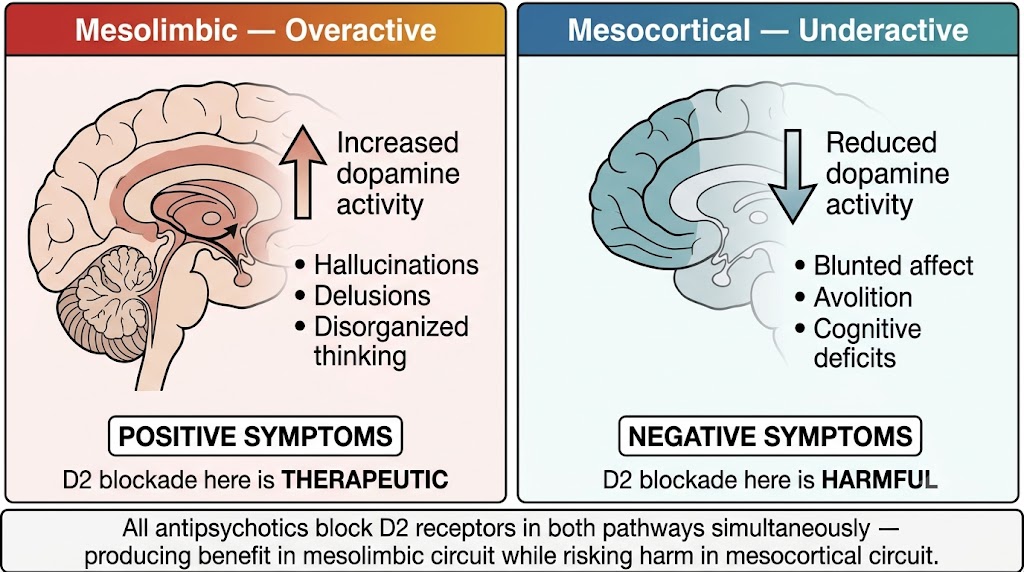
Two-panel diagram contrasting the mesolimbic pathway (overactive in schizophrenia, D2 blockade is therapeutic, reduces positive symptoms including hallucinations and delusions) with the mesocortical pathway (underactive, D2 blockade is harmful, worsens negative symptoms including blunted affect, avolition, and cognitive deficits), with a shared rule box stating antipsychotics block both pathways simultaneously.
The dopamine hypothesis: concurrent mesolimbic overactivity (positive symptoms) and mesocortical underactivity (negative symptoms) explain why antipsychotic D2 blockade treats one dimension while potentially worsening the other. Figure generated by Gemini AI.

Section 2

Dopamine Receptor Subtypes

The D1 and D2 receptor families: distribution, signaling, and pharmacological relevance

Five dopamine receptor subtypes — designated D1 through D5 — have been identified in the brain. They fall into two families based on how they signal inside the neuron. For antipsychotic pharmacology, the D2 receptor is by far the most important, but understanding the D1 family provides essential context for why negative symptoms and cognitive deficits are so difficult to treat.

The D1-Like Family: D1 and D5

The D1-like family includes the D1 and D5 receptors. These receptors couple to stimulatory G proteins (Gs), which activate adenylyl cyclase and increase cyclic adenosine monophosphate (cyclic AMP) inside the cell. The net effect of D1 family activation is generally excitatory — it increases the activity of the neurons that express these receptors.

D1 receptors are the most abundant dopamine receptors in the brain and are expressed at high density in the prefrontal cortex, striatum, and nucleus accumbens. In the prefrontal cortex, D1 receptor stimulation supports working memory by maintaining the persistent neuronal firing that underlies short-term information storage. The mesocortical dopamine deficiency in schizophrenia reduces D1 stimulation in the prefrontal cortex, which is one reason working memory and executive function are impaired. No currently approved antipsychotic directly targets D1 receptors.

The D2-Like Family: D2, D3, and D4

The D2-like family includes the D2, D3, and D4 receptors. These receptors couple to inhibitory G proteins (Gi), which inhibit adenylyl cyclase and decrease cyclic AMP. Their activation generally reduces the activity of the neurons that express them.

The D2 receptor is the primary target of all currently approved antipsychotics. It is expressed at high density in the striatum, nucleus accumbens, pituitary gland, and to a lesser degree in the prefrontal cortex. Every drug capable of producing antipsychotic effect achieves this by occupying D2 receptors — whether it blocks them completely (as first-generation and most second-generation antipsychotics do) or activates them only partially (as partial agonists like aripiprazole do). The D2 receptor is therefore the pharmacological anchor of the entire antipsychotic drug class.

The D3 receptor is concentrated in limbic regions, particularly the nucleus accumbens. Its limbic distribution makes it an attractive target for addressing motivational deficits in negative symptoms with reduced motor side effects, an approach exploited by cariprazine, which preferentially binds D3 over D2. The D4 receptor is found at lower density in the frontal cortex and limbic structures. Clozapine has notably higher D4 affinity relative to D2 compared with other antipsychotics, a property that may contribute to its exceptional efficacy in treatment-resistant schizophrenia, though the exact significance of D4 blockade remains debated.

D1-Like Family

D1 and D5 Receptors

  • Couple to Gs protein — increase cyclic AMP
  • D1: abundant in striatum and prefrontal cortex
  • D1 supports working memory in prefrontal cortex
  • D1 hypostimulation contributes to cognitive deficits in schizophrenia
  • Not directly targeted by current antipsychotics

D2-Like Family

D2, D3, and D4 Receptors

  • Couple to Gi protein — decrease cyclic AMP
  • D2: primary target of all antipsychotics
  • D2: high density in striatum, nucleus accumbens, pituitary
  • D3: limbic predominance; targeted by cariprazine
  • D4: frontal cortex and limbic; high affinity for clozapine

Section 3

The Four Dopaminergic Pathways

Origin, projection, function, and the clinical consequence of antipsychotic D2 blockade in each circuit

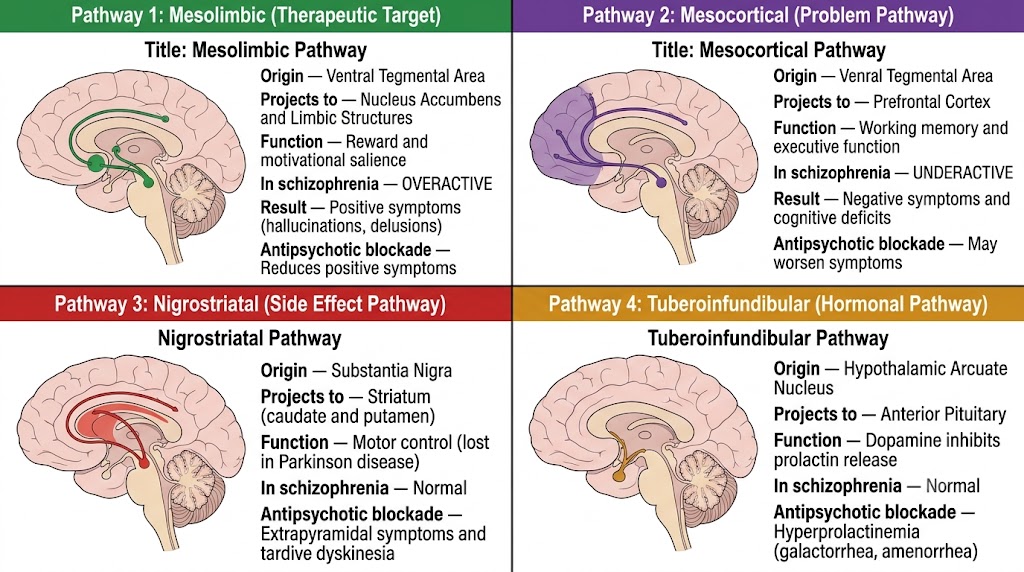
Dopamine does not act uniformly throughout the brain. It operates through four distinct projection systems, each originating in the midbrain and projecting to different targets. Because antipsychotics block dopamine receptors throughout the brain rather than selectively in one pathway, every pathway is affected simultaneously — producing both the desired therapeutic effects and the characteristic adverse effects of the drug class.

Two-by-two grid diagram showing the four major dopamine pathways: mesolimbic (overactive in schizophrenia, therapeutic target), mesocortical (underactive, negative symptoms), nigrostriatal (motor side effects), and tuberoinfundibular (prolactin regulation), each with origin, projection, function, and consequence of antipsychotic blockade.
The four major dopaminergic pathways and the clinical consequence of antipsychotic D2 receptor blockade in each circuit. Figure generated by Gemini AI.

Pathway 1 — Therapeutic Target

Mesolimbic Pathway

  • Origin: Ventral tegmental area (midbrain)
  • Projects to: Nucleus accumbens, amygdala, hippocampus
  • Function: Reward processing, motivational salience
  • In schizophrenia: Dopamine overactivity — produces positive symptoms (hallucinations, delusions)
  • Antipsychotic blockade here: Reduces positive symptoms — the desired therapeutic effect

Pathway 2 — Problem Pathway

Mesocortical Pathway

  • Origin: Ventral tegmental area (midbrain)
  • Projects to: Prefrontal cortex and association cortex
  • Function: Working memory, executive function, motivation
  • In schizophrenia: Dopamine underactivity — produces negative symptoms and cognitive deficits
  • Antipsychotic blockade here: Worsens an already deficient pathway — can worsen negative symptoms

Pathway 3 — Side Effect Pathway

Nigrostriatal Pathway

  • Origin: Substantia nigra pars compacta
  • Projects to: Striatum (caudate nucleus and putamen)
  • Function: Motor control — this is the pathway lost in Parkinson disease
  • In schizophrenia: Normal — not part of the disease process
  • Antipsychotic blockade here: Produces extrapyramidal symptoms — drug-induced Parkinson-like motor effects, dystonia, akathisia, tardive dyskinesia

Pathway 4 — Hormonal Pathway

Tuberoinfundibular Pathway

  • Origin: Hypothalamic arcuate nucleus
  • Projects to: Anterior pituitary via the portal circulation
  • Function: Dopamine tonically inhibits prolactin release from pituitary lactotroph cells
  • In schizophrenia: Normal — not part of the disease process
  • Antipsychotic blockade here: Removes dopamine inhibition of prolactin — causes elevated prolactin (hyperprolactinemia), leading to galactorrhea, amenorrhea, and sexual dysfunction
High-Yield: The Four-Pathway Framework

Every antipsychotic adverse effect maps to one of these pathways. Extrapyramidal symptoms come from nigrostriatal blockade. Hyperprolactinemia comes from tuberoinfundibular blockade. Worsening of negative symptoms comes from mesocortical blockade. Only mesolimbic blockade is therapeutically beneficial. Because current antipsychotics cannot selectively block just the mesolimbic pathway, all four consequences occur simultaneously to varying degrees with every agent.


Section 4

Clinical Dimensions of Schizophrenia

Positive, negative, and cognitive symptoms: neurobiological substrates and differential pharmacological responsiveness

Schizophrenia produces three clinically distinct symptom dimensions, each with its own neurobiological substrate and its own response — or lack of response — to antipsychotic treatment. Understanding these dimensions as separate targets with different pharmacological profiles is essential for setting realistic expectations about what antipsychotics can and cannot accomplish.

Positive Symptoms

Positive symptoms are distortions or excesses of normal mental function. The term "positive" refers to the presence of experiences that should not be there — not to anything favorable about them. Positive symptoms include hallucinations (most commonly auditory — hearing voices), delusions (fixed false beliefs, often paranoid in character), disorganized thinking, and bizarre behavior.

Positive symptoms are driven by mesolimbic dopamine excess and are the dimension most responsive to antipsychotic treatment. Most patients with schizophrenia achieve substantial reduction in positive symptoms with adequate antipsychotic therapy. When positive symptoms persist despite two adequate antipsychotic trials at adequate doses — a condition affecting approximately 20 to 30 percent of patients — the patient meets criteria for treatment-resistant schizophrenia, for which clozapine has the strongest evidence base.

Negative Symptoms

Negative symptoms are reductions in or absences of normal mental function. They include blunted affect (reduced emotional expressivity), alogia (reduced verbal output and spontaneity), avolition (reduced motivation and self-directed activity), anhedonia (reduced capacity for pleasure), and asociality (reduced interest in social interaction). These five domains together produce the characteristic withdrawal and motivational poverty seen in chronic schizophrenia.

Negative symptoms arise from mesocortical dopamine deficiency and are the dimension most responsible for long-term functional disability. A patient whose positive symptoms are well controlled but who retains severe avolition and anhedonia may be unable to work, maintain relationships, or live independently. Negative symptoms respond poorly to standard antipsychotic treatment — and first-generation antipsychotics can actually worsen them by further suppressing an already deficient mesocortical dopamine pathway.

An important distinction: negative symptoms can be primary (intrinsic to the illness, reflecting mesocortical dopamine deficiency) or secondary (caused by drug-induced motor side effects that mimic avolition and blunted affect, by depression, or by excessive sedation from medication). Secondary negative symptoms may improve by addressing their underlying cause — reducing extrapyramidal side effects, treating depression, or reducing medication dose.

Cognitive Symptoms

Cognitive deficits in schizophrenia affect attention, working memory, processing speed, verbal learning, and executive function. They are present before the first psychotic episode, worsen at illness onset, and are strong independent predictors of functional outcome — often more predictive than the severity of positive or negative symptoms.

No currently approved antipsychotic has demonstrated robust improvement in cognitive function beyond what can be explained by reducing positive symptom burden. Anticholinergic medications used to manage drug-induced motor side effects actually worsen cognitive function further, which is one of the reasons minimizing anticholinergic drug exposure in schizophrenia is clinically important.

The Treatment Gap

Antipsychotics are effective for positive symptoms. They are largely ineffective — and may be harmful — for negative symptoms and cognitive deficits. This treatment gap explains why schizophrenia remains a condition of high disability despite adequate pharmacological management of psychotic episodes. The development of agents that address negative and cognitive symptoms without worsening them is the central unmet need in schizophrenia pharmacology.


Section 5

Receptor Binding Beyond Dopamine

Serotonin, histamine, muscarinic, and adrenergic receptor interactions and their clinical consequences

Antipsychotics are not selective dopamine blockers. Every antipsychotic binds to a constellation of receptors in addition to D2, and the full receptor binding profile of each agent determines its side effect pattern and, in the case of second-generation antipsychotics, its reduced tendency to cause motor side effects. Knowing which receptor causes which clinical consequence is essential for predicting and managing adverse effects.

Serotonin 5-HT2A Receptor Blockade — The Basis of Atypicality

Serotonin normally suppresses dopamine release in the prefrontal cortex and striatum through inhibitory interneurons. When an antipsychotic also blocks serotonin 5-HT2A receptors, it removes this inhibition and partially restores dopamine release in these areas. In the striatum, this restoration of dopamine tone partially counteracts the motor side effects that would otherwise result from D2 blockade alone. In the prefrontal cortex, this effect may partially improve mesocortical dopamine activity.

This is why second-generation antipsychotics, which combine serotonin 5-HT2A blockade with D2 blockade, produce fewer extrapyramidal symptoms than first-generation antipsychotics at comparable antipsychotic doses. The higher the ratio of 5-HT2A blockade to D2 blockade, the lower the extrapyramidal symptom burden — this is the pharmacological definition of "atypicality."

Other Receptor Interactions and Their Clinical Effects

Three other receptor classes account for most of the remaining adverse effects of antipsychotic drugs, and each maps cleanly to a predictable clinical consequence.

Histamine H1 Blockade

Sedation and Weight Gain

  • Blocks histamine H1 receptors in the central nervous system
  • Produces sedation and drowsiness
  • Stimulates appetite through hypothalamic effects — major driver of weight gain
  • Highest H1 affinity: clozapine, olanzapine, quetiapine
  • Lowest H1 affinity: aripiprazole, ziprasidone, lurasidone

Muscarinic M1 Blockade

Anticholinergic Effects

  • Blocks muscarinic acetylcholine receptors
  • Peripheral effects: dry mouth, urinary retention, constipation, blurred vision, tachycardia
  • Central effects: cognitive impairment, sedation
  • Highest M1 burden: clozapine, thioridazine, chlorpromazine
  • Important: anticholinergic agents added to treat motor side effects add to this burden

Alpha-1 Adrenergic Blockade

Orthostatic Hypotension

  • Blocks alpha-1 adrenergic receptors on vascular smooth muscle
  • Impairs the vasoconstriction response when standing — blood pressure drops
  • Produces orthostatic hypotension, reflex tachycardia, dizziness, and risk of falls
  • Highest alpha-1 burden: clozapine, chlorpromazine, low-potency first-generation antipsychotics
  • Managed with gradual dose titration; especially important in elderly patients

Section 6

Classification of Antipsychotic Agents

First-generation, second-generation, and partial agonists: the pharmacological basis of each category

Antipsychotic drugs are divided into three mechanistic categories. Understanding the pharmacological basis of each category — not just the names — allows you to predict the adverse effect profile of any agent based on its class membership and then refine that prediction based on its individual receptor binding profile.

First-Generation (Typical) Antipsychotics

First-generation antipsychotics produce antipsychotic effect through potent, relatively selective D2 receptor blockade. Because they have limited activity at other receptors, their full D2 blocking activity reaches all four dopaminergic pathways without buffering — which means effective suppression of positive symptoms but a high rate of extrapyramidal symptoms, tardive dyskinesia, and hyperprolactinemia.

Within the first-generation class, agents are categorized by potency — which in this context means the milligram dose required to achieve a therapeutic level of D2 occupancy, not clinical superiority. High-potency agents such as haloperidol and fluphenazine achieve D2 blockade at doses of 2 to 20 milligrams per day and carry the highest risk of extrapyramidal symptoms because of their tight, selective D2 binding. Low-potency agents such as chlorpromazine and thioridazine require doses of 200 to 1000 milligrams per day and carry lower extrapyramidal symptom risk — because their anticholinergic and antihistaminergic activity partially offsets the motor consequences of D2 blockade — but produce more sedation, more anticholinergic effects, and more orthostatic hypotension.

Second-Generation (Atypical) Antipsychotics

Second-generation antipsychotics combine D2 receptor blockade with additional blockade of serotonin 5-HT2A receptors. This serotonin-dopamine antagonism partially restores dopamine tone in the nigrostriatal and mesocortical pathways, reducing extrapyramidal symptom risk and potentially offering some advantage for negative symptoms. The category is defined not by superior antipsychotic efficacy — they are not more effective than first-generation agents at reducing positive symptoms — but by a lower motor side effect burden at clinically effective doses.

The trade-off for this reduced motor burden is a different adverse effect profile: second-generation antipsychotics as a class produce more weight gain, glucose dysregulation, and dyslipidemia than first-generation agents, effects that are most pronounced with clozapine and olanzapine. Key second-generation agents include clozapine, olanzapine, quetiapine, risperidone, paliperidone, ziprasidone, lurasidone, and asenapine. Their individual profiles are covered in Modules 3 and 4.

Partial D2 Agonists

A third mechanistic category comprises the partial D2 agonists — aripiprazole, brexpiprazole, and cariprazine. Rather than blocking the D2 receptor completely, these drugs activate it partially. In circuits where dopamine is excessive (mesolimbic pathway in psychosis), the partial agonist competes with dopamine and produces a net reduction in receptor activation — a functional antagonist effect that reduces positive symptoms. In circuits where dopamine is deficient (mesocortical pathway), the partial agonist provides some residual receptor activation that a full antagonist would eliminate entirely.

This mechanism produces a favorable profile: low extrapyramidal symptom risk, minimal prolactin elevation, and — particularly for cariprazine — some benefit for negative symptoms. The characteristic adverse effect of this class is akathisia (a distressing sense of inner restlessness and inability to stay still), which occurs at higher rates with partial agonists than with most second-generation antipsychotics.

Classification at a Glance

First-generation antipsychotics (haloperidol, chlorpromazine, fluphenazine): potent D2 blockade — effective for positive symptoms, high extrapyramidal symptom and tardive dyskinesia risk, low metabolic risk.

Second-generation antipsychotics (clozapine, olanzapine, quetiapine, risperidone, lurasidone, ziprasidone): D2 plus 5-HT2A blockade — lower extrapyramidal symptom risk, higher metabolic risk (especially clozapine and olanzapine).

Partial D2 agonists (aripiprazole, brexpiprazole, cariprazine): partial D2 activation — minimal extrapyramidal symptoms, minimal prolactin elevation, minimal metabolic effects, akathisia as the primary adverse effect.


Suggested References
Author / Organization Title Source
Stahl SM Stahl's Essential Psychopharmacology: Neuroscientific Basis and Practical Applications. 4th ed. Cambridge University Press; 2013:129–237
Seeman P, Lee T, Chau-Wong M, Wong K Antipsychotic drug doses and neuroleptic/dopamine receptors Nature. 1976;261(5562):717–719
Howes OD, Kapur S The dopamine hypothesis of schizophrenia: version III — the final common pathway Schizophr Bull. 2009;35(3):549–562
Javitt DC, Zukin SR Recent advances in the phencyclidine model of schizophrenia Am J Psychiatry. 1991;148(10):1301–1308
Goldman-Rakic PS The cortical dopamine system: role in memory and cognition Adv Pharmacol. 1998;42:707–711
Tandon R, Nasrallah HA, Keshavan MS Schizophrenia, "just the facts" 4. Clinical features and conceptualization Schizophr Res. 2009;110(1–3):1–23
Kane J, Honigfeld G, Singer J, Meltzer H Clozapine for the treatment-resistant schizophrenic: a double-blind comparison with chlorpromazine Arch Gen Psychiatry. 1988;45(9):789–796
Nemeth G, Laszlovszky I, Czobor P, et al Cariprazine versus risperidone monotherapy for treatment of predominant negative symptoms in patients with schizophrenia Lancet. 2017;389(10074):1103–1113
Cella M, Roberts S, Pillny M, et al Psychosocial and behavioural interventions for the negative symptoms of schizophrenia: a systematic review of efficacy meta-analyses Br J Psychiatry. 2023;223(1):8–17
Lieberman JA, Stroup TS, McEvoy JP, et al Effectiveness of antipsychotic drugs in patients with chronic schizophrenia N Engl J Med. 2005;353(12):1209–1223
Kapur S, Zipursky R, Jones C, Remington G, Houle S Relationship between dopamine D2 occupancy, clinical response, and side effects: a double-blind PET study of first-episode schizophrenia Am J Psychiatry. 2000;157(4):514–520
Smart SE, Kepinska AP, Murray RM, MacCabe JH Predictors of treatment resistant schizophrenia: a systematic review of prospective observational studies Psychol Med. 2021;51(1):44–53