Introduction to Medical Pharmacology
Heparins and Indirect Thrombin Inhibitors
Chapter 39 · Module 2 of 6Section 1
Mechanism of action, pharmacokinetics, protein binding, and clinical pharmacology
Unfractionated heparin is a naturally occurring, highly sulfated glycosaminoglycan extracted from porcine intestinal mucosa, with a molecular weight ranging from 3,000 to 30,000 daltons. Its anticoagulant activity is entirely indirect, dependent on the plasma protein antithrombin III, and its highly heterogeneous molecular composition produces nonlinear pharmacokinetics that necessitate laboratory monitoring. Despite these limitations, unfractionated heparin remains the anticoagulant of choice in specific high-acuity clinical settings because of its short half-life, ready reversibility with protamine sulfate, and safety in severe renal impairment.
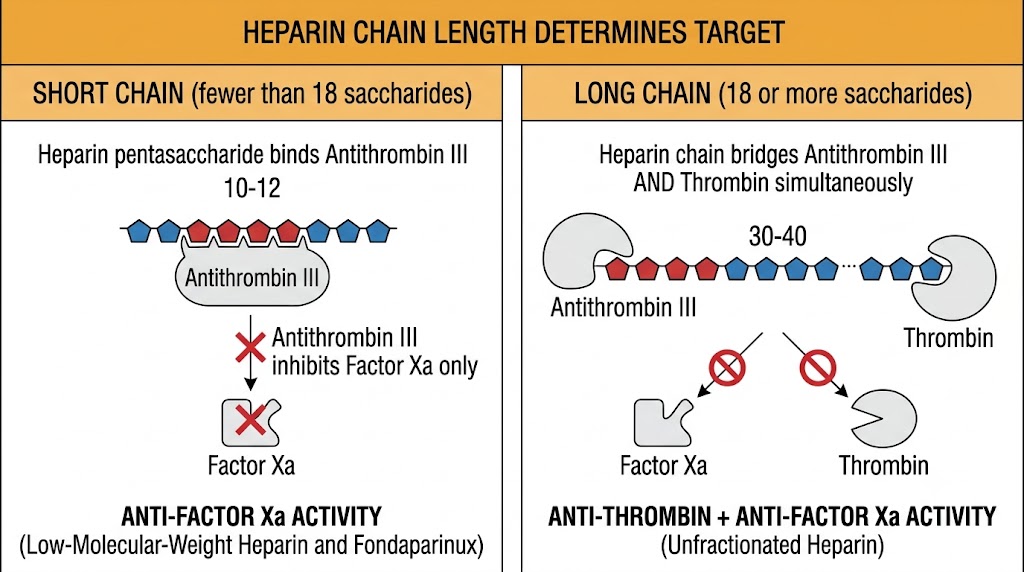
The anticoagulant activity of unfractionated heparin resides in a specific pentasaccharide sequence present in approximately one-third of heparin molecules. This pentasaccharide binds to antithrombin III, inducing a conformational change that exposes its reactive site loop and converts antithrombin III from a slow, progressive inhibitor to a rapid inhibitor of coagulation serine proteases. The accelerated antithrombin III inhibits thrombin (factor IIa) and factor Xa with roughly equal potency, as well as factors IXa, XIa, and XIIa to a lesser degree.
For thrombin inhibition, heparin must simultaneously bind both antithrombin III and thrombin, forming a ternary complex. This bridging requirement means that only heparin chains of at least 18 saccharide units can inhibit thrombin. For factor Xa inhibition, the pentasaccharide sequence alone is sufficient without bridging — which is why shorter heparin fragments retain anti-factor Xa activity but not anti-thrombin activity. This molecular length distinction is the pharmacological basis for the difference between unfractionated heparin and the low-molecular-weight heparins.
Unfractionated heparin pharmacokinetics are governed by two simultaneous clearance mechanisms: a rapid, saturable, dose-dependent mechanism mediated by binding to endothelial cells and macrophages, and a slower, first-order renal clearance mechanism. At low doses, the saturable cellular clearance pathway dominates, producing a short apparent half-life of approximately 30 minutes. At higher doses, the cellular pathway saturates and the half-life extends to 60 to 90 minutes. This dose-dependent nonlinearity means that doubling the dose produces a greater-than-proportional increase in anticoagulant effect — making weight-based dosing with activated partial thromboplastin time-guided adjustment mandatory for therapeutic anticoagulation.
Unfractionated heparin binds extensively and non-specifically to a large number of plasma proteins beyond antithrombin III, including platelet factor 4, fibronectin, vitronectin, and acute-phase reactant proteins. Only the fraction not bound to these non-antithrombin III proteins is pharmacologically active, and this fraction varies substantially between patients — particularly in inflammatory states where elevated platelet factor 4 (released from activated platelets) reduces heparin availability. This nonspecific protein binding underlies the well-documented interpatient variability in activated partial thromboplastin time response to fixed heparin doses and the phenomenon of heparin resistance.
Unfractionated heparin is administered intravenously for therapeutic anticoagulation in acute settings, or subcutaneously for prophylaxis. Intravenous unfractionated heparin provides immediate anticoagulation; subcutaneous unfractionated heparin has a delayed onset of one to two hours and reduced bioavailability at prophylactic doses. The standard approach to therapeutic intravenous anticoagulation uses a weight-based nomogram: a bolus of 80 units per kilogram followed by an infusion of 18 units per kilogram per hour, with subsequent activated partial thromboplastin time-guided adjustment to a target of 60 to 100 seconds. Unfractionated heparin requires no dose adjustment for renal impairment, making it the preferred anticoagulant in patients with severe acute kidney injury where low-molecular-weight heparins would accumulate.
Unfractionated Heparin — Key Clinical Points
Mechanism: antithrombin III-dependent; equal anti-thrombin and anti-factor Xa activity (1:1); requires chains of at least 18 saccharide units for thrombin inhibition. Monitoring: activated partial thromboplastin time 60 to 100 seconds (reagent-dependent) or anti-factor Xa 0.3 to 0.7 units per milliliter; check every 6 hours until two consecutive therapeutic values. No renal dose adjustment required. Reversal: protamine sulfate 1 mg per 100 units unfractionated heparin given in last 2 to 4 hours; maximum 50 mg; slow intravenous infusion to avoid hypotension.
Section 2
Comparative pharmacology, renal dosing, predictable kinetics, and fondaparinux
Low-molecular-weight heparins are produced by controlled depolymerization of unfractionated heparin, yielding fragments with a mean molecular weight of 4,000 to 6,000 daltons. This smaller size dramatically alters the pharmacological profile: the anti-factor Xa to anti-thrombin activity ratio shifts from 1:1 for unfractionated heparin to 2:1 to 4:1 for most low-molecular-weight heparins, protein binding is substantially reduced, and the pharmacokinetic profile becomes linear and predictable. These properties enable fixed weight-based dosing, once- or twice-daily subcutaneous administration, and the elimination of routine laboratory monitoring for most patients.
Low-molecular-weight heparin molecules containing the critical pentasaccharide sequence retain the ability to accelerate antithrombin III inhibition of factor Xa, because factor Xa inhibition requires only the pentasaccharide-antithrombin III complex without bridging. However, because most low-molecular-weight heparin chains are fewer than 18 saccharide units in length, most molecules are too short to simultaneously bridge antithrombin III and thrombin. The result is preferential anti-factor Xa activity with reduced anti-thrombin activity.
The specific anti-factor Xa to anti-thrombin ratio differs between preparations: enoxaparin approximately 3.8:1, dalteparin approximately 2.7:1, tinzaparin approximately 1.9:1. Because clearance is primarily renal through glomerular filtration, the pharmacokinetics are linear — doubling the dose produces a proportional doubling of anticoagulant effect — and subcutaneous bioavailability exceeds 90%, enabling reliable fixed dosing without intravenous administration.
Because low-molecular-weight heparin clearance is primarily renal, accumulation occurs in patients with reduced creatinine clearance. Enoxaparin, the most widely used agent, requires dose reduction for therapeutic anticoagulation when creatinine clearance falls below 30 milliliters per minute: the twice-daily dose of 1 mg per kilogram every 12 hours is reduced to 1 mg per kilogram every 24 hours. Anti-factor Xa monitoring with a target peak level (drawn 4 hours after subcutaneous injection) of 0.6 to 1.0 units per milliliter for twice-daily dosing and 1.0 to 2.0 units per milliliter for once-daily dosing is recommended when pharmacokinetics may be altered — specifically in creatinine clearance below 30 milliliters per minute, weight above 100 kilograms or below 50 kilograms, and pregnancy.
Fondaparinux is a synthetic pentasaccharide representing the minimal structural unit of heparin required for antithrombin III binding. As a pure pentasaccharide, it selectively accelerates antithrombin III inhibition of factor Xa only, with no ability to bridge antithrombin III to thrombin and therefore no direct thrombin inhibition. Fondaparinux is administered subcutaneously once daily with 100% bioavailability and a half-life of 17 to 21 hours.
Because fondaparinux is entirely synthetic and does not contain the polymer sequences responsible for platelet factor 4 immune complex formation, it does not cause heparin-induced thrombocytopenia and is a therapeutic option in patients with a history of heparin-induced thrombocytopenia requiring parenteral anticoagulation. Clearance is entirely renal, and fondaparinux is contraindicated when creatinine clearance is below 30 milliliters per minute. Protamine sulfate does not neutralize fondaparinux and no approved reversal agent exists; bleeding management relies on discontinuation and supportive measures.
Unfractionated
Unfractionated Heparin
Depolymerized Fragments
Low-Molecular-Weight Heparins
Synthetic Pentasaccharide
Fondaparinux
Section 3
Pathophysiology, the 4T score, laboratory diagnosis, and the paradox of thrombocytopenia with thrombosis
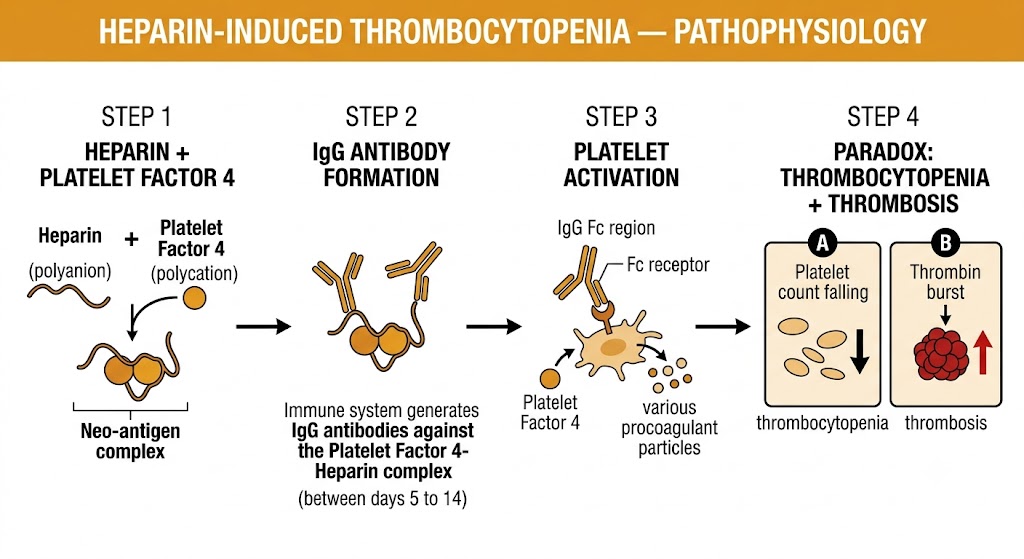
Heparin-induced thrombocytopenia is one of the most clinically dangerous drug-induced immune reactions in medicine. Its defining paradox is that an anticoagulant causes a profoundly prothrombotic state: the same antibodies that deplete platelets through immune-mediated clearance simultaneously activate them, generating a thrombin burst that can produce catastrophic arterial and venous thrombosis. The key clinical skill is recognizing heparin-induced thrombocytopenia promptly and acting on that recognition immediately.
Two distinct syndromes carry the name heparin-induced thrombocytopenia. Type I (heparin-associated thrombocytopenia) is a non-immune, direct pharmacological effect of heparin on platelets, occurring in up to 10% of patients receiving unfractionated heparin within the first one to two days. It produces a mild, transient platelet count decrease that resolves spontaneously without any change in therapy and carries no thrombosis risk. No specific intervention is required.
Type II heparin-induced thrombocytopenia is a distinct immune-mediated syndrome caused by antibodies to a complex of platelet factor 4 and heparin. It occurs in 0.1 to 5% of heparin-exposed patients (higher incidence with unfractionated heparin than low-molecular-weight heparin; lowest with fondaparinux), typically develops 5 to 14 days after heparin initiation, and is associated with a 20 to 50% risk of thrombosis. All subsequent use of the term heparin-induced thrombocytopenia in this module refers to Type II.
Heparin, a polyanion, forms an electrostatic complex with platelet factor 4, a polycation released from platelet alpha-granules. This complex creates a neo-antigen recognized as foreign by the immune system. In susceptible individuals, immunoglobulin G antibodies against the platelet factor 4-heparin complex are generated within 5 to 14 days of exposure. These antibodies have two pathological consequences: the immunoglobulin G Fc region cross-links Fc-gamma receptor IIA on platelet surfaces, activating platelets and triggering further platelet factor 4 release and procoagulant microparticle generation; simultaneously the immune complex binds monocytes and endothelial cells, generating tissue factor expression and amplifying thrombin generation. The result is a massively prothrombotic state despite thrombocytopenia — explaining the counterintuitive syndrome of falling platelet count with increasing clot formation. Even heparin catheter flushes at doses of 10 to 100 units are sufficient to sustain the prothrombotic process once antibodies are present.
The classic presentation is a platelet count fall of 50% or more from baseline occurring 5 to 14 days after heparin initiation, in association with thrombosis or thromboembolic complications. Both venous thrombosis (deep vein thrombosis, pulmonary embolism) and arterial thrombosis (limb ischemia, stroke) occur; venous is more common. Limb gangrene in the setting of a falling platelet count on heparin is a medical emergency.
The 4T score is the validated pretest probability tool for heparin-induced thrombocytopenia, assigning points across four categories: Thrombocytopenia (magnitude and pattern of platelet fall), Timing (onset relative to heparin exposure), Thrombosis (presence and type), and other causes of Thrombocytopenia (absence of alternative explanations). A score of 0 to 3 indicates low probability, with a negative predictive value exceeding 99%, effectively ruling out heparin-induced thrombocytopenia and permitting continued heparin use. A score of 4 to 5 indicates intermediate probability — heparin should be discontinued and laboratory testing initiated. A score of 6 to 8 indicates high probability — heparin must be stopped immediately and empirical alternative anticoagulation initiated before laboratory results are available.
Laboratory confirmation requires either an immunological or a functional assay. The enzyme-linked immunosorbent assay for anti-platelet factor 4-heparin immunoglobulin G antibodies is highly sensitive (greater than 95%) but has lower specificity, as platelet factor 4-heparin antibodies can be generated in up to 50% of patients after cardiac surgery without causing clinical heparin-induced thrombocytopenia. The serotonin release assay, considered the gold standard functional test, measures whether patient plasma activates normal donor platelets in the presence of therapeutic concentrations of heparin; a positive result (greater than 20% serotonin release) confirms platelet-activating antibodies with specificity exceeding 95%. Because the serotonin release assay is technically demanding and not widely available, the enzyme-linked immunosorbent assay is the practical first-line test.
4T Score — Interpretation
Score 0 to 3 (low probability): negative predictive value greater than 99%; continue heparin with monitoring. Score 4 to 5 (intermediate): discontinue heparin; send immunological assay. Score 6 to 8 (high): stop all heparin immediately; start alternative anticoagulation empirically before laboratory results return. Each of the four categories (thrombocytopenia, timing, thrombosis, other causes) contributes 0 to 2 points; maximum score 8.
Section 4
Alternative anticoagulants in heparin-induced thrombocytopenia, protamine sulfate, andexanet alfa, and transition to warfarin
Management of confirmed or suspected heparin-induced thrombocytopenia requires two simultaneous actions: immediate cessation of all heparin in any form, and initiation of alternative non-heparin anticoagulation at therapeutic doses. The second action is as mandatory as the first, because the prothrombotic state of heparin-induced thrombocytopenia persists for days to weeks after heparin discontinuation and thrombosis risk remains extremely high without active anticoagulation.
When heparin-induced thrombocytopenia is suspected, all heparin must be stopped immediately regardless of indication, dose, route, or formulation. This includes unfractionated heparin infusions, low-molecular-weight heparin injections, heparin catheter flushes, heparin-coated catheters, and heparin in dialysis circuits. Low-molecular-weight heparin is not an appropriate alternative anticoagulant in heparin-induced thrombocytopenia because it cross-reacts with heparin-induced thrombocytopenia antibodies in approximately 90% of cases and perpetuates platelet activation.
Argatroban is a synthetic, small-molecule, reversible direct thrombin inhibitor that binds directly to the thrombin active site, inhibiting all thrombin-mediated reactions without requiring antithrombin III. It is metabolized entirely by the liver and does not require renal excretion, making it the preferred direct thrombin inhibitor in patients with renal failure. Standard dosing is 2 micrograms per kilogram per minute as a continuous intravenous infusion, titrated to an activated partial thromboplastin time of 1.5 to 3 times baseline; reduced to 0.5 to 1.0 micrograms per kilogram per minute in hepatic impairment or seriously ill patients. An important interaction: argatroban prolongs the prothrombin time and international normalized ratio independently of vitamin K-dependent factor levels, so when transitioning to warfarin, a combined argatroban-plus-warfarin international normalized ratio target of 4.0 or above is required before argatroban can be discontinued.
Bivalirudin is a 20-amino acid synthetic analogue of hirudin that reversibly binds both the active site and fibrinogen-binding site of thrombin. It is cleared by both renal excretion (20%) and proteolytic cleavage by thrombin itself (80%), with a short half-life of approximately 25 minutes. This short half-life and thrombin-mediated cleavage make bivalirudin preferred when rapid offset is needed — such as cardiac surgery requiring cardiopulmonary bypass in a heparin-induced thrombocytopenia patient. Dose reduction is required for creatinine clearance below 30 milliliters per minute.
Warfarin can be initiated in heparin-induced thrombocytopenia patients only after the platelet count has recovered to a stable level above 150 × 10⁹ per liter. Early warfarin initiation during active heparin-induced thrombocytopenia with low platelet count risks precipitating microvascular thrombosis and limb gangrene — for the same reason as warfarin-induced skin necrosis in protein C deficiency: protein C, which is vitamin K-dependent with a short half-life, falls before procoagulant factors, creating a transient procoagulant state in the setting of already-active thrombin generation. Warfarin should be started at low doses and overlapped with the alternative anticoagulant for at least 5 days until the international normalized ratio has been therapeutic for 2 consecutive measurements. Total anticoagulation duration is typically 1 to 3 months without thrombosis and 3 to 6 months with associated thrombosis.
Protamine sulfate is a polycationic peptide that neutralizes heparin by forming a stable ionic complex, rendering it biologically inert. For unfractionated heparin, 1 mg of protamine neutralizes approximately 100 units of heparin given in the preceding 2 to 4 hours; the maximum single dose is 50 mg. Protamine must be administered slowly over at least 10 minutes to avoid hypotension, bradycardia, and pulmonary vasoconstriction from complement activation. Risk of anaphylaxis is increased in patients with fish allergy, prior protamine exposure, or prior neutral protamine Hagedorn insulin use. Protamine partially neutralizes low-molecular-weight heparins (fully neutralizing anti-thrombin activity but only approximately 60 to 80% of anti-factor Xa activity) and has no significant activity against fondaparinux.
Andexanet alfa is a recombinant catalytically inactive factor Xa decoy protein that sequesters direct factor Xa inhibitors (rivaroxaban, apixaban, edoxaban) and to a lesser extent low-molecular-weight heparin anti-factor Xa activity, restoring endogenous thrombin generation. It is approved for reversal of rivaroxaban and apixaban in life-threatening or uncontrolled bleeding. Thrombotic events following andexanet alfa administration occur in approximately 10 to 15% of treated patients, reflecting the shift to a transiently hypercoagulable state after reversal.
Renal Failure Preferred
Argatroban
Hepatic Failure / Cardiac Surgery Preferred
Bivalirudin
Section 5
Venous thromboembolism prophylaxis and treatment, acute coronary syndrome anticoagulation, and bridging therapy
Selecting the appropriate heparin-based anticoagulant for a given clinical indication requires integrating the pharmacological differences between unfractionated heparin, low-molecular-weight heparins, and fondaparinux with patient-specific factors including renal function, body weight, thromboembolic risk, bleeding risk, and the need for procedural reversibility.
For venous thromboembolism prophylaxis in surgical patients, subcutaneous unfractionated heparin at 5,000 units every 8 to 12 hours and subcutaneous enoxaparin at 40 mg once daily are equivalent options. For high-risk orthopedic surgery, extended prophylaxis for 10 to 35 days with low-molecular-weight heparin or fondaparinux is guideline-recommended; fondaparinux demonstrated superior venous thromboembolism prevention compared to enoxaparin in major orthopedic surgery trials but carries higher bleeding risk and lacks a reversal agent.
For treatment of acute deep vein thrombosis and pulmonary embolism, low-molecular-weight heparin has been demonstrated non-inferior to unfractionated heparin and is the preferred initial anticoagulant for most patients treated outside the intensive care unit setting. Unfractionated heparin retains first-line status for massive pulmonary embolism with hemodynamic instability (where thrombolysis may be immediately required and unfractionated heparin can be rapidly reversed with protamine), for pulmonary embolism with severe renal impairment, and in intensive care unit settings requiring frequent dose adjustment. Low-molecular-weight heparin (dalteparin) is preferred over warfarin for cancer-associated venous thromboembolism, where it reduces recurrence more effectively.
In acute coronary syndrome, parenteral anticoagulation with unfractionated heparin, enoxaparin, fondaparinux, or bivalirudin is used during the acute phase and during percutaneous coronary intervention. Fondaparinux demonstrated superior net clinical outcomes compared to enoxaparin in a large acute coronary syndrome trial but is associated with catheter thrombosis during percutaneous coronary intervention if used as the sole anticoagulant, requiring supplemental unfractionated heparin for the procedure.
Bridging anticoagulation refers to use of a short-acting parenteral anticoagulant to cover the perioperative period when long-term oral anticoagulation is interrupted for surgery. Low-molecular-weight heparin at therapeutic doses is the standard bridging agent. However, for most patients with atrial fibrillation and moderate stroke risk, a large randomized trial demonstrated that forgoing bridging anticoagulation was non-inferior to low-molecular-weight heparin bridging for preventing thromboembolism while significantly reducing perioperative bleeding. Current guidelines therefore recommend against routine bridging in most atrial fibrillation patients, reserving it for patients at very high thromboembolic risk — mechanical heart valves, recent stroke, or recent venous thromboembolism within 3 months.
Drug Selection by Clinical Context
Severe renal impairment (creatinine clearance below 30): unfractionated heparin preferred; fondaparinux contraindicated; low-molecular-weight heparin requires dose reduction and anti-factor Xa monitoring. Massive pulmonary embolism requiring possible thrombolysis: unfractionated heparin (rapidly reversible with protamine). Cancer-associated venous thromboembolism: low-molecular-weight heparin preferred over warfarin. Orthopedic venous thromboembolism prophylaxis: fondaparinux or low-molecular-weight heparin for extended duration. Heparin-induced thrombocytopenia: stop all heparin; argatroban (renal failure) or bivalirudin (hepatic impairment or cardiac surgery).
| Author / Organization | Title | Source |
|---|---|---|
| Hirsh J, Warkentin TE, Shaughnessy SG, et al. | Heparin and low-molecular-weight heparin: mechanisms of action, pharmacokinetics, dosing, monitoring, efficacy, and safety | Chest. 2001;119(1 Suppl):64S-94S. |
| Weitz JI | Low-molecular-weight heparins | N Engl J Med. 1997;337(10):688-698. |
| Raschke RA, Reilly BM, Guidry JR, Fontana JR, Srinivas S | The weight-based heparin dosing nomogram compared with a standard care nomogram | Ann Intern Med. 1993;119(9):874-881. |
| Lim W, Dentali F, Eikelboom JW, Crowther MA | Meta-analysis: low-molecular-weight heparin and bleeding in patients with severe renal insufficiency | Ann Intern Med. 2006;144(9):673-684. |
| Garcia DA, Baglin TP, Weitz JI, Samama MM | Parenteral anticoagulants: antithrombotic therapy and prevention of thrombosis, 9th ed: ACCP Evidence-Based Clinical Practice Guidelines | Chest. 2012;141(2 Suppl):e24S-e43S. |
| Bounameaux H, Perneger T | Fondaparinux: a new synthetic pentasaccharide for thrombosis prevention | Lancet. 2002;359(9319):1710-1711. |
| Connolly SJ, Milling TJ Jr, Eikelboom JW, et al. | Andexanet alfa for acute major bleeding associated with factor Xa inhibitors | N Engl J Med. 2016;375(12):1131-1141. |
| Monagle P, Chan AKC, Goldenberg NA, et al. | Antithrombotic therapy in neonates and children: antithrombotic therapy and prevention of thrombosis, 9th ed: ACCP Guidelines | Chest. 2012;141(2 Suppl):e737S-e801S. |
| Bates SM, Middeldorp S, Rodger M, James AH, Greer I | Guidance for the treatment and prevention of obstetric-associated venous thromboembolism | J Thromb Thrombolysis. 2016;41(1):92-128. |
| Warkentin TE, Levine MN, Hirsh J, et al. | Heparin-induced thrombocytopenia in patients treated with low-molecular-weight heparin or unfractionated heparin | N Engl J Med. 1995;332(20):1330-1335. |
| Cuker A, Arepally GM, Chong BH, et al. | American Society of Hematology 2018 guidelines for management of venous thromboembolism: heparin-induced thrombocytopenia | Blood Adv. 2018;2(22):3360-3392. |
| Lo GK, Juhl D, Warkentin TE, Sigouin CS, Eichler P, Greinacher A | Evaluation of pretest clinical score (4 T's) for the diagnosis of heparin-induced thrombocytopenia in two clinical settings | J Thromb Haemost. 2006;4(4):759-765. |
| Lewis BE, Wallis DE, Berkowitz SD, et al. | Argatroban anticoagulant therapy in patients with heparin-induced thrombocytopenia | Circulation. 2001;103(14):1838-1843. |
| Kearon C, Akl EA, Ornelas J, et al. | Antithrombotic therapy for VTE disease: CHEST guideline and expert panel report | Chest. 2016;149(2):315-352. |