CHAPTER 39  ·  COAGULATION

Introduction to Medical Pharmacology

Pharmacological Management of Coagulation

Thrombolytic Therapy and Procoagulant Agents

Chapter 39  ·  Module 6 of 6

Section 1

Thrombolytic Agents — Mechanisms and Comparative Pharmacology

Plasminogen activation, fibrin specificity, alteplase, tenecteplase, reteplase, and streptokinase

Thrombolytic agents exploit the endogenous fibrinolytic system by delivering exogenous plasminogen activators that dramatically accelerate clot dissolution. Plasmin, the active fibrinolytic protease, cleaves fibrin at multiple sites to generate soluble fibrin degradation products. The defining clinical distinction among thrombolytics is fibrin specificity — the degree to which plasminogen activation is confined to the clot surface versus occurring throughout the systemic circulation.

Mechanism — Fibrin Specificity

Plasminogen binds to fibrin clots via lysine-binding sites in its kringle domains, concentrating it at the thrombus surface. Tissue-type plasminogen activator (tPA), the endogenous endothelial plasminogen activator, has very low catalytic activity for plasminogen in free solution but is approximately 1,000-fold more active when bound to fibrin, effectively concentrating plasminogen activation at the clot surface and limiting systemic plasmin generation. When systemic plasmin is generated — as occurs with non-fibrin-specific agents — it cleaves circulating fibrinogen, factor V, factor VIII, and von Willebrand factor, producing a systemic lytic state with higher bleeding risk. Endogenous regulation is provided by plasminogen activator inhibitor-1 (the principal physiological brake on tPA activity) and alpha-2-antiplasmin (which rapidly inactivates free, non-fibrin-bound plasmin).
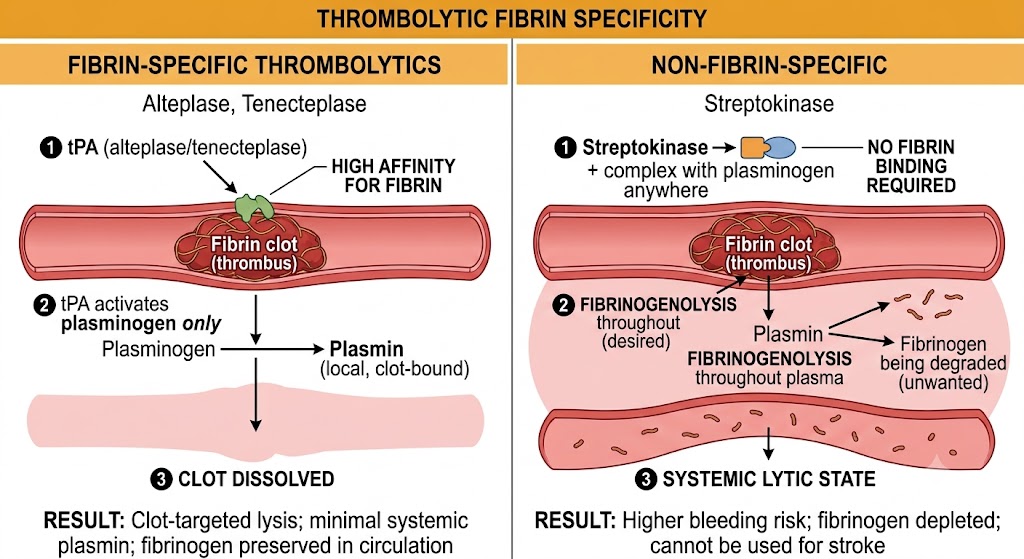
Two-panel diagram comparing thrombolytic fibrin specificity. Left panel shows fibrin-specific thrombolytics (alteplase, tenecteplase): tPA binds fibrin at the clot surface with high affinity, activating plasminogen only at the clot surface to generate local clot-bound plasmin, resulting in clot dissolution with fibrinogen preserved in circulation. Right panel shows non-fibrin-specific streptokinase forming a complex with plasminogen anywhere in the circulation without fibrin binding, generating systemic plasmin that causes fibrinogenolysis throughout plasma and a systemic lytic state with higher bleeding risk.
Thrombolytic fibrin specificity — fibrin-specific agents (alteplase, tenecteplase) concentrate plasminogen activation at the clot surface; streptokinase produces a systemic lytic state with fibrinogen depletion and higher bleeding risk. Figure generated for Introduction to Medical Pharmacology, Chapter 39.

Alteplase, Tenecteplase, and Reteplase

Alteplase is recombinant human tissue-type plasminogen activator with a plasma half-life of approximately 3 to 5 minutes, requiring continuous intravenous infusion. For ST-elevation myocardial infarction: 15 mg bolus, then 0.75 mg per kilogram over 30 minutes (maximum 50 mg), then 0.5 mg per kilogram over 60 minutes (maximum 35 mg), total maximum 100 mg. For acute ischemic stroke: 0.9 mg per kilogram (maximum 90 mg total), with 10% given as a bolus over 1 minute and the remainder infused over 60 minutes. For massive pulmonary embolism: 100 mg over 2 hours. Alteplase is the only FDA-approved thrombolytic for acute ischemic stroke and is the reference agent for all indications.

Tenecteplase is an engineered variant of alteplase with three amino acid substitutions that extend the plasma half-life to approximately 20 to 24 minutes, increase fibrin specificity, and produce approximately 80-fold greater resistance to plasminogen activator inhibitor-1 inhibition. The extended half-life allows single intravenous bolus administration, simplifying use in emergency and out-of-hospital settings. Dosing for ST-elevation myocardial infarction is weight-based: 30 to 50 mg as a single intravenous bolus (dose determined by body weight in 10 kg increments). The ASSENT-2 trial demonstrated non-inferiority to alteplase for 30-day mortality in ST-elevation myocardial infarction with significantly less non-cerebral major bleeding, making tenecteplase the preferred fibrinolytic for ST-elevation myocardial infarction in many contemporary protocols.

Reteplase is a deletion mutant of alteplase retaining only the kringle 2 domain and catalytic domain, with a half-life of approximately 13 to 16 minutes. It is administered as two fixed-dose intravenous boluses of 10 units 30 minutes apart, without weight-based dosing. Reteplase is approved for ST-elevation myocardial infarction and acute myocardial infarction but not for acute ischemic stroke or pulmonary embolism.

Streptokinase is a non-enzymatic protein from beta-hemolytic streptococci that forms a 1:1 complex with plasminogen, inducing a conformational change that creates an active site capable of cleaving free plasminogen throughout the circulation regardless of fibrin binding. It produces a systemic lytic state with consumption of plasminogen, fibrinogen, and fibrin. Streptokinase is antigenic; prior streptococcal infection or prior streptokinase administration can produce antibodies sufficient to neutralize a subsequent therapeutic dose, making repeat administration within 6 to 12 months ineffective. It is not used for stroke (systemic lytic state is prohibitive) and carries the highest systemic bleeding risk of any thrombolytic.

Reference Agent

Alteplase

  • Fibrin-specific; half-life 3 to 5 minutes
  • Weight-based infusion over 90 min (STEMI) or 60 min (stroke, PE)
  • Only FDA-approved for stroke; universal indication coverage

Single Bolus

Tenecteplase

  • Fibrin-specific; half-life 20 to 24 min
  • Single weight-based bolus; 80-fold greater PAI-1 resistance
  • Less non-cerebral bleeding than alteplase; preferred for STEMI

Double Bolus

Reteplase

  • Moderately fibrin-specific; half-life 13 to 16 min
  • Two fixed 10-unit boluses 30 min apart; no weight adjustment
  • STEMI and AMI only; not approved for stroke or PE

Non-Fibrin-Specific

Streptokinase

  • Systemic lytic state; highest bleeding risk
  • Antigenic; no repeat within 6 to 12 months
  • 1.5 million units over 60 min; STEMI only; low cost
Section 2

Clinical Indications and Contraindications

ST-elevation myocardial infarction, acute ischemic stroke, pulmonary embolism, and contraindication screening

The clinical application of thrombolytic therapy is defined by three major indications: ST-elevation myocardial infarction requiring fibrinolysis when percutaneous coronary intervention is not available within 120 minutes, acute ischemic stroke within the 4.5-hour window, and massive pulmonary embolism with hemodynamic instability. Benefit is time-dependent across all three indications, and contraindication screening is mandatory before every administration.

ST-Elevation Myocardial Infarction

Primary percutaneous coronary intervention is the preferred reperfusion strategy when it can be performed within 120 minutes of first medical contact. Fibrinolytic therapy is indicated when primary percutaneous coronary intervention cannot be delivered within that window. Benefit is greatest within 3 hours of symptom onset, declining substantially beyond 6 hours. If fibrinolysis achieves successful reperfusion (defined by symptom relief, ST-segment resolution greater than 50% at 60 to 90 minutes, and reperfusion arrhythmia), routine early coronary angiography at 3 to 24 hours is recommended (the pharmacoinvasive strategy). Failed fibrinolysis — defined as less than 50% ST resolution at 90 minutes — requires immediate rescue percutaneous coronary intervention. Clopidogrel is the preferred P2Y12 inhibitor combined with fibrinolysis; prasugrel and ticagrelor are not recommended in combination with fibrinolytics due to additive intracranial hemorrhage concern.

Acute Ischemic Stroke

Alteplase is the only FDA-approved thrombolytic for acute ischemic stroke and the most evidence-based pharmacological intervention in stroke management. The time window is within 4.5 hours of stroke symptom onset (or last known well time). In the pivotal NINDS trial (0 to 3 hours), alteplase-treated patients were 30% more likely to have minimal or no disability at 3 months compared with placebo; the benefit was achieved at the cost of a 6-fold increase in symptomatic intracranial hemorrhage (6.4% versus 0.6%), which did not translate to increased 3-month mortality. The ECASS-3 trial extended the benefit to the 3 to 4.5-hour window.

Before alteplase administration for stroke: confirm ischemic (not hemorrhagic) stroke by non-contrast brain computed tomography scan; blood pressure must be below 185/110 mmHg and maintained below 180/105 mmHg for at least 24 hours after thrombolysis; blood glucose must be above 50 mg per deciliter; platelet count must be at or above 100,000 per microliter. Mechanical thrombectomy (endovascular clot retrieval) has largely replaced systemic fibrinolysis for large vessel occlusion stroke when thrombectomy can be performed within 24 hours; intravenous alteplase is still administered as a bridge prior to thrombectomy in eligible patients.

Pulmonary Embolism and Contraindications

In massive pulmonary embolism — defined by hemodynamic instability (systolic blood pressure below 90 mmHg, requirement for vasopressors, cardiac arrest, or signs of severe right ventricular failure) — systemic intravenous thrombolysis is indicated unless there are absolute contraindications. Alteplase 100 mg intravenously over 2 hours is the standard regimen. For submassive (intermediate-risk) pulmonary embolism in hemodynamically stable patients, anticoagulation alone is preferred; catheter-directed thrombolysis (infusing low-dose alteplase locally through a catheter advanced into the thrombus) is an intermediate option that reduces the systemic thrombolytic dose by approximately 90% and may be appropriate for intermediate-high-risk patients with right ventricular dysfunction.

Absolute contraindications apply to all indications and all agents: prior intracranial hemorrhage at any time, known structural cerebrovascular lesion (arteriovenous malformation or aneurysm), ischemic stroke within 3 months, active internal bleeding (excluding menses), significant closed head trauma within 3 months, and intracranial or intraspinal surgery within 2 months. For stroke thrombolysis, additional absolute contraindications include intracranial neoplasm, blood pressure persistently above 185/110 mmHg despite treatment, platelet count below 100,000 per microliter, blood glucose below 50 mg per deciliter, computed tomography evidence of established large infarct, and current anticoagulation with an elevated international normalized ratio or recent direct oral anticoagulant use.


Section 3

Thrombolytic Bleeding Reversal and Antifibrinolytic Agents

Intracranial hemorrhage management, cryoprecipitate, tranexamic acid, epsilon-aminocaproic acid, and broader clinical applications

Symptomatic intracranial hemorrhage following thrombolysis is the most devastating complication, occurring in approximately 2 to 6% of stroke patients and 0.5 to 1% of ST-elevation myocardial infarction and pulmonary embolism patients treated with systemic fibrinolytics. Rapid recognition and a structured reversal protocol are essential.

Reversal Protocol

When post-thrombolysis bleeding is suspected — particularly sudden neurological deterioration after stroke thrombolysis — the thrombolytic infusion must be stopped immediately. Laboratory evaluation includes complete blood count, prothrombin time and international normalized ratio, activated partial thromboplastin time, fibrinogen level, and type and crossmatch. Fibrinogen levels below 150 mg per deciliter confirm a systemic lytic state requiring active replacement.

Cryoprecipitate is the preferred product for fibrinogen replacement; each unit contains approximately 150 to 250 mg of fibrinogen as well as factor VIII, factor XIII, von Willebrand factor, and fibronectin. The standard empirical dose is 10 units intravenously, targeting a fibrinogen level above 150 mg per deciliter. Cryoprecipitate is far more volume-efficient for fibrinogen replacement than fresh frozen plasma (which contains fibrinogen at approximately 2 to 3 mg per milliliter per unit versus approximately 15 to 30 mg per milliliter per unit in cryoprecipitate).

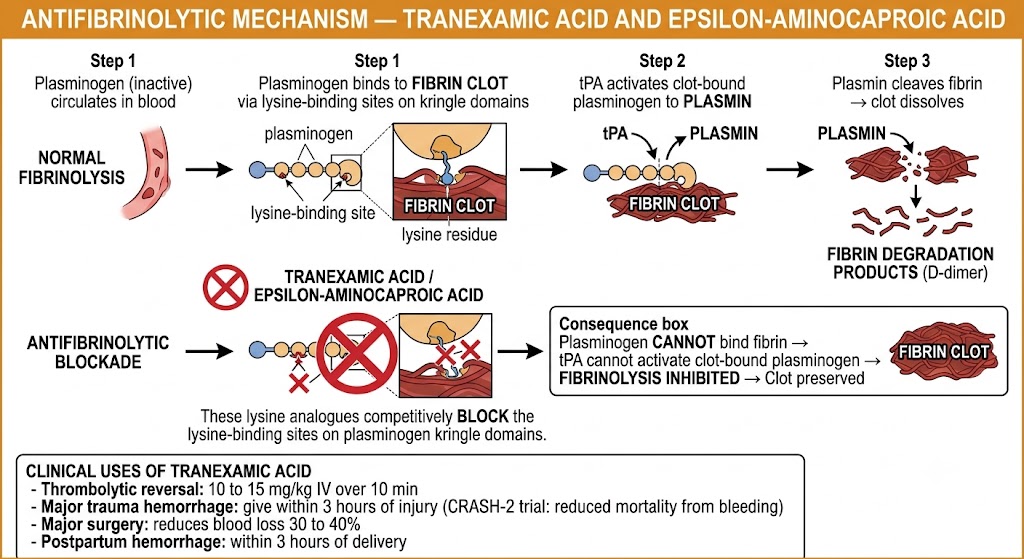
Mechanism diagram of antifibrinolytic agents. Upper row shows normal fibrinolysis: plasminogen binds to fibrin clot via lysine-binding sites on kringle domains, tPA activates clot-bound plasminogen to plasmin, and plasmin cleaves fibrin to produce fibrin degradation products including D-dimer. Lower row shows antifibrinolytic blockade: tranexamic acid and epsilon-aminocaproic acid competitively block the lysine-binding sites on plasminogen kringle domains, preventing plasminogen from binding fibrin, so tPA cannot activate clot-bound plasminogen and fibrinolysis is inhibited. A clinical uses box lists tranexamic acid indications: thrombolytic reversal, major trauma hemorrhage within 3 hours, major surgery, and postpartum hemorrhage.
Antifibrinolytic mechanism — tranexamic acid and epsilon-aminocaproic acid block plasminogen lysine-binding sites, preventing fibrin binding and plasminogen activation. Figure generated for Introduction to Medical Pharmacology, Chapter 39.

Tranexamic Acid and Epsilon-Aminocaproic Acid

Tranexamic acid and epsilon-aminocaproic acid are lysine analogues that competitively inhibit the lysine-binding sites in plasminogen kringle domains, blocking plasminogen binding to fibrin and preventing plasminogen activation by tissue-type plasminogen activator at the clot surface. For thrombolytic reversal: tranexamic acid 10 to 15 mg per kilogram intravenously over 10 minutes; epsilon-aminocaproic acid 5 g intravenously over 15 to 30 minutes followed by 1 to 1.25 g per hour infusion.

Beyond thrombolytic reversal, tranexamic acid has established roles in reducing surgical blood loss and traumatic hemorrhage. The CRASH-2 trial (n = 20,211 trauma patients) demonstrated that tranexamic acid given within 3 hours of injury reduced all-cause mortality by approximately 9% relative risk and death due to bleeding, with no increase in vascular occlusive events; the benefit was time-dependent with no benefit and possibly harm when given more than 3 hours after injury. In major elective surgery including cardiac surgery and joint arthroplasty, tranexamic acid reduces intraoperative blood loss and allogeneic transfusion requirements by 30 to 40%. It is also effective in postpartum hemorrhage when given within 3 hours of delivery. Tranexamic acid is contraindicated in patients with active intravascular clotting and should be used with caution in subarachnoid hemorrhage (where it reduces rebleeding but may increase cerebral ischemic complications at higher doses).

Post-Thrombolysis Bleeding Protocol

Stop thrombolytic infusion immediately. Obtain emergent head computed tomography if neurological deterioration. Check complete blood count, prothrombin time, activated partial thromboplastin time, fibrinogen level. If fibrinogen below 150 mg per deciliter: give 10 units cryoprecipitate intravenously; recheck fibrinogen; repeat until at or above 150 mg per deciliter. Give antifibrinolytic: tranexamic acid 10 to 15 mg per kilogram intravenously over 10 minutes OR epsilon-aminocaproic acid 5 g intravenous load then 1 g per hour. If platelets below 100,000 per microliter with active bleeding: platelet transfusion. Hold all antithrombotic therapy for at least 24 hours after stroke thrombolysis. Maintain systolic blood pressure below 180 mmHg to reduce hemorrhagic expansion.


Section 4

Anticoagulant Reversal Agents

Vitamin K, protamine sulfate, idarucizumab, andexanet alfa, and four-factor prothrombin complex concentrate

Procoagulant and hemostatic agents encompass a pharmacologically diverse set of drugs united by their clinical function: reversing the effects of anticoagulants or directly restoring hemostatic capacity. Selecting among reversal strategies requires knowing the specific anticoagulant, the severity and location of bleeding, the time since the last dose, and relevant organ function.

Vitamin K and Protamine Sulfate

Phytonadione (vitamin K1) restores vitamin K epoxide reductase substrate availability and reverses warfarin anticoagulation, but onset is delayed because new factor synthesis is required. Factor VII, with the shortest half-life of approximately 4 to 6 hours, is the first to recover; prothrombin (half-life approximately 60 to 70 hours) recovers last. Intravenous vitamin K produces measurable international normalized ratio reduction within 6 to 8 hours; oral vitamin K achieves correction within 24 to 48 hours. For life-threatening bleeding, intravenous vitamin K must be combined with four-factor prothrombin complex concentrate to achieve immediate factor replacement while endogenous synthesis is restored. For non-urgent reversal (elevated international normalized ratio without active bleeding), oral vitamin K 2.5 to 5 mg is effective and preferred. Intravenous vitamin K carries a small risk of anaphylaxis and must be infused slowly.

Protamine sulfate is a polycationic protein that reverses unfractionated heparin anticoagulation by forming a stable ionic complex, rendering heparin pharmacologically inactive within minutes. The dose is 1 mg protamine per 100 units of unfractionated heparin given in the preceding 2 to 3 hours. Protamine has more limited activity against low-molecular-weight heparins: it completely neutralizes anti-thrombin activity but only partially neutralizes anti-factor Xa activity (approximately 60 to 75%). It has no activity against fondaparinux. Adverse effects include bradycardia, hypotension (from histamine release and complement activation), and anaphylaxis — risk is higher in patients with prior protamine or salmon exposure, or who use neutral protamine Hagedorn insulin.

Idarucizumab and Andexanet Alfa

Idarucizumab is a humanized monoclonal antibody fragment that binds dabigatran with approximately 350 times greater affinity than dabigatran binds thrombin, forming an irreversible 1:1 complex that neutralizes dabigatran immediately. The approved dose is 5 g intravenously as two separate 2.5 g boluses given no more than 15 minutes apart. Complete reversal is achieved within minutes. Rebound dabigatran anticoagulation can occur within 12 to 24 hours in patients with high body burden (particularly renal impairment); a second 5 g dose can be given if rebound occurs with clinical manifestations.

Andexanet alfa is a modified recombinant inactive factor Xa decoy protein that binds and sequesters factor Xa inhibitors (apixaban, rivaroxaban, edoxaban) in the circulation, restoring endogenous factor Xa activity. Dosing depends on the specific agent and timing of last dose: low-dose regimen (400 mg bolus followed by 480 mg over 2 hours) for lower doses or when more than 8 hours have elapsed; high-dose regimen (800 mg bolus followed by 960 mg over 2 hours) for higher doses taken within 8 hours. Thrombotic events occurred in approximately 10% of patients within 30 days in the pivotal trial. Anticoagulation should be resumed as soon as clinically safe.

Four-Factor Prothrombin Complex Concentrate and Fresh Frozen Plasma

Four-factor prothrombin complex concentrate contains all four vitamin K-dependent procoagulant factors (II, VII, IX, X) plus proteins C and S in concentrated lyophilized form, achieving international normalized ratio correction within 15 to 30 minutes. Dosing is weight-based and international normalized ratio-guided: 25 units per kilogram for international normalized ratio 2.0 to 3.9, 35 units per kilogram for international normalized ratio 4.0 to 6.0, and 50 units per kilogram for international normalized ratio above 6.0, all with a maximum of 5,000 units. It must always be accompanied by intravenous vitamin K to prevent international normalized ratio re-elevation as factors are catabolized. For factor Xa inhibitor reversal when andexanet alfa is unavailable, four-factor prothrombin complex concentrate at 50 units per kilogram is the best non-specific alternative; it has limited utility for dabigatran reversal (does not neutralize the direct thrombin inhibitor).

Fresh frozen plasma contains all clotting factors at normal plasma concentrations but requires large volumes (15 to 20 mL per kilogram), blood group compatibility testing, and thawing. It is standard for factor replacement in factor XI deficiency, liver disease coagulopathy, and consumptive coagulopathy such as disseminated intravascular coagulation where broad replacement is needed. In disseminated intravascular coagulation, antifibrinolytic agents such as tranexamic acid are generally avoided because fibrinolysis in that syndrome is reactive and protective against microvascular thrombosis; the exception is disseminated intravascular coagulation associated with acute promyelocytic leukemia, where a primary hyperfibrinolytic state predominates and tranexamic acid can be beneficial.

Anticoagulant Reversal Quick Reference

Agent-Specific Selection

  • Unfractionated heparin: protamine 1 mg per 100 units (last 2 to 3 hours)
  • Low-molecular-weight heparin: protamine 1 mg per 1 mg enoxaparin (within 8 hours); partial anti-factor Xa reversal only
  • Warfarin life-threatening bleed: four-factor prothrombin complex concentrate (dose by INR) plus intravenous vitamin K 10 mg
  • Warfarin non-urgent: oral vitamin K 2.5 to 5 mg
  • Dabigatran: idarucizumab 5 g intravenously (two 2.5 g boluses)
  • Apixaban or rivaroxaban: andexanet alfa; four-factor prothrombin complex concentrate 50 units per kilogram if unavailable
  • Fondaparinux: no specific reversal agent; four-factor prothrombin complex concentrate or recombinant factor VIIa off-label

Hemostatic Replacement Products

When and What

  • Cryoprecipitate (10 units): fibrinogen replacement in thrombolytic-associated bleeding; target fibrinogen above 150 mg per deciliter
  • Four-factor prothrombin complex concentrate: urgent warfarin reversal; factor Xa inhibitor reversal (non-specific); faster and more volume-efficient than fresh frozen plasma
  • Fresh frozen plasma: broad factor replacement in liver disease, factor XI deficiency, disseminated intravascular coagulation; large volume required
  • Platelet transfusion: platelet count below 100,000 per microliter with active bleeding; reverses abciximab (drug redistribution)

Suggested References
Author / Organization Title Source
Cesarman-Maus G, Hajjar KA Molecular mechanisms of fibrinolysis Br J Haematol. 2005;129(3):307-321.
Antman EM, Morrow DA ST-elevation myocardial infarction: management. In: Libby P, et al., eds. Braunwald's Heart Disease. 12th ed. Philadelphia: Elsevier; 2022:504-540.
O'Gara PT, Kushner FG, Ascheim DD, et al. 2013 ACCF/AHA guideline for the management of ST-elevation myocardial infarction J Am Coll Cardiol. 2013;61(4):e78-e140.
Van de Werf F, Adgey J, Ardissino D, et al. (ASSENT-2) Single-bolus tenecteplase compared with front-loaded alteplase in acute myocardial infarction Lancet. 1999;354(9180):716-722.
Powers WJ, Rabinstein AA, Ackerson T, et al. 2019 update to the 2018 guidelines for the early management of acute ischemic stroke Stroke. 2019;50(12):e344-e418.
Hacke W, Kaste M, Bluhmki E, et al. (ECASS-3) Thrombolysis with alteplase 3 to 4.5 hours after acute ischemic stroke N Engl J Med. 2008;359(13):1317-1329.
Kearon C, Akl EA, Ornelas J, et al. Antithrombotic therapy for VTE disease: CHEST guideline and expert panel report Chest. 2016;149(2):315-352.
Meyer G, Vicaut E, Danays T, et al. (PEITHO) Fibrinolysis for patients with intermediate-risk pulmonary embolism N Engl J Med. 2014;370(15):1402-1411.
Frontera JA, Lewin JJ, Rabinstein AA, et al. Guideline for reversal of antithrombotics in intracranial hemorrhage: executive summary Neurocrit Care. 2016;24(1):6-46.
CRASH-2 Trial Collaborators Effects of tranexamic acid on death, vascular occlusive events, and blood transfusion in trauma patients with significant haemorrhage Lancet. 2010;376(9734):23-32.
Holbrook A, Schulman S, Witt DM, et al. Evidence-based management of anticoagulant therapy: Antithrombotic Therapy and Prevention of Thrombosis, 9th ed. ACCP guidelines Chest. 2012;141(2 Suppl):e152S-e184S.
Crowther MA, Warkentin TE Bleeding risk and the management of bleeding complications in patients undergoing anticoagulant therapy Blood. 2008;111(10):4871-4879.
Pollack CV Jr, Reilly PA, van Ryn J, et al. (RE-VERSE AD) Idarucizumab for dabigatran reversal — full cohort analysis N Engl J Med. 2017;377(5):431-441.
Connolly SJ, Crowther M, Eikelboom JW, et al. (ANNEXA-4) Full study report of andexanet alfa for bleeding associated with factor Xa inhibitors N Engl J Med. 2019;380(14):1326-1335.
Levi M, Toh CH, Thachil J, Watson HG Guidelines for the diagnosis and management of disseminated intravascular coagulation Br J Haematol. 2009;145(1):24-33.