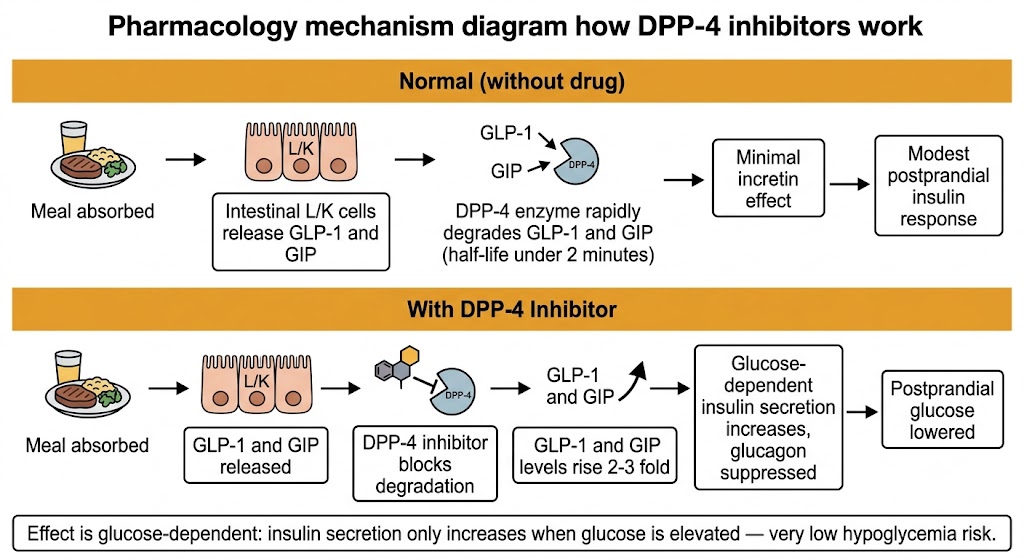
Thiazolidinediones (pioglitazone, rosiglitazone) improve insulin sensitivity by activating peroxisome proliferator-activated receptor gamma, a nuclear receptor that regulates the transcription of genes involved in glucose and lipid metabolism. They are the only oral agents that directly address peripheral insulin resistance at the nuclear level rather than stimulating insulin secretion or blocking glucose absorption.
Peroxisome proliferator-activated receptor gamma is most highly expressed in adipose tissue, where its activation promotes differentiation of preadipocytes into small, insulin-sensitive adipocytes, redistributes lipid from visceral to subcutaneous depots, and increases expression of glucose transporter type 4 and adiponectin. The net effect is improved insulin signaling in adipose tissue, muscle, and liver, reducing fasting and postprandial glucose without stimulating insulin secretion. Because they require transcriptional changes to take effect, thiazolidinediones have a slow onset — full glucose-lowering effect may take 6 to 12 weeks.
Pioglitazone is the primary thiazolidinedione in clinical use. Rosiglitazone was associated with increased risk of myocardial infarction in meta-analysis and now carries severe prescribing restrictions in most markets. Pioglitazone, by contrast, showed modest macrovascular benefit in the PROactive trial (reduction in the composite secondary endpoint) and is also approved for nonalcoholic steatohepatitis in some guidelines, where it reduces hepatic inflammation and fibrosis.
Fluid retention and edema: peroxisome proliferator-activated receptor gamma activation increases renal sodium reabsorption; peripheral edema occurs in 5 to 15 percent of patients. Heart failure (New York Heart Association class III or IV): contraindicated — fluid retention worsens heart failure. Weight gain: 2 to 4 kg, due to fluid retention and increased adipogenesis. Bone fractures: increased fracture risk in women (distal radius, foot, ankle) due to effects on osteoblast differentiation. Bladder cancer: pioglitazone carries an FDA warning for possible increased bladder cancer risk with long-term use — avoid in patients with active bladder cancer history.
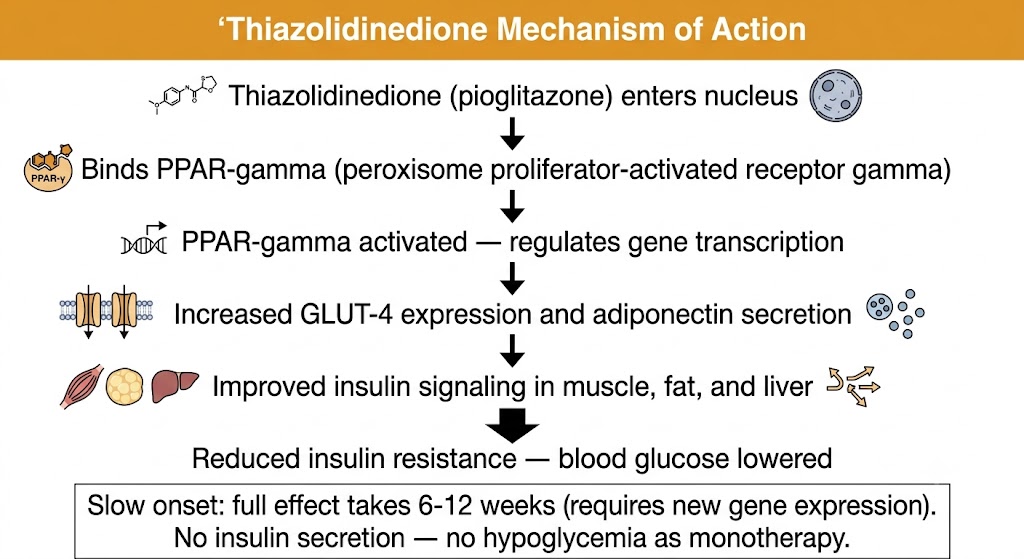
Dipeptidyl peptidase-4 inhibitors (sitagliptin, saxagliptin, linagliptin, alogliptin) work by blocking the enzyme that degrades glucagon-like peptide-1 and glucose-dependent insulinotropic polypeptide after meal absorption. By prolonging incretin activity, they enhance glucose-dependent insulin secretion and suppress glucagon — but only when glucose is elevated, giving them a very low intrinsic hypoglycemia risk.
Glucagon-like peptide-1 and glucose-dependent insulinotropic polypeptide are released from intestinal L and K cells respectively after meals. They amplify insulin secretion from beta cells and suppress glucagon from alpha cells in a glucose-dependent manner — effects that cease when glucose returns to normal. Dipeptidyl peptidase-4 is the enzyme that rapidly degrades these incretins (half-life of glucagon-like peptide-1 is only 1 to 2 minutes in plasma). Dipeptidyl peptidase-4 inhibitors block this enzyme, raising active incretin levels two- to threefold and prolonging their postprandial effects. Because the mechanism is glucose-dependent, hypoglycemia is rare as monotherapy.
All dipeptidyl peptidase-4 inhibitors lower glycated hemoglobin by approximately 0.5 to 0.8 percent and are weight neutral. Linagliptin is the only agent in the class primarily eliminated by biliary excretion rather than renal excretion, making it usable without dose adjustment across all stages of chronic kidney disease — a practical advantage over sitagliptin and saxagliptin, which require dose reduction with renal impairment. Cardiovascular outcome trials (TECOS with sitagliptin, SAVOR-TIMI 53 with saxagliptin, EXAMINE with alogliptin) showed cardiovascular safety but no cardiovascular benefit. Saxagliptin specifically was associated with increased heart failure hospitalization in SAVOR-TIMI 53, an effect not consistently seen with other agents in the class but prompting caution in patients with heart failure.
Pancreatitis: rare but reported across the class; hold if acute pancreatitis occurs and do not restart. Nasopharyngitis and upper respiratory infections: increased incidence due to dipeptidyl peptidase-4's role in immune cell regulation. Saxagliptin and heart failure: increased hospitalization signal in SAVOR-TIMI 53 — avoid in patients with established heart failure if alternatives are available. Dose adjustment: sitagliptin and saxagliptin require renal dose reduction; linagliptin does not.
Alpha-glucosidase inhibitors (acarbose, miglitol) work at the intestinal brush border to slow the digestion of complex carbohydrates, reducing the rate of glucose absorption after meals. They lower postprandial glucose excursions without stimulating insulin secretion and carry no intrinsic hypoglycemia risk as monotherapy.
Alpha-glucosidases are brush border enzymes (sucrase, maltase, glucoamylase) in the small intestinal enterocytes that cleave oligosaccharides and disaccharides into absorbable monosaccharides. Acarbose and miglitol competitively inhibit these enzymes, slowing but not completely blocking carbohydrate digestion. Undigested carbohydrates pass into the colon, where bacterial fermentation produces gas and short-chain fatty acids — explaining the class's primary limitation: flatulence, bloating, and diarrhea that affect the majority of patients, particularly at higher doses. Starting at low doses and titrating slowly substantially improves tolerability.
Alpha-glucosidase inhibitors reduce postprandial glucose by 40 to 60 mg/dL and lower glycated hemoglobin by approximately 0.5 to 0.8 percent. Their effect is specifically on postprandial excursions, with minimal effect on fasting glucose. They are taken with the first bite of each meal. Acarbose is minimally absorbed systemically; miglitol has greater systemic absorption but no systemic glucose-lowering effect. Because they act locally, drug interactions are few. Hypoglycemia can occur when alpha-glucosidase inhibitors are combined with insulin or sulfonylureas; it must be treated with pure glucose (glucose tablets) rather than sucrose-containing foods, since sucrose digestion is also inhibited.
Must be taken with the first bite of each meal — no effect if taken fasting or after eating. Gastrointestinal side effects are dose-dependent and the primary reason for discontinuation. Treat hypoglycemia with glucose tablets, not sucrose. Contraindicated in inflammatory bowel disease and bowel obstruction. Limited use in the United States due to poor tolerability but widely used in Asia where high-carbohydrate diets make postprandial glucose control particularly relevant.
The three drug classes covered in this module share the advantage of no intrinsic hypoglycemia risk, but differ substantially in their tolerability profiles and the clinical scenarios where they are preferred. None has demonstrated cardiovascular outcome benefit, distinguishing them from glucagon-like peptide-1 receptor agonists and sodium-glucose cotransporter-2 inhibitors.
Thiazolidinediones are preferred when insulin resistance is the dominant feature and the patient does not have heart failure. Pioglitazone is particularly useful in patients with nonalcoholic steatohepatitis and in those who have had an ischemic stroke or transient ischemic attack (the IRIS trial showed reduced recurrent stroke risk with pioglitazone in insulin-resistant patients). Dipeptidyl peptidase-4 inhibitors are well tolerated, weight neutral, and useful when glycated hemoglobin reduction needs to be modest and hypoglycemia risk is a concern — particularly in older patients. Linagliptin is preferred when renal impairment complicates dosing of other agents. Alpha-glucosidase inhibitors occupy a narrow niche in the United States but are valuable where postprandial glucose control is the primary target.
Thiazolidinediones: best for insulin resistance, nonalcoholic steatohepatitis, post-stroke; avoid in heart failure and bladder cancer history.
Dipeptidyl peptidase-4 inhibitors: well tolerated, weight neutral, good in elderly and chronic kidney disease; linagliptin requires no renal dose adjustment; avoid saxagliptin in heart failure.
Alpha-glucosidase inhibitors: postprandial glucose target only; poor gastrointestinal tolerability limits use; treat hypoglycemia with glucose tablets not sucrose.
| Author / Organization | Title | Source |
|---|---|---|
| Lehmann JM et al | An antidiabetic thiazolidinedione is a high affinity ligand for peroxisome proliferator-activated receptor gamma | J Biol Chem. 1995;270(22):12953–12956 |
| Nesto RW et al | Thiazolidinedione use, fluid retention, and congestive heart failure | Circulation. 2003;108(23):2941–2948 |
| Dormandy JA et al (PROactive) | Secondary prevention of macrovascular events in patients with type 2 diabetes in the PROactive Study | Lancet. 2005;366(9493):1279–1289 |
| Drucker DJ, Nauck MA | The incretin system: glucagon-like peptide-1 receptor agonists and dipeptidyl peptidase-4 inhibitors in type 2 diabetes | Lancet. 2006;368(9548):1696–1705 |
| Deacon CF | Physiology and pharmacology of DPP-4 in glucose homeostasis and the treatment of type 2 diabetes | Front Endocrinol. 2019;10:80 |
| Scheen AJ | Pharmacokinetics of dipeptidylpeptidase-4 inhibitors | Diabetes Obes Metab. 2010;12(8):648–658 |
| Scirica BM et al (SAVOR-TIMI 53) | Saxagliptin and cardiovascular outcomes in patients with type 2 diabetes mellitus | N Engl J Med. 2013;369(14):1317–1326 |
| Bischoff H | Pharmacology of alpha-glucosidase inhibition | Eur J Clin Invest. 1994;24(Suppl 3):3–10 |
| Chiasson JL et al (STOP-NIDDM) | Acarbose for prevention of type 2 diabetes mellitus: the STOP-NIDDM randomised trial | Lancet. 2002;359(9323):2072–2077 |
| Monami M et al | Safety of dipeptidyl peptidase-4 inhibitors: a meta-analysis of randomized clinical trials | Curr Med Res Opin. 2011;27(Suppl 3):57–64 |
| American Diabetes Association | Standards of Care in Diabetes—2024 | Diabetes Care. 2024;47(Suppl 1):S1–S321 |
| Sanyal AJ et al | Pioglitazone, vitamin E, or placebo for nonalcoholic steatohepatitis | N Engl J Med. 2010;362(18):1675–1685 |
| Kernan WN et al (IRIS) | Pioglitazone after ischemic stroke or transient ischemic attack | N Engl J Med. 2016;374(14):1321–1331 |
| Green JB et al (TECOS) | Effect of sitagliptin on cardiovascular outcomes in type 2 diabetes | N Engl J Med. 2015;373(3):232–242 |
| Kahn SE et al (ADOPT) | Glycemic durability of rosiglitazone, metformin, or glyburide monotherapy | N Engl J Med. 2006;355(23):2427–2443 |