CHAPTER 29  ·  DIABETES PHARMACOLOGY
Section 01
Tirzepatide: Dual GIP/GLP-1 Receptor Agonism
Mechanism of dual agonism, glucose-lowering superiority over semaglutide, weight loss efficacy, and cardiovascular outcome data

Tirzepatide is a single synthetic peptide that acts as a co-agonist at both the glucose-dependent insulinotropic polypeptide receptor and the glucagon-like peptide-1 receptor. This dual agonism produces glucose lowering and weight loss that substantially exceeds what is achievable with glucagon-like peptide-1 receptor agonism alone, making tirzepatide the most effective pharmacological agent for both glycemic control and weight reduction currently approved.

Glucose-dependent insulinotropic polypeptide is the other major incretin hormone alongside glucagon-like peptide-1, secreted from intestinal K cells in response to fat and carbohydrate ingestion. In healthy individuals, glucose-dependent insulinotropic polypeptide is responsible for roughly half of the postprandial incretin effect. In type 2 diabetes mellitus, the glucagon-like peptide-1 response is preserved but blunted, while the glucose-dependent insulinotropic polypeptide response is largely intact — making the glucose-dependent insulinotropic polypeptide receptor an important pharmacological target. Tirzepatide exploits this by combining glucose-dependent insulinotropic polypeptide receptor agonism (which amplifies insulin secretion and may enhance glucagon-like peptide-1 receptor sensitivity) with glucagon-like peptide-1 receptor agonism to produce additive or synergistic effects.

The SURPASS clinical trial program established tirzepatide's superiority over semaglutide. In the head-to-head SURPASS-2 trial, tirzepatide 15 mg reduced glycated hemoglobin by 2.46 percent and body weight by 12.4 kg over 40 weeks, compared with 2.09 percent and 6.2 kg for semaglutide 1 mg — representing approximately double the weight loss with superior glucose lowering. In the SURMOUNT obesity trials, tirzepatide 15 mg produced approximately 20 to 22 percent body weight reduction in patients without diabetes — the largest pharmacological weight reduction reported in a randomized controlled trial at the time of approval. The SURPASS-CVOT trial (2025) demonstrated superiority of tirzepatide over dulaglutide for major adverse cardiovascular event reduction in type 2 diabetes mellitus with established cardiovascular disease.

Tirzepatide vs Semaglutide: Key Differences

Mechanism: tirzepatide adds glucose-dependent insulinotropic polypeptide receptor agonism to glucagon-like peptide-1 receptor agonism; semaglutide is a pure glucagon-like peptide-1 receptor agonist.
Glycated hemoglobin reduction: tirzepatide 1.5 to 2.5%; semaglutide 1.0 to 2.0%.
Weight loss: tirzepatide 15 to 22%; semaglutide 10 to 15%.
Dosing: both once weekly subcutaneous; tirzepatide also available in higher obesity doses.
Adverse effects: similar gastrointestinal profile; same contraindications (medullary thyroid carcinoma, multiple endocrine neoplasia type 2).
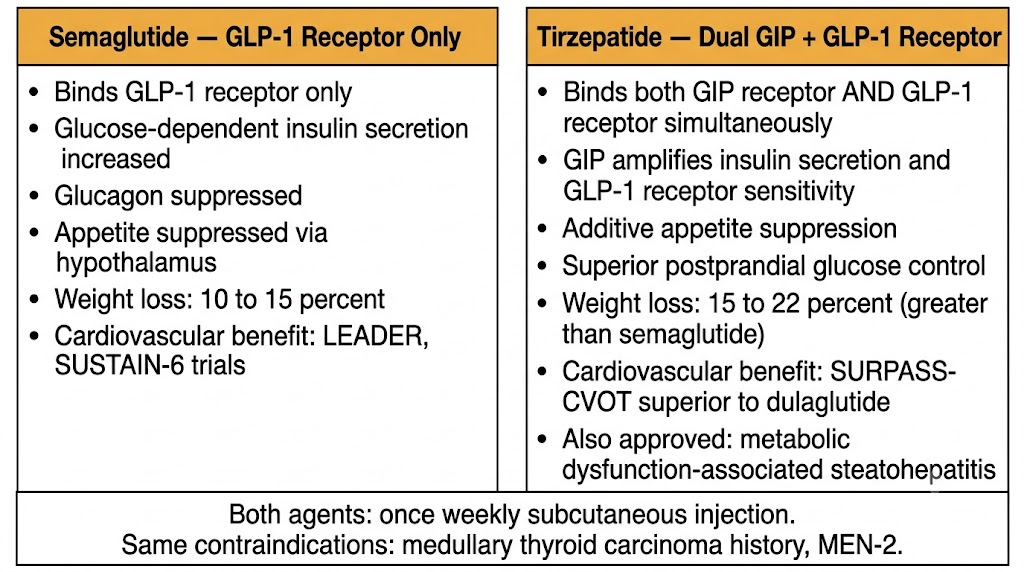
Two-panel comparison diagram: left panel shows semaglutide (GLP-1 receptor only) — binds GLP-1 receptor, glucose-dependent insulin secretion increased, glucagon suppressed, appetite suppressed via hypothalamus, weight loss 10 to 15 percent, cardiovascular benefit in LEADER and SUSTAIN-6. Right panel shows tirzepatide (dual GIP plus GLP-1 receptor) — binds both receptors simultaneously, GIP amplifies insulin secretion and GLP-1 sensitivity, additive appetite suppression, superior postprandial control, weight loss 15 to 22 percent, SURPASS-CVOT cardiovascular superiority, approved for metabolic dysfunction-associated steatohepatitis. Shared note: both once weekly subcutaneous, same contraindications.
Semaglutide versus tirzepatide: mechanism and efficacy comparison. Generated with Gemini AI for educational use.
Section 02
Central Pharmacology of Weight Loss
Hypothalamic energy balance circuits, glucagon-like peptide-1 receptor signaling in appetite regulation, and why incretin-based weight loss differs from caloric restriction

The weight loss produced by glucagon-like peptide-1 receptor agonists and tirzepatide is not simply a side effect of glucose lowering — it reflects direct pharmacological action on the central nervous system circuits that regulate energy homeostasis. Understanding this mechanism explains why incretin-based weight loss is sustained, why it reduces the defended body weight set point, and why it differs qualitatively from behavioral caloric restriction.

The hypothalamic arcuate nucleus contains two opposing neuronal populations that regulate energy balance: pro-opiomelanocortin neurons, which promote satiety and reduce food intake when activated, and agouti-related peptide neurons, which drive hunger and food-seeking when activated. Glucagon-like peptide-1 receptors are expressed on pro-opiomelanocortin neurons, and their activation increases pro-opiomelanocortin neuron firing, suppressing appetite. Glucagon-like peptide-1 receptor agonists reach these neurons primarily through the area postrema and nucleus tractus solitarius in the brainstem (circumventricular organs lacking the blood-brain barrier), and through vagal afferents from the gut, rather than by crossing the blood-brain barrier directly.

Unlike behavioral caloric restriction, which activates counter-regulatory mechanisms (increased hunger, reduced energy expenditure) that oppose and ultimately reverse weight loss, glucagon-like peptide-1 receptor agonism reduces the defended body weight set point — the hypothalamic system that defends a particular body weight regardless of caloric intake. This is why weight regain after stopping glucagon-like peptide-1 receptor agonist therapy is rapid and essentially complete: the defended set point returns to its pre-treatment level when the pharmacological signal is removed.

Clinical Implication of Set Point Pharmacology

Weight loss with glucagon-like peptide-1 receptor agonists requires continuous therapy to be maintained. Stopping the drug after achieving target weight results in return of the pre-treatment body weight within 12 months in most patients. This positions these agents as chronic therapies analogous to antihypertensives, not temporary interventions.

Section 03
Emerging and Pipeline Agents
Triple agonists, amylin analogs, and oral small-molecule glucagon-like peptide-1 receptor agonists

The clinical success of tirzepatide has driven rapid development of next-generation incretin therapies targeting additional receptor systems. The pipeline includes triple agonists (glucagon-like peptide-1, glucose-dependent insulinotropic polypeptide, and glucagon receptor co-agonists), amylin analogs combined with glucagon-like peptide-1 receptor agonists, and oral small-molecule glucagon-like peptide-1 receptor agonists that overcome the bioavailability limitations of peptide-based oral formulations.

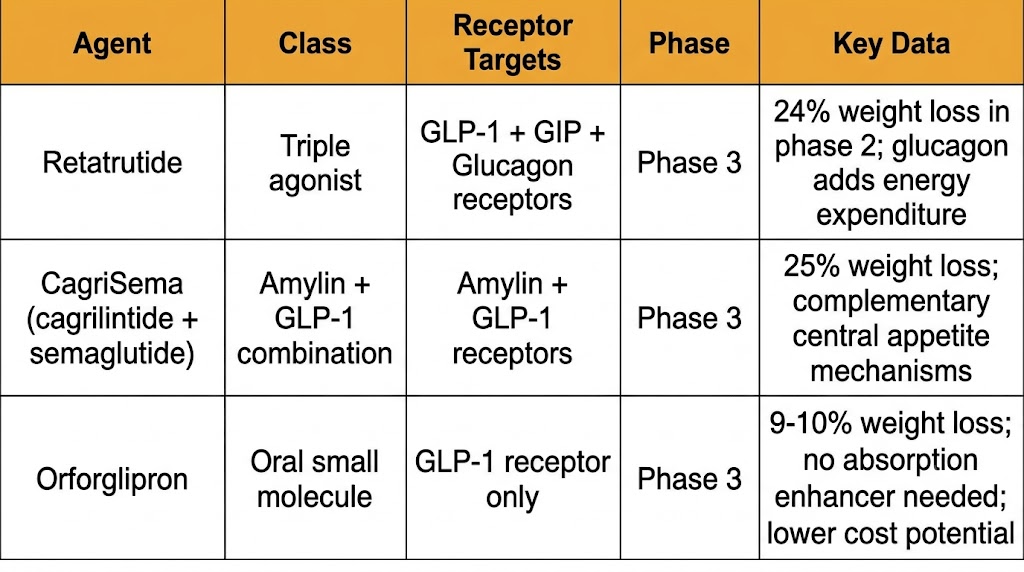
Retatrutide is a triple agonist targeting glucagon-like peptide-1, glucose-dependent insulinotropic polypeptide, and glucagon receptors simultaneously. Phase 2 trials have reported approximately 24 percent body weight reduction — exceeding tirzepatide — with the glucagon receptor component contributing additional energy expenditure and hepatic fat reduction. Glucagon receptor agonism independently reduces liver fat and increases energy expenditure, at the cost of potential glucose elevation if not adequately offset by the glucagon-like peptide-1 and glucose-dependent insulinotropic polypeptide components. Phase 3 trials are ongoing.

Cagrilintide is a long-acting amylin analog. Amylin is co-secreted with insulin from beta cells and acts centrally to reduce food intake and slow gastric emptying. Cagrilintide combined with semaglutide (the combination called CagriSema) has shown additive weight loss approaching 25 percent in phase 2 trials, suggesting complementary central mechanisms between amylin and glucagon-like peptide-1 receptor signaling. Orforglipron is an oral non-peptide small-molecule glucagon-like peptide-1 receptor agonist that does not require an absorption enhancer, potentially offering greater convenience and lower cost than peptide-based oral formulations. Phase 2 data showed glycated hemoglobin reduction of approximately 1.5 percent and weight loss of 9 to 10 percent.

Reference table of pipeline incretin agents: retatrutide (triple agonist, GLP-1 plus GIP plus glucagon receptors, phase 3, 24 percent weight loss in phase 2); CagriSema — cagrilintide plus semaglutide (amylin plus GLP-1 combination, phase 3, 25 percent weight loss); orforglipron (oral small molecule GLP-1 receptor agonist, phase 3, 9 to 10 percent weight loss, no absorption enhancer needed, lower cost potential).
Pipeline incretin agents: receptor targets, development phase, and key efficacy data. Generated with Gemini AI for educational use.
Section 04
Tirzepatide Beyond Diabetes: MASH and Heart Failure
SYNERGY-NASH trial in metabolic dysfunction-associated steatohepatitis and SUMMIT trial in heart failure with preserved ejection fraction

Tirzepatide's pharmacological effects on hepatic fat metabolism and cardiac function have generated major clinical trial data in two non-diabetes indications: metabolic dysfunction-associated steatohepatitis (previously called nonalcoholic steatohepatitis) and heart failure with preserved ejection fraction complicated by obesity.

The SYNERGY-NASH trial demonstrated that tirzepatide produced resolution of metabolic dysfunction-associated steatohepatitis without worsening of fibrosis in 62 percent of treated patients versus 19 percent on placebo, and improvement in fibrosis by at least one stage in 55 percent versus 30 percent on placebo. These are the most impressive results for any pharmacological agent in metabolic dysfunction-associated steatohepatitis to date and led to the first approval of a medication for this indication. The mechanism involves reduction of hepatic lipotoxicity through weight loss, reduction in hepatic fat deposition, and direct anti-inflammatory effects of glucagon-like peptide-1 and glucose-dependent insulinotropic polypeptide receptor signaling in hepatocytes.

The SUMMIT trial evaluated tirzepatide in patients with heart failure with preserved ejection fraction and obesity (body mass index above 30). Tirzepatide significantly reduced the primary composite endpoint of cardiovascular death or worsening heart failure events, improved six-minute walk distance, and improved quality of life scores compared with placebo. Heart failure with preserved ejection fraction — the most common form of heart failure and one for which few disease-modifying therapies exist — is strongly associated with obesity, and the benefit of tirzepatide is thought to reflect both weight loss and direct cardiac effects.

Expanding Indications of Tirzepatide

Approved: type 2 diabetes mellitus (Mounjaro), obesity (Zepbound), metabolic dysfunction-associated steatohepatitis.
Trial evidence: heart failure with preserved ejection fraction and obesity (SUMMIT), cardiovascular outcome superiority over dulaglutide (SURPASS-CVOT).
Emerging: chronic kidney disease, obstructive sleep apnea, polycystic ovary syndrome.

Visual Summary
Tirzepatide, Weight Pharmacology, and Emerging Agents
Dual agonism mechanism, weight loss biology, pipeline agents, and expanded indications
Suggested References
Author / OrganizationTitleSource
Coskun T et alLY3298176, a novel dual GIP and GLP-1 receptor agonist for the treatment of type 2 diabetes mellitusMol Metab. 2018;18:3–14
Nauck MA, D’Alessio DATirzepatide, a dual GIP/GLP-1 receptor co-agonist for the treatment of type 2 diabetesCardiovasc Diabetol. 2022;21(1):169
Frias JP et al (SURPASS-2)Tirzepatide versus semaglutide once weekly in patients with type 2 diabetesN Engl J Med. 2021;385(6):503–515
Jastreboff AM et al (SURMOUNT-1)Tirzepatide once weekly for the treatment of obesityN Engl J Med. 2022;387(3):205–216
Nicholls SJ et al (SURPASS-CVOT)Cardiovascular outcomes with tirzepatide versus dulaglutide in type 2 diabetesN Engl J Med. 2025;393(24):2409–2420
Cone RDAnatomy and regulation of the central melanocortin systemNat Neurosci. 2005;8(5):571–578
Drucker DJGLP-1 physiology informs the pharmacotherapy of obesityMol Metab. 2022;57:101351
Jastreboff AM et al (retatrutide)Triple-hormone-receptor agonist retatrutide for obesity — a phase 2 trialN Engl J Med. 2023;389(6):514–526
Frias JP et al (CagriSema)Efficacy and safety of co-administered cagrilintide 2.4 mg with semaglutide 2.4 mg in type 2 diabetesLancet. 2023;402(10403):720–730
Frias JP et al (orforglipron)Efficacy and safety of oral orforglipron in patients with type 2 diabetesLancet. 2023;402(10400):472–483
Loomba R et al (SYNERGY-NASH)Tirzepatide for metabolic dysfunction-associated steatohepatitis with liver fibrosisN Engl J Med. 2024;391(4):299–310
Packer M et al (SUMMIT)Tirzepatide for heart failure with preserved ejection fraction and obesityN Engl J Med. 2025;392(5):427–437
Garvey WT et al (SURMOUNT-2)Tirzepatide once weekly for the treatment of obesity in people with type 2 diabetesLancet. 2023;402(10402):613–626
Kosiborod MN et alSemaglutide in patients with heart failure with preserved ejection fraction and obesityN Engl J Med. 2023;389(12):1069–1084
American Diabetes AssociationStandards of Care in Diabetes—2024Diabetes Care. 2024;47(Suppl 1):S1–S321
↑ Back to top