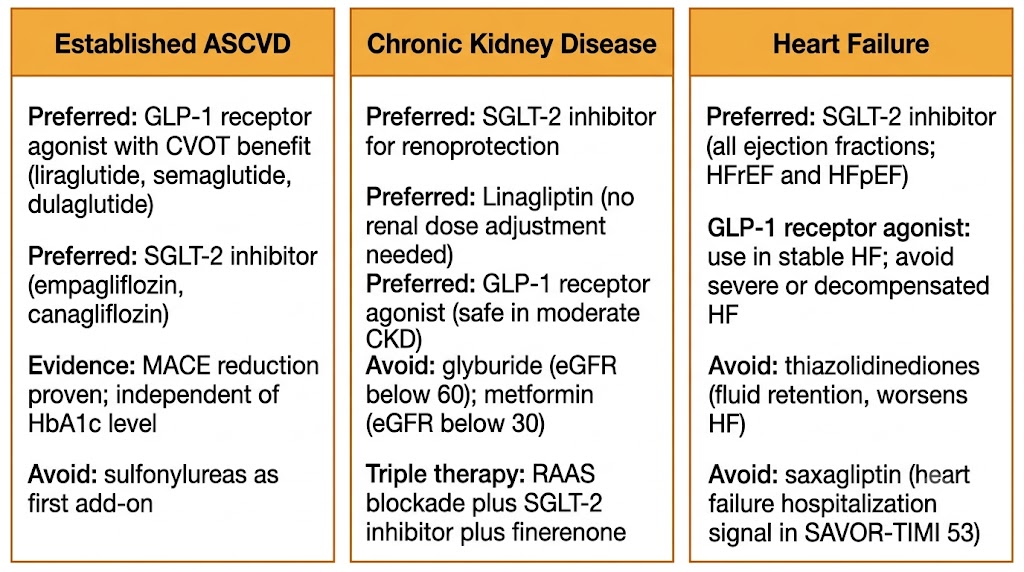
In patients with type 2 diabetes mellitus and established atherosclerotic cardiovascular disease — prior myocardial infarction, stroke, or symptomatic peripheral arterial disease — the choice of antihyperglycemic agent is driven primarily by cardiovascular outcome trial evidence, not by glycated hemoglobin level. Current guidelines position a glucagon-like peptide-1 receptor agonist with proven cardiovascular benefit or a sodium-glucose cotransporter-2 inhibitor with proven cardiovascular benefit as preferred agents in this population, often regardless of baseline glycated hemoglobin or whether metformin has been tried first.
The cardiovascular outcome trial evidence is strongest for liraglutide (LEADER: 13 percent major adverse cardiovascular event reduction, 38 percent cardiovascular mortality reduction), semaglutide (SUSTAIN-6: 26 percent major adverse cardiovascular event reduction), and empagliflozin (EMPA-REG OUTCOME: 14 percent major adverse cardiovascular event reduction, 38 percent cardiovascular mortality reduction). The combination of a glucagon-like peptide-1 receptor agonist and a sodium-glucose cotransporter-2 inhibitor is increasingly used and provides complementary mechanisms — the glucagon-like peptide-1 receptor agonist adds weight loss and antiatherosclerotic effects, while the sodium-glucose cotransporter-2 inhibitor adds hemodynamic benefits and renal protection.
First priority: add a glucagon-like peptide-1 receptor agonist with proven cardiovascular benefit (liraglutide, semaglutide, dulaglutide) or a sodium-glucose cotransporter-2 inhibitor with proven cardiovascular benefit (empagliflozin, canagliflozin, dapagliflozin), independent of glycated hemoglobin level.
Metformin: continue if tolerated; not required before adding cardiorenal protective agents.
Avoid: sulfonylureas as initial add-on in this population (cardiovascular neutral at best, weight gain, hypoglycemia).
DPP-4 inhibitors: cardiovascular neutral — acceptable but not preferred over agents with proven benefit.
Chronic kidney disease is both a complication and a risk multiplier in type 2 diabetes mellitus — it increases cardiovascular risk, limits drug options, and creates a dangerous hypoglycemia-prone environment. Drug selection in this population is guided by three priorities: slowing chronic kidney disease progression, reducing cardiovascular risk, and avoiding agents that accumulate or cause hypoglycemia in renal impairment.
Sodium-glucose cotransporter-2 inhibitors are the cornerstone of renoprotection in diabetic chronic kidney disease with proteinuria. The CREDENCE trial (canagliflozin) and DAPA-CKD trial (dapagliflozin) demonstrated 30 to 44 percent reductions in the composite renal endpoint of estimated glomerular filtration rate decline, end-stage kidney disease, or renal death in patients already on maximum renin-angiotensin-aldosterone system blockade. These agents are now guideline-recommended as add-on therapy to renin-angiotensin-aldosterone system blockade in patients with type 2 diabetes mellitus and proteinuric chronic kidney disease regardless of glycated hemoglobin. Importantly, cardiorenal protection persists at estimated glomerular filtration rate values as low as 20 to 25 mL/min even when glycemic benefit is negligible.
Finerenone, a non-steroidal mineralocorticoid receptor antagonist, has demonstrated renal and cardiovascular protection in diabetic chronic kidney disease in the FIDELIO-DKD and FIGARO-DKD trials when added to renin-angiotensin-aldosterone system blockade — including in patients already on sodium-glucose cotransporter-2 inhibitors, suggesting additive benefit. The combination of renin-angiotensin-aldosterone system blockade plus sodium-glucose cotransporter-2 inhibitor plus finerenone is emerging as a triple-therapy standard for proteinuric diabetic chronic kidney disease.
Renal impairment increases hypoglycemia risk through multiple mechanisms: reduced insulin clearance prolongs insulin action; reduced gluconeogenesis substrate delivery impairs counter-regulatory glucose recovery; sulfonylurea active metabolites (especially glyburide) accumulate. Preferred agents in advanced chronic kidney disease: insulin (with dose reduction), linagliptin (no renal dose adjustment), glucagon-like peptide-1 receptor agonists (most safe in moderate chronic kidney disease). Avoid: glyburide at any estimated glomerular filtration rate below 60 mL/min; metformin below 30 mL/min.
Heart failure is both a common comorbidity and a treatment target in type 2 diabetes mellitus. The pharmacological approach differs by ejection fraction and requires awareness of which antihyperglycemic agents worsen heart failure versus which provide proven benefit.
Sodium-glucose cotransporter-2 inhibitors are the preferred antihyperglycemic agents in type 2 diabetes mellitus with heart failure across the ejection fraction spectrum. In heart failure with reduced ejection fraction, DAPA-HF and EMPEROR-Reduced demonstrated approximately 25 percent reductions in cardiovascular death or worsening heart failure. In heart failure with preserved ejection fraction, EMPEROR-Preserved and DELIVER demonstrated benefit of empagliflozin and dapagliflozin respectively. These agents are now classified as heart failure medications in their own right, recommended by cardiology guidelines independently of their antihyperglycemic role.
Glucagon-like peptide-1 receptor agonists have a more complex relationship with heart failure. While liraglutide, semaglutide, and dulaglutide reduce heart failure hospitalization in the cardiovascular outcome trials, the FIGHT trial (liraglutide in advanced heart failure with reduced ejection fraction) showed no benefit and a trend toward harm in patients with severe heart failure. Current guidance is to use glucagon-like peptide-1 receptor agonists with caution in severe or decompensated heart failure but not to avoid them in stable mild-to-moderate heart failure with reduced ejection fraction.
Thiazolidinediones (pioglitazone, rosiglitazone): contraindicated in New York Heart Association class III and IV heart failure — fluid retention directly worsens heart failure. Saxagliptin: increased heart failure hospitalization in SAVOR-TIMI 53 — avoid in patients with heart failure if alternatives exist. Alogliptin: similar signal in EXAMINE trial. Metformin: historically contraindicated in heart failure due to lactic acidosis concern, but this restriction has been substantially relaxed — current evidence supports metformin use in stable compensated heart failure with preserved renal function.
Insulin is the pharmacological standard of care for both pre-existing diabetes mellitus in pregnancy and gestational diabetes mellitus requiring drug therapy. No oral antihyperglycemic agent has the safety database of insulin in pregnancy, and most are either contraindicated or used only when insulin is not feasible or acceptable to the patient.
Gestational diabetes mellitus is diagnosed by oral glucose tolerance testing, typically at 24 to 28 weeks of gestation, using either the one-step (75 g glucose, fasting plus 1-hour plus 2-hour values) or two-step approach (50 g non-fasting screen followed by 100 g diagnostic test if screen positive). The glucose targets during pregnancy are tighter than standard diabetes targets: fasting below 95 mg/dL, 1-hour postprandial below 140 mg/dL, 2-hour postprandial below 120 mg/dL. Approximately 70 to 85 percent of gestational diabetes mellitus cases are managed with dietary modification alone; the remainder require pharmacological therapy.
When pharmacological therapy is needed for gestational diabetes mellitus, insulin is first-line. Metformin has the most evidence among oral agents — the MiG trial showed comparable glycemic control to insulin with lower maternal weight gain and lower neonatal hypoglycemia, but metformin crosses the placenta and long-term follow-up data on offspring are incomplete. Glyburide has been used but meta-analyses show increased neonatal hypoglycemia and macrosomia compared with insulin, and most major guidelines now discourage its routine use. Glucagon-like peptide-1 receptor agonists, sodium-glucose cotransporter-2 inhibitors, and thiazolidinediones are contraindicated or not recommended in pregnancy due to insufficient safety data.
Preferred rapid-acting analogs: lispro and aspart (most safety data). Regular insulin: also acceptable. Basal insulin: neutral protamine Hagedorn is most studied; glargine used in clinical practice with acceptable safety record; degludec not recommended (insufficient data). Insulin requirements rise progressively through the second and third trimester, often doubling by term, then fall abruptly within 24 to 48 hours after delivery as placental hormones clear. Gestational diabetes mellitus typically resolves postpartum but confers a 40 to 60 percent lifetime risk of developing type 2 diabetes mellitus — retest with fasting glucose or oral glucose tolerance test at 6 to 12 weeks postpartum and annually thereafter.
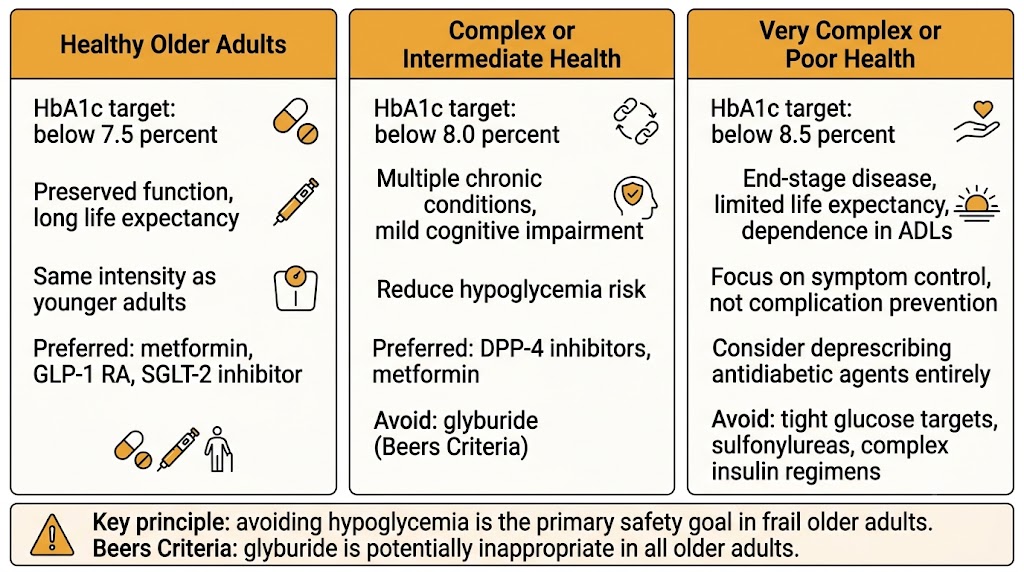
Diabetes management in older adults requires individualization of glycemic targets based on functional status, cognitive function, life expectancy, and the balance between the harms of hypoglycemia and the benefits of tight glucose control. For many older adults, avoiding hypoglycemia is a higher priority than achieving the tightest possible glycated hemoglobin level.
The American Diabetes Association stratifies glycemic targets by health status in older adults. Healthy older adults with preserved function and long life expectancy: glycated hemoglobin target below 7.5 percent — similar to younger adults. Complex or intermediate health (multiple chronic conditions, mild cognitive impairment, functional limitations): glycated hemoglobin target below 8.0 percent. Very complex or poor health (end-stage organ disease, moderate-to-severe cognitive impairment, dependence in activities of daily living, limited life expectancy): glycated hemoglobin target below 8.5 percent — the focus shifts entirely to symptom management and avoidance of hypoglycemia, with consideration of deprescribing antihyperglycemic agents entirely if the patient cannot safely recognize or respond to hypoglycemia.
Drug selection in older adults prioritizes agents with low hypoglycemia risk. Metformin remains appropriate in healthy older adults with preserved renal function. Glucagon-like peptide-1 receptor agonists and sodium-glucose cotransporter-2 inhibitors are preferred add-on agents when cardiovascular or renal benefit is desired. Dipeptidyl peptidase-4 inhibitors are well tolerated and weight neutral. Sulfonylureas — particularly glyburide — are on the Beers Criteria as potentially inappropriate in older adults due to prolonged hypoglycemia risk. Insulin can be used when needed but requires careful patient selection given the cognitive and functional demands of insulin self-management.
Consider deprescribing antihyperglycemic agents in older adults with: glycated hemoglobin well below target suggesting overtreatment; recurrent hypoglycemia; cognitive impairment preventing safe self-management; limited life expectancy where microvascular complication prevention is no longer relevant. Sulfonylureas and insulin should be reduced or stopped first. Metformin and agents without hypoglycemia risk (glucagon-like peptide-1 receptor agonists, dipeptidyl peptidase-4 inhibitors, sodium-glucose cotransporter-2 inhibitors) can often be continued at lower doses for symptom control and cardiorenal benefit.
| Author / Organization | Title | Source |
|---|---|---|
| American Diabetes Association | Standards of Care in Diabetes—2024 | Diabetes Care. 2024;47(Suppl 1):S1–S321 |
| Marso SP et al (LEADER) | Liraglutide and cardiovascular outcomes in type 2 diabetes | N Engl J Med. 2016;375(4):311–322 |
| Zinman B et al (EMPA-REG OUTCOME) | Empagliflozin, cardiovascular outcomes, and mortality in type 2 diabetes | N Engl J Med. 2015;373(22):2117–2128 |
| Moen MF et al | Frequency of hypoglycemia and its significance in chronic kidney disease | Clin J Am Soc Nephrol. 2009;4(6):1121–1127 |
| Perkovic V et al (CREDENCE) | Canagliflozin and renal outcomes in type 2 diabetes and nephropathy | N Engl J Med. 2019;380(24):2295–2306 |
| Bakris GL et al (FIDELIO-DKD) | Effect of finerenone on chronic kidney disease outcomes in type 2 diabetes | N Engl J Med. 2020;383(23):2219–2229 |
| McMurray JJV et al (DAPA-HF) | Dapagliflozin in patients with heart failure and reduced ejection fraction | N Engl J Med. 2019;381(21):1995–2008 |
| Scirica BM et al (SAVOR-TIMI 53) | Saxagliptin and cardiovascular outcomes in patients with type 2 diabetes mellitus | N Engl J Med. 2013;369(14):1317–1326 |
| Margulies KB et al (FIGHT) | Effects of liraglutide on clinical stability among patients with advanced heart failure and reduced ejection fraction | JAMA. 2016;316(5):500–508 |
| American College of Obstetricians and Gynecologists | ACOG Practice Bulletin No. 190: Gestational Diabetes Mellitus | Obstet Gynecol. 2018;131(2):e49–e64 |
| Rowan JA et al (MiG Trial) | Metformin versus insulin for the treatment of gestational diabetes | N Engl J Med. 2008;358(19):2003–2015 |
| American Diabetes Association | Older Adults: Standards of Care in Diabetes—2024 | Diabetes Care. 2024;47(Suppl 1):S244–S257 |
| American Geriatrics Society | 2023 updated AGS Beers Criteria for potentially inappropriate medication use in older adults | J Am Geriatr Soc. 2023;71(7):2052–2081 |