How obstetric ergot alkaloids act on uterine smooth muscle, and what distinguishes them from other ergot derivatives
Among all the ergot alkaloids, ergonovine and its semi-synthetic derivative methylergonovine stand apart by their relatively selective action on uterine smooth muscle. While they share the lysergic acid backbone and multi-receptor profile of the broader ergot class, their predominant clinical effect at obstetric doses is powerful, sustained uterine contraction — which is precisely what is needed to control postpartum hemorrhage.
Ergonovine (also called ergometrine) and methylergonovine are ergot alkaloids classified as uterotonics — drugs that stimulate uterine smooth muscle contraction. Methylergonovine is the methyl derivative of ergonovine and is the agent most widely used in the United States. Both are direct-acting agents, meaning they stimulate the uterus directly rather than through an intermediate hormonal pathway.
This classification places them in the same functional category as oxytocin and the prostaglandins (carboprost and misoprostol), all of which are used to manage postpartum hemorrhage. However, each of these agents works through a different receptor mechanism, which explains why they can be used sequentially or in combination when a single agent is insufficient.
Methylergonovine produces uterine contraction primarily through two receptor mechanisms acting simultaneously on myometrial smooth muscle cells. First, alpha-adrenergic receptor activation increases intracellular calcium, triggering smooth muscle contraction. Second, serotonin type 2 receptor activation reinforces this contractile effect through a parallel calcium-dependent pathway. The result is a sustained, tetanic contraction of the uterus — qualitatively different from the rhythmic, wave-like contractions that oxytocin produces.
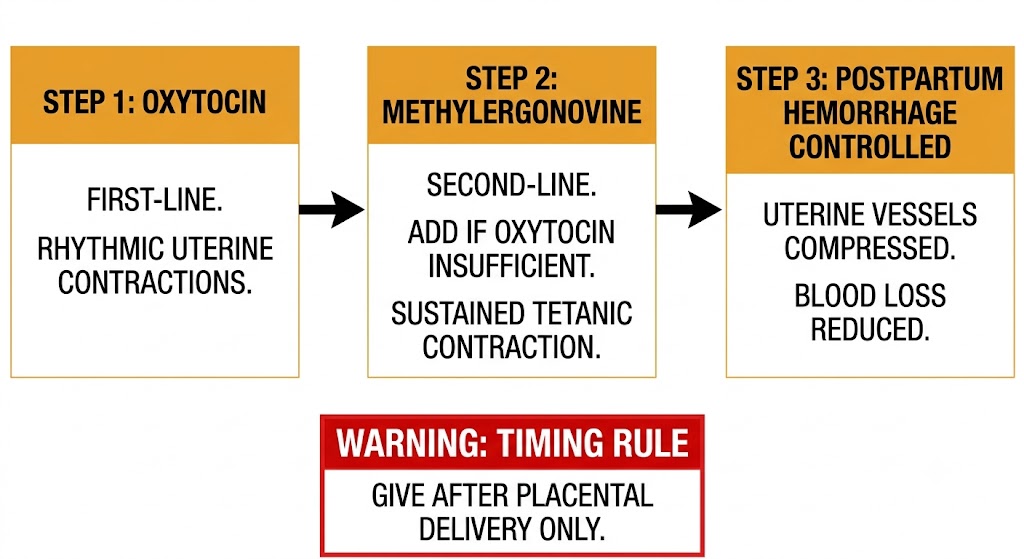
This distinction matters clinically. Oxytocin produces rhythmic contractions that allow uterine relaxation between contractions, preserving some blood flow through the uterine vasculature. Methylergonovine produces sustained contraction that mechanically compresses the uterine blood vessels more continuously, which is more effective at controlling hemorrhage but also means that the uterus remains contracted without the intermittent relaxation that oxytocin provides.
Methylergonovine activates alpha-adrenergic and serotonin type 2 receptors on uterine smooth muscle → sustained tetanic contraction → mechanical compression of uterine blood vessels → reduced postpartum blood loss. Effect is direct and does not depend on endogenous oxytocin or prostaglandins.
Indications, route of administration, timing of use, and the relationship between methylergonovine and first-line oxytocin therapy
Postpartum hemorrhage — defined as blood loss greater than 500 milliliters after vaginal delivery or greater than 1000 milliliters after cesarean delivery — is one of the leading causes of maternal mortality worldwide. Methylergonovine is a second-line uterotonic agent used when first-line therapy with oxytocin is insufficient to achieve adequate uterine tone.
The primary indication for methylergonovine is the prevention and treatment of postpartum hemorrhage due to uterine atony — the failure of the uterus to contract adequately after delivery of the placenta. Uterine atony accounts for approximately 80 percent of postpartum hemorrhage cases and is the most common indication for uterotonic therapy.
Methylergonovine is administered after delivery of the placenta, not before or during placental delivery. This timing is important: giving the drug before the placenta has been delivered risks trapping the placenta in a contracted uterus, which complicates the third stage of labor and can convert a normal delivery into an obstetric emergency.
Methylergonovine is administered by intramuscular injection for routine postpartum hemorrhage prevention and treatment. The intramuscular route provides reliable absorption with onset of action within two to five minutes. An oral formulation is available for maintenance therapy — continuing uterine tone after the acute postpartum period — but is not used for acute hemorrhage control.
Intravenous administration is possible in emergencies but carries a substantially higher risk of severe hypertension and cardiovascular complications because the rapid delivery of drug to central receptors produces intense vasoconstriction. When intravenous administration is used, it must be given slowly and with careful blood pressure monitoring. The intramuscular route is preferred for all non-emergency situations.
Oxytocin is the first-line uterotonic agent for both prevention and treatment of postpartum hemorrhage. It is used routinely at the time of placental delivery in active management of the third stage of labor. When oxytocin alone does not produce adequate uterine tone — or when postpartum hemorrhage develops despite oxytocin — methylergonovine is added as a second-line agent.
The complementary receptor mechanisms of the two drugs make them a logical pairing: oxytocin acts through its own receptor on the myometrium, while methylergonovine acts through alpha-adrenergic and serotonin type 2 receptors. These are pharmacologically distinct pathways, so the drugs can be used together without competing for the same receptor.
Why hypertension is an absolute contraindication, and what other patient conditions preclude safe use of obstetric ergot alkaloids
The contraindication profile of methylergonovine is driven directly by its vasoconstrictor mechanism. The same alpha-adrenergic and serotonin type 2 receptor activation that contracts the uterus also contracts blood vessels throughout the body — a property that is dangerous in patients whose cardiovascular system cannot tolerate a sudden increase in peripheral vascular resistance.
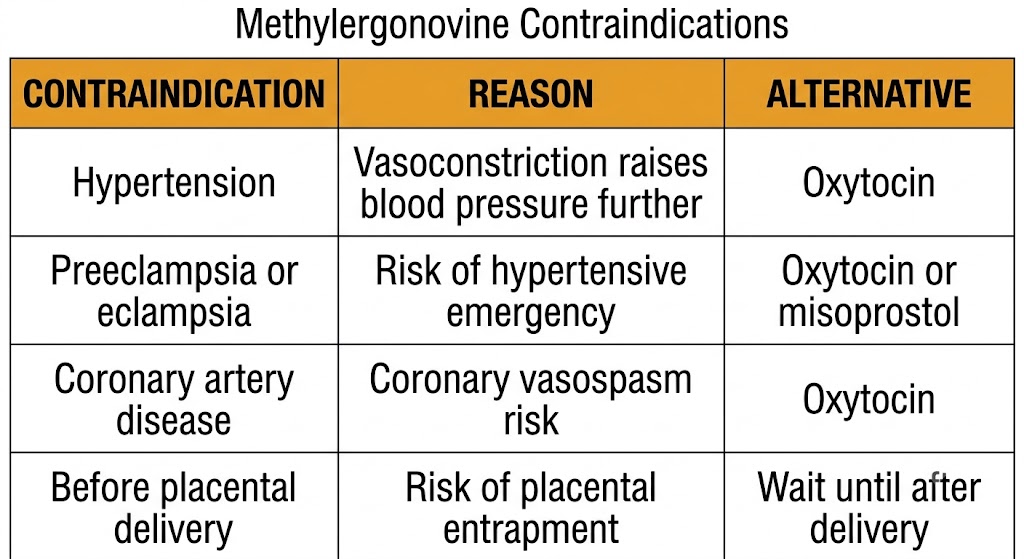
Hypertension in any form is an absolute contraindication to methylergonovine. This includes chronic hypertension, gestational hypertension, preeclampsia, and eclampsia. The mechanism is straightforward: methylergonovine produces systemic vasoconstriction that raises peripheral vascular resistance and increases blood pressure. In a patient whose blood pressure is already elevated, this additional increase can trigger hypertensive emergency — severe headache, visual changes, stroke, or hypertensive encephalopathy.
Preeclampsia requires special emphasis because it is the hypertensive condition most commonly encountered in the obstetric setting where methylergonovine would otherwise be indicated. The combination of preeclampsia and postpartum hemorrhage presents a clinical dilemma: the patient needs a uterotonic agent, but methylergonovine is contraindicated. In this situation, oxytocin remains safe and is the appropriate choice. Carboprost or misoprostol are used if additional uterotonic therapy is needed beyond oxytocin.
Methylergonovine is absolutely contraindicated in hypertension including preeclampsia and eclampsia. Vasoconstriction from the drug raises blood pressure further and can precipitate hypertensive emergency, stroke, or cardiovascular collapse in patients with pre-existing elevated blood pressure.
Peripheral vascular disease and coronary artery disease are contraindications for the same reason as hypertension: the vasoconstrictor effect of methylergonovine reduces blood flow in vessels that are already compromised by atherosclerosis or vasospasm. In patients with coronary artery disease, methylergonovine can trigger coronary vasospasm and myocardial ischemia.
Use before delivery of the placenta is contraindicated because of the risk of trapping the placenta in a firmly contracted uterus. This is a timing contraindication rather than a patient characteristic contraindication, but it is equally absolute in clinical practice.
The adverse effect profile of obstetric ergot alkaloids at therapeutic doses, and the cytochrome P450 3A4 interaction that applies to this subclass as much as to the migraine ergots
At the doses used for postpartum hemorrhage management, methylergonovine is generally well tolerated in patients without cardiovascular contraindications. The adverse effects that occur reflect the drug’s vasoconstrictor mechanism and its dopaminergic activity on the gastrointestinal system.
Hypertension is the most clinically significant adverse effect and occurs even in patients without pre-existing hypertension, though it is usually transient at therapeutic doses. Blood pressure should be monitored during and after administration. Patients who develop significant hypertension after methylergonovine require blood pressure management and should not receive repeat dosing.
Nausea and vomiting are common and reflect dopaminergic stimulation of the chemoreceptor trigger zone in the medulla — the same mechanism that produces nausea with other ergot alkaloids. These effects are generally self-limiting and manageable with antiemetic therapy. Headache may also occur and reflects the vasoconstrictor effect on cranial blood vessels.
Methylergonovine is metabolized by cytochrome P450 3A4, and potent inhibitors of this enzyme substantially raise its plasma concentration. The same drug interaction that causes ergotism with ergotamine and dihydroergotamine applies here: macrolide antibiotics (erythromycin, clarithromycin), azole antifungal agents (itraconazole, ketoconazole), and human immunodeficiency virus protease inhibitors (ritonavir) all inhibit cytochrome P450 3A4 and can produce dangerous elevations in methylergonovine levels.
In the obstetric context, this interaction is especially relevant because postpartum patients may be receiving antibiotic prophylaxis. Erythromycin and clarithromycin are contraindicated in combination with methylergonovine. Azithromycin, which does not significantly inhibit cytochrome P450 3A4, is the preferred macrolide when antibiotic therapy is needed alongside methylergonovine.
Methylergonovine + erythromycin or clarithromycin = contraindicated. Cytochrome P450 3A4 inhibition raises methylergonovine plasma concentrations → severe vasoconstriction and hypertension. Use azithromycin instead when a macrolide antibiotic is needed in the postpartum period.
| Author / Organization | Title | Source |
|---|---|---|
| de Groot AN, van Dongen PW, Vree TB, Hekster YA, van Roosmalen J | Ergot alkaloids: current status and review of clinical pharmacology and therapeutic use compared with other oxytocics in obstetrics and gynaecology | Drugs. 1998;56(4):523–535 |
| American College of Obstetricians and Gynecologists | ACOG Practice Bulletin No. 183: Postpartum Hemorrhage | Obstet Gynecol. 2017;130(4):e168–e186 |
| Begley CM, Gyte GM, Devane D, McGuire W, Weeks A, Biesty LM | Active versus expectant management for women in the third stage of labour | Cochrane Database Syst Rev. 2019;2(2):CD007412 |
| World Health Organization | WHO recommendations for the prevention and treatment of postpartum haemorrhage | Geneva: WHO; 2012 |
| Anderson JM, Etches D | Prevention and management of postpartum hemorrhage | Am Fam Physician. 2007;75(6):875–882 |
| Moir DD, Amoa AB | Ergometrine or oxytocin? Blood loss and side-effects at spontaneous vertex delivery | Br J Anaesth. 1979;51(2):113–117 |
| Dresser GK, Spence JD, Bailey DG | Pharmacokinetic-pharmacodynamic consequences and clinical relevance of cytochrome P450 3A4 inhibition | Clin Pharmacokinet. 2000;38(1):41–57 |
| Fuchs AR, Fuchs F | Endocrinology of human parturition: a review | Br J Obstet Gynaecol. 1984;91(10):948–967 |
| Collins PW, Bell SF, de Lloyd L, Collis RE | Management of postpartum haemorrhage: from research into practice, a narrative review of the literature and the Cardiff experience | Int J Obstet Anesth. 2019;37:106–114 |