Anti-tumor necrosis factor biologics, JAK inhibitors, gut-selective biologics, and therapeutic drug monitoring
GAST · Module 4 of 8Infliximab, adalimumab, certolizumab pegol, and golimumab — mechanism of tumor necrosis factor neutralization, immunogenicity and anti-drug antibody formation, combination therapy with thiopurines, pre-biologic screening, and the biosimilar landscape
Anti-tumor necrosis factor biologics were the first targeted therapies approved for inflammatory bowel disease and remain the most widely used advanced therapies. They neutralize tumor necrosis factor-alpha, a central pro-inflammatory cytokine in both ulcerative colitis and Crohn's disease. Their efficacy is well established, but systematic pre-treatment screening and monitoring are mandatory.
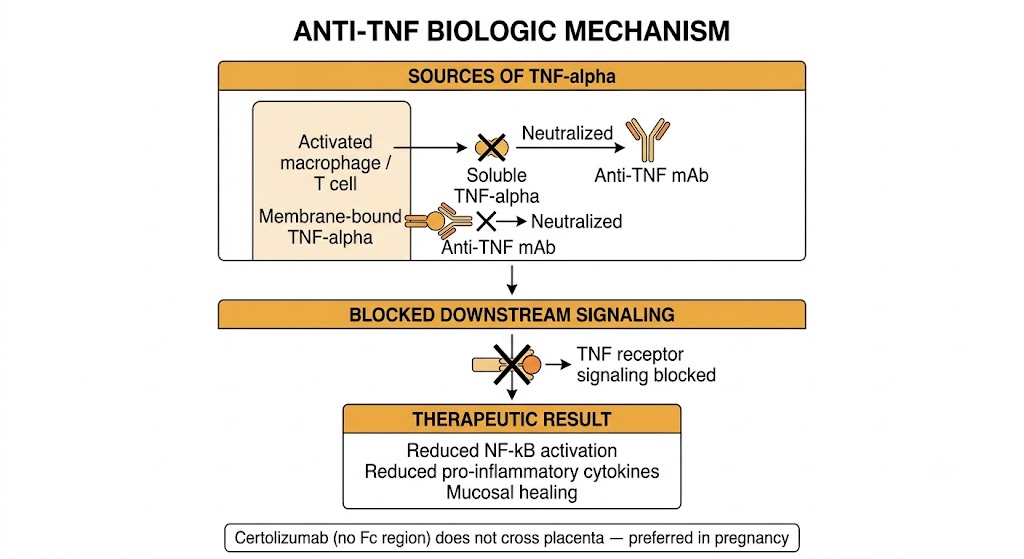
Infliximab is a chimeric (25 percent murine, 75 percent human) immunoglobulin G1 monoclonal antibody given by intravenous infusion at 5 milligrams per kilogram at weeks 0, 2, and 6 for induction, then every 8 weeks for maintenance. Its chimeric structure makes it more immunogenic than fully human agents; anti-drug antibodies form against the murine component and are the primary mechanism of secondary loss of response. Biosimilars to infliximab are available and have equivalent efficacy and safety in switching studies; biosimilar substitution is standard in most health systems.
Adalimumab is a fully human immunoglobulin G1 monoclonal antibody administered subcutaneously, with lower immunogenicity than infliximab and the convenience of self-injection. Certolizumab pegol is a polyethylene glycol-conjugated Fab' fragment lacking the Fc region; because the Fc region mediates placental transfer via the neonatal Fc receptor, certolizumab does not cross the placenta and is the preferred anti-tumor necrosis factor agent when therapy must continue during the third trimester of pregnancy. Golimumab is a fully human anti-tumor necrosis factor monoclonal antibody approved specifically for ulcerative colitis, with monthly maintenance subcutaneous dosing.
Combining anti-tumor necrosis factor biologics with azathioprine or 6-mercaptopurine reduces formation of anti-drug antibodies against the biologic, increases trough drug concentrations, and improves long-term clinical outcomes. This was demonstrated for infliximab in the SONIC trial and for adalimumab in controlled studies. However, combination immunosuppression increases the risk of opportunistic infections and, importantly, hepatosplenic T-cell lymphoma — a rare but almost always fatal malignancy reported almost exclusively in young males on long-term combined anti-tumor necrosis factor plus thiopurine therapy. After 2 years of combination therapy in patients who are in deep remission, consideration of withdrawing the immunomodulator while continuing the biologic is reasonable.
All anti-tumor necrosis factor agents carry a class-wide requirement for pre-treatment infectious screening. Tumor necrosis factor-alpha is essential for maintaining granuloma integrity; neutralizing it releases viable mycobacteria from quiescent granulomas, causing reactivation tuberculosis. A tuberculin skin test or interferon-gamma release assay plus chest X-ray must be performed before starting any anti-tumor necrosis factor agent; latent tuberculosis must be treated for at least 4 weeks before starting the biologic. Hepatitis B surface antigen, antibody to hepatitis B core antigen, and antibody to hepatitis B surface antigen must be checked; hepatitis B surface antigen-positive patients require antiviral prophylaxis throughout biologic therapy. All live vaccines are contraindicated once biologics are started; vaccination should be updated before initiating therapy.
Tuberculosis: tuberculin skin test or interferon-gamma release assay plus chest X-ray. Treat latent tuberculosis at least 4 weeks before starting. Hepatitis B: hepatitis B surface antigen, antibody to hepatitis B core antigen, antibody to hepatitis B surface antigen. Hepatitis B surface antigen-positive patients need antiviral prophylaxis. Hepatitis C: screen. Varicella immunity: vaccinate if non-immune before starting (live vaccine contraindicated once biologics are active). Update all vaccinations. Document screening in the medical record.
JAK-STAT signaling as the mechanistic target, oral bioavailability and rapid onset as advantages over biologics, the 2022 FDA black box warning for cardiovascular events and malignancy, and the cardiovascular risk stratification required before prescribing
JAK inhibitors are oral small-molecule immunosuppressants that block intracellular JAK-STAT signaling downstream of multiple cytokine receptors simultaneously. Their oral route, rapid onset, and lack of immunogenicity offer practical advantages over biologics, but a class-wide cardiovascular and malignancy safety signal requires careful patient selection.
The Janus kinase family — JAK1, JAK2, JAK3, and TYK2 — pairs in combinations to transduce signals from cytokines including interleukin-6, interleukin-12, interleukin-23, and the common gamma chain cytokines that drive T-cell differentiation and mucosal inflammation. JAK inhibitors block these receptors' intracellular signaling simultaneously, suppressing multiple cytokine-driven pathways with a single oral drug. Unlike biologics, JAK inhibitors are small molecules with reliable oral bioavailability, rapid onset of action measurable within days, and no immunogenicity because they are not recognized as foreign proteins.
Tofacitinib is a pan-JAK inhibitor with relative selectivity for JAK1 and JAK3, approved for moderate to severe ulcerative colitis. Upadacitinib is a selective JAK1 inhibitor approved for both ulcerative colitis and Crohn's disease; JAK1 selectivity was designed to reduce JAK2-mediated adverse effects such as anemia and neutropenia. In clinical trials, upadacitinib demonstrated induction and maintenance efficacy comparable or superior to adalimumab for both conditions.
A post-marketing safety trial comparing tofacitinib with tumor necrosis factor inhibitors in rheumatoid arthritis patients aged 50 years or older with at least one cardiovascular risk factor found increased incidence of major adverse cardiovascular events including myocardial infarction and stroke, malignancy particularly lung cancer, and venous thromboembolism with tofacitinib. The FDA applied a class-wide black box warning to all approved JAK inhibitors in 2022, stating they should be used only in patients who have had an inadequate response or intolerance to tumor necrosis factor inhibitors, and should be avoided in patients with known cardiovascular risk factors, active malignancy, or prior thromboembolism history unless no adequate alternatives exist. Herpes zoster reactivation occurs at higher rates with JAK inhibitors than with biologics; recombinant zoster vaccine should be given before or as early as possible after starting JAK inhibitor therapy.
Use JAK inhibitors only after inadequate response or intolerance to at least one tumor necrosis factor inhibitor. Screen for cardiovascular risk factors, active malignancy, and prior venous thromboembolism before prescribing. Avoid in patients aged 50 or older with cardiovascular risk factors when alternatives exist. Vaccinate against herpes zoster before starting. Monitor lipids — mild low-density lipoprotein elevation occurs with JAK inhibitors and should be managed per standard cardiovascular risk reduction principles.
Vedolizumab's alpha-4-beta-7 integrin blockade and favorable infection profile, ustekinumab's dual interleukin-12 and interleukin-23 p40 blockade, and risankizumab's selective interleukin-23 p19 blockade
Gut-selective biologics offer meaningful safety advantages over systemic anti-tumor necrosis factor agents, particularly for patients at elevated infection risk. Understanding the mechanistic basis of their gut selectivity explains both their favorable adverse effect profiles and their slower onset of action in Crohn's disease.
Vedolizumab is a humanized immunoglobulin G1 monoclonal antibody that selectively blocks the alpha-4-beta-7 integrin on gut-homing lymphocytes, preventing their interaction with mucosal addressin cell adhesion molecule-1 on intestinal vascular endothelium and blocking their trafficking to the gastrointestinal mucosa. Because alpha-4-beta-7 integrin is expressed predominantly on gut-homing rather than systemic memory T cells, vedolizumab's immunosuppressive effect is compartmentalized to the gut. This produces a systemic infection and malignancy risk profile that is substantially more favorable than systemic biologics — large post-marketing datasets show no increase in serious systemic infections compared with baseline inflammatory bowel disease rates. Vedolizumab does not require latent tuberculosis screening. It is approved for both ulcerative colitis and Crohn's disease and is the preferred biologic in patients at elevated infection risk including elderly patients and those with prior serious infections.
The trade-off is slower onset of action than anti-tumor necrosis factor agents, particularly in Crohn's disease where clinical response may not be apparent until weeks 10 to 14. This limits its use in acutely severe disease requiring rapid response.
Ustekinumab is a fully human immunoglobulin G1 monoclonal antibody that binds the p40 subunit shared by interleukin-12 and interleukin-23, blocking both cytokines simultaneously. Interleukin-12 drives interferon-gamma production by Th1 cells; interleukin-23 maintains Th17 cells producing interleukin-17 and interleukin-22, key mediators of mucosal inflammation in inflammatory bowel disease. Ustekinumab is given as a single weight-based intravenous induction dose followed by subcutaneous maintenance every 8 or 12 weeks. It has an excellent safety profile with no increased tuberculosis reactivation risk and a favorable infection profile comparable to vedolizumab. It is approved for both Crohn's disease and ulcerative colitis.
Risankizumab selectively blocks the interleukin-23 p19 subunit, inhibiting only interleukin-23 without affecting interleukin-12. This selective approach is based on evidence that the Th17 pathway driven by interleukin-23 is the dominant pathological mechanism in both Crohn's disease and ulcerative colitis, while preserving interleukin-12-dependent protective antiviral and antimycobacterial immunity. Risankizumab is approved for moderate to severe Crohn's disease and ulcerative colitis, with intravenous induction at weeks 0, 4, and 8 followed by subcutaneous maintenance every 8 weeks. Safety data show no unexpected infection or malignancy signals.
Alpha-4-beta-7 integrin is expressed predominantly on gut-homing lymphocytes, not systemic lymphocytes. Blocking it suppresses gut mucosal immune trafficking while leaving systemic immune surveillance largely intact. In practice: no latent tuberculosis screening required, no increase in systemic serious infections, no dose modification needed in elderly patients on clinical grounds alone. Preferred biologic when infection risk is elevated. The trade-off: slower onset than anti-tumor necrosis factor agents, particularly in Crohn's disease.
Proactive versus reactive therapeutic drug monitoring, primary non-response versus secondary loss of response, anti-drug antibodies and low trough concentrations as distinct mechanisms requiring different management strategies, and practical biologic positioning in ulcerative colitis and Crohn's disease
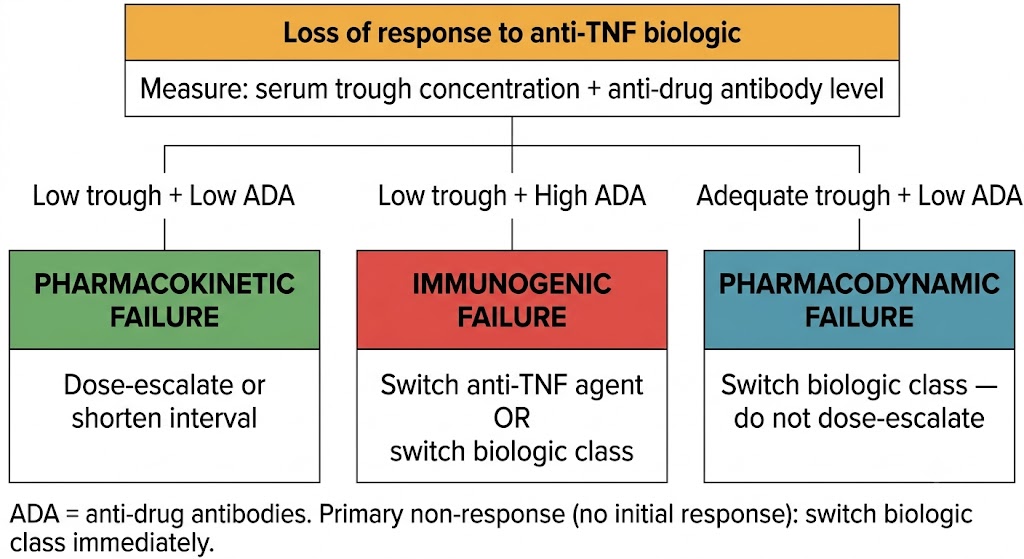
Therapeutic drug monitoring — measuring serum trough drug concentrations and anti-drug antibody levels — is the key tool for managing loss of response to biologic therapy. The mechanism of loss of response determines the next step, and measuring drug levels before making that decision is essential.
Secondary loss of response — loss of clinical benefit after initial successful maintenance — affects approximately 40 to 50 percent of anti-tumor necrosis factor-treated patients over 5 years. Three distinct mechanisms must be distinguished because each requires a different therapeutic response. Pharmacokinetic failure (low trough concentration with low or absent anti-drug antibodies) results from drug clearance outpacing dosing; management is dose escalation or interval shortening. Immunogenic failure (low trough concentration with high anti-drug antibodies) results from anti-drug antibody-mediated drug clearance; management is switching to a different anti-tumor necrosis factor agent or a different biologic class. Pharmacodynamic failure (adequate trough concentration despite loss of response) indicates that tumor necrosis factor is no longer the dominant driver of inflammation; management requires switching to a different biologic class. Measuring trough and anti-drug antibody levels before deciding on the next step distinguishes all three mechanisms.
Primary non-response — failure to achieve meaningful response within 8 to 14 weeks at standard induction doses — indicates that the target mechanism is not the dominant driver of inflammation in that patient. Switching to a different biologic class is appropriate; dose escalation of the same agent is not.
For both ulcerative colitis and Crohn's disease requiring advanced therapy, anti-tumor necrosis factor agents, vedolizumab, and ustekinumab are all guideline-recommended first-line biologic options. Anti-tumor necrosis factor agents are preferred when rapid response is needed or when significant extraintestinal manifestations such as ankylosing spondylitis, uveitis, or pyoderma gangrenosum are present — these manifestations respond to anti-tumor necrosis factor or ustekinumab, but vedolizumab's gut selectivity means it does not reliably treat extra-intestinal disease. Vedolizumab and ustekinumab are preferred in patients with elevated infection risk. JAK inhibitors are second-line options for ulcerative colitis after inadequate anti-tumor necrosis factor response, per the black box warning.
In pregnancy, certolizumab pegol is preferred among anti-tumor necrosis factor agents because it does not cross the placenta. Infliximab and adalimumab do cross the placenta in the third trimester via neonatal Fc receptor; infants born to mothers who received these agents after 22 weeks of gestation should not receive live vaccines until 6 months of age.
| Author / Organization | Title | Source |
|---|---|---|
| Colombel JF et al. | Infliximab, azathioprine, or combination therapy for Crohn's disease (SONIC trial) | N Engl J Med 2010;362(15):1383–1395 |
| Rahier JF et al. | Second European evidence-based consensus on the prevention, diagnosis and management of opportunistic infections in IBD | J Crohns Colitis 2014;8(6):443–468 |
| Ytterberg SR et al. | Cardiovascular and cancer risk with tofacitinib in rheumatoid arthritis (ORAL Surveillance) | N Engl J Med 2022;386(4):316–326 |
| Feagan BG et al. | Vedolizumab as induction and maintenance therapy for ulcerative colitis | N Engl J Med 2013;369(8):699–710 |
| Feagan BG et al. | Ustekinumab as induction and maintenance therapy for Crohn's disease | N Engl J Med 2016;375(20):1946–1960 |
| D'Haens G et al. | Risankizumab as induction therapy for Crohn's disease (ADVANCE and MOTIVATE) | Lancet 2022;399(10340):2015–2030 |
| Papamichael K et al. | Therapeutic drug monitoring of biologics in inflammatory bowel disease: unmet needs and future perspectives | Lancet Gastroenterol Hepatol 2022;7(2):171–185 |
| Lichtenstein GR et al. | ACG clinical guideline: management of Crohn's disease in adults | Am J Gastroenterol 2018;113(4):481–517 |