CHAPTER 31  ·  GONADAL & OVARIAN PHARMACOLOGY
Section 1
Hormone Therapy: Evidence and the Timing Rule
WHI findings, two distinct trial arms, and when hormone therapy is appropriate
Two WHI Arms — Two Different Risk Profiles

The Women's Health Initiative comprised two parallel trials. The first randomized women with an intact uterus to conjugated equine estrogens plus medroxyprogesterone acetate versus placebo; this arm was stopped early when breast cancer incidence in the hormone therapy group crossed the predefined stopping threshold. The second randomized hysterectomized women to conjugated equine estrogens alone versus placebo; this arm showed no increase in breast cancer — and a non-significant trend toward reduction.

These two arms must never be conflated. The breast cancer signal in the Women's Health Initiative came from the medroxyprogesterone acetate component, not from estrogen alone. Applying the combined arm risk data to other hormone therapy regimens — particularly transdermal estradiol plus micronized progesterone, which was not tested in the Women's Health Initiative — is not pharmacologically justified.

The Timing Rule

The cardiovascular risk-benefit of hormone therapy depends critically on when it is started relative to menopause. Women who begin hormone therapy within 10 years of menopause onset, or before age 60, show a neutral or favorable cardiovascular profile. Women who begin more than 10 years after menopause, or after age 60, show net cardiovascular harm — particularly increased coronary events and stroke. The Women's Health Initiative enrolled women with a mean age of 63, more than a decade past the mean menopause age of 51, which means the trial was not designed to answer the question most relevant to symptomatic perimenopausal women.

Current guidance holds that for healthy women under 60 or within 10 years of menopause who have bothersome vasomotor symptoms, the benefits of hormone therapy outweigh the risks in the absence of specific contraindications. Hormone therapy should not be withheld based on age alone if the woman is within this therapeutic window.

Progestin Type and Breast Cancer Risk

The type of progestin in a combined hormone therapy regimen modifies the breast cancer risk signal. Medroxyprogesterone acetate is associated with a breast cancer risk increase in combined hormone therapy regimens. Micronized progesterone is not associated with a statistically significant breast cancer risk increase in large observational datasets. When a woman with an intact uterus requires systemic progestin to protect the endometrium, micronized progesterone is the preferred choice in women prioritizing breast cancer risk minimization.

WHI: Never Conflate the Two Arms

Conjugated equine estrogens plus medroxyprogesterone acetate (intact uterus arm): breast cancer increased, coronary heart disease increased, stroke increased, venous thromboembolism increased. Conjugated equine estrogens alone (hysterectomized arm): no breast cancer increase, reduced hip fracture, stroke increased. The medroxyprogesterone acetate component drives the breast cancer signal. Transdermal estradiol plus micronized progesterone was not tested in the Women's Health Initiative — its risk profile cannot be inferred directly from either arm.


Section 2
Route-Dependent Risks and Regimen Selection
Oral vs. transdermal estrogen, progestin requirement, and the preferred regimen
Oral vs. Transdermal Estrogen: VTE Risk

As established in Module 1, oral estrogen exposes the liver to supraphysiological portal concentrations, stimulating coagulation factor synthesis and increasing venous thromboembolism risk approximately two to four times above non-user rates. Transdermal estradiol bypasses this portal exposure and does not increase venous thromboembolism risk at therapeutic doses in observational data. This route-risk difference is clinically decisive in women with venous thromboembolism risk factors — prior clot, thrombophilia, obesity — where transdermal estradiol is the preferred route if hormone therapy is indicated.
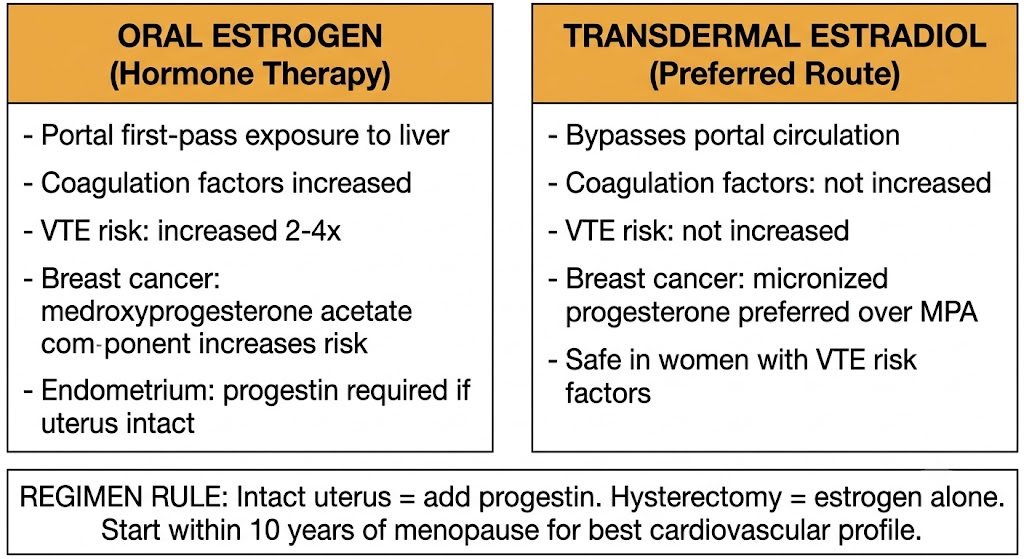
Two-panel diagram comparing oral estrogen hormone therapy (portal first-pass, VTE risk increased 2-4x, medroxyprogesterone acetate increases breast cancer risk, progestin required with intact uterus) versus transdermal estradiol (bypasses portal, VTE risk not increased, micronized progesterone preferred, safe with VTE risk factors) with shared regimen rule box.
Gemini AI illustration. Oral estrogen versus transdermal estradiol in hormone therapy: VTE risk, breast cancer risk, and regimen selection rules.
Progestin Requirement and Endometrial Protection

Women with an intact uterus must receive a progestin alongside systemic estrogen. Unopposed systemic estrogen produces endometrial hyperplasia and increases endometrial cancer risk substantially with prolonged use. The progestin component prevents this by opposing estrogen-driven endometrial proliferation and maintaining endometrial atrophy.

Women who have had a hysterectomy do not require progestin — estrogen alone is the appropriate regimen and avoids the additional risks associated with synthetic progestins.

The Evidence-Preferred Regimen

For women with a uterus who require systemic hormone therapy, the combination of transdermal estradiol and oral micronized progesterone carries the most favorable current safety evidence: venous thromboembolism-neutral (transdermal route), no significant breast cancer signal increase (micronized progesterone versus medroxyprogesterone acetate), and a cardiovascular-favorable profile when started within the timing window. This regimen was not used in the Women's Health Initiative, which tested oral conjugated equine estrogens plus medroxyprogesterone acetate — direct extrapolation of Women's Health Initiative risk data to this regimen is pharmacologically unjustified.

Regimen Selection Rules

Intact uterus: must add progestin to estrogen (endometrial protection). Hysterectomy: estrogen alone (no progestin needed). VTE risk factors: transdermal estradiol preferred (not oral). Breast cancer risk concern: micronized progesterone preferred over medroxyprogesterone acetate. Start within 10 years of menopause or before age 60 for best cardiovascular risk-benefit profile.
Section 3
Selective Estrogen Receptor Modulators
Tamoxifen, raloxifene, and ospemifene — tissue-selective estrogen receptor pharmacology
Tamoxifen

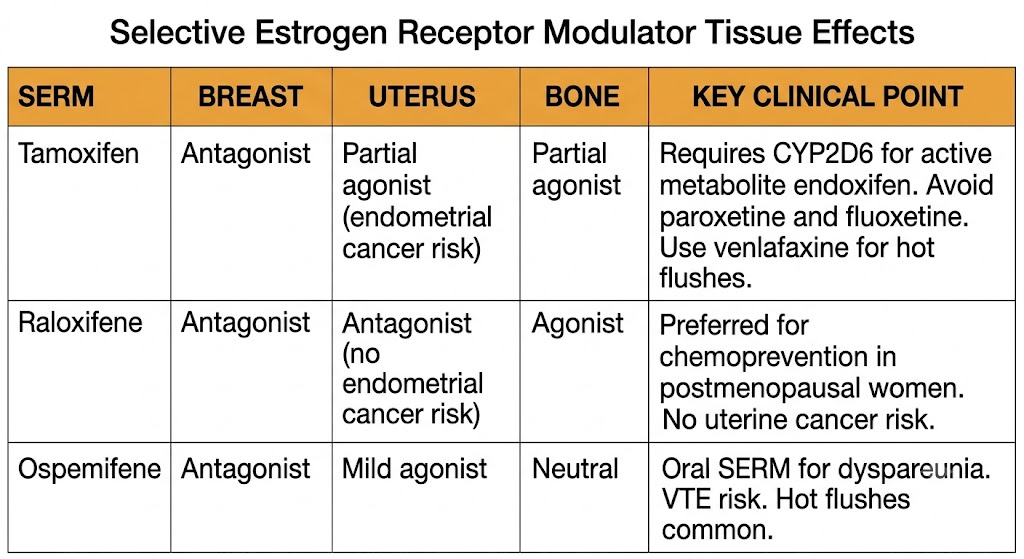
Tamoxifen is a selective estrogen receptor modulator that produces tissue-selective effects depending on which tissue's receptor conformation and coactivator environment it encounters. In breast tissue it acts as an estrogen receptor antagonist — blocking estradiol-driven proliferation — making it the standard adjuvant hormonal therapy for premenopausal women with hormone receptor-positive breast cancer, used for 5 to 10 years depending on recurrence risk. In bone it acts as a partial agonist, maintaining bone mineral density in postmenopausal women. In the uterus it acts as a partial agonist, producing endometrial stimulation and increasing the risk of endometrial hyperplasia and endometrial carcinoma with long-term use. Uterine cancer risk is the primary serious adverse effect of tamoxifen.

Tamoxifen and CYP2D6: A High-Yield Drug Interaction

Tamoxifen itself has low estrogen receptor affinity. Its anticancer activity depends on conversion to its active metabolite endoxifen by the cytochrome P450 2D6 enzyme. Patients who are cytochrome P450 2D6 poor metabolizers (carrying two non-functional alleles) achieve much lower endoxifen levels and have higher breast cancer recurrence rates on tamoxifen.

The clinical consequence: potent cytochrome P450 2D6 inhibitors co-prescribed with tamoxifen substantially reduce endoxifen levels and may compromise the oncological benefit of therapy. Paroxetine and fluoxetine — two selective serotonin reuptake inhibitors commonly used for vasomotor symptoms in breast cancer survivors — are potent cytochrome P450 2D6 inhibitors and should not be co-prescribed with tamoxifen. Venlafaxine (a serotonin-norepinephrine reuptake inhibitor) is a much weaker inhibitor and is the preferred agent for vasomotor symptoms in women on tamoxifen. Gabapentin is also a safe alternative.

Reference table of selective estrogen receptor modulator tissue effects: tamoxifen (breast antagonist, uterine partial agonist causing endometrial cancer risk, bone partial agonist, CYP2D6-dependent endoxifen), raloxifene (breast and uterine antagonist, bone agonist, no endometrial cancer risk), ospemifene (breast antagonist, mild uterine agonist, for dyspareunia).
Gemini AI illustration. Selective estrogen receptor modulator tissue-selective effects across breast, uterus, and bone.
Raloxifene

Raloxifene differs from tamoxifen in one clinically decisive way: it antagonizes the estrogen receptor in both breast and uterus, rather than acting as a partial agonist in the uterus. As a result, raloxifene does not carry the endometrial cancer risk associated with tamoxifen, making it the preferred selective estrogen receptor modulator for breast cancer chemoprevention in postmenopausal women. Raloxifene is also approved for osteoporosis prevention and treatment in postmenopausal women through its bone agonist activity. It is somewhat less effective than tamoxifen at reducing non-invasive ductal carcinoma in situ, but produces fewer thromboembolic events and no uterine cancer risk. Like all selective estrogen receptor modulators, raloxifene carries a venous thromboembolism risk similar to oral estrogen and is contraindicated in women with active or prior venous thromboembolism.

Ospemifene

Ospemifene is an oral selective estrogen receptor modulator approved for moderate to severe dyspareunia due to vulvovaginal atrophy in postmenopausal women. It acts as an estrogen receptor agonist in vaginal epithelium (improving lubrication and reducing dyspareunia) and as an estrogen receptor antagonist in breast tissue. Unlike vaginal estrogen preparations, ospemifene is taken orally and achieves systemic absorption. It carries a venous thromboembolism risk and is contraindicated in women with prior venous thromboembolism or estrogen-sensitive malignancy. Hot flushes are the most common adverse effect.

Paroxetine + Tamoxifen: Avoid This Combination

Paroxetine is a potent cytochrome P450 2D6 inhibitor. Co-prescribing with tamoxifen reduces endoxifen levels by up to 75%, potentially converting an extensive metabolizer into the functional equivalent of a poor metabolizer and compromising the oncological benefit of adjuvant tamoxifen. For vasomotor symptoms in women on tamoxifen: use venlafaxine or gabapentin, not paroxetine or fluoxetine. Escitalopram and citalopram are weak cytochrome P450 2D6 inhibitors and are acceptable alternatives if a selective serotonin reuptake inhibitor is needed.


Section 4
GnRH Agonists
Receptor downregulation, the initial flare, and add-back therapy
Mechanism: Why Continuous Stimulation Causes Suppression

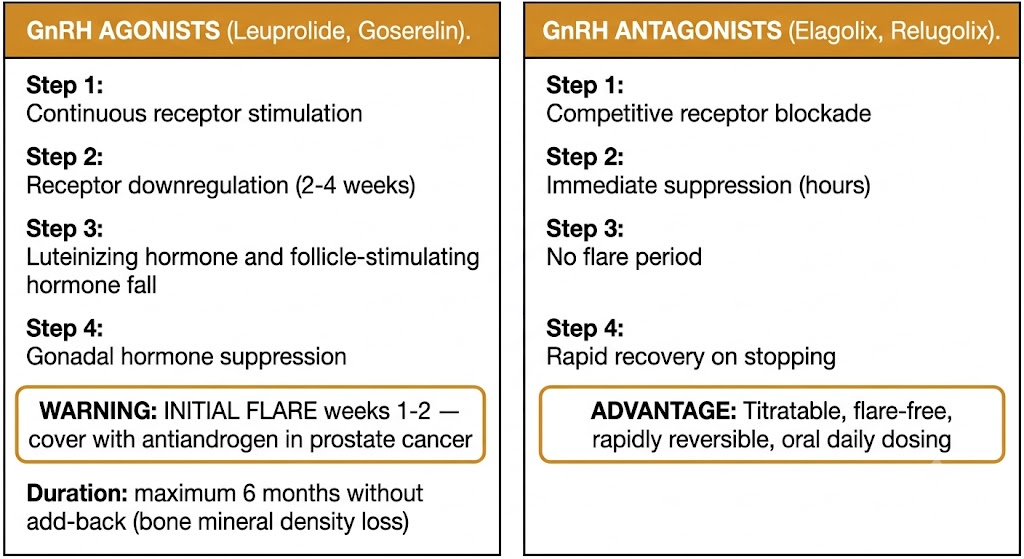
Endogenous gonadotropin-releasing hormone is released from the hypothalamus in pulses every 60 to 120 minutes. This pulsatile pattern is required for sustained luteinizing hormone and follicle-stimulating hormone secretion. Gonadotropin-releasing hormone agonists are synthetic analogues that resist enzymatic degradation and therefore produce continuous rather than pulsatile receptor stimulation. This continuous occupation causes receptor downregulation and desensitization — the pituitary stops responding to the constant signal. After 2 to 4 weeks, luteinizing hormone and follicle-stimulating hormone fall to castrate levels, followed by a corresponding fall in gonadal sex hormones. The pharmacological result is reversible pharmacological hypogonadism.

The Initial Flare

Before receptor downregulation takes effect, the first 1 to 2 weeks of gonadotropin-releasing hormone agonist therapy produce a paradoxical stimulation — a flare of luteinizing hormone, follicle-stimulating hormone, and sex hormone release. In women with endometriosis or fibroids, this flare can temporarily worsen symptoms. In men with high-volume metastatic prostate cancer, the testosterone flare can precipitate serious disease progression (spinal cord compression, pain crisis), which is why an antiandrogen is co-administered for the first 4 weeks of agonist therapy in these patients.

Available Agents

Available gonadotropin-releasing hormone agonists include leuprolide acetate (depot injections at 1-, 3-, and 6-month intervals), goserelin acetate (subcutaneous depot implant), and nafarelin acetate (intranasal spray). All produce equivalent gonadal suppression when dosed appropriately; the choice is determined by route preference and dosing interval.

Two-panel diagram comparing GnRH agonists (leuprolide, goserelin) showing continuous stimulation leading to receptor downregulation over 2-4 weeks with initial flare warning and 6-month duration limit, versus GnRH antagonists (elagolix, relugolix) showing competitive receptor blockade with immediate suppression, no flare, and rapid reversibility.
Gemini AI illustration. GnRH agonist versus antagonist mechanisms: downregulation with flare versus immediate competitive blockade.
Add-Back Therapy

Gonadotropin-releasing hormone agonist therapy without any estrogen replacement produces clinically significant bone mineral density loss within 6 months — the generally accepted maximum duration of monotherapy. Add-back therapy restores a low level of estrogen (with or without a progestin) concurrently with ongoing agonist use. The rationale is a differential estrogen threshold: endometriotic lesions and fibroids require higher estrogen concentrations for stimulation than bone and brain require for protection. A low add-back dose that is insufficient to stimulate disease activity can still protect bone and reduce vasomotor symptoms. Add-back allows extension of safe agonist use from 6 months to 12 months or longer.

GnRH Agonist Duration Rule

Without add-back: maximum 6 months (bone mineral density loss becomes clinically significant beyond this). With add-back: up to 12 months or longer with bone density monitoring. In men with high-volume metastatic prostate cancer starting a gonadotropin-releasing hormone agonist: cover the first 4 weeks with an antiandrogen to prevent testosterone flare complications.


Section 5
GnRH Antagonists
Immediate suppression, no flare, and oral dosing
Mechanism: Competitive Blockade vs. Downregulation

Gonadotropin-releasing hormone antagonists suppress gonadal function through competitive receptor blockade rather than receptor downregulation. By occupying and blocking the gonadotropin-releasing hormone receptor immediately, they prevent endogenous gonadotropin-releasing hormone from stimulating the pituitary — without any initial stimulatory phase. The result is immediate suppression of luteinizing hormone, follicle-stimulating hormone, and sex hormones within hours of the first dose, with no flare. Cessation of therapy results in rapid recovery of gonadotropin secretion, making these agents rapidly reversible.

Available Agents and Indications

Elagolix (Orilissa) is an oral gonadotropin-releasing hormone antagonist approved for endometriosis-associated pain. A key feature is dose-dependent, titratable suppression: at the lower dose, elagolix produces partial estrogen suppression in the low-normal premenopausal range — sufficient for pain reduction with less bone mineral density loss and fewer hot flushes. At the higher dose, it produces near-complete suppression equivalent to a gonadotropin-releasing hormone agonist, with greater pain relief but more adverse effects. The lower dose is approved for up to 24 months; the higher dose only 6 months, due to bone mineral density concerns.

Relugolix (Orgovyx) is an oral gonadotropin-releasing hormone antagonist approved for advanced prostate cancer. A fixed-dose combination of relugolix with low-dose estradiol and norethindrone acetate (Myfembree) is approved for heavy menstrual bleeding due to uterine fibroids — the antagonist suppresses fibroid-stimulating hormones while the add-back components protect against bone loss and vasomotor symptoms.

GnRH Agonist vs. Antagonist: Key Distinction

Agonists: continuous stimulation → downregulation → suppression (delayed 2–4 weeks, flare period, depot injectable, slow offset). Antagonists: competitive blockade → immediate suppression (hours, no flare, daily oral, rapid offset at stopping). Both achieve gonadal suppression. Antagonists are titratable and flare-free; agonists provide compliance-independent sustained delivery from a single depot injection.


Section 6
Endometriosis and Uterine Fibroids
Pharmacological management hierarchies and the role of the levonorgestrel intrauterine device
Endometriosis: Treatment Hierarchy

Endometriosis is an estrogen-dependent condition defined by endometrial glands and stroma outside the uterine cavity. Pharmacological management targets its estrogen dependence.

First-line treatments are combined oral contraceptives and progestin-only preparations (oral norethindrone acetate or medroxyprogesterone acetate, the levonorgestrel intrauterine device, or the etonogestrel implant). These suppress cyclical hormonal stimulation of ectopic implants and reduce dysmenorrhea and pelvic pain. The levonorgestrel intrauterine device is particularly effective for dysmenorrhea and heavy bleeding associated with endometriosis because it delivers locally high levonorgestrel concentrations to the uterine and pelvic environment, producing endometrial atrophy and reducing retrograde menstruation.

Second-line treatments are gonadotropin-releasing hormone agonists (with add-back) and gonadotropin-releasing hormone antagonists. These produce more complete estrogen suppression and are used when first-line agents fail to control pain adequately.

Uterine Fibroids: Pharmacological Options

Uterine fibroids are benign smooth muscle tumors whose growth depends on both estrogen and progesterone. The levonorgestrel intrauterine device (52 mg) is a highly effective first-line option for fibroid-related heavy menstrual bleeding when the fibroid anatomy permits intrauterine device placement — local endometrial atrophy from levonorgestrel profoundly reduces bleeding even while fibroids persist in the myometrium.

Gonadotropin-releasing hormone agonists reduce uterine and fibroid volume substantially over 3 to 6 months of treatment by producing hypoestrogenic atrophy of fibroid tissue. This preoperative volume reduction is used to facilitate less invasive surgery, reduce intraoperative blood loss, and correct preoperative anemia. A critical point: fibroid volume returns to pre-treatment size rapidly after stopping the agonist. Gonadotropin-releasing hormone agonists are therefore a surgical bridge, not a long-term standalone treatment for fibroids.

The relugolix combination tablet (relugolix with estradiol and norethindrone acetate) is the first approved long-term non-surgical pharmacological option for fibroid-associated heavy menstrual bleeding, providing sustained efficacy over 52 weeks without the bone mineral density concerns of prolonged gonadotropin-releasing hormone agonist monotherapy.

Levonorgestrel Intrauterine Device: First-Line for Both Conditions

The 52 mg levonorgestrel intrauterine device addresses the two shared symptoms of endometriosis and uterine fibroids — dysmenorrhea and heavy menstrual bleeding — through local endometrial atrophy, without systemic hypoestrogenism. In endometriosis it suppresses ectopic proliferation and reduces retrograde menstruation. In fibroids (when the cavity is not significantly distorted) it profoundly reduces bleeding. It is the preferred initial pharmacological option in women who need symptom control without requiring fibroid volume reduction or systemic disease suppression.


Suggested References
Author / Organization Title Source
Rossouw JE, Anderson GL, Prentice RL, et al; WHI Investigators. Risks and benefits of estrogen plus progestin in healthy postmenopausal women: principal results from the Women's Health Initiative randomized controlled trial JAMA. 2002;288(3):321–333
Manson JE, Chlebowski RT, Stefanick ML, et al. Menopausal hormone therapy and health outcomes during the intervention and extended poststopping phases of the Women's Health Initiative randomized trials JAMA. 2013;310(13):1353–1368
Hodis HN, Mack WJ, Henderson VW, et al; ELITE Research Group. Vascular effects of early versus late postmenopausal treatment with estradiol N Engl J Med. 2016;374(13):1221–1231
Fournier A, Berrino F, Clavel-Chapelon F. Unequal risks for breast cancer associated with different hormone replacement therapies: results from the E3N cohort study Breast Cancer Res Treat. 2008;107(1):103–111
Canonico M, Oger E, Plu-Bureau G, et al; ESTHER Study Group. Hormone therapy and venous thromboembolism among postmenopausal women: impact of the route of estrogen administration and progestogens Circulation. 2007;115(7):840–845
Vinogradova Y, Coupland C, Hippisley-Cox J. Use of hormone replacement therapy and risk of venous thromboembolism: nested case-control studies using the QResearch and CPRD databases BMJ. 2019;364:k4810
Collaborative Group on Hormonal Factors in Breast Cancer. Type and timing of menopausal hormone therapy and breast cancer risk: individual participant meta-analysis of the worldwide epidemiological evidence Lancet. 2019;394(10204):1159–1168
Jordan VC. Tamoxifen: a most unlikely pioneering medicine Nat Rev Drug Discov. 2003;2(3):205–213
Goetz MP, Kamal A, Ames MM. Tamoxifen pharmacogenomics: the role of CYP2D6 as a predictor of drug response Clin Pharmacol Ther. 2008;83(1):160–166
Vogel VG, Costantino JP, Wickerham DL, et al; NSABP. Effects of tamoxifen vs raloxifene on the risk of developing invasive breast cancer and other disease outcomes: the NSABP Study of Tamoxifen and Raloxifene (STAR) P-2 trial JAMA. 2006;295(23):2727–2741
Schally AV, Arimura A, Baba Y, et al. Isolation and properties of the FSH and LH-releasing hormone Biochem Biophys Res Commun. 1971;43(2):393–399
Surrey ES, Hornstein MD. Prolonged GnRH agonist and add-back therapy for symptomatic endometriosis: long-term follow-up Obstet Gynecol. 2002;99(5 Pt 1):709–719
Taylor HS, Giudice LC, Lessey BA, et al. Treatment of endometriosis-associated pain with elagolix, an oral GnRH antagonist N Engl J Med. 2017;377(1):28–40
Al-Hendy A, Lukes AS, Poindexter AN 3rd, et al. Treatment of uterine fibroid symptoms with relugolix combination therapy N Engl J Med. 2021;384(7):630–642
Dunselman GA, Vermeulen N, Becker C, et al; ESHRE. ESHRE guideline: management of women with endometriosis Hum Reprod. 2014;29(3):400–412