CHAPTER 40  ·  IMMUNOPHARMACOLOGY
Section 1
Tumor Necrosis Factor Inhibitors
Structural classes, the Fc-region distinction and pregnancy safety, etanercept and granulomatous disease, and infectious safety screening

Tumor necrosis factor-alpha (TNF-alpha) inhibitors were the first biologic drugs approved for inflammatory diseases and remain among the most widely prescribed biologics globally. Five agents are in clinical use spanning three structural classes. Their structural differences carry clinically meaningful consequences for pregnancy safety, mechanism of action in granulomatous disease, and immunogenicity.

Structural Classes and Key Distinctions

Four of the five agents are monoclonal antibodies or antibody fragments that bind TNF-alpha directly. Infliximab is a chimeric immunoglobulin G1 monoclonal antibody (approximately 25% murine sequence), making it the most immunogenic of the class. Adalimumab and golimumab are fully human immunoglobulin G1 monoclonal antibodies. Certolizumab pegol is a humanized polyethylene glycol-conjugated Fab fragment that lacks the Fc region entirely. Etanercept is structurally distinct from the others: it is a dimeric fusion protein combining the extracellular domain of TNF receptor 2 with the Fc region of human immunoglobulin G1, and it binds both TNF-alpha and lymphotoxin-alpha (also called TNF-beta), which the monoclonal antibodies do not target.

The absence of the Fc region in certolizumab pegol has two important clinical consequences. First, transplacental transfer of immunoglobulins from mother to fetus occurs primarily through neonatal Fc receptor-mediated active transport of the Fc region during the second and third trimesters. Certolizumab pegol, lacking the Fc region, does not undergo this transport and produces minimal or undetectable drug concentrations in cord blood, making it the preferred TNF inhibitor when biologic therapy is required during pregnancy. Second, certolizumab pegol cannot mediate antibody-dependent cellular cytotoxicity or complement-dependent cytotoxicity through the Fc pathway.

Etanercept is consistently less effective than the anti-TNF monoclonal antibodies in granulomatous inflammatory diseases including Crohn's disease, sarcoidosis, and granulomatosis with polyangiitis. The mechanistic basis is believed to relate to differences in binding membrane-bound TNF: the monoclonal antibodies bind both membrane-bound and soluble TNF and induce reverse signaling through membrane-bound TNF, which may be necessary for granuloma dissolution. Etanercept, as a soluble receptor decoy, preferentially binds soluble TNF and appears less effective at disrupting granulomatous macrophage activation. Etanercept must not be substituted for infliximab or adalimumab in Crohn's disease or sarcoidosis.

Indications and Infectious Safety

The five TNF inhibitors collectively are approved for rheumatoid arthritis, juvenile idiopathic arthritis, ankylosing spondylitis, psoriatic arthritis, plaque psoriasis, and inflammatory bowel disease (infliximab, adalimumab, and golimumab for Crohn's disease and ulcerative colitis; etanercept is not approved for inflammatory bowel disease). Biosimilars for infliximab, adalimumab, etanercept, and golimumab are widely available and clinically interchangeable for approved indications.

TNF-alpha is essential for maintaining the granulomatous immune response that contains latent Mycobacterium tuberculosis. TNF inhibitor therapy dramatically increases the risk of active tuberculosis, often as extrapulmonary or disseminated disease. Screening with tuberculin skin test (TST) or an interferon-gamma release assay (IGRA) is mandatory before initiating any TNF inhibitor; confirmed latent tuberculosis requires at least four weeks of isoniazid prophylaxis before starting the biologic, with the full nine-month course continued concurrently. Hepatitis B virus reactivation is a second critical concern: hepatitis B surface antigen and core antibody testing is mandatory before treatment; surface antigen-positive patients require antiviral prophylaxis (entecavir or tenofovir) throughout therapy.
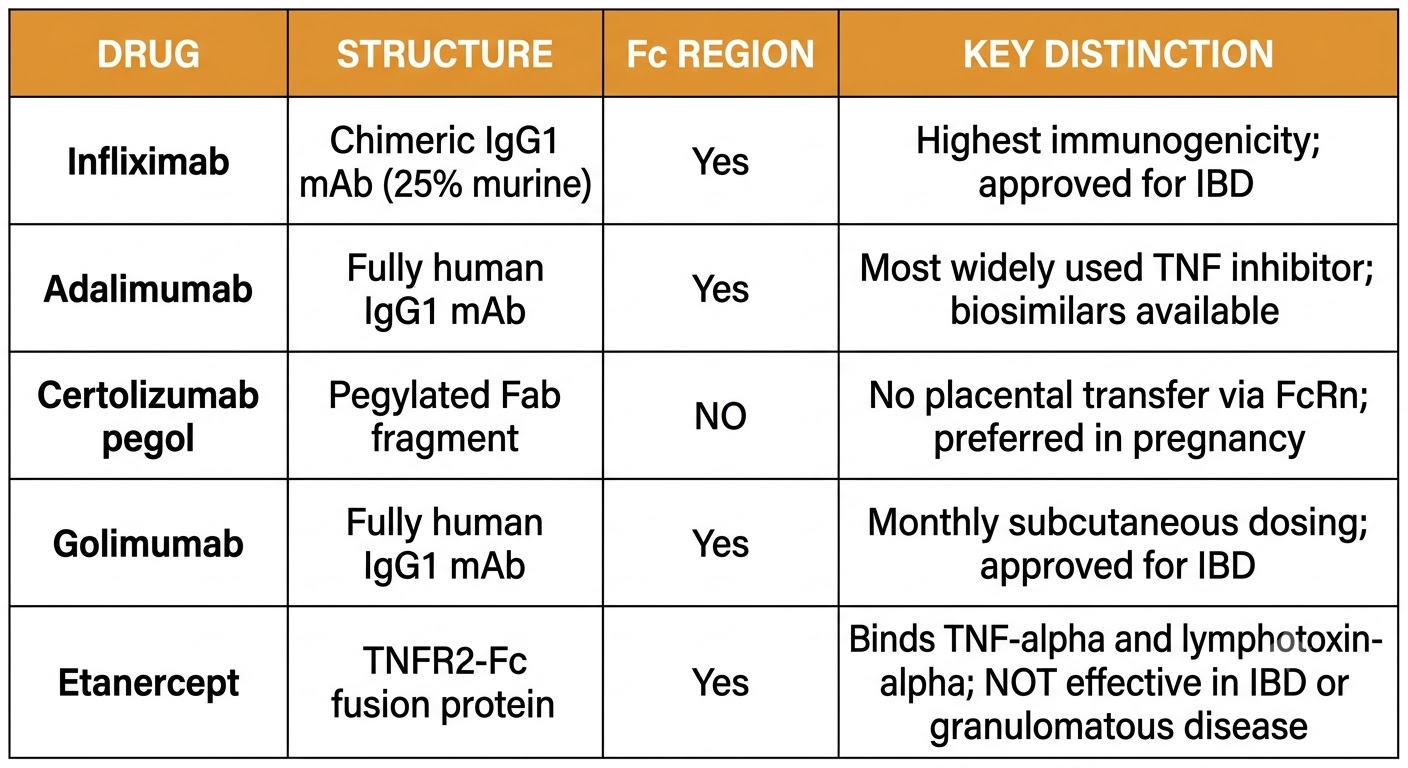
Reference table comparing the five TNF inhibitors: infliximab (chimeric IgG1, Fc present, highest immunogenicity, approved for IBD), adalimumab (fully human IgG1, most widely used), certolizumab pegol (pegylated Fab fragment, no Fc region, no placental transfer, preferred in pregnancy), golimumab (fully human IgG1, monthly dosing, approved for IBD), and etanercept (TNFR2-Fc fusion protein, binds TNF-alpha and lymphotoxin-alpha, not effective in IBD or granulomatous disease).
Structural classification and key distinctions among the five approved TNF-alpha inhibitors. The absence of the Fc region in certolizumab pegol prevents placental transfer, making it the preferred agent in pregnancy. Etanercept is ineffective in inflammatory bowel disease and granulomatous disease. Abbreviations: Fab = antigen-binding fragment; FcRn = neonatal Fc receptor; IBD = inflammatory bowel disease; IgG1 = immunoglobulin G1; mAb = monoclonal antibody; TNF = tumor necrosis factor; TNFR2 = TNF receptor 2.
TNF Inhibitor Absolute Contraindications

Active infection including untreated latent tuberculosis, active hepatitis B virus, and active serious fungal infection. Moderate-to-severe heart failure (New York Heart Association class III or IV) — TNF inhibitors worsen cardiac function. Active demyelinating disease including multiple sclerosis and optic neuritis. Active malignancy (except adequately treated skin cancers). Never combine two biologic agents — additive immunosuppression causes unacceptable serious infection risk. Pregnancy: certolizumab pegol is preferred; other Fc-containing agents should be discontinued by week 22 to 24 of pregnancy when possible.

Section 2
Interleukin Antagonists and B-Cell Targeted Biologics
IL-1 and IL-6 pathway inhibitors, the IL-17/IL-23 axis, rituximab, belimumab, anifrolumab, and type 2 inflammation biologics

Beyond TNF-alpha, a growing array of biologic agents target individual interleukins, their receptors, or specific immune cell populations. Each drug class is defined by its target cytokine or cell surface antigen, and understanding the biology of the target predicts both the therapeutic indication and the specific safety considerations of each agent.

Interleukin-6 Receptor Inhibitors

Tocilizumab and sarilumab are humanized monoclonal antibodies directed against the interleukin-6 receptor alpha chain (IL-6Ralpha), blocking all downstream interleukin-6 signaling through the Janus kinase 1/2-signal transducer and activator of transcription 3 (JAK1/2-STAT3) axis. This suppresses hepatic synthesis of acute-phase reactants so completely that C-reactive protein (CRP) is reduced to near zero and can no longer be used as an infection biomarker in patients on these drugs. Clinicians must rely on procalcitonin, clinical assessment, and microbiological investigation to detect concurrent infections. Tocilizumab is approved for rheumatoid arthritis, systemic juvenile idiopathic arthritis, giant cell arteritis, and cytokine release syndrome (CRS) — the life-threatening inflammatory complication of chimeric antigen receptor T-cell therapy and bispecific antibody therapy — where intravenous tocilizumab rapidly reverses fever and hemodynamic instability within 24 hours.

The Interleukin-17 and Interleukin-23 Axis

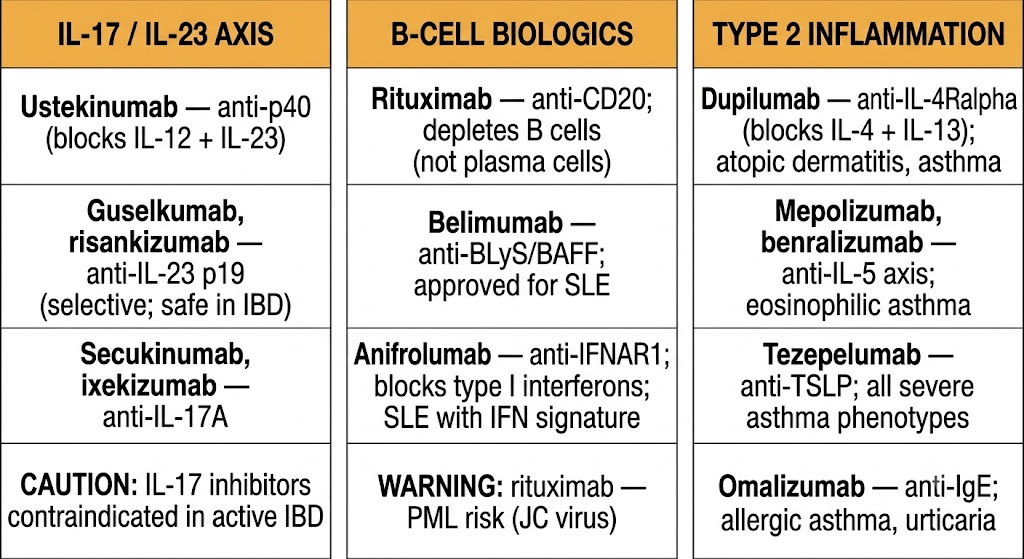
Ustekinumab targets the p40 subunit shared by interleukin-12 and interleukin-23, blocking both cytokines simultaneously. It is approved for psoriasis, psoriatic arthritis, Crohn's disease, and ulcerative colitis, and is dosed subcutaneously every 12 weeks after induction — the least frequent maintenance schedule of any approved biologic for these indications. Selective interleukin-23 p19 inhibitors (guselkumab, risankizumab, tildrakizumab) block only interleukin-23, preserving interleukin-12-dependent Th1 immunity; risankizumab is approved for psoriasis, psoriatic arthritis, Crohn's disease, and ulcerative colitis.

Secukinumab and ixekizumab bind and neutralize interleukin-17A, and bimekizumab blocks both interleukin-17A and interleukin-17F simultaneously. These agents are highly effective in plaque psoriasis and are first-line biologics for ankylosing spondylitis. A critical class-specific safety issue is an increased risk of mucocutaneous candidiasis (oral and esophageal), reflecting the physiological role of interleukin-17A in antifungal mucosal immunity. More seriously, clinical trials of interleukin-17A inhibitors in Crohn's disease showed unexpected disease worsening; interleukin-17A inhibitors are contraindicated in active inflammatory bowel disease and must be used with caution in patients with a history of inflammatory bowel disease. The selective interleukin-23 p19 inhibitors do not carry this inflammatory bowel disease risk and are preferred when a patient has concurrent psoriasis and inflammatory bowel disease.

B-Cell Targeted Biologics: Rituximab and Belimumab

Rituximab is a chimeric anti-CD20 monoclonal antibody that depletes B cells from the pre-B through memory B-cell stages through complement-dependent cytotoxicity, antibody-dependent cellular cytotoxicity, and direct apoptosis induction. Plasma cells, which lack CD20, are spared — a limitation in diseases driven by long-lived plasma cell autoantibody production. Rituximab is approved for rheumatoid arthritis (after TNF inhibitor failure), granulomatosis with polyangiitis, microscopic polyangiitis, and pemphigus vulgaris, and is used off-label for systemic lupus erythematosus, immune thrombocytopenia, and neuromyelitis optica. The most serious infectious complication is progressive multifocal leukoencephalopathy (PML), a potentially fatal demyelinating brain infection caused by reactivation of JC virus (John Cunningham virus) in profoundly immunosuppressed patients; monitoring of JC virus antibody titers is recommended in long-term rituximab users. Hypogammaglobulinemia from cumulative B-cell depletion and hepatitis B virus reactivation are additional important risks.

Belimumab is a fully human monoclonal antibody targeting B lymphocyte stimulator (BLyS, also called B-cell activating factor (BAFF)), a TNF superfamily cytokine critical for B-cell survival. BLyS levels are elevated in systemic lupus erythematosus (SLE) and correlate with disease activity and anti-double-stranded DNA antibody titers. Belimumab is approved for active, autoantibody-positive systemic lupus erythematosus on standard therapy, and for active lupus nephritis. Anifrolumab is a monoclonal antibody blocking the type I interferon receptor subunit 1 (IFNAR1), suppressing the entire type I interferon response that drives B-cell hyperactivation and autoantibody production in the 60 to 80% of systemic lupus erythematosus patients with a positive interferon gene signature. Anifrolumab is approved for moderate-to-severe systemic lupus erythematosus and carries a slightly higher rate of herpes zoster reactivation reflecting impaired type I interferon antiviral defense.

Type 2 Inflammation Biologics

Dupilumab is a fully human monoclonal antibody targeting the interleukin-4 receptor alpha chain (IL-4Ralpha), which is shared by both the type I interleukin-4 receptor (using the gamma-c chain) and the type II receptor (also binding interleukin-13). By blocking this shared subunit, dupilumab simultaneously inhibits signaling by both interleukin-4 and interleukin-13, the principal Th2 cytokines driving IgE class switching, goblet cell metaplasia, smooth muscle hyperreactivity, and barrier dysfunction. It is approved for atopic dermatitis, asthma, chronic rhinosinusitis with nasal polyposis, eosinophilic esophagitis, and prurigo nodularis. Unlike conventional immunosuppressants, dupilumab does not cause significant immunosuppression or increased infection risk. The most common adverse effects are injection site reactions and conjunctivitis, occurring in approximately 10% of patients with atopic dermatitis.

Mepolizumab and reslizumab are anti-interleukin-5 monoclonal antibodies; benralizumab targets the interleukin-5 receptor alpha chain and additionally depletes eosinophils through antibody-dependent cellular cytotoxicity, producing near-complete blood eosinophil depletion within weeks. All three are approved for severe eosinophilic asthma and reduce exacerbation rates by approximately 50% in patients with blood eosinophil counts above 300 cells per microliter. Tezepelumab blocks thymic stromal lymphopoietin (TSLP), an upstream epithelial alarmin cytokine, and is effective in both eosinophilic and non-eosinophilic severe asthma phenotypes — distinguishing it from the anti-interleukin-5 agents, which primarily benefit patients with elevated eosinophil counts. Omalizumab is a humanized anti-IgE monoclonal antibody that binds free IgE, preventing it from binding high-affinity Fc epsilon receptors on mast cells and basophils; it is approved for allergic asthma, chronic spontaneous urticaria, and chronic rhinosinusitis with nasal polyposis.

Three-panel comparison diagram showing: left panel IL-17/IL-23 axis biologics including ustekinumab (anti-p40), guselkumab and risankizumab (anti-IL-23 p19, safe in IBD), secukinumab and ixekizumab (anti-IL-17A) with caution that IL-17 inhibitors are contraindicated in active IBD; center panel B-cell biologics including rituximab (anti-CD20, PML risk), belimumab (anti-BLyS/BAFF for SLE), and anifrolumab (anti-IFNAR1 for SLE with interferon signature); right panel type 2 inflammation biologics including dupilumab (anti-IL-4Ralpha), mepolizumab and benralizumab (anti-IL-5 axis), tezepelumab (anti-TSLP), and omalizumab (anti-IgE).
Biologic agents targeting the IL-17/IL-23 axis, B-cell pathways, and type 2 inflammation. IL-17 inhibitors are contraindicated in active inflammatory bowel disease; selective IL-23 p19 inhibitors are safe in inflammatory bowel disease. Rituximab carries a risk of progressive multifocal leukoencephalopathy from JC virus reactivation. Abbreviations: BAFF = B-cell activating factor; BLyS = B lymphocyte stimulator; IBD = inflammatory bowel disease; IFNAR1 = type I interferon receptor subunit 1; IL = interleukin; PML = progressive multifocal leukoencephalopathy; SLE = systemic lupus erythematosus; TSLP = thymic stromal lymphopoietin.
Interleukin-6 Receptor Blockade — Critical CRP Monitoring Caveat

Tocilizumab and sarilumab suppress hepatic CRP synthesis so completely that CRP becomes unreliable as an infection biomarker. A patient with active sepsis may have a normal or low CRP while on an interleukin-6 receptor inhibitor. Use procalcitonin, blood cultures, clinical examination, and imaging to detect infection in these patients. This caveat also applies to monitoring disease activity in rheumatoid arthritis: disease activity scores incorporating CRP will be artificially low; use clinical examination and ultrasound to assess synovitis independently.


Section 3
Biologic Drug Safety, Screening, and Class-Wide Principles
Universal pre-treatment evaluation, infection prophylaxis, vaccination strategy, immunogenicity, biosimilars, and pregnancy management

Biologic immunosuppressants, while highly targeted in mechanism, share a set of class-wide safety considerations that apply regardless of the specific cytokine or cell target. Systematic pre-treatment screening, vaccination optimization, and ongoing monitoring are essential for safe biologic prescribing across all indications.

Mandatory Pre-Treatment Screening

Before initiating any biologic immunosuppressant, standardized pre-treatment evaluation must be completed. Tuberculosis screening with TST or IGRA is required for all patients; prior Bacille Calmette-Guerin (BCG) vaccination causes false-positive TST but not IGRA, so IGRA is preferred in BCG-vaccinated patients. Positive screening in the absence of active tuberculosis requires at least four weeks of isoniazid prophylaxis before biologic initiation. Hepatitis B serology — surface antigen, surface antibody, and total core antibody — is mandatory: surface antigen-positive patients require antiviral prophylaxis (entecavir or tenofovir) before starting the biologic; core antibody-positive but surface antigen-negative patients are monitored with hepatitis B virus DNA levels every three months. A complete blood count, comprehensive metabolic panel, and baseline chest imaging in high-risk patients complete the standard pre-treatment evaluation.

Vaccination Strategy

Live attenuated vaccines are contraindicated once any biologic immunosuppressant is started, because impaired immune surveillance may allow vaccine-strain organisms to cause disseminated infection. Live vaccines include live-attenuated intranasal influenza vaccine, yellow fever vaccine, oral typhoid vaccine, varicella-zoster live vaccine (Zostavax), and measles-mumps-rubella vaccine. Inactivated and subunit vaccines — including inactivated influenza, pneumococcal vaccines, recombinant zoster vaccine (Shingrix), hepatitis A, hepatitis B, and COVID-19 vaccines — may be given during biologic therapy, though immunogenicity may be reduced. All recommended vaccines should be completed at least two to four weeks before biologic initiation. Shingrix (two-dose series) is strongly recommended before starting biologics that increase herpes zoster risk; because Shingrix is an inactivated subunit vaccine, it is safe to use during biologic therapy when vaccination before initiation was not possible.

Immunogenicity and Biosimilars

All biologic agents can induce anti-drug antibodies (ADAs) that reduce drug efficacy and may cause hypersensitivity reactions. Immunogenicity is highest with chimeric biologics containing more murine protein sequence (infliximab, rituximab) and lower with humanized and fully human agents. Concurrent immunosuppressive therapy — particularly methotrexate and azathioprine — substantially reduces anti-drug antibody formation by suppressing the adaptive immune response to the biologic, which is the rationale for combining methotrexate with infliximab or adalimumab in rheumatoid arthritis and inflammatory bowel disease. Loss of biologic efficacy over time is often caused by anti-drug antibody formation; therapeutic drug monitoring of biologic trough levels and anti-drug antibody titers guides decisions about dose escalation, interval shortening, or switching. Biosimilars for infliximab, adalimumab, etanercept, rituximab, and ustekinumab are approved as equivalent, cost-effective alternatives to reference biologics.

Biologic Approximate Half-Lives — Clinical Reference

TNF inhibitors: Infliximab approximately 9.5 days (intravenous every 8 weeks); adalimumab approximately 14 days (subcutaneous every 2 weeks); etanercept approximately 4 days (subcutaneous weekly); certolizumab approximately 14 days (subcutaneous every 2 weeks); golimumab approximately 14 days (subcutaneous monthly). Interleukin-6 receptor: Tocilizumab approximately 11 to 13 days. Interleukin-17/23 axis: Secukinumab approximately 27 days (subcutaneous monthly maintenance); ustekinumab approximately 21 days (subcutaneous every 12 weeks). B-cell and type 2: Rituximab approximately 18 to 22 days (intravenous every 6 months); belimumab approximately 19 days; dupilumab approximately 20 days (subcutaneous every 2 weeks); mepolizumab approximately 16 to 22 days (subcutaneous monthly); benralizumab approximately 15 days (subcutaneous every 8 weeks). Half-life governs perioperative withholding intervals and the timing of live vaccine administration after stopping therapy.


Suggested References
Author / Organization Title Source
Tracey D, Klareskog L, Sasso EH, Salfeld JG, Tak PP Tumor necrosis factor antagonist mechanisms of action: a comprehensive review Pharmacol Ther. 2008;117(2):244-279
Keystone EC, Genovese MC, Klareskog L, et al Golimumab, a human antibody to tumour necrosis factor alpha given by monthly subcutaneous injections, in active rheumatoid arthritis despite methotrexate therapy Ann Rheum Dis. 2009;68(6):789-796
Singh JA, Saag KG, Bridges SL Jr, et al 2015 American College of Rheumatology guideline for the treatment of rheumatoid arthritis Arthritis Rheumatol. 2016;68(1):1-26
Martinon F, Mayor A, Tschopp J The inflammasomes: guardians of the body Annu Rev Immunol. 2009;27:229-265
Tanaka T, Narazaki M, Kishimoto T IL-6 in inflammation, immunity, and disease Cold Spring Harb Perspect Biol. 2014;6(10):a016295
Le RQ, Li L, Yuan W, et al FDA approval summary: tocilizumab for treatment of chimeric antigen receptor T cell-induced severe or life-threatening cytokine release syndrome Oncologist. 2018;23(8):943-947
Miossec P, Kolls JK Targeting IL-17 and TH17 cells in chronic inflammation Nat Rev Drug Discov. 2012;11(10):763-776
Gordon KB, Strober B, Lebwohl M, et al Efficacy and safety of risankizumab in moderate-to-severe plaque psoriasis (UltIMMa-1 and UltIMMa-2) Lancet. 2018;392(10148):650-661
Feagan BG, Sandborn WJ, Gasink C, et al Ustekinumab as induction and maintenance therapy for Crohn's disease N Engl J Med. 2016;375(20):1946-1960
Pescovitz MD Rituximab, an anti-cd20 monoclonal antibody: history and mechanism of action Am J Transplant. 2006;6(5 Pt 1):859-866
Furie R, Rovin BH, Houssiau F, et al Two-year, randomized, controlled trial of belimumab in lupus nephritis N Engl J Med. 2020;383(12):1117-1128
Morand EF, Furie R, Tanaka Y, et al Trial of anifrolumab in active systemic lupus erythematosus N Engl J Med. 2020;382(3):211-221
Gandhi NA, Bennett BL, Graham NMH, et al Targeting key proximal drivers of type 2 inflammation in disease Nat Rev Drug Discov. 2016;15(1):35-50
Menzies-Gow A, Corren J, Bourdin A, et al Tezepelumab in adults and adolescents with severe, uncontrolled asthma N Engl J Med. 2021;384(19):1800-1809
Furst DE, Keystone EC, Fleischmann R, et al Updated consensus statement on biological agents for the treatment of rheumatic diseases, 2012 Ann Rheum Dis. 2013;72(Suppl 2):ii2-ii34