Cognitive decline as a non-motor feature of advancing disease, and the pharmacological options for managing it
Dementia develops in a substantial proportion of patients with Parkinson's disease, typically emerging years after the onset of motor symptoms. It reflects neurodegeneration extending beyond the nigrostriatal pathway to involve cortical and limbic regions. Managing Parkinson's disease dementia requires drugs that improve cognition without worsening the motor features of the disease — a constraint that limits the options available.
The primary pharmacological approach to Parkinson's disease dementia is inhibition of acetylcholinesterase, the enzyme that degrades acetylcholine in the synaptic cleft. By increasing cholinergic transmission in cortical circuits, cholinesterase inhibitors partially compensate for the cholinergic deficits that contribute to cognitive impairment.
Rivastigmine is the only cholinesterase inhibitor with Food and Drug Administration approval specifically for Parkinson's disease dementia. It inhibits both acetylcholinesterase and butyrylcholinesterase and is available as an oral capsule and a transdermal patch — the patch being better tolerated because it avoids peak plasma concentrations that drive nausea. Donepezil is used off-label for Parkinson's disease dementia with a similar mechanism but lacks the specific approval that rivastigmine carries. Galantamine is occasionally used but has less supporting evidence in Parkinson's disease specifically.
Anticholinergic drugs must be scrupulously avoided in patients with Parkinson's disease dementia. Muscarinic receptor blockade worsens cognitive function and can precipitate delirium — the opposite of what cholinesterase inhibitors are trying to achieve. This is another reason, beyond the Beers Criteria motor safety concern discussed in Module 6, why anticholinergic agents have no role in the management of Parkinson's disease in patients with cognitive impairment.
Rivastigmine is the only Food and Drug Administration-approved cholinesterase inhibitor for Parkinson's disease dementia. It is the drug to name when asked specifically about this indication. Donepezil is used off-label and is acceptable in practice, but rivastigmine carries the regulatory distinction that Step 1 questions are likely to test.
Why typical antipsychotics are dangerous in Parkinson's disease — and the drugs that treat psychosis without worsening motor symptoms
Psychosis — most commonly visual hallucinations — affects many patients with advanced Parkinson's disease. It may be driven by the disease itself or by dopaminergic medications. Managing it presents a fundamental pharmacological challenge: the drugs most commonly used to treat psychosis (antipsychotics) work by blocking dopamine receptors, which directly worsens the motor symptoms of Parkinson's disease. This tension defines the entire approach to Parkinson's disease psychosis management.
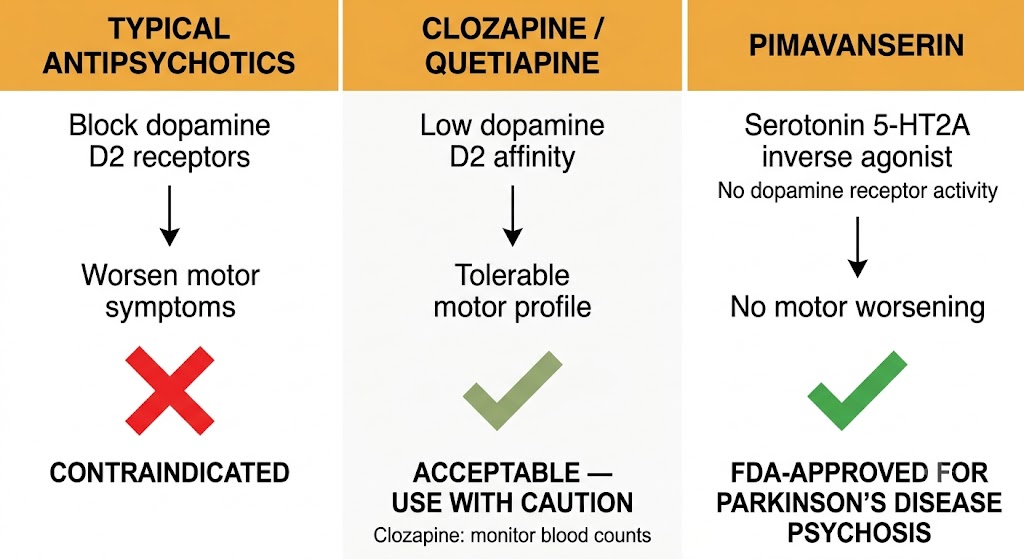
Typical antipsychotics — including haloperidol and the phenothiazines — block dopamine D2 receptors throughout the brain, including in the nigrostriatal pathway. In a patient with Parkinson's disease whose motor function already depends on maximizing the dopamine signal in the striatum, D2 receptor blockade produces severe motor deterioration. Typical antipsychotics are absolutely contraindicated in Parkinson's disease psychosis. Risperidone, while classified as an atypical antipsychotic, has high D2 receptor affinity and is similarly contraindicated for the same reason.
Two atypical antipsychotics are used in Parkinson's disease psychosis because they have low affinity for dopamine D2 receptors relative to their antipsychotic potency. Clozapine has the most evidence and efficacy but requires regular monitoring for agranulocytosis — absolute neutrophil count must be checked weekly for the first six months and periodically thereafter. Quetiapine is used more commonly in practice because it does not require the intensive blood count monitoring that clozapine demands, though its evidence base in Parkinson's disease psychosis is less robust.
Pimavanserin is the only drug approved by the Food and Drug Administration specifically for Parkinson's disease psychosis. Its mechanism is entirely distinct from all other antipsychotics: it is a selective inverse agonist at serotonin 5-HT2A receptors and has no dopamine receptor activity whatsoever. By modulating serotonergic rather than dopaminergic pathways, pimavanserin reduces hallucinations and delusions without any risk of worsening motor symptoms — making it uniquely suited to the Parkinson's disease context. The absence of dopamine D2 blockade is its defining pharmacological feature.
Managing mood and sleep disturbances while avoiding drugs that worsen motor symptoms or interact with antiparkinson medications
Depression is among the most common non-motor features of Parkinson's disease, affecting nearly half of all patients. Sleep disorders — including insomnia, restless legs syndrome, and rapid eye movement sleep behavior disorder — are also prevalent and contribute significantly to quality of life impairment. Drug selection in both domains requires attention to interactions with the antiparkinson regimen.
Selective serotonin reuptake inhibitors and serotonin-norepinephrine reuptake inhibitors are the preferred antidepressants in Parkinson's disease. They are generally well tolerated and have no direct adverse effect on motor function. The main caution when using them alongside monoamine oxidase B inhibitors is serotonin syndrome risk — the combination requires monitoring and should be used cautiously, particularly with selegiline given its amphetamine metabolites.
Tricyclic antidepressants are generally avoided in Parkinson's disease patients, particularly the elderly, because of their significant anticholinergic burden — which worsens cognition — and their cardiac adverse effects. Although some tricyclics have mild antiparkinsonian properties, this does not justify their routine use given the safer alternatives available.
Restless legs syndrome is common in Parkinson's disease and responds well to the same dopaminergic agents used for motor symptoms — particularly dopamine agonists such as pramipexole and ropinirole, which are approved for restless legs syndrome as well as Parkinson's disease. Optimizing the evening levodopa dose also helps some patients.
Rapid eye movement sleep behavior disorder — in which patients act out dream content because the normal motor paralysis of rapid eye movement sleep is lost — often precedes the motor symptoms of Parkinson's disease by years and is highly associated with synucleinopathies. Clonazepam and melatonin are used for symptomatic management, though neither treats the underlying neurodegeneration.
Orthostatic hypotension, constipation, and urinary symptoms as targets for pharmacological intervention
Autonomic dysfunction is a nearly universal non-motor feature of Parkinson's disease that reflects degeneration of autonomic ganglia and peripheral autonomic nerves in addition to the central nervous system pathology. Orthostatic hypotension is the most clinically significant autonomic manifestation and the one most amenable to pharmacological treatment.
Orthostatic hypotension in Parkinson's disease has two components: the disease itself impairs autonomic cardiovascular reflexes, and dopaminergic medications — particularly dopamine agonists and levodopa — cause vasodilation that further reduces standing blood pressure. Initial management involves non-pharmacological measures: increased salt and fluid intake, compression stockings, and elevating the head of the bed at night.
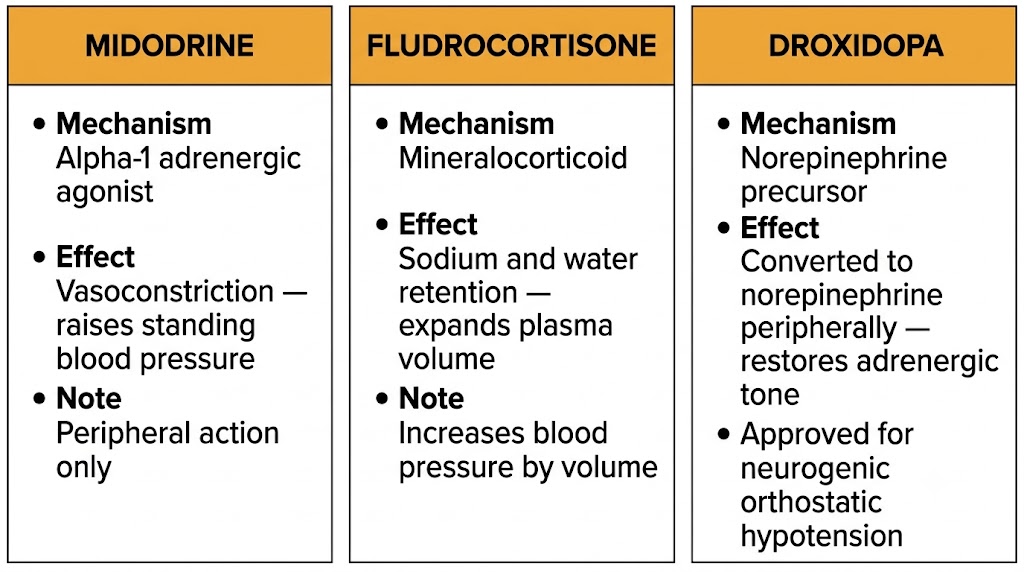
When pharmacological treatment is needed, three agents are used. Fludrocortisone is a mineralocorticoid that increases plasma volume by promoting sodium and water retention. Midodrine is a peripherally acting alpha-1 adrenergic agonist that causes vasoconstriction, raising standing blood pressure without central stimulant effects. Droxidopa is a norepinephrine precursor that is converted to norepinephrine peripherally, restoring adrenergic vascular tone — it is specifically approved for neurogenic orthostatic hypotension.
Constipation in Parkinson's disease reflects slowing of gastrointestinal motility from autonomic dysfunction and is worsened by anticholinergic medications. Management emphasizes adequate hydration, dietary fiber, and osmotic laxatives. Urinary symptoms — including urgency, frequency, and nocturia from detrusor overactivity — may be treated with bladder-targeted antimuscarinics such as oxybutynin, though these carry cognitive risk in older patients and should be used cautiously.
| Author / Organization | Title | Source |
|---|---|---|
| Katzung BG, Trevor AJ | Basic and Clinical Pharmacology, 15th edition | McGraw-Hill, 2021 |
| Brunton LL, Knollmann BC | Goodman and Gilman's The Pharmacological Basis of Therapeutics, 13th edition | McGraw-Hill, 2018 |
| Le T, Bhushan V | First Aid for the USMLE Step 1 | McGraw-Hill, current edition |
| Connolly BS, Lang AE | Pharmacological treatment of Parkinson disease: a review | JAMA, 2014 |
| Cummings J et al. | Pimavanserin for patients with Parkinson's disease psychosis: a randomised, placebo-controlled phase 3 trial | Lancet, 2014 |