CHAPTER 3 · PHARMACODYNAMICS

Section 1

Pharmacodynamic Drug Interactions

When two drugs produce additive or synergistic toxicity at the same effector — cardiac, central nervous system, and renal

Pharmacodynamic drug interactions occur when two drugs act on the same physiological target or converging pathways to produce effects that are greater than either drug alone. Unlike pharmacokinetic interactions — which alter drug concentration and can often be managed by dose adjustment — pharmacodynamic interactions occur at the effector organ regardless of plasma concentration. The most clinically dangerous patterns are additive QT prolongation with risk of fatal arrhythmia, additive central nervous system and respiratory depression with risk of overdose death, and cumulative nephrotoxicity.

QT Prolongation and Torsades de Pointes

The QT interval on the electrocardiogram represents the time for the ventricles to depolarize and fully repolarize. Repolarization depends on outward potassium current through specific cardiac potassium channels. Many drugs block these channels and delay repolarization, lengthening the QT interval. When the QT interval is prolonged beyond a critical threshold — generally a corrected QT interval above 500 milliseconds — the risk of a dangerous arrhythmia called torsades de pointes rises substantially. Torsades de pointes is a polymorphic ventricular tachycardia that can degenerate into ventricular fibrillation and sudden cardiac death.

The danger of combining two QT-prolonging drugs is additive prolongation. Each drug alone may push the corrected QT interval modestly; together they may exceed the threshold for torsades de pointes. This pharmacodynamic interaction occurs even when neither drug affects the plasma concentration of the other. Risk factors that amplify vulnerability include female sex (women have longer baseline QT intervals), hypokalemia (reduced potassium gradient impairs repolarization), hypomagnesemia, bradycardia, and pre-existing long QT syndrome from congenital ion channel variants.

Drug classes that commonly prolong the QT interval include class I and class III antiarrhythmics (quinidine, sotalol, amiodarone), macrolide and fluoroquinolone antibiotics, azole antifungals, antipsychotics (haloperidol, quetiapine, ziprasidone), and methadone. The clinical management is straightforward: check baseline corrected QT before starting any QT-prolonging drug, correct hypokalemia and hypomagnesemia before and during therapy, monitor corrected QT after initiation, and avoid combining two or more QT-prolonging drugs unless the benefit clearly outweighs the risk. Hold the drug if the corrected QT exceeds 500 milliseconds or increases more than 60 milliseconds from baseline.
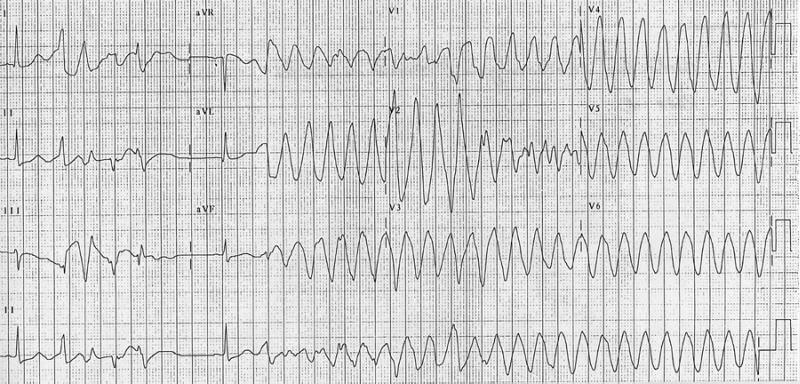
Twelve-lead electrocardiogram showing torsades de pointes, with characteristic twisting of QRS complexes around the isoelectric baseline, in a patient with hypokalemia and prolonged QT interval.
CardioNetworks ECGpedia. Twelve-lead electrocardiogram showing torsades de pointes in a 56-year-old female with hypokalemia (potassium 2.4 mmol/L) and prolonged QT interval. QRS complexes twist characteristically around the isoelectric baseline. Source: Wikimedia Commons. License: CC BY-SA 3.0.

Additive Central Nervous System and Respiratory Depression

Central nervous system depressants act through different receptor mechanisms but converge on the same outcome: reduced neuronal excitability and impaired brainstem respiratory drive. Opioids activate mu-opioid receptors through Gi signaling to suppress the respiratory control centers of the brainstem. Benzodiazepines enhance gamma-aminobutyric acid-mediated inhibitory signaling throughout the brain and brainstem. Alcohol potentiates gamma-aminobutyric acid activity and inhibits glutamate signaling. Gabapentinoids reduce excitatory neurotransmitter release. Each class contributes to respiratory depression through its own mechanism, and their combination produces additive — and at higher doses, potentially synergistic — respiratory suppression.

The opioid-benzodiazepine combination is the most clinically significant. The United States Food and Drug Administration issued a black box warning in 2016 on the concurrent prescribing of opioids and benzodiazepines, citing evidence that the combination substantially increases the risk of respiratory depression, sedation, and death compared to either drug alone. Patients receiving both classes require explicit counseling about the risk, should have naloxone prescribed and accessible, and should be monitored for signs of excessive sedation. The combination cannot be managed simply by reducing the plasma concentration of one agent — the interaction is at the effector (the respiratory control center), not at the pharmacokinetic level.

Gabapentin and pregabalin, increasingly co-prescribed with opioids for pain, also contribute to additive respiratory depression and are associated with increased overdose mortality in patients on opioid therapy. This is a pharmacodynamic interaction that prescribers should recognize regardless of the plasma concentrations of either drug.

Cumulative Nephrotoxicity

The kidney is uniquely vulnerable to drug toxicity because it receives 20 to 25 percent of cardiac output, concentrates drugs in the tubular lumen to levels far above plasma concentrations, and has high metabolic demands in the proximal tubule. When two drugs that each cause kidney injury are given together, the result is frequently additive — and sometimes synergistic — toxicity that exceeds the risk of either agent alone.

Aminoglycosides (gentamicin, tobramycin, amikacin) cause direct proximal tubule injury through intracellular drug accumulation. Vancomycin independently causes tubular toxicity, and the combination of aminoglycoside plus vancomycin produces substantially greater nephrotoxicity than either agent alone — a well-documented interaction that requires daily monitoring of serum creatinine and drug levels when the combination cannot be avoided.

Nonsteroidal anti-inflammatory drugs reduce renal prostaglandin synthesis, impairing the compensatory afferent arteriolar vasodilation that maintains glomerular filtration rate under conditions of reduced renal perfusion. Angiotensin converting enzyme inhibitors and angiotensin receptor blockers dilate the efferent arteriole, reducing glomerular filtration pressure. Diuretics reduce circulating volume. The combination of a nonsteroidal anti-inflammatory drug with an angiotensin converting enzyme inhibitor or angiotensin receptor blocker and a diuretic — the “triple whammy” — simultaneously removes three compensatory mechanisms for maintaining glomerular filtration rate, and produces a high rate of acute kidney injury in at-risk patients, particularly the elderly and those with baseline chronic kidney disease or heart failure.

High-Risk Pharmacodynamic Combinations

QT prolongation: check baseline corrected QT before starting; correct hypokalemia and hypomagnesemia; avoid combining two or more QT-prolonging drugs; hold if corrected QT exceeds 500 ms or increases >60 ms from baseline. Classes: antiarrhythmics, macrolides, fluoroquinolones, azoles, antipsychotics, methadone.

Central nervous system depression: opioid plus benzodiazepine warrants black box warning; prescribe naloxone for at-risk patients; recognize gabapentinoid contribution; cannot be managed by plasma concentration monitoring alone.

Nephrotoxicity: aminoglycoside plus vancomycin requires daily creatinine monitoring; triple whammy (nonsteroidal anti-inflammatory drug plus angiotensin converting enzyme inhibitor or angiotensin receptor blocker plus diuretic) causes high acute kidney injury risk in elderly and those with chronic kidney disease.


Section 2

Tolerance, Cross-Tolerance, and the Addiction Distinction

What tolerance is, how it develops at different levels, and why it is not the same as dependence or addiction

Pharmacological tolerance is a reduction in drug effect that develops during continued drug exposure, requiring higher doses to achieve the same response. It is a predictable consequence of prolonged receptor activation and is distinct from physical dependence (the development of a withdrawal syndrome on discontinuation) and from addiction (compulsive drug use despite adverse consequences). Clear understanding of these distinctions is essential for appropriate opioid prescribing, pain management, and patient communication.

How Tolerance Develops

Tolerance operates through mechanisms at multiple levels, each with a different time course. Short-term receptor-level tolerance, developing over minutes to hours, involves phosphorylation and uncoupling of the receptor from its downstream effectors — the desensitization process described in Module 3. Intermediate tolerance over hours to days involves internalization and reduced cell-surface receptor number. Long-term tolerance over days to weeks involves transcriptional downregulation: the cell synthesizes less receptor protein. At each stage, the drug-receptor system becomes less responsive, shifting the dose-response curve rightward so that higher concentrations are needed to achieve the same effect.

Beyond the receptor itself, the body engages physiological counter-regulatory mechanisms that oppose drug effects at the systems level. Chronic diuretic use activates the renin-angiotensin-aldosterone system, which increases renal sodium retention and partially counteracts the drug-induced natriuresis — contributing to diuretic resistance in chronic heart failure. Chronic glucocorticoid administration suppresses the hypothalamic-pituitary-adrenal axis through negative feedback, so that higher doses may eventually be needed to maintain the same degree of immunosuppression as the adrenal axis adapts.

With opioids, an additional complication can emerge: opioid-induced hyperalgesia, in which chronic opioid use paradoxically increases pain sensitivity through central nervous system sensitization. This is distinct from simple tolerance — it is not that the opioid has lost effectiveness, but that the baseline state has shifted toward increased pain perception. Opioid-induced hyperalgesia should be suspected when pain worsens during dose escalation rather than improving.

Cross-Tolerance

Cross-tolerance occurs when tolerance to one drug reduces sensitivity to another drug in the same class or with a related mechanism. A patient who has developed tolerance to one opioid through downregulation of mu-opioid receptors will be partly or fully tolerant to all other mu-opioid agonists, because the receptor population that all of them share has been reduced or desensitized. This means that a patient on chronic high-dose opioids requires substantially higher doses of any opioid, including for perioperative analgesia, than an opioid-naive patient.

Cross-tolerance is not always complete. Partial cross-tolerance between different opioids — meaning the degree of tolerance does not transfer perfectly from one drug to another — is the pharmacological basis for opioid rotation in pain management. When a patient has developed tolerance to one opioid and is switched to a different one, the new opioid may achieve effective analgesia at a lower equianalgesic dose because the specific receptor adaptations are not fully transferred. Equianalgesic dose tables provide starting estimates when rotating opioids, but incomplete cross-tolerance means doses should initially be reduced and then titrated upward based on patient response.

Cross-tolerance between benzodiazepines and alcohol at the gamma-aminobutyric acid type A receptor explains why patients with alcohol use disorder require substantially higher benzodiazepine doses to manage alcohol withdrawal compared with non-tolerant patients — the gamma-aminobutyric acid type A receptor has been desensitized and downregulated by chronic alcohol exposure.

Tolerance vs. Dependence vs. Addiction

These three terms are used interchangeably in everyday speech but describe distinct and separable phenomena.

Tolerance is a pharmacological adaptation — reduced drug effect at a given dose, requiring dose escalation to maintain the same response. It is a predictable consequence of any chronic agonist exposure at virtually any receptor system. Tolerance to opioids, benzodiazepines, nitrates, and beta-agonists all develop through the mechanisms described above, and all are managed by dose adjustment or drug holidays.

Physical dependence is a physiological state in which the body has adapted to the continuous presence of a drug, and a withdrawal syndrome occurs if the drug is abruptly discontinued. Physical dependence is also a predictable consequence of chronic exposure to many drug classes. Beta-blockers produce physical dependence (rebound tachycardia and angina on abrupt withdrawal). Glucocorticoids produce physical dependence (adrenal insufficiency on abrupt withdrawal). Opioids produce physical dependence (the withdrawal syndrome of lacrimation, piloerection, diarrhea, and autonomic hyperactivity). Physical dependence does not mean the patient is addicted — it means the drug should be tapered rather than stopped abruptly.

Addiction is a chronic, relapsing neurological disorder characterized by compulsive drug-seeking and drug use despite adverse consequences. It involves pathological changes in brain reward circuits — particularly the mesolimbic dopamine pathway — that drive craving and compulsive behavior. Addiction can occur without physical dependence (as can happen with stimulants) and physical dependence can occur without addiction (as in a patient receiving chronic opioids for cancer pain). A patient who requires increasing doses of opioids for pain control and who would experience withdrawal if opioids were stopped abruptly is physically dependent and has developed tolerance — but is not addicted unless compulsive drug-seeking behavior is present. Conflating these concepts leads to undertreatment of legitimate pain.

Three Distinct Concepts

Tolerance: reduced drug effect at the same dose; requires dose escalation; a pharmacological adaptation; does not imply addiction.

Physical dependence: withdrawal syndrome on abrupt discontinuation; a physiological adaptation; managed by tapering; does not imply addiction. Examples: opioids, benzodiazepines, beta-blockers, glucocorticoids, clonidine.

Addiction: compulsive drug-seeking despite adverse consequences; a neurological disorder involving reward pathway pathology; can occur without tolerance or physical dependence; is not an inevitable consequence of opioid prescribing for pain.


Section 3

Pharmacogenomics and Drug Response Variability

How inherited variation at drug targets explains why different patients respond differently to the same drug at the same plasma concentration

When two patients receive the same drug at the same dose and achieve the same plasma concentration but have different clinical responses, the explanation may lie in pharmacodynamic variability — differences at the drug target itself rather than in how the drug is absorbed or metabolized. Inherited genetic polymorphisms in receptors, ion channels, and enzymes that drugs act on can markedly alter the relationship between drug concentration and drug effect, with clinically important consequences for dosing and drug selection.

Pharmacodynamic vs. Pharmacokinetic Variability

The distinction matters for clinical interpretation. Pharmacokinetic variability — from polymorphisms in drug-metabolizing enzymes like cytochrome P450 2C9 or 2D6 — changes the plasma concentration achieved at a given dose. Pharmacodynamic variability — from polymorphisms in the drug target — changes the response produced at a given plasma concentration. For drugs where both types of variability occur, comprehensive prediction of individual response requires accounting for both. Warfarin is the clearest example: cytochrome P450 2C9 polymorphisms affect how quickly warfarin is metabolized (pharmacokinetic variability), while vitamin K epoxide reductase complex 1 polymorphisms affect how sensitive the target enzyme is to warfarin inhibition (pharmacodynamic variability). Together they account for approximately 35 to 50 percent of the variance in stable warfarin dose requirements across populations.

Warfarin and Vitamin K Epoxide Reductase Complex 1 Polymorphisms

Warfarin works by inhibiting vitamin K epoxide reductase complex 1, the enzyme that recycles vitamin K into the active form needed for synthesis of clotting factors II, VII, IX, and X. The gene encoding this enzyme contains a common promoter polymorphism that substantially alters how much of the enzyme is expressed. Patients carrying the variant allele produce less of the target enzyme. Because warfarin inhibits the enzyme, patients who express less of it are more sensitive to warfarin — they achieve the same degree of anticoagulation at a much lower dose. The other allele produces more enzyme, and those patients are relatively warfarin-resistant, requiring higher doses to reach the same anticoagulant effect.

This polymorphism shows substantial frequency differences across ancestry groups. The allele associated with reduced enzyme expression and increased warfarin sensitivity is far more common in East Asian populations than in European populations, and least common in African populations. This is a pharmacodynamic explanation for the well-established clinical observation that East Asian patients typically require lower warfarin doses than European patients to maintain the same target international normalized ratio. The United States Food and Drug Administration updated warfarin labeling in 2010 to include genotype-based dose guidance, and genotype-informed dosing algorithms are available that incorporate both the target enzyme gene and the metabolizing enzyme gene alongside clinical factors like age and body size.

Beta-1 Adrenergic Receptor Polymorphisms

The beta-1 adrenergic receptor gene contains a functionally important variant at a position that determines how efficiently the receptor couples to its downstream signaling pathway. Patients carrying the more active variant produce more cyclic adenosine monophosphate per receptor molecule activated. When a beta-blocker blocks these more active receptors, the hemodynamic effect — heart rate slowing, blood pressure reduction, improvement in heart failure outcomes — is more pronounced. Patients carrying the less active variant get a smaller response to the same beta-blocker dose and may need higher doses to achieve equivalent benefit.

In heart failure management, where beta-blocker dose titration is already individualized based on hemodynamic tolerance, this genetic variation contributes to why some patients show dramatic improvement in left ventricular function while others have more modest responses at standard doses. Pharmacogenomic testing for this variant has been proposed as a tool to guide dosing, but routine clinical use remains investigational, and current guidelines base dose decisions on hemodynamic response rather than genotype.

SCN1A Mutations and Paradoxical Drug Response in Dravet Syndrome

Dravet syndrome is a severe childhood epilepsy caused by loss-of-function mutations in the SCN1A gene, which encodes a voltage-gated sodium channel subtype expressed predominantly in inhibitory interneurons. When inhibitory interneurons lose half their sodium channel function, they fire less effectively, resulting in reduced inhibitory tone throughout the brain and severe, refractory seizures.

The pharmacodynamic paradox of Dravet syndrome is that sodium channel-blocking antiepileptic drugs — including carbamazepine, phenytoin, and lamotrigine — are specifically contraindicated and can dramatically worsen seizure control. The reason is that these drugs further reduce sodium channel activity in the inhibitory interneurons that are already compromised, weakening inhibitory tone further and paradoxically increasing seizure frequency and severity. This is one of the most striking examples of genetically determined pharmacodynamic response: the same drugs that are first-line treatment for most epilepsies are harmful in Dravet syndrome because the underlying pathophysiology renders the normal pharmacological mechanism counterproductive.

Preferred treatments in Dravet syndrome include valproate, clobazam, and more recently approved agents including fenfluramine and cannabidiol, none of which rely on sodium channel blockade as their primary mechanism. Genetic testing for SCN1A mutations is now standard in children presenting with fever-triggered seizures beginning in the first year of life, because early identification of Dravet syndrome directly and immediately changes drug selection.

Pharmacogenomics at a Glance

Vitamin K epoxide reductase complex 1 polymorphism → warfarin sensitivity: variant allele = less target enzyme = more sensitive to warfarin = lower dose needed. East Asian patients have higher variant allele frequency → typically require lower warfarin doses. Both the target enzyme gene and the cytochrome P450 2C9 metabolizing enzyme gene contribute to warfarin dose prediction.

Beta-1 adrenergic receptor polymorphism → variable beta-blocker response: more active receptor variant → stronger heart rate and blood pressure response to beta-blockade and greater heart failure benefit. Less active variant → blunted response at standard doses.

SCN1A mutation (Dravet syndrome) → paradoxical pharmacodynamic response: sodium channel-blocking antiepileptics (carbamazepine, phenytoin, lamotrigine) worsen seizures because they further suppress already-compromised inhibitory interneurons. Contraindicated. Use valproate, clobazam, fenfluramine, or cannabidiol instead.


Suggested References
Author / Organization Title Source
Roden DM Drug-induced prolongation of the QT interval N Engl J Med. 2004;350(10):1013-1022.
Nachimuthu S, Assar MD, Schussler JM Drug-induced QT interval prolongation: mechanisms and clinical management Ther Adv Drug Saf. 2012;3(5):241-253.
Park TW, Saitz R, Ganoczy D, Ilgen MA, Bohnert AS Benzodiazepine prescribing patterns and deaths from drug overdose among US veterans receiving opioid analgesics: case-cohort study BMJ. 2015;350:h2698.
Schetz M, Dasta J, Goldstein S, Golper T Drug-induced acute kidney injury Curr Opin Crit Care. 2005;11(6):555-565.
Christie MJ Cellular neuroadaptations to chronic opioids: tolerance, withdrawal and addiction Br J Pharmacol. 2008;154(2):384-396.
Liggett SB Pharmacogenomics of beta-1-adrenergic receptor polymorphisms in heart failure: a paradigm for the genetics of therapeutic targets Pharmacogenomics. 2004;5(3):281-292.
Johnson JA, Cavallari LH Warfarin pharmacogenetics Trends Cardiovasc Med. 2015;25(1):33-41.
Kwan P, Brodie MJ Neurological channelopathies: genetic disorders of altered ionic channels Lancet Neurol. 2002;1(3):178-188.