CHAPTER 25  ·  PULMONARY PHARMACOLOGY
Section 1

Airway Smooth Muscle Physiology: Bronchoconstriction and Bronchodilation

The Gq pathway that drives bronchoconstriction, the Gs/cyclic AMP axis that produces bronchodilation, muscarinic receptor subtypes M1 through M3, and the phosphodiesterase isoforms relevant to airway pharmacology

Every drug class used to treat obstructive airway disease acts by shifting the contractile state of airway smooth muscle. Understanding the two opposing signaling pathways that govern this contractile state — and the receptor subtypes and enzymes that feed into each — predicts both the therapeutic effect and the adverse effects of every bronchodilator in clinical use.

Bronchoconstriction: The Gq Pathway

Bronchoconstriction is triggered when agonists such as acetylcholine, histamine, or cysteinyl leukotrienes bind to their respective Gq-coupled receptors on airway smooth muscle. Gq activation stimulates phospholipase C, which generates inositol trisphosphate (IP3) and diacylglycerol. IP3 releases stored calcium from the sarcoplasmic reticulum, raising intracellular calcium concentration. The calcium-calmodulin complex then activates myosin light chain kinase, which phosphorylates myosin light chain, drives cross-bridge cycling, and produces muscle contraction.

This cascade is the molecular mechanism for the bronchoconstriction caused by acetylcholine at M3 muscarinic receptors and by leukotrienes at CysLT1 receptors — the two most pharmacologically important Gq-coupled inputs to the airway.

Bronchodilation: The Gs/Cyclic AMP Axis

Bronchodilation is produced through the opposing Gs-coupled pathway. When beta-2 adrenergic receptors on airway smooth muscle are activated, Gs stimulates adenylyl cyclase, raising intracellular cyclic AMP. Cyclic AMP activates protein kinase A, which phosphorylates myosin light chain kinase to reduce its activity and simultaneously activates myosin light chain phosphatase to increase it. The net result is dephosphorylation of myosin light chain, cross-bridge dissociation, and muscle relaxation.

Phosphodiesterase enzymes terminate this signal by degrading cyclic AMP. Phosphodiesterase 3 is the principal cyclic AMP-degrading isoform in airway smooth muscle; its inhibition prolongs bronchodilation. Phosphodiesterase 4 is the dominant isoform in inflammatory cells — eosinophils, mast cells, neutrophils, and macrophages — and its inhibition reduces inflammatory mediator release in addition to producing modest bronchodilation. This distinction explains why the selective phosphodiesterase 4 inhibitor roflumilast is used for its anti-inflammatory effect in chronic obstructive pulmonary disease rather than as a primary bronchodilator.

Muscarinic Receptor Subtypes: M1, M2, and M3

Three muscarinic receptor subtypes have distinct roles in the airway. M3 receptors on airway smooth muscle and submucosal glands are the primary effectors of bronchoconstriction and mucus secretion — they are the main therapeutic target of anticholinergic bronchodilators. M1 receptors on parasympathetic ganglia facilitate ganglionic neurotransmission, amplifying overall parasympathetic tone to the airway. M2 autoreceptors on postganglionic nerve terminals function as a negative feedback brake: when acetylcholine binds M2, further release is inhibited.

The clinical consequence of this subtype distribution is that an ideal anticholinergic bronchodilator would block M1 and M3 while sparing M2. Blocking M2 removes the inhibitory feedback brake and allows greater acetylcholine release, partially offsetting the bronchodilation from M3 blockade. As discussed in Section 4, tiotropium achieves functional M3 selectivity through differential kinetics rather than receptor affinity.
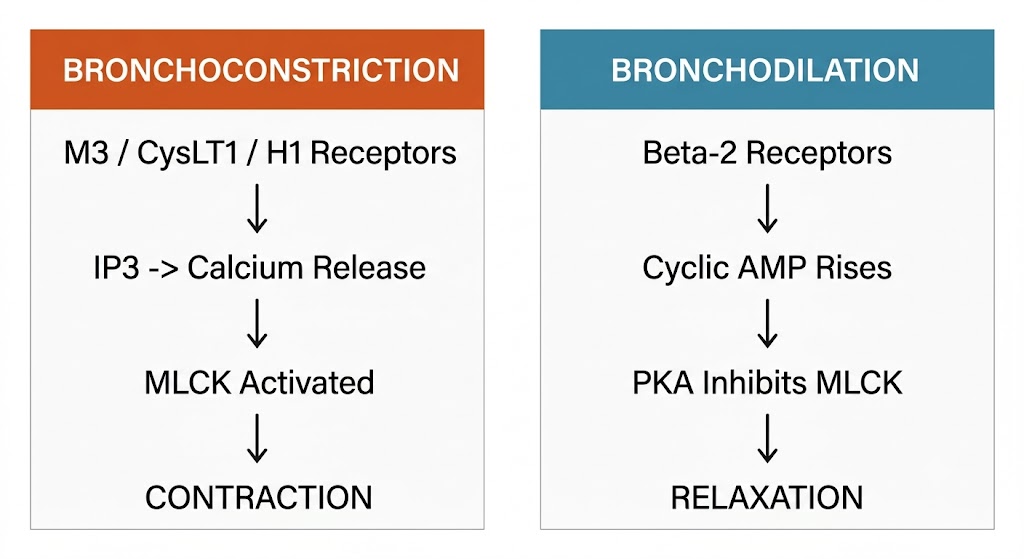
Two-panel diagram showing airway smooth muscle signaling: left panel shows Gq-driven bronchoconstriction pathway from M3/CysLT1/H1 receptors through IP3 and calcium release to MLCK activation and contraction; right panel shows Gs-driven bronchodilation pathway from beta-2 receptors through cyclic AMP and PKA to MLCK inhibition and relaxation.
Airway smooth muscle signaling: the opposing bronchoconstriction (Gq/IP3/calcium) and bronchodilation (Gs/cyclic AMP/PKA) pathways. Generated with Gemini AI for educational use.
Airway Smooth Muscle Signaling: Key Relationships

Bronchoconstriction: Gq-coupled receptors (M3 muscarinic, CysLT1, H1 histamine) raise intracellular calcium via IP3, activating myosin light chain kinase and driving contraction.

Bronchodilation: beta-2 adrenergic receptors raise cyclic AMP via adenylyl cyclase, activating protein kinase A, which inactivates myosin light chain kinase and activates myosin light chain phosphatase.

Phosphodiesterase 3 degrades cyclic AMP in airway smooth muscle; phosphodiesterase 4 in inflammatory cells. Inhibiting either prolongs bronchodilation or reduces inflammation respectively.

Section 2

Short-Acting Beta-2 Agonists: Pharmacology and Adverse Effects

Albuterol as the prototype rescue bronchodilator, onset and duration, levalbuterol and stereoselective pharmacology, and the systemic adverse effect profile

Short-acting beta-2 agonists are the standard of care for acute bronchospasm and serve as rescue therapy across all obstructive lung diseases. Albuterol is the prototype, and understanding its receptor selectivity, onset characteristics, and systemic adverse effects provides the framework for evaluating the entire class.

Albuterol: Mechanism and Clinical Profile

Albuterol is a selective beta-2 adrenergic receptor agonist — approximately 200-fold selective for beta-2 over beta-1 receptors at therapeutic doses — though this selectivity is not absolute and diminishes at higher doses. It activates adenylyl cyclase via Gs, raises cyclic AMP, and activates protein kinase A to relax airway smooth muscle. Inhaled albuterol has an onset of action of 5 to 15 minutes and a duration of 4 to 6 hours, making it ideal for as-needed rescue use and for pre-treatment before exercise to prevent exercise-induced bronchoconstriction.

Levalbuterol is the isolated R-enantiomer of albuterol — the pharmacologically active form. Racemic albuterol contains both the active R-enantiomer and the inactive S-enantiomer in equal proportions. The rationale for levalbuterol is that eliminating the inactive enantiomer reduces total drug exposure while maintaining bronchodilatory efficacy. In practice, clinical trials have not consistently shown a meaningful advantage for levalbuterol over equivalent doses of racemic albuterol, and current guidelines do not preferentially recommend one over the other.

Systemic Adverse Effects

The systemic adverse effects of short-acting beta-2 agonists reflect beta-2 receptor stimulation in tissues outside the airway. Skeletal muscle tremor is the most common, caused by beta-2 receptor activation in slow-twitch muscle fibers and most pronounced at higher doses. Tachycardia occurs by two mechanisms: direct cardiac beta-1 stimulation from imperfect selectivity, and reflex tachycardia secondary to beta-2-mediated peripheral vasodilation.

Hypokalemia is clinically important in acute severe asthma. Beta-2 receptor activation increases sodium-potassium ATPase activity in skeletal muscle, driving potassium into cells and lowering serum potassium. This effect is dose-dependent and additive with concurrent systemic corticosteroids and loop diuretics — all of which may be used simultaneously in acute severe asthma. Hyperglycemia occurs through beta-2-mediated glycogenolysis and inhibition of insulin secretion from pancreatic beta cells.

Monitoring in High-Dose Albuterol Use

In acute severe asthma requiring high-dose or continuous nebulized albuterol, monitor serum potassium, cardiac rhythm, and blood glucose. Hypokalemia is additive with systemic corticosteroids and diuretics commonly used in the same setting. Tremor is the most reliable dose-dependent sign of systemic beta-2 exposure.


Section 3

Long-Acting Beta-2 Agonists: Pharmacology and Safety

Salmeterol versus formoterol pharmacological differences, the LABA black box warning and its basis, SMART therapy, and the COPD exception to the ICS requirement

Long-acting beta-2 agonists share the bronchodilatory mechanism of short-acting agents but differ critically in their duration of action, onset speed, and intrinsic efficacy at the receptor. These pharmacological differences have direct clinical consequences, particularly regarding safety constraints in asthma.

Salmeterol versus Formoterol

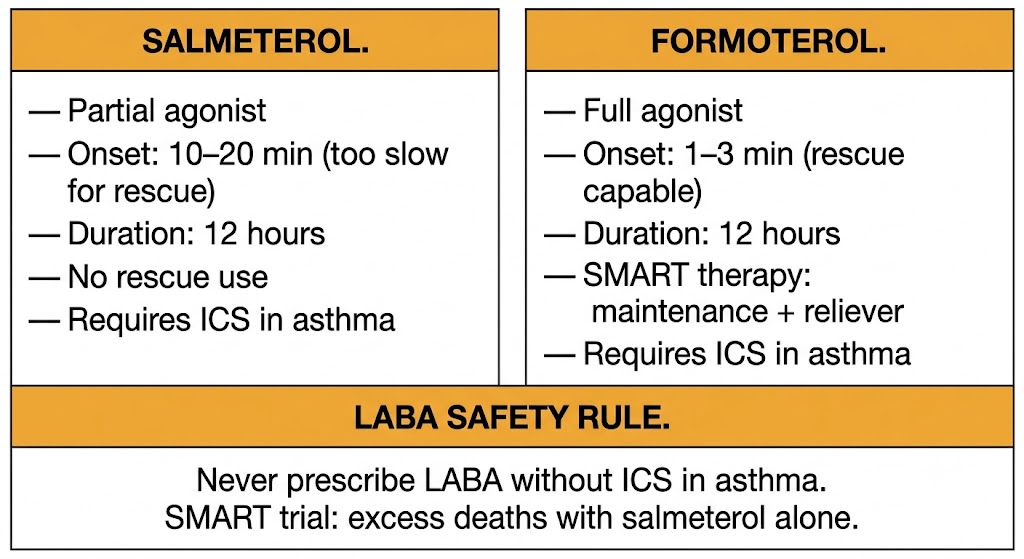
Salmeterol is a partial agonist at the beta-2 receptor with a slow onset of 10 to 20 minutes and a duration of approximately 12 hours. Because of its slow onset, salmeterol cannot serve as a rescue bronchodilator and should never be used for acute bronchoconstriction. Its prolonged duration reflects tight receptor binding mediated by its lipophilic side chain.

Formoterol is a full agonist at the beta-2 receptor and differs from salmeterol in two clinically consequential ways. First, its onset of action is 1 to 3 minutes after inhalation — comparable to albuterol — making it the only long-acting beta-2 agonist with a rapid enough onset to serve as a rescue bronchodilator. Second, as a full agonist it produces greater maximal bronchodilation per unit receptor occupancy than salmeterol. This combination of sustained action and rapid onset is what makes formoterol suitable for the SMART (Single Maintenance and Reliever Therapy) strategy, in which budesonide/formoterol is used as both the daily maintenance controller and the as-needed reliever inhaler.

Two-panel comparison of salmeterol versus formoterol showing key differences: salmeterol is a partial agonist with 10-20 minute onset and no rescue use; formoterol is a full agonist with 1-3 minute onset suitable for SMART therapy. Shared lower box states the LABA safety rule requiring ICS co-administration in asthma.
Salmeterol versus formoterol: pharmacological differences and the LABA safety rule in asthma. Generated with Gemini AI for educational use.
LABA Black Box Warning and Asthma Safety

Long-acting beta-2 agonists carry a black box warning for asthma based on the SMART trial (Salmeterol Multicenter Asthma Research Trial), which was terminated early because of a statistically significant increase in asthma-related deaths in the salmeterol group. The deaths were concentrated in patients not using concurrent inhaled corticosteroids — establishing that long-acting beta-2 agonist monotherapy in asthma is dangerous because it suppresses symptoms without controlling the underlying eosinophilic airway inflammation, allowing silent disease progression to fatal exacerbation.

As a result, long-acting beta-2 agonists in asthma are approved only in fixed-dose combination with inhaled corticosteroids. Long-acting beta-2 agonist monotherapy in asthma remains absolutely contraindicated regardless of disease severity. Subsequent large trials (AUSTRI, STADIA, VESTRI) confirmed that when long-acting beta-2 agonists are combined with inhaled corticosteroids, the excess mortality signal is abolished.

In chronic obstructive pulmonary disease, this safety constraint does not apply. Long-acting beta-2 agonist monotherapy is appropriate in chronic obstructive pulmonary disease, and the concern from the SMART trial — which involved asthma patients — has not been demonstrated in this population.

Safety Rule: LABAs in Asthma

Long-acting beta-2 agonist monotherapy is absolutely contraindicated in asthma. The SMART trial demonstrated excess asthma mortality with salmeterol in patients not using inhaled corticosteroids. In asthma, long-acting beta-2 agonists are prescribed only as fixed-dose combinations with inhaled corticosteroids. This constraint does not apply in chronic obstructive pulmonary disease.


Section 4

Anticholinergic Bronchodilators: SAMAs, LAMAs, and Fixed-Dose Combinations

Ipratropium non-selectivity and additive bronchodilation in acute asthma, tiotropium kinetic M3 selectivity, LAMA class adverse effects, and the rationale for LABA/LAMA combinations in COPD

Anticholinergic bronchodilators block muscarinic receptors on airway smooth muscle and submucosal glands, reducing acetylcholine-mediated bronchoconstriction and mucus hypersecretion. Their mechanism is complementary to beta-2 agonist bronchodilation: they target the parasympathetic bronchoconstriction pathway while beta-2 agonists target the smooth muscle relaxation pathway directly. This pharmacological complementarity is the rationale for combining the two classes in both acute management and chronic maintenance therapy.

Ipratropium: Short-Acting Muscarinic Antagonist

Ipratropium is a quaternary ammonium compound derived from atropine. The permanent positive charge prevents significant systemic absorption after inhalation, minimizing central nervous system and systemic anticholinergic adverse effects. Ipratropium blocks M1, M2, and M3 receptors without meaningful subtype selectivity, with onset of 15 to 30 minutes and duration of 4 to 8 hours.

In acute severe asthma, adding ipratropium to short-acting beta-2 agonist therapy provides clinically meaningful additive bronchodilation — the two drugs work through independent pathways on the same airway smooth muscle cell. This combination reduces hospital admission rates in severe acute asthma by approximately 25% compared with short-acting beta-2 agonist alone. Standard dosing for acute asthma combines nebulized ipratropium 0.5 mg with albuterol 2.5 to 5 mg, repeated every 20 minutes for three doses.

Tiotropium: Kinetic M3 Selectivity

Tiotropium is the first-generation long-acting muscarinic antagonist (LAMA) and achieves functional M3 selectivity through differential dissociation kinetics rather than receptor affinity selectivity. Tiotropium dissociates from M3 receptors very slowly — half-life of approximately 35 hours — while it dissociates from M2 autoreceptors far more rapidly, with a half-life of approximately 3.6 hours. With once-daily dosing, M3 receptor occupancy is sustained throughout the 24-hour dosing interval while M2 receptor occupancy is not, producing net functional M3 selectivity and allowing the inhibitory autoreceptor feedback to recover between doses.

This kinetic distinction from ipratropium is the basis for tiotropium's superiority in sustained 24-hour bronchodilation. Second-generation long-acting muscarinic antagonists including umeclidinium, aclidinium, and glycopyrrolate provide additional options with once-daily or twice-daily dosing profiles for chronic obstructive pulmonary disease maintenance therapy.

Adverse Effects and Contraindications

The class adverse effects of anticholinergic bronchodilators reflect muscarinic blockade outside the airway. Dry mouth is the most common, affecting up to 16% of patients on tiotropium. Urinary retention is a clinically important risk in men with benign prostatic hyperplasia, where reduction in parasympathetic tone to the bladder detrusor can precipitate acute retention. Acute angle-closure glaucoma is an absolute contraindication; drug reaching the eye — particularly with nebulized formulations — can precipitate acute angle closure in susceptible patients. Constipation reflects reduced parasympathetic tone in the gastrointestinal tract.

SAMA
Ipratropium
  • Quaternary ammonium — minimal systemic absorption
  • Non-selective: M1, M2, M3
  • Onset 15–30 min, duration 4–8 h
  • First-line add-on in acute severe asthma
LAMA
Tiotropium
  • Kinetic M3 selectivity (slow M3 dissociation)
  • Once-daily dosing; 24-h bronchodilation
  • First-line in COPD maintenance
  • Absolute contraindication: angle-closure glaucoma

Section 5

Clinical Positioning: Inhaler Devices, Asthma, and COPD Management

Inhaled drug delivery principles, spacer use with inhaled corticosteroids, GINA 2024 ICS/formoterol reliever strategy, GOLD 2024 bronchodilator positioning, and acute severe asthma management

The clinical effectiveness of any inhaled bronchodilator depends not only on its pharmacological profile but also on how much drug actually reaches the lower airways. Device choice and inhalation technique are therefore as clinically important as drug selection — particularly in patients with severe airflow obstruction or poor coordination.

Inhaled Drug Delivery: Key Principles

Optimal lung deposition requires particles in the 1 to 5 micrometer aerodynamic diameter range. Larger particles deposit in the oropharynx rather than the lower airways — the primary source of oral candidiasis and dysphonia with inhaled corticosteroids. Smaller particles follow airflow in and out without depositing.

Pressurized metered-dose inhalers require coordinated actuation and inhalation; a valved holding chamber (spacer) eliminates this coordination requirement and improves lower airway deposition by allowing larger particles to settle in the spacer. For inhaled corticosteroids delivered by pressurized metered-dose inhaler, spacer use reduces oropharyngeal deposition and the risk of oral candidiasis. Dry powder inhalers require a minimum inspiratory flow rate to de-aggregate the powder effectively — patients with severe obstruction may not generate sufficient flow, making them a less reliable choice in this context.

GINA 2024: Asthma Step Therapy

The key change in GINA 2024 is that inhaled corticosteroid-containing treatment is present at every step of the asthma treatment ladder, including in patients with very mild infrequent symptoms. The preferred reliever at all steps is as-needed budesonide/formoterol (an inhaled corticosteroid/long-acting beta-2 agonist combination), replacing the previous approach of using a short-acting beta-2 agonist alone as the step 1 and step 2 reliever. This change is based on evidence that as-needed budesonide/formoterol reduces severe exacerbation rates compared with as-needed short-acting beta-2 agonist alone, while delivering lower total inhaled corticosteroid exposure than scheduled controller therapy in patients who use their reliever infrequently.

Long-acting beta-2 agonist monotherapy remains absolutely contraindicated in asthma at every step. A separate long-acting beta-2 agonist inhaler is never prescribed without concurrent inhaled corticosteroid.

GOLD 2024: COPD Bronchodilator Positioning

For most patients with moderate-to-severe chronic obstructive pulmonary disease, dual bronchodilator therapy with a long-acting beta-2 agonist and a long-acting muscarinic antagonist is the preferred first-line maintenance regimen. Inhaled corticosteroid-containing triple therapy (inhaled corticosteroid/long-acting beta-2 agonist/long-acting muscarinic antagonist) is reserved for patients with high exacerbation risk and blood eosinophil counts of 300 cells per microliter or higher, where the anti-inflammatory benefit of inhaled corticosteroids is most likely to translate into exacerbation reduction. A short-acting beta-2 agonist is used for acute symptom relief in all groups.

Acute Severe Asthma Management

The management of acute severe asthma integrates short-acting beta-2 agonist, short-acting muscarinic antagonist, and systemic corticosteroid therapy. High-dose nebulized albuterol is the immediate first-line bronchodilator, and ipratropium is added because its additive bronchodilation through the muscarinic pathway reduces hospital admission rates. Systemic corticosteroids (oral prednisone or intravenous methylprednisolone) are added for any presentation that does not respond promptly to initial bronchodilators; they reduce airway inflammation over 4 to 6 hours but do not produce acute bronchodilation. Intravenous magnesium sulfate is used in acute severe asthma refractory to initial therapy — it blocks calcium entry into smooth muscle, producing bronchodilation independent of the beta-2 or muscarinic pathways.

Clinical Framework: Bronchodilator Positioning

Asthma (GINA 2024): preferred reliever at all steps is as-needed budesonide/formoterol. Long-acting beta-2 agonist always combined with inhaled corticosteroid; monotherapy contraindicated.

COPD (GOLD 2024): long-acting beta-2 agonist/long-acting muscarinic antagonist combination preferred for moderate-to-severe disease. Triple therapy for high exacerbation risk with eosinophils 300 or higher. Short-acting beta-2 agonist for acute relief.

Acute severe asthma: albuterol plus ipratropium plus systemic corticosteroids. Add intravenous magnesium for inadequate response to initial bronchodilators.


Suggested References
Author / Organization Title Source
Barnes PJ Cellular and molecular mechanisms of asthma and COPD Clin Sci (Lond). 2017;131(13):1541–1558
Cazzola M, Page CP, Calzetta L, Matera MG Pharmacology and therapeutics of bronchodilators Pharmacol Rev. 2012;64(3):450–504
Barnes PJ Nitric oxide and airway disease Ann Med. 1995;27(3):389–393
Rodrigo GJ, Rodrigo C, Hall JB Acute asthma in adults: a review Chest. 2004;125(3):1081–1102
Schreck DM, Babin S Comparison of racemic albuterol and levalbuterol in the treatment of acute asthma in the ED Am J Emerg Med. 2005;23(7):842–847
Busse WW, Bateman ED, Caplan AL, et al Combined analysis of asthma safety trials of long-acting beta2-agonists N Engl J Med. 2018;378(26):2497–2505
Rodrigo GJ, Castro-Rodriguez JA Anticholinergics in the treatment of children and adults with acute asthma: a systematic review with meta-analysis Thorax. 2005;60(9):740–746
Wise RA, Anzueto A, Cotton D, et al Tiotropium Respimat inhaler and the risk of death in COPD N Engl J Med. 2013;369(16):1491–1501
Wedzicha JA, Banerji D, Chapman KR, et al Indacaterol-glycopyrronium versus salmeterol-fluticasone for COPD N Engl J Med. 2016;374(23):2222–2234
Dolovich MB, Dhand R Aerosol drug delivery: developments in device design and clinical use Lancet. 2011;377(9770):1032–1045
Agusti A, Celli BR, Criner GJ, et al Global Initiative for Chronic Obstructive Lung Disease 2023 Report: GOLD executive summary Eur Respir J. 2023;61(4):2300239
O'Byrne PM, FitzGerald JM, Bateman ED, et al Inhaled combined budesonide-formoterol as needed in mild asthma N Engl J Med. 2018;378(20):1865–1876