Pulmonary arterial hypertension is a progressive, obliterative disease of the small pulmonary arteries that leads to right ventricular failure if untreated. Unlike systemic hypertension, it cannot be managed with conventional antihypertensives — effective treatment requires agents specifically targeting the three vasoactive pathways dysregulated in the pulmonary vasculature.
Pulmonary arterial hypertension is defined hemodynamically as a mean pulmonary arterial pressure greater than 20 mmHg at rest, measured by right heart catheterization, with a pulmonary arterial wedge pressure at or below 15 mmHg and a pulmonary vascular resistance greater than 2 Wood units. These thresholds, updated in the 2022 European Society of Cardiology and European Respiratory Society guidelines, distinguish precapillary from postcapillary pulmonary hypertension. Pulmonary arterial hypertension is classified as Group 1 in the World Health Organization clinical classification — pulmonary arterial hypertension-specific therapies are approved for Group 1 only and must not be applied across other groups without careful clinical evaluation.
The underlying pathology involves three simultaneous processes in the small pulmonary arteries. First, endothelial dysfunction produces an imbalance between vasodilatory mediators — primarily prostacyclin and nitric oxide — and vasoconstrictive mediators, primarily endothelin-1, shifting vascular tone toward sustained constriction. Second, abnormal proliferation of pulmonary arterial smooth muscle cells and endothelial cells produces intimal thickening, medial hypertrophy, and adventitial fibrosis — collectively termed pulmonary vascular remodeling. Third, in situ microthrombosis within obliterated vessels further increases pulmonary vascular resistance.
The net result is a fixed, progressive increase in pulmonary vascular resistance that forces the right ventricle to generate ever-higher pressures to maintain forward cardiac output. The right ventricle hypertrophies initially but eventually dilates and fails as it cannot sustain the chronic pressure overload. Right ventricular failure is the mechanism of death in most patients with pulmonary arterial hypertension. All three approved pharmacological classes act by targeting the endothelial imbalance — not the structural remodeling, which is largely irreversible.
Prostacyclin pathway (deficient in PAH): prostacyclin analogs and prostacyclin receptor agonists restore vasodilatory and antiproliferative prostacyclin signaling.
Endothelin pathway (overactive in PAH): endothelin receptor antagonists block endothelin-1-mediated vasoconstriction and smooth muscle proliferation.
Nitric oxide–cGMP pathway (deficient in PAH): phosphodiesterase-5 inhibitors and soluble guanylate cyclase stimulators enhance nitric oxide signaling and cyclic GMP-mediated vasodilation.
Prostacyclin — produced by healthy vascular endothelium — is both a potent vasodilator and an inhibitor of platelet aggregation and smooth muscle cell proliferation. Its deficiency in pulmonary arterial hypertension is one of the earliest and most fundamental pathological findings, and restoring prostacyclin signaling produces meaningful clinical benefit.
Prostacyclin acts through IP receptors (prostacyclin receptors) on pulmonary arterial smooth muscle cells and platelets, coupling to Gs proteins to raise cyclic AMP, activate protein kinase A, and produce vasodilation and inhibition of smooth muscle cell proliferation. The same cyclic AMP pathway that drives bronchodilation in the airway drives vasodilation in the pulmonary vasculature. Prostacyclin analogs mimic this endogenous signaling; selexipag is a non-prostanoid agonist that selectively activates the IP receptor without the off-target prostaglandin receptor binding that contributes to some side effects of prostacyclin analogs.
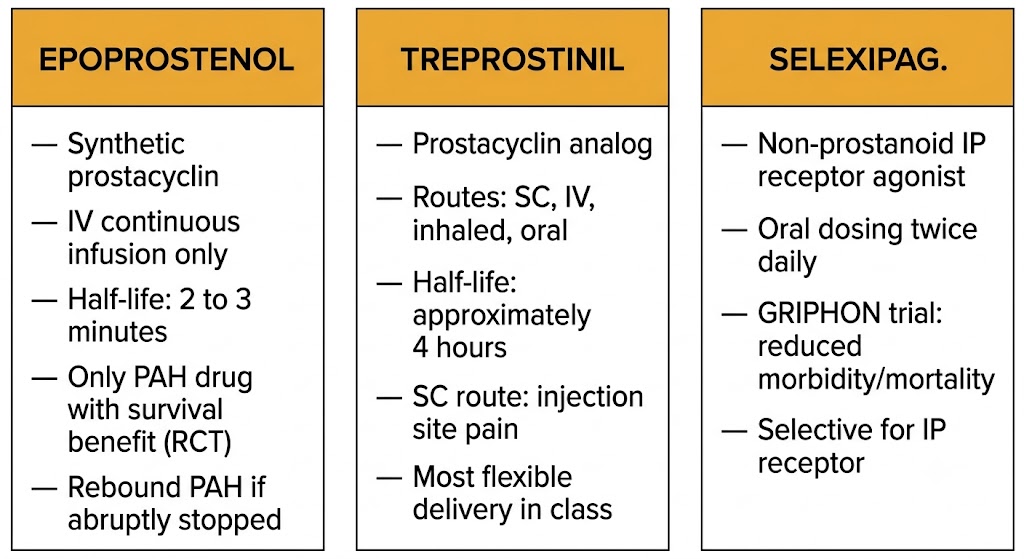
Epoprostenol (synthetic prostacyclin) is the most potent and best-validated agent in the class. It is the only pulmonary arterial hypertension therapy proven to reduce mortality in a randomized controlled trial — the 1996 Barst trial demonstrated improved survival with continuous intravenous epoprostenol in severe pulmonary arterial hypertension. However, epoprostenol has an extremely short half-life of approximately 2 to 3 minutes and is chemically unstable at room temperature in many formulations, requiring continuous intravenous infusion through a permanent central venous catheter. Abrupt discontinuation causes severe rebound pulmonary hypertension and can be fatal; catheter infections and pump failures are important safety concerns in clinical management.
Treprostinil is a prostacyclin analog with a half-life of approximately 4 hours, enabling subcutaneous, intravenous, inhaled, and oral routes of administration. Subcutaneous treprostinil avoids the central venous catheter requirement of epoprostenol but causes significant injection site pain that limits tolerability for many patients. The inhaled formulation delivers drug directly to ventilated lung segments, theoretically improving ventilation-perfusion matching. Iloprost is a stable prostacyclin analog available by inhalation (six to nine times daily) or intravenously. The frequent inhalation requirement is a major adherence barrier for the inhaled formulation. Selexipag is an oral, selective IP receptor agonist whose active metabolite (produced by hydrolysis) has 37-fold selectivity for the IP receptor over other prostaglandin receptors. The GRIPHON trial demonstrated that selexipag reduced the composite of morbidity and mortality events in pulmonary arterial hypertension patients on background therapy, establishing it as an oral option for combination regimens.
Endothelin-1 is the most potent endogenous vasoconstrictor and is produced in excess by dysfunctional pulmonary vascular endothelium in pulmonary arterial hypertension. Blocking endothelin-1 receptors reduces both vasoconstriction and smooth muscle cell proliferation, addressing two of the three pathological processes simultaneously.
Endothelin-1 acts on two receptor subtypes with opposing functions in the pulmonary vasculature. Endothelin A receptors on pulmonary arterial smooth muscle cells mediate vasoconstriction and proliferation — blocking them is therapeutically desirable. Endothelin B receptors on pulmonary vascular endothelial cells mediate vasodilation (by stimulating nitric oxide and prostacyclin release) and endothelin clearance — blocking them is therapeutically counterproductive. This distinction drives the pharmacological debate between dual endothelin A/B receptor antagonism versus selective endothelin A receptor antagonism.
Bosentan is a dual endothelin A and B receptor antagonist — it blocks both subtypes. Despite the theoretical concern about endothelin B blockade, bosentan demonstrated clear clinical benefit in the BREATHE-1 trial and was the first oral agent approved for pulmonary arterial hypertension. Ambrisentan is a selective endothelin A receptor antagonist, preserving endothelin B-mediated vasodilation and clearance. Macitentan is a dual endothelin A and B antagonist with high tissue penetency and sustained receptor binding; the SERAPHIN trial demonstrated that macitentan reduced the composite morbidity and mortality endpoint compared with placebo, providing the strongest evidence base among endothelin receptor antagonists.
Hepatotoxicity is a class-wide concern for endothelin receptor antagonists. Bosentan has the most pronounced hepatotoxic signal — elevated liver enzymes occur in approximately 10% of patients, and monthly liver function test monitoring is required. Ambrisentan and macitentan have substantially lower hepatotoxicity rates, but liver enzyme monitoring is still recommended. Teratogenicity is an absolute contraindication for all endothelin receptor antagonists — animal studies demonstrate major teratogenic effects, and two reliable forms of contraception are required for women of childbearing potential throughout treatment. Peripheral edema and anemia (from fluid retention and hemodilution) are additional class effects. Bosentan is also a significant inducer of cytochrome P450 3A4 and 2C9, reducing plasma concentrations of warfarin, statins, cyclosporine, and other medications.
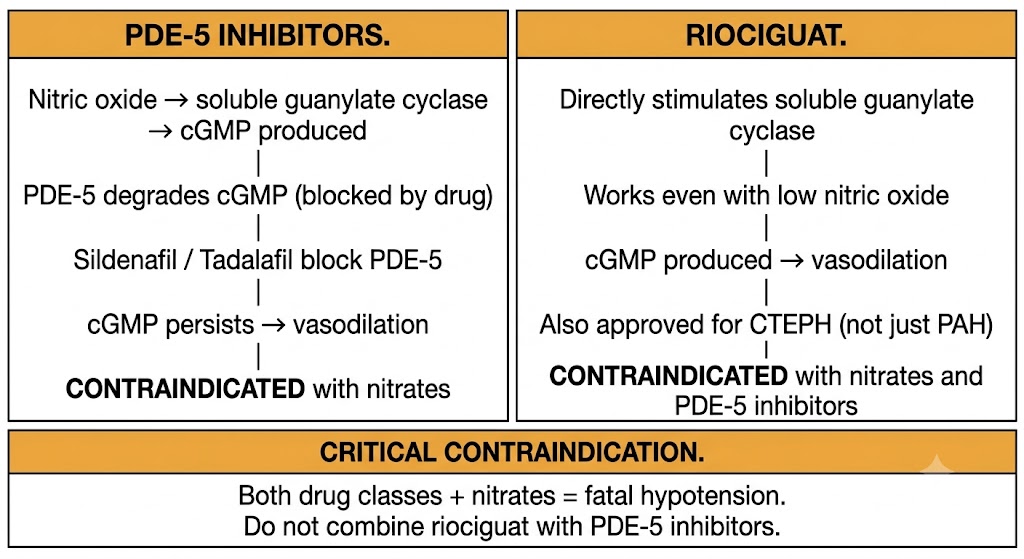
The nitric oxide–cyclic GMP signaling axis is the third deficient pathway in pulmonary arterial hypertension. Nitric oxide produced by endothelial cells activates soluble guanylate cyclase in pulmonary arterial smooth muscle cells to generate cyclic GMP, which activates protein kinase G and produces vasodilation. Two pharmacological approaches amplify this pathway: inhibiting cyclic GMP breakdown with phosphodiesterase-5 inhibitors, or directly stimulating the enzyme that produces cyclic GMP.
Sildenafil and tadalafil inhibit phosphodiesterase-5, the enzyme responsible for cyclic GMP degradation in pulmonary arterial smooth muscle cells. By preventing cyclic GMP breakdown, they sustain and amplify the vasodilatory nitric oxide signal, reducing pulmonary vascular resistance. Both are oral agents — sildenafil is dosed three times daily and tadalafil once daily. The SUPER-1 trial demonstrated that sildenafil improved exercise capacity and hemodynamics in pulmonary arterial hypertension; tadalafil has similar evidence from the PHIRST trial. Both are well-tolerated with adverse effects including headache, flushing, and nasal congestion reflecting systemic vasodilation. The critical drug interaction is with nitrates of any form: phosphodiesterase-5 inhibitors combined with nitrates produce potentially fatal systemic hypotension through additive cyclic GMP elevation — this combination is absolutely contraindicated.
Riociguat works upstream of phosphodiesterase-5 inhibitors by directly stimulating soluble guanylate cyclase, the enzyme that converts GTP to cyclic GMP. It acts through two complementary mechanisms: it sensitizes soluble guanylate cyclase to the low nitric oxide concentrations present in the diseased pulmonary vasculature, and it directly stimulates the enzyme independent of nitric oxide. The result is increased cyclic GMP production even when endothelial nitric oxide production is impaired. Riociguat is unique in having demonstrated efficacy in chronic thromboembolic pulmonary hypertension — a distinct form of pulmonary hypertension caused by organized thrombus obstructing the pulmonary arteries — making it the only approved oral therapy for this condition in patients who are not candidates for surgical pulmonary endarterectomy. Riociguat shares the absolute nitrate contraindication with phosphodiesterase-5 inhibitors, and the two drug classes must never be combined due to excessive cyclic GMP accumulation and profound hypotension.
Phosphodiesterase-5 inhibitors (sildenafil, tadalafil) and riociguat are absolutely contraindicated with nitrates of any form (nitroglycerin, isosorbide mononitrate/dinitrate, amyl nitrite). Both drug classes elevate cyclic GMP — their combination produces profound, potentially fatal systemic hypotension. Riociguat and phosphodiesterase-5 inhibitors must not be combined with each other for the same reason.
Because pulmonary arterial hypertension involves three simultaneously dysregulated pathways, combining drugs from different classes produces additive or synergistic benefit. Contemporary guidelines endorse upfront combination therapy for most newly diagnosed patients rather than sequential add-on therapy — a paradigm shift driven by trial evidence showing that early aggressive treatment improves outcomes.
The AMBITION trial compared upfront combination therapy with ambrisentan plus tadalafil against either drug as monotherapy in treatment-naive patients with pulmonary arterial hypertension. The combination arm reduced the risk of the primary composite endpoint (clinical failure events) by 50% relative to monotherapy pooled, demonstrating that two-drug upfront therapy is superior to sequential addition of a second drug. This trial established dual upfront combination therapy as the standard initial approach for most newly diagnosed pulmonary arterial hypertension patients.
Triple therapy — adding a prostacyclin-pathway agent to an established dual combination — is used in patients who remain at intermediate or high risk after optimized dual therapy. The GRIPHON trial supporting selexipag enrolled patients predominantly on background endothelin receptor antagonist and/or phosphodiesterase-5 inhibitor therapy, providing the evidence base for triple combination regimens.
Current guidelines use a three-strata risk assessment (low, intermediate, high) based on clinical parameters including World Health Organization functional class, six-minute walk distance, brain natriuretic peptide, right atrial pressure, cardiac index, and mixed venous oxygen saturation. The treatment goal is to achieve and maintain low-risk status. Patients assessed as intermediate or high risk at any follow-up visit require treatment escalation. This treat-to-target approach — borrowed conceptually from oncology and rheumatology — prevents the common error of accepting stable but suboptimal disease as a satisfactory outcome in a condition with relentlessly progressive underlying pathology.
Newly diagnosed, low-to-intermediate risk: upfront dual therapy — endothelin receptor antagonist plus phosphodiesterase-5 inhibitor (AMBITION trial standard).
High risk or deteriorating on dual therapy: escalate to triple therapy adding a prostacyclin pathway agent (prostacyclin analog or selexipag).
Reassess risk every 3 to 6 months. Persistent intermediate or high risk is a treatment failure requiring escalation — do not accept stability as success in a progressive disease.
| Author / Organization | Title | Source |
|---|---|---|
| Humbert M, Kovacs G, Hoeper MM, et al | 2022 ESC/ERS Guidelines for the diagnosis and treatment of pulmonary hypertension | Eur Heart J. 2022;43(38):3618–3731 |
| Rabinovitch M | Molecular pathogenesis of pulmonary arterial hypertension | J Clin Invest. 2012;122(12):4306–4313 |
| Tuder RM, Archer SL, Dorfmuller P, et al | Relevant issues in the pathology and pathobiology of pulmonary hypertension | J Am Coll Cardiol. 2013;62(25 Suppl):D4–D12 |
| Barst RJ, Rubin LJ, Long WA, et al | A comparison of continuous intravenous epoprostenol with conventional therapy for primary pulmonary hypertension | N Engl J Med. 1996;334(5):296–302 |
| Channick RN, Olschewski H, Seeger W, et al | Safety and efficacy of inhaled treprostinil as add-on therapy to bosentan in pulmonary arterial hypertension | J Am Coll Cardiol. 2006;48(7):1433–1437 |
| Sitbon O, Channick R, Chin KM, et al | Selexipag for the treatment of pulmonary arterial hypertension | N Engl J Med. 2015;373(26):2522–2533 |
| Dupuis J, Hoeper MM | Endothelin receptor antagonists in pulmonary arterial hypertension | Eur Respir J. 2008;31(2):407–415 |
| Rubin LJ, Badesch DB, Barst RJ, et al | Bosentan therapy for pulmonary arterial hypertension | N Engl J Med. 2002;346(12):896–903 |
| Galie N, Ghofrani HA, Torbicki A, et al | Sildenafil citrate therapy for pulmonary arterial hypertension | N Engl J Med. 2005;353(20):2148–2157 |
| Ghofrani HA, Galie N, Grimminger F, et al | Riociguat for the treatment of pulmonary arterial hypertension | N Engl J Med. 2013;369(4):330–340 |
| Galie N, Barberà JA, Frost AE, et al | Initial use of ambrisentan plus tadalafil in pulmonary arterial hypertension (AMBITION) | N Engl J Med. 2015;373(9):834–844 |