Chapter 12  ·  Sedative-Hypnotic Drugs
Section 1

Introduction

The benzodiazepine class and the receptor system they target

Benzodiazepines are among the most widely prescribed psychoactive drugs in clinical practice. They are used for anxiety disorders, insomnia, seizure management, alcohol withdrawal, procedural sedation, and muscle spasticity. Introduced in the 1960s, they represented a major advance over barbiturates because of their wider therapeutic index and substantially lower lethality in overdose. Despite this relative safety, benzodiazepines carry a significant burden of tolerance, physical dependence, cognitive impairment, and misuse risk that demands careful clinical management.

This module covers the gamma-aminobutyric acid type A receptor complex that underlies benzodiazepine action, the pharmacokinetic spectrum that distinguishes agents within the class, the major clinical indications, the pharmacology of tolerance and dependence, special population considerations, and the reversal agent flumazenil.


Section 2

The GABA-A Receptor and the Benzodiazepine Binding Site

Mechanism of positive allosteric modulation and its clinical consequences

The gamma-aminobutyric acid type A receptor is the principal mediator of rapid inhibitory neurotransmission in the central nervous system. Understanding its structure and how benzodiazepines interact with it explains both the therapeutic effects and the safety profile of the entire class.

Receptor Structure and Normal Function

The gamma-aminobutyric acid type A receptor is a ligand-gated ion channel assembled as a pentameric complex, most commonly comprising two alpha subunits, two beta subunits, and one gamma subunit arranged around a central chloride-permeable pore. When gamma-aminobutyric acid binds to sites at the alpha-beta subunit interfaces, the channel opens and allows chloride ions to flow into the neuron. The resulting hyperpolarization reduces the probability of action potential generation, producing inhibition.

How Benzodiazepines Modulate the Receptor

The benzodiazepine binding site is located at the interface between the alpha and gamma-2 subunits, a position distinct from the site where gamma-aminobutyric acid itself binds. Benzodiazepines are positive allosteric modulators: they do not directly open the chloride channel but instead increase the frequency of channel opening when gamma-aminobutyric acid is present. This is the key pharmacodynamic distinction from barbiturates, which at high concentrations can directly open the channel independent of gamma-aminobutyric acid.

The clinical consequence of this allosteric mechanism is that benzodiazepine activity depends on endogenous gamma-aminobutyric acid tone. Without gamma-aminobutyric acid, benzodiazepines have minimal effect. This ceiling on receptor activation is a major reason benzodiazepines have a wider margin of safety than barbiturates in overdose.
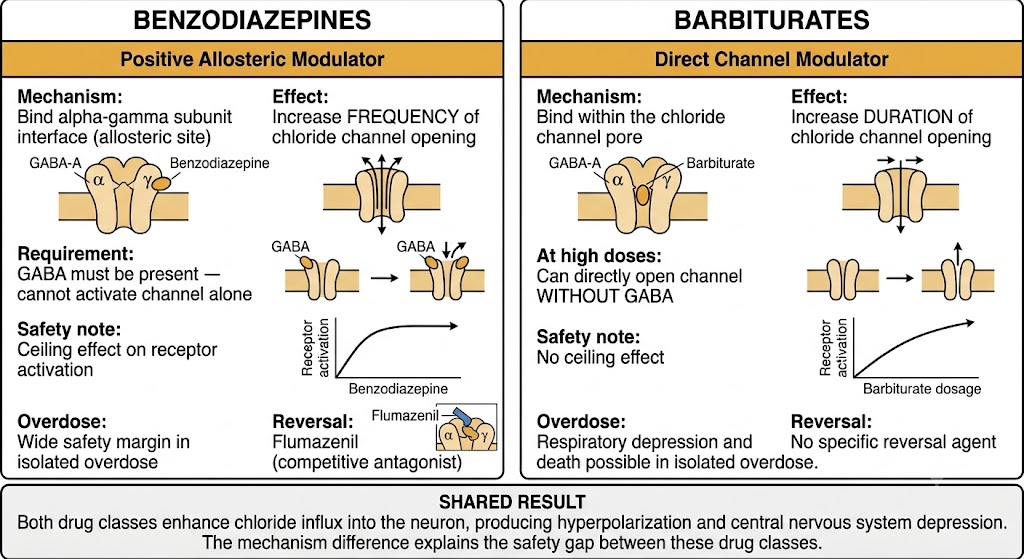
Two-panel diagram comparing benzodiazepine and barbiturate mechanisms at the GABA-A receptor chloride channel.
Figure generated by Gemini AI.
Subunit Composition and Pharmacological Specificity

The subunit composition of the gamma-aminobutyric acid type A receptor determines which effects a drug produces. Receptors containing alpha-1 subunits mediate sedation, anterograde amnesia, and anticonvulsant effects. Receptors containing alpha-2 and alpha-3 subunits mediate anxiolytic and muscle relaxant effects. Classic benzodiazepines bind non-selectively to all receptor subtypes that contain a histidine residue at a conserved position in the alpha subunit, which is why a single benzodiazepine simultaneously produces sedation, anxiolysis, amnesia, anticonvulsant activity, and muscle relaxation. The non-benzodiazepine hypnotics discussed in Module 2 have relative alpha-1 selectivity, which partially explains their more targeted hypnotic effect.

Mechanism Comparison: Benzodiazepines vs. Barbiturates

Benzodiazepines: Positive allosteric modulators. Increase frequency of chloride channel opening. Require gamma-aminobutyric acid to be present. Cannot directly activate the channel. Ceiling effect limits lethality in isolated overdose.

Barbiturates: Increase duration of chloride channel opening. At high concentrations, directly activate the channel without gamma-aminobutyric acid. No ceiling effect. Respiratory depression and death possible in isolated overdose. This distinction underlies the shift from barbiturates to benzodiazepines for most clinical indications.


Section 3

Pharmacokinetic Spectrum

From ultra-short-acting to long-acting agents: how duration governs drug selection

All benzodiazepines share the same mechanism of action, but their clinical profiles differ substantially based on pharmacokinetics. The most clinically important variables are lipophilicity, half-life of the parent compound, and the presence of active metabolites. These differences determine which agent is chosen for which indication.

Lipophilicity and Onset

Highly lipophilic agents such as diazepam cross the blood-brain barrier rapidly, producing a fast onset of action. This makes them effective for acute seizure termination but also increases abuse potential because rapid central nervous system effect is reinforcing. Less lipophilic agents such as lorazepam and oxazepam have slower onset and lower abuse potential but are less suitable when immediate effect is required.

Duration Categories and Active Metabolites

The presence or absence of pharmacologically active metabolites is as important as the parent compound half-life. Diazepam has a parent half-life of 20 to 100 hours, but its active metabolite desmethyldiazepam has a half-life of 36 to 200 hours, meaning clinical effect persists for days to weeks in patients on chronic therapy. Chlordiazepoxide also generates multiple active metabolites. By contrast, lorazepam, oxazepam, and temazepam undergo direct glucuronidation and produce no active metabolites, making their duration far more predictable.

Ultra-Short to Short-Acting
Triazolam, Oxazepam, Lorazepam, Temazepam
  • Triazolam: half-life 1.5 to 5 hours. Prototype ultra-short agent. Rebound insomnia, anterograde amnesia, and early morning anxiety after each dose. Use has declined.
  • Oxazepam, lorazepam, temazepam (the LOT agents): half-life 5 to 22 hours. Direct glucuronidation, no active metabolites. Preferred in elderly patients and hepatic impairment.
  • Shorter duration limits accumulation but requires more frequent dosing in sustained-use settings such as alcohol withdrawal.
Intermediate to Long-Acting
Clonazepam, Alprazolam, Diazepam, Chlordiazepoxide
  • Clonazepam: half-life 20 to 60 hours. High potency. Suitable for panic disorder and certain seizure syndromes. Once or twice daily dosing feasible.
  • Diazepam: half-life 20 to 100 hours for parent compound, plus active metabolite with half-life up to 200 hours. Ideal for alcohol withdrawal due to self-tapering effect.
  • Chlordiazepoxide: multiple active metabolites. Also used for alcohol withdrawal. High accumulation risk in elderly patients.
Clinical Mnemonic: The LOT Agents

LOT = Lorazepam, Oxazepam, Temazepam. These three benzodiazepines are glucuronidated directly and produce no active metabolites. Glucuronidation is relatively preserved in liver disease and in older adults, making these the preferred benzodiazepines when hepatic oxidative metabolism is impaired. They are also preferred in elderly patients for the same reason. The name LOT is the standard mnemonic for this high-yield pharmacokinetic distinction.


Section 4

Clinical Indications

Anxiety disorders, insomnia, acute seizures, alcohol withdrawal, and procedural sedation

Benzodiazepines are effective across a wide range of clinical indications, but their role has shifted in most areas toward adjunctive or short-term use as better-tolerated first-line agents have emerged. Understanding which indication calls for which agent, and why, is the highest-yield clinical application of benzodiazepine pharmacokinetics.

Anxiety Disorders

Benzodiazepines produce rapid anxiolytic effects and are effective across generalized anxiety disorder, panic disorder, social anxiety disorder, and situational anxiety. However, first-line pharmacotherapy for chronic anxiety is now selective serotonin reuptake inhibitors or serotonin-norepinephrine reuptake inhibitors. Benzodiazepines are used adjunctively during the two to four week latency period before antidepressant effect is established, or for acute situational anxiety. Chronic benzodiazepine use for anxiety leads to tolerance to the anxiolytic effect and a withdrawal syndrome that can mimic the original disorder.

For panic disorder, alprazolam and clonazepam have established efficacy and are approved for this indication. Clonazepam is preferred by many clinicians because its longer half-life reduces inter-dose anxiety and rebound panic that occur with shorter-acting agents.

Insomnia

As hypnotics, benzodiazepines reduce sleep-onset latency and increase total sleep time, but they suppress slow-wave sleep and rapid eye movement sleep, producing sleep that is less architecturally restorative than natural sleep. Rebound insomnia upon discontinuation is common and often worse than the original complaint. Current guidelines endorse cognitive behavioral therapy for insomnia as first-line treatment, with pharmacotherapy reserved for short-term use in patients who cannot access or fail behavioral approaches. Temazepam is the most commonly used benzodiazepine for insomnia, given its intermediate half-life and absence of active metabolites.

Acute Seizure Management

Benzodiazepines are first-line agents for acute seizure termination and status epilepticus. Intravenous lorazepam and intramuscular midazolam have the strongest evidence in this setting. The RAMPART trial demonstrated that intramuscular midazolam was non-inferior to intravenous lorazepam for prehospital status epilepticus and was more effective operationally because it did not require establishing intravenous access. Intravenous lorazepam 0.1 milligrams per kilogram is the standard hospital initial treatment, followed by a longer-acting antiseizure agent to prevent recurrence.

Alcohol Withdrawal

Benzodiazepines are the agents of choice for managing alcohol withdrawal syndrome, including prevention and treatment of withdrawal seizures and delirium tremens. The pathophysiology involves gamma-aminobutyric acid type A receptor downregulation and excitatory pathway upregulation during chronic alcohol exposure; abrupt cessation unmasks this imbalance, producing a hyperadrenergic withdrawal state. Benzodiazepines restore gamma-aminobutyric acid tone and suppress the syndrome.

Long-acting agents such as diazepam and chlordiazepoxide are preferred in medically stable patients because their extended half-lives produce a self-tapering effect. In patients with hepatic impairment or elderly patients at risk for accumulation, the LOT agents, particularly lorazepam or oxazepam, are substituted.

Procedural Sedation

Midazolam is the preferred benzodiazepine for procedural sedation and preoperative anxiolysis. Its short half-life of 1.5 to 2.5 hours, rapid intravenous onset of one to two minutes, and reliable anterograde amnestic effect make it well-suited for this purpose. Unlike diazepam, midazolam is water-soluble at pharmaceutical pH, eliminating the venous irritation associated with propylene glycol-based formulations. An important pharmacokinetic caveat: midazolam is metabolized by the cytochrome P450 3A4 enzyme system to an active glucuronide metabolite that accumulates in renal failure, which can produce prolonged sedation in intensive care unit patients receiving continuous infusions.


Section 5

Tolerance, Dependence, and Withdrawal

The neuroadaptive mechanisms that complicate long-term benzodiazepine use

Physical dependence and tolerance are predictable consequences of regular benzodiazepine use, even at therapeutic doses. Understanding these phenomena is essential for safe prescribing, appropriate tapering, and recognition of withdrawal in clinical settings.

Tolerance

Repeated benzodiazepine exposure leads to pharmacodynamic tolerance through receptor internalization, decreased receptor sensitivity from altered subunit phosphorylation, and downregulation of total receptor expression. Tolerance develops at different rates for different effects. Tolerance to sedation and hypnotic effects develops within days to weeks. Tolerance to anxiolytic effects is more variable. Anticonvulsant tolerance is a recognized clinical problem in patients on chronic benzodiazepine monotherapy for epilepsy. Importantly, tolerance does not fully protect against respiratory depression in overdose, particularly when benzodiazepines are combined with opioids or alcohol.

Physical Dependence

Physical dependence, defined by a withdrawal syndrome upon dose reduction or cessation, can develop within weeks of regular use. The neuroadaptive mechanism is the same as tolerance: gamma-aminobutyric acid type A receptor downregulation with compensatory upregulation of excitatory pathways. When the drug is withdrawn, the unmasked excess of excitatory drive produces the withdrawal syndrome. Dependence is more common with high-potency, short-acting agents, with alprazolam being the highest-risk prototype.

Withdrawal Syndrome

Benzodiazepine withdrawal spans a spectrum from mild to life-threatening, physiologically analogous to alcohol withdrawal. Mild to moderate symptoms include anxiety, insomnia, irritability, tremor, diaphoresis, palpitations, and sensory hypersensitivity. These typically emerge within 24 to 48 hours of discontinuing short-acting agents and within three to seven days of discontinuing long-acting agents. Severe withdrawal includes grand mal seizures, delirium, hyperthermia, and autonomic instability. Risk of severe withdrawal is highest in patients using high doses, high-potency agents, or with prior withdrawal seizure history.

Tapering Principles

Abrupt discontinuation in physically dependent patients is contraindicated. The standard approach is gradual dose reduction, typically no faster than five to ten percent of the current dose per week, with slower tapers associated with better outcomes in patients on long-term high-dose therapy. For patients on short-acting agents, conversion to an equivalent dose of a long-acting agent such as diazepam followed by a structured taper reduces the symptom burden of inter-dose withdrawal. Standard equivalency: diazepam 5 milligrams is approximately equivalent to lorazepam 0.5 milligrams, alprazolam 0.25 to 0.5 milligrams, or clonazepam 0.25 to 0.5 milligrams.


Section 6

Flumazenil

The benzodiazepine reversal agent: mechanism, indications, and critical limitations

Flumazenil is a competitive benzodiazepine receptor antagonist. It binds with high affinity to the benzodiazepine site on the gamma-aminobutyric acid type A receptor without intrinsic agonist activity, reversing benzodiazepine-mediated sedation and respiratory depression. Its short half-life of approximately 40 to 80 minutes is substantially shorter than all benzodiazepines it is used to reverse, making resedation a predictable concern after each dose.

Indications

Flumazenil is approved for two indications. First, reversal of procedural sedation when post-procedure benzodiazepine effect requires rapid reversal. Standard dosing begins with 0.2 milligrams intravenously over 15 seconds, repeated at one-minute intervals to a maximum of 1 milligram. Second, management of benzodiazepine overdose presenting with respiratory depression or coma when clinical and pharmacological context supports its use.

Critical Contraindications and Limitations

The risks of flumazenil are high-yield and frequently tested. Three situations require particular attention.

Contraindication 1
Seizure Risk in Dependent Patients
  • Flumazenil precipitates acute benzodiazepine withdrawal and seizures in physically dependent patients.
  • These seizures may be refractory because the reversal agent occupies the binding site needed to treat seizures with benzodiazepines.
  • Chronic benzodiazepine use is a relative to absolute contraindication. Benzodiazepine use for seizure control is an absolute contraindication.
Contraindication 2
Tricyclic Antidepressant Co-ingestion
  • If benzodiazepines were given to control seizures from tricyclic antidepressant overdose, flumazenil reversal unmasks the seizure risk.
  • The resulting seizures cannot be treated with benzodiazepines because flumazenil blocks the binding site.
  • Suspected tricyclic antidepressant co-ingestion is a contraindication to flumazenil.
Limitation
Short Duration and Resedation
  • Flumazenil half-life is 40 to 80 minutes. All benzodiazepines outlast a single dose.
  • Resedation is predictable. Patients must be monitored for at least one to two hours after the last dose.
  • Repeat dosing up to 3 milligrams per hour or a continuous infusion may be required for massive ingestions.
  • In mixed overdose, flumazenil does not reverse opioid, alcohol, or other sedative toxicity.
Clinical Rule: Supportive Care First

Supportive care remains the foundation of benzodiazepine overdose management. Flumazenil is reserved for specific clinical scenarios where its benefit clearly outweighs the risks of precipitating withdrawal seizures and rebound sedation. It should not be given routinely to every patient presenting in altered mental status from possible benzodiazepine ingestion.


Section 7

Special Populations and Drug Interactions

Elderly patients, hepatic impairment, pregnancy, and the opioid interaction

Several patient populations face substantially elevated risk from benzodiazepines due to pharmacokinetic and pharmacodynamic differences. The opioid-benzodiazepine combination is one of the most dangerous and prevalent drug interactions in clinical practice.

Elderly Patients

Benzodiazepines are listed on the American Geriatrics Society Beers Criteria as medications to avoid in older adults. Age-related pharmacokinetic changes include reduced hepatic oxidative metabolism, decreased serum albumin causing higher free drug fractions, and increased body fat that serves as a reservoir prolonging drug effect. Age-related pharmacodynamic changes include increased central nervous system sensitivity to gamma-aminobutyric acid modulators. The clinical result is disproportionate risk of sedation, cognitive impairment, psychomotor slowing, falls, and fractures. When benzodiazepines are unavoidable in elderly patients, LOT agents at the lowest effective dose are preferred.

Hepatic Impairment

Benzodiazepines dependent on hepatic cytochrome P450 oxidative metabolism, including diazepam, chlordiazepoxide, alprazolam, and triazolam, accumulate in liver disease. The LOT agents are preferred because glucuronidation is relatively preserved in hepatic impairment. However, even glucuronidation may be impaired in severe cirrhosis, and all benzodiazepines carry risk of precipitating hepatic encephalopathy in advanced liver disease.

Pregnancy and Lactation

All benzodiazepines cross the placenta. Chronic use in the third trimester can produce neonatal withdrawal syndrome and neonatal abstinence syndrome after delivery. Benzodiazepines are present in breast milk and can cause neonatal sedation. For non-urgent indications, avoidance or minimization of exposure is the goal. For acute seizure management in pregnancy, the benefit of treatment clearly outweighs the risk.

Opioid Co-administration

The concurrent use of benzodiazepines and opioids carries a boxed warning. Both drug classes depress central nervous system and respiratory function through independent mechanisms. Combined use produces synergistic respiratory depression that is greater than the sum of either agent alone. This combination is one of the leading causes of drug overdose deaths in the United States. The clinical implication is that co-prescription requires explicit risk-benefit justification and patient counseling, and that overdose management must address both drug classes simultaneously.

Cytochrome P450 3A4 Interactions

Most benzodiazepines except the LOT agents are metabolized by the cytochrome P450 3A4 enzyme. Strong inhibitors of this enzyme, including azole antifungals such as ketoconazole and itraconazole, and certain macrolide antibiotics, substantially increase plasma levels of susceptible benzodiazepines. Alprazolam is particularly vulnerable to this interaction because of its relatively high potency; cytochrome P450 3A4 inhibition has been implicated in alprazolam overdose fatalities. Strong cytochrome P450 3A4 inducers such as rifampin reduce benzodiazepine plasma levels and may reduce efficacy.


Suggested References
Author / Organization Title Source
Sternbach LHThe benzodiazepine storyJournal of Medicinal Chemistry, 1979; 22(1): 1-7
Ashton HThe diagnosis and management of benzodiazepine dependenceCurrent Opinion in Psychiatry, 2005; 18(3): 249-255
Sieghart WStructure, pharmacology, and function of GABA-A receptor subtypesAdvances in Pharmacology, 2006; 54: 231-263
Rudolph U, Mohler HGABA-based therapeutic approaches: GABA-A receptor subtype functionsCurrent Opinion in Pharmacology, 2006; 6(1): 18-23
Greenblatt DJ, Shader RI, Abernethy DRCurrent status of benzodiazepines (first of two parts)New England Journal of Medicine, 1983; 309(6): 354-358
Riss J, Cloyd J, Gates J, Collins SBenzodiazepines in epilepsy: pharmacology and pharmacokineticsActa Neurologica Scandinavica, 2008; 118(2): 69-86
Sateia MJ, Buysse DJ, Krystal AD, et al.Clinical practice guideline for the pharmacological treatment of chronic insomnia in adultsJournal of Clinical Sleep Medicine, 2017; 13(2): 307-349
Silbergleit R, Durkalski V, Lowenstein D, et al.Intramuscular versus intravenous therapy for prehospital status epilepticus (RAMPART trial)New England Journal of Medicine, 2012; 366(7): 591-600
Mayo-Smith MFPharmacological management of alcohol withdrawal: a meta-analysis and evidence-based practice guidelineJAMA, 1997; 278(2): 144-151
American Geriatrics Society2023 updated AGS Beers Criteria for potentially inappropriate medication use in older adultsJournal of the American Geriatrics Society, 2023; 71(7): 2052-2081
Park TW, Saitz R, Ganoczy D, et al.Benzodiazepine prescribing patterns and deaths from drug overdose among US veterans receiving opioid analgesicsBMJ, 2015; 350: h2698
Lader MBenzodiazepine harm: how can it be reduced?British Journal of Clinical Pharmacology, 2014; 77(2): 295-301