Chapter 12  ·  Sedative-Hypnotic Drugs
Section 1

Introduction

Toxicology, dependence pharmacology, and clinical management across the sedative-hypnotic class

Sedative-hypnotic drugs are among the most frequently encountered agents in the settings of intentional overdose, iatrogenic toxicity, physical dependence, and challenging deprescribing scenarios. This module covers four high-yield clinical management areas: the presentation and management of sedative-hypnotic overdose; the pharmacology of cross-tolerance and cross-dependence that governs treatment strategy; evidence-based protocols for benzodiazepine tapering and alcohol withdrawal management; and the framework for deprescribing chronic benzodiazepines. These topics build on the mechanistic foundations from Modules 1 through 3.


Section 2

Sedative-Hypnotic Overdose

Clinical presentation, the co-ingestant problem, and the management algorithm

Sedative-hypnotic overdose presents as dose-dependent central nervous system and respiratory depression, modified by the specific agent, dose, formulation, and most importantly the presence of co-ingestants. The respiratory manifestations — decreased rate and tidal volume, loss of hypercapnic drive, upper airway obstruction, and ultimately apnea — are the principal cause of morbidity and mortality.

The Co-Ingestant Problem

Isolated benzodiazepine overdose in a non-tolerant patient rarely causes fatal respiratory arrest. Mortality risk is dramatically amplified by co-ingestion with other central nervous system depressants. Opioids and alcohol are the most common co-ingestants. Benzodiazepines are co-detected in 30 to 75 percent of opioid overdose fatalities in autopsy studies. The mechanism is additive to synergistic respiratory depression: benzodiazepines suppress cortical arousal and reduce the ventilatory response to elevated carbon dioxide via gamma-aminobutyric acid type A receptor modulation, while opioids directly depress brainstem respiratory centers via mu-opioid receptors.

An important monitoring point: pulse oximetry alone is a delayed indicator of respiratory depression, particularly in patients on supplemental oxygen, because oxygen saturation can remain deceptively normal while hypoventilation and carbon dioxide retention progress. Capnography (end-tidal carbon dioxide monitoring) detects hypoventilation substantially earlier and should be used when available.

Management Algorithm
Steps 1–2
Airway, Breathing, and Targeted Reversal
  • Step 1 — Airway and breathing: Supplemental oxygen and airway positioning first. Intubate for inadequate ventilatory effort, inability to protect the airway, or deteriorating oxygenation. This decision must not await drug identification.
  • Step 2 — Flumazenil (selected cases only): Indicated only for isolated benzodiazepine exposure without physical dependence, no tricyclic antidepressant co-ingestion, no seizure history. Contraindicated far more often than it is indicated in emergency presentations given the prevalence of co-ingestion and dependence.
  • There is no reversal agent for barbiturates, Z-drugs, propofol, or most other sedative-hypnotics.
Steps 3–4
Supportive Care and Enhanced Elimination
  • Step 3 — Supportive care: Foundation of management. Maintain ventilation, treat hypotension with fluids and vasopressors, correct hypothermia, monitor for rhabdomyolysis from prolonged immobility.
  • Step 4 — Enhanced elimination (phenobarbital): Multiple-dose activated charcoal every 4 to 6 hours significantly enhances phenobarbital elimination via interrupted enterohepatic recirculation. Urinary alkalinization with sodium bicarbonate (targeting urine pH 7.5 to 8.0) further increases renal elimination by ion-trapping. Hemodialysis for life-threatening phenobarbital toxicity not responding to supportive care.
  • Activated charcoal (1 g/kg) appropriate within 1 to 2 hours of ingestion with protected airway.

Section 3

Cross-Tolerance and the Pharmacology of Sedative-Hypnotic Dependence

Why all GABA-A-active agents share dependence and how this governs clinical strategy

All sedative-hypnotic drugs that act at the gamma-aminobutyric acid type A receptor share cross-tolerance and cross-dependence. This is a fundamental pharmacological principle with major clinical implications.

The Neurobiological Basis

Chronic exposure to any gamma-aminobutyric acid type A-potentiating agent produces compensatory neuroadaptation: downregulation of gamma-aminobutyric acid type A receptor expression, internalization of surface receptors, altered subunit phosphorylation states, and upregulation of excitatory pathways — particularly N-methyl-D-aspartate glutamate receptors and voltage-gated calcium channels. When the sedative-hypnotic is withdrawn, the resulting imbalance between reduced inhibitory tone and enhanced excitatory tone produces the withdrawal syndrome regardless of which specific agent caused the dependence.

Because this neuroadaptation is shared across the class, any gamma-aminobutyric acid type A-active drug can suppress withdrawal from any other. A patient dependent on alcohol can be treated with benzodiazepines; a patient dependent on benzodiazepines can be treated with phenobarbital; and cross-tolerance means that a dependent patient will require substantially higher doses of any of these agents to achieve a given clinical effect.
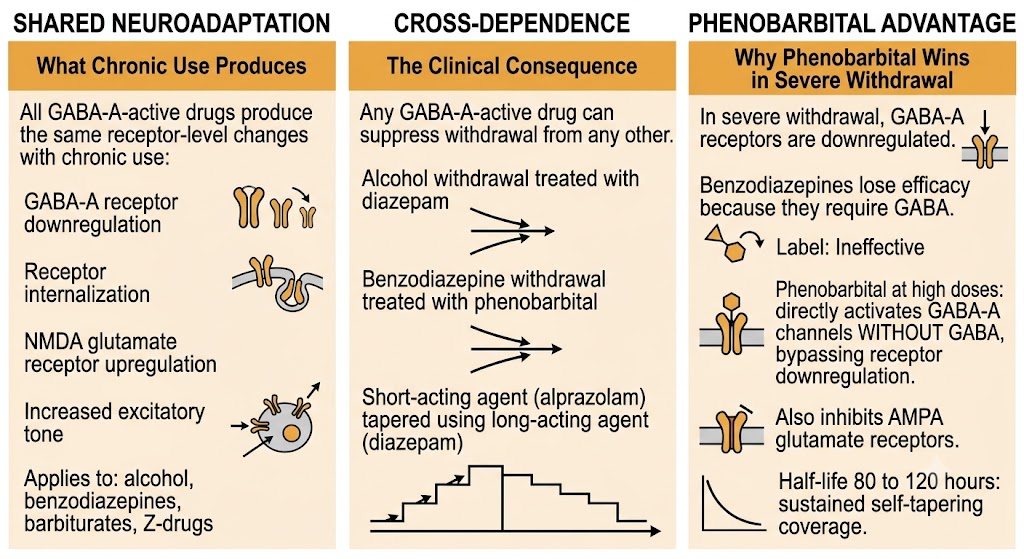
Diagram showing how cross-dependence among GABA-A-active sedative-hypnotics underlies clinical treatment strategies.
Figure generated by Gemini AI.
Clinical Applications of Cross-Dependence

Benzodiazepine taper using a long-acting agent: A patient dependent on a short-acting, high-potency benzodiazepine such as alprazolam is converted to an equivalent dose of diazepam before beginning a structured taper. Cross-dependence ensures the long-acting agent fully suppresses withdrawal, while the prolonged half-life of diazepam eliminates inter-dose withdrawal and provides self-tapering kinetics.

Alcohol withdrawal management: Benzodiazepines suppress alcohol withdrawal because the gamma-aminobutyric acid type A receptor neuroadaptations driving alcohol withdrawal are identical to those that benzodiazepines modulate. Cross-dependence is the pharmacological basis for this treatment.

Phenobarbital in severe withdrawal: Phenobarbital suppresses both alcohol and benzodiazepine withdrawal through cross-dependence, plus the added mechanistic advantage that at high concentrations it directly activates gamma-aminobutyric acid type A channels without gamma-aminobutyric acid, bypassing the receptor downregulation that limits benzodiazepine efficacy in severe withdrawal states.

Clinical Pearl: Tolerance Does Not Equal Safety

Patients who appear functionally normal on doses that would sedate a naive patient have developed profound behavioral tolerance. However, physical dependence persists, and the receptor-level protection against lethal overdose does not develop to the same degree as behavioral tolerance. A chronic high-dose benzodiazepine user who combines their agent with opioids or alcohol faces substantially higher overdose risk than their apparent tolerance would suggest. This principle underlies the boxed warning on opioid-benzodiazepine co-prescription.

Section 4

Benzodiazepine Dependence and Tapering

Equivalency, taper rate, and adjunctive pharmacology

Abrupt discontinuation of benzodiazepines in physically dependent patients is contraindicated and can cause life-threatening seizures and delirium. Structured gradual tapering, typically with conversion to a long-acting agent, is the standard of care.

Diazepam Equivalency Reference

The following approximate equivalencies to diazepam 5 milligrams are used for taper planning. Individual variation is significant and these values should be starting frameworks, not rigid prescriptions: lorazepam 0.5 milligrams; alprazolam 0.25 to 0.5 milligrams (use the conservative 0.25 milligram estimate in high-dose users given its high potency and rapid receptor binding); clonazepam 0.25 to 0.5 milligrams; chlordiazepoxide 12.5 milligrams; oxazepam 10 to 15 milligrams; temazepam 10 milligrams; triazolam 0.125 milligrams.

Taper Rate and Duration

Evidence supports a rate of no faster than 5 to 10 percent of the current dose per week. Most patients manage well at 10 percent per week during early stages when the absolute dose is high, but require slower reductions — 5 percent or less per two weeks — as the dose decreases and each incremental reduction represents a larger proportional change in receptor occupancy. Taper duration for patients on long-term high-dose therapy typically spans months to years. The standard approach is conversion to an equivalent diazepam dose followed by a gradual structured reduction.

Adjunctive Pharmacological Support

Section 5

Alcohol Withdrawal: Pharmacological Management

Clinical timeline, benzodiazepine protocols, and phenobarbital loading

Chronic alcohol use leads to compensatory neuroadaptation at gamma-aminobutyric acid type A receptors (downregulation and reduced sensitivity) and N-methyl-D-aspartate glutamate receptors (upregulation and increased sensitivity). Upon cessation, the resulting excitatory-inhibitory imbalance drives the alcohol withdrawal syndrome — a spectrum from mild autonomic hyperactivity to life-threatening seizures and delirium tremens.

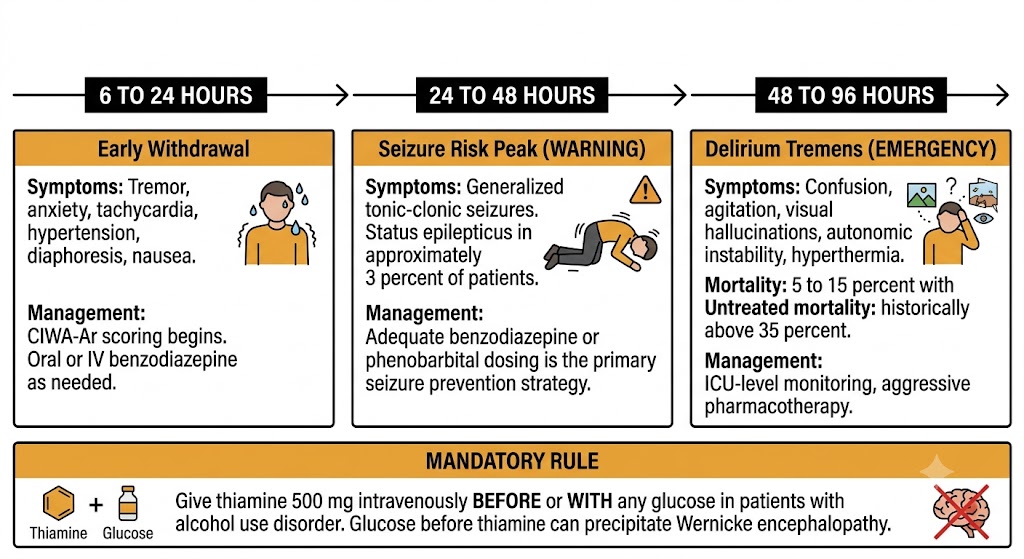
Timeline diagram showing the clinical progression of alcohol withdrawal syndrome from 6 hours to 96 hours after cessation.
Figure generated by Gemini AI.
Clinical Timeline
6–24 Hours
Early Withdrawal
  • Tremor, anxiety, tachycardia, hypertension, diaphoresis, nausea
  • Mild to moderate CIWA-Ar scores
  • Most patients can be managed with oral benzodiazepines
24–48 Hours
Seizure Risk Window
  • Withdrawal seizures peak in this window
  • Typically single generalized tonic-clonic events
  • Status epilepticus in approximately 3 percent of withdrawing patients
  • Adequate benzodiazepine or phenobarbital dosing is the primary prevention
48–96 Hours
Delirium Tremens
  • Confusion, agitation, visual hallucinations (most characteristic), autonomic instability, hyperthermia
  • Mortality 5 to 15 percent even with treatment; untreated mortality historically exceeds 35 percent
  • Medical emergency requiring intensive monitoring and aggressive pharmacotherapy
Benzodiazepine Selection and CIWA-Ar Dosing

The Clinical Institute Withdrawal Assessment for Alcohol-Revised (CIWA-Ar) is a validated 10-item scoring instrument used for symptom-triggered dosing — administering benzodiazepines only when scores exceed a threshold (typically 8 to 10). Symptom-triggered dosing reduces total benzodiazepine consumption by 60 to 70 percent and shortens treatment duration compared to fixed-schedule dosing without increasing seizure risk in patients who can cooperate with scoring.

Long-acting agents — diazepam, chlordiazepoxide — are preferred in medically stable patients without hepatic disease. Their self-tapering pharmacokinetics reduce the complexity of withdrawal management. The LOT agents — lorazepam, oxazepam — are reserved for patients with hepatic disease, elderly patients, or those where accumulation is dangerous, despite requiring more frequent dosing and closer monitoring.

Phenobarbital Loading: The Evidence-Based Alternative

Fixed-dose intravenous phenobarbital loading (10 to 15 milligrams per kilogram over 30 to 60 minutes) has prospective and observational data supporting reduced benzodiazepine requirements, lower rates of delirium tremens, and fewer intensive care unit admissions compared to benzodiazepine-only protocols. The pharmacological rationale is threefold: at loading concentrations, phenobarbital directly activates gamma-aminobutyric acid type A channels without gamma-aminobutyric acid, bypassing receptor downregulation that limits benzodiazepine efficacy in severe withdrawal; it inhibits AMPA glutamate receptors, attenuating excitatory withdrawal pathophysiology; and its half-life of 80 to 120 hours provides sustained self-tapering coverage. Current evidence has shifted several emergency medicine and critical care programs toward phenobarbital-first or phenobarbital-adjunctive protocols for moderate-to-severe alcohol withdrawal.

Mandatory: Thiamine Before Glucose

Thiamine (vitamin B1) supplementation — 500 milligrams intravenously three times daily for at least three days — is mandatory in patients with alcohol use disorder to prevent Wernicke encephalopathy. Administration of glucose before thiamine in a thiamine-depleted patient can precipitate Wernicke encephalopathy by increasing metabolic demand for thiamine. Thiamine must precede or accompany glucose administration. This is a non-negotiable clinical rule whenever intravenous dextrose is given to a patient with known or suspected alcohol use disorder.


Section 6

Deprescribing Chronic Benzodiazepines

Evidence-based approach to discontinuation in long-term users

Long-term benzodiazepine use is common — particularly in elderly patients, those with chronic anxiety or insomnia, and those originally prescribed these agents for short-term indications that became indefinite. Deprescribing is increasingly a formal clinical priority, with strong evidence that structured reduction is feasible and associated with improved cognitive function, reduced fall risk, and improved quality of life in many patients.

Assessment Before Deprescribing

Before initiating a taper, clinicians must assess: the agent, dose, and duration of use; whether the original clinical indication still exists and is treatable by non-benzodiazepine means; the degree of physical dependence (inter-dose symptoms, prior withdrawal history, dose escalation); comorbid psychiatric conditions and substance use disorders; and the patient's motivation and social support. Cognitive behavioral therapy for insomnia or anxiety should be initiated or optimized during the taper period to address the underlying indication non-pharmacologically.

Key Evidence Points

Suggested References
Author / Organization Title Source
Sun EC, Dixit A, Humphreys K, et al.Association between concurrent use of prescription opioids and benzodiazepines and overdoseBMJ, 2017; 356: j760
Proudfoot AT, Krenzelok EP, Vale JAPosition paper on urine alkalinizationJournal of Toxicology: Clinical Toxicology, 2004; 42(1): 1-26
Lader MDependence and withdrawal: comparison of the benzodiazepines and selective serotonin reuptake inhibitorsAddiction, 2012; 107(5): 909-910
Ashton HThe diagnosis and management of benzodiazepine dependenceCurrent Opinion in Psychiatry, 2005; 18(3): 249-255
Schweizer E, Rickels K, Case WG, Greenblatt DJCarbamazepine treatment in patients discontinuing long-term benzodiazepine therapyArchives of General Psychiatry, 1991; 48(5): 448-452
Mayo-Smith MFPharmacological management of alcohol withdrawal: a meta-analysis and evidence-based practice guidelineJAMA, 1997; 278(2): 144-151
Tidwell WP, Thomas TL, Pouliot JD, et al.Treatment of alcohol withdrawal syndrome: phenobarbital versus CIWA-Ar protocolAmerican Journal of Critical Care, 2018; 27(6): 454-460
Devlin JW, Skrobik Y, Gelinas C, et al.Clinical practice guidelines for the prevention and management of pain, agitation/sedation, delirium, immobility, and sleep disruption in adult patients in the ICUCritical Care Medicine, 2018; 46(9): e825-e873
Mugunthan K, McGuire T, Glasziou PMinimal interventions to decrease long-term use of benzodiazepines in primary care: a systematic review and meta-analysisBritish Journal of General Practice, 2011; 61(590): e573-e578
American Geriatrics Society2023 updated AGS Beers Criteria for potentially inappropriate medication use in older adultsJournal of the American Geriatrics Society, 2023; 71(7): 2052-2081