CHAPTER 30  ·  THYROID PHARMACOLOGY
Section 1

Primary vs. Central Hypothyroidism

Diagnosis, thyroid-stimulating hormone interpretation, and the monitoring pivot

Hypothyroidism can arise from thyroid gland failure (primary) or from inadequate pituitary or hypothalamic stimulation (central). The distinction determines which laboratory test is used for monitoring and changes the entire management approach.

Primary Hypothyroidism

In primary hypothyroidism, the thyroid gland fails and thyroid-stimulating hormone rises as the pituitary responds to inadequate hormone output. Hashimoto's thyroiditis is the dominant cause in iodine-sufficient populations. Post-ablative hypothyroidism after radioactive iodine or thyroidectomy is the second most common cause; levothyroxine requirements are predictable and often full replacement from initiation. Iatrogenic causes include thionamide overtreatment, lithium, amiodarone, and immune checkpoint inhibitors.

In primary hypothyroidism, thyroid-stimulating hormone is both the diagnostic endpoint and the monitoring tool. A thyroid-stimulating hormone above the reference range with a low or low-normal free thyroxine confirms the diagnosis, and thyroid-stimulating hormone normalizes reliably once adequate levothyroxine replacement is achieved.

Central Hypothyroidism

Central hypothyroidism arises from pituitary or hypothalamic disease and presents with a distinctly different biochemical pattern: thyroid-stimulating hormone is low, inappropriately normal, or only mildly elevated despite a subnormal free thyroxine, because the pituitary cannot mount a normal response to hormone deficiency. Common causes include pituitary macroadenoma, pituitary surgery or radiation, traumatic brain injury, Sheehan's syndrome, and infiltrative diseases such as sarcoidosis and hemochromatosis.

In central hypothyroidism, free thyroxine — not thyroid-stimulating hormone — is the monitoring endpoint. The target is free thyroxine in the upper half of the reference range, verified at least 6 weeks after any dose change. Using thyroid-stimulating hormone as the endpoint in central hypothyroidism leads to systematic under-replacement, because thyroid-stimulating hormone remains low or normal even at subtherapeutic doses.

Subclinical Hypothyroidism

Subclinical hypothyroidism is defined as a thyroid-stimulating hormone above the upper reference limit with a normal free thyroxine. Treatment is recommended when thyroid-stimulating hormone exceeds 10 mIU/L regardless of symptoms, and in younger patients (under 65) with thyroid-stimulating hormone 4.5–10 mIU/L who have symptoms, positive anti-thyroid peroxidase antibodies, dyslipidemia, or pregnancy risk. In elderly patients over 70 with thyroid-stimulating hormone 4.5–10 mIU/L and no symptoms, the TRUST trial demonstrated no benefit of levothyroxine on quality of life, fatigue, or cognitive function; watchful waiting with repeat testing in 3–6 months is appropriate.

The Monitoring Pivot: Primary vs. Central

Primary hypothyroidism: thyroid-stimulating hormone is the endpoint — normalize thyroid-stimulating hormone and free thyroxine follows. Central hypothyroidism: thyroid-stimulating hormone cannot be used because pituitary disease prevents a normal response — use free thyroxine, targeting the upper half of the reference range, checked 6 weeks after any dose change. Misclassifying central hypothyroidism as primary and using thyroid-stimulating hormone to guide dosing leads to chronic under-replacement.
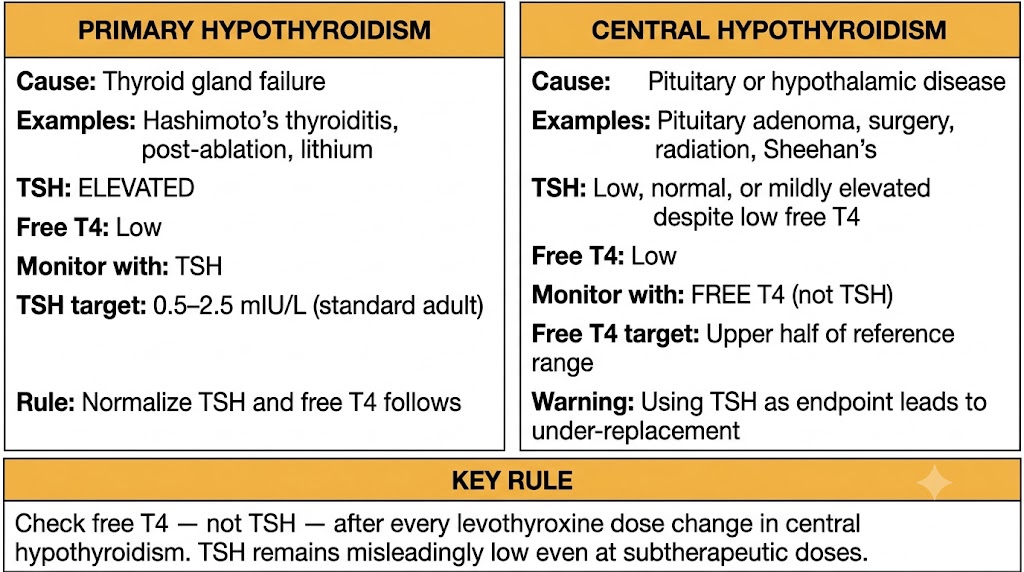
Two-panel comparison of primary versus central hypothyroidism showing TSH pattern and monitoring endpoint
Primary vs. central hypothyroidism. In primary hypothyroidism, thyroid-stimulating hormone is elevated and serves as the monitoring endpoint. In central hypothyroidism, thyroid-stimulating hormone is unreliable; free thyroxine in the upper half of the reference range is the target.

Section 2

Levothyroxine Dosing and Thyroid-Stimulating Hormone Targets

Weight-based initiation, titration intervals, formulation selection, and context-specific goals

Levothyroxine dosing is not one-size-fits-all. The starting dose, titration schedule, and thyroid-stimulating hormone target all vary by clinical context — and the 6-week steady-state rule applies universally.

Starting Dose and Titration

Full levothyroxine replacement for complete hypothyroidism (post-thyroidectomy or post-ablation) requires approximately 1.6 micrograms per kilogram of actual body weight per day, yielding a starting dose of 88–125 micrograms in most adults. In obese patients, lean body weight is more appropriate than total body weight, because adipose tissue does not proportionally increase levothyroxine metabolism. Patients with residual thyroid function (such as those with Hashimoto's thyroiditis not yet ablated) typically require lower doses of 1.0–1.3 micrograms per kilogram per day.

After any dose initiation or change, thyroid-stimulating hormone should not be rechecked sooner than 6 weeks. The 6–7 day half-life of levothyroxine requires four to five half-lives to reach steady state; an earlier measurement captures a non-equilibrium value and leads to inappropriate dose adjustments.

Thyroid-Stimulating Hormone Targets by Context

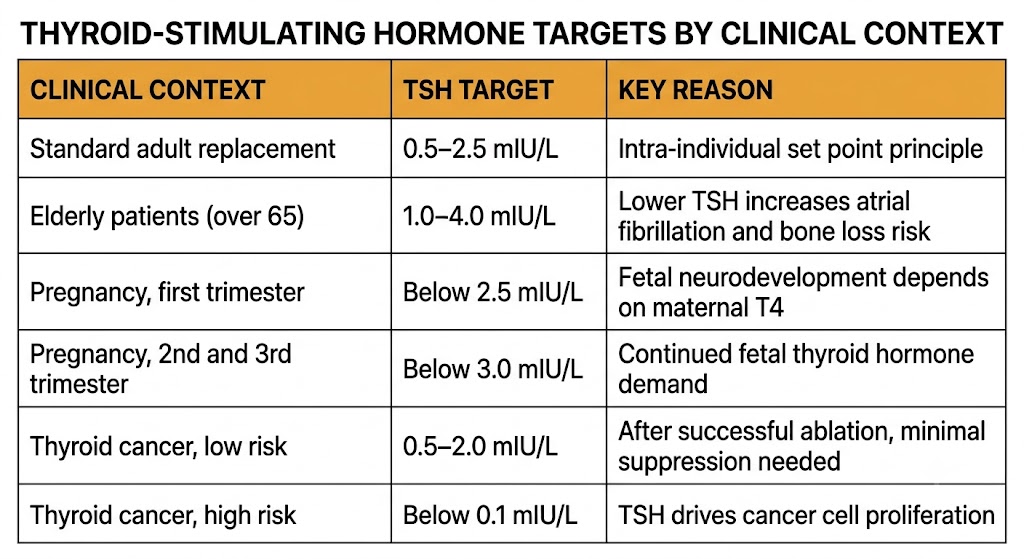
Thyroid-stimulating hormone targets differ significantly across populations. Standard adult replacement targets thyroid-stimulating hormone of 0.5–2.5 mIU/L. Elderly patients over 65 should target 1.0–4.0 mIU/L, because lower thyroid-stimulating hormone in this group is associated with atrial fibrillation and bone mineral density loss. In pregnancy, targets are trimester-specific: below 2.5 mIU/L in the first trimester and below 3.0 mIU/L in the second and third trimesters. In differentiated thyroid cancer, targets are risk-stratified: low-risk disease after successful ablation targets 0.5–2.0 mIU/L; high-risk disease targets below 0.1 mIU/L.

Formulation Selection

Standard levothyroxine tablets require an acidic gastric environment for dissolution and are susceptible to absorption variability. Proton pump inhibitor use, achlorhydria, gastric bypass, and celiac disease all impair tablet absorption and may require dose increases of 20–50%. Liquid levothyroxine solution is minimally affected by gastric pH or food and is the preferred formulation in documented malabsorption or when nasogastric tube administration is required. Soft gelatin capsules outperform tablets in malabsorptive states. Any switch between formulations or between branded and generic levothyroxine warrants a thyroid-stimulating hormone recheck at 6 weeks, as bioavailability can differ by up to 12.5%.

Dosing
Starting Dose Rules
  • Complete hypothyroidism: 1.6 mcg/kg/day actual body weight
  • Obese patients: use lean body weight
  • Partial function (Hashimoto's): 1.0–1.3 mcg/kg/day
  • Cardiac disease / elderly: start low (12.5–25 mcg/day), uptitrate slowly
Targets
Thyroid-Stimulating Hormone by Context
  • Standard adult: 0.5–2.5 mIU/L
  • Elderly (>65): 1.0–4.0 mIU/L
  • Pregnancy 1st trimester: <2.5 mIU/L
  • Pregnancy 2nd/3rd trimester: <3.0 mIU/L
  • Thyroid cancer low-risk: 0.5–2.0 mIU/L
  • Thyroid cancer high-risk: <0.1 mIU/L

Table of levothyroxine thyroid-stimulating hormone targets across six clinical contexts
Thyroid-stimulating hormone targets by clinical context. A single universal target is never appropriate. Elderly patients, pregnant women, and thyroid cancer patients each require individualized goals based on the balance of therapeutic benefit and treatment risk.
Section 3

Special Dosing Contexts

Cardiac disease, pregnancy, pediatrics, and malabsorption

Several clinical contexts require modified levothyroxine strategies that deviate from the standard weight-based approach. Recognizing these situations prevents both under-treatment and iatrogenic harm.

Cardiac Disease and Elderly Patients

Levothyroxine increases cardiac oxygen demand and heart rate. Abrupt full replacement in patients with underlying coronary artery disease can precipitate angina, myocardial infarction, or arrhythmia. The standard approach is to initiate at 12.5–25 micrograms per day and uptitrate by 12.5–25 micrograms every 4–6 weeks, targeting the lower end of the age-appropriate thyroid-stimulating hormone range. There is no absolute contraindication to levothyroxine in cardiac disease, but the titration must be gradual and monitored. If a patient with severe coronary artery disease requires urgent cardiac intervention, it should not be delayed for thyroid optimization; hypothyroidism correction proceeds postoperatively.

Pregnancy

Maternal thyroxine is the sole source of thyroid hormone for the fetus during the first trimester, before fetal thyroid development is complete at approximately 18–20 weeks. Adequate maternal thyroxine is essential for fetal brain development; even subclinical maternal hypothyroidism in the first trimester is associated with impaired neurodevelopmental outcomes.

Levothyroxine demand increases by 30–50% during pregnancy, driven by rising estrogen-induced thyroxine-binding globulin production, placental type 3 deiodinase activity consuming maternal thyroxine, and increased renal iodine clearance. Women with pre-existing hypothyroidism almost universally require dose escalation — typically 25–30% above pre-pregnancy dose — beginning as soon as pregnancy is confirmed. Thyroid-stimulating hormone should be monitored every 4 weeks in the first trimester and every 4–6 weeks thereafter. Women planning pregnancy should achieve thyroid-stimulating hormone below 2.5 mIU/L before conception.

Malabsorption and Bariatric Surgery

Malabsorptive conditions including celiac disease, short bowel syndrome, and inflammatory bowel disease flares typically require 20–30% higher levothyroxine doses and benefit from switching to liquid formulations. Roux-en-Y gastric bypass bypasses the proximal small intestine where most levothyroxine absorption occurs; post-surgical patients often require 30–50% dose increases and should have thyroid-stimulating hormone monitored 6–8 weeks after surgery.

Pregnancy: Act on Positive Test Without Waiting

Women with known hypothyroidism should increase their levothyroxine dose by approximately 25–30% as soon as pregnancy is confirmed — without waiting for a physician visit. One practical method is to take two extra tablets per week. The first-trimester window for fetal neurodevelopment is narrow and time-sensitive; delays in dose escalation carry real developmental risk. Pre-conception thyroid-stimulating hormone below 2.5 mIU/L provides the widest safety margin for the critical early weeks.


Section 4

Combination T4/T3 Therapy

Persistent symptoms on levothyroxine, deiodinase pharmacogenomics, and clinical selection

A subset of patients on adequate levothyroxine report persistent symptoms despite thyroid-stimulating hormone in the target range. Combination therapy with levothyroxine plus liothyronine is a debated option for this population.

Why Some Patients Remain Symptomatic

The proposed mechanism involves the type 2 deiodinase Thr92Ala polymorphism. Individuals homozygous for the Ala92 variant have reduced type 2 deiodinase activity in the brain and pituitary, potentially impairing local thyroxine-to-triiodothyronine conversion in tissues that depend on this enzyme for intracellular triiodothyronine. Circulating thyroxine may be adequate by thyroid-stimulating hormone metrics while brain triiodothyronine remains suboptimal. Approximately 16% of the population is homozygous for this variant.

Evidence and Guidelines

Randomized trials have produced inconsistent results. Some trials show benefit in mood and cognition with combination therapy; larger unselected-population trials have not confirmed this. The inconsistency may reflect dilution of the true effect in the majority who lack the relevant polymorphism. The 2014 American Thyroid Association guidelines state that evidence is insufficient to recommend combination therapy as first-line treatment, but it may be considered as a trial in patients who remain symptomatic on adequate levothyroxine after exclusion of other causes.

If a trial is undertaken, liothyronine is added at low dose (5–10 micrograms once or twice daily) with a corresponding reduction in levothyroxine to avoid overtreatment. The combination should be reassessed after 3–6 months and discontinued if no benefit is apparent. Combination therapy is contraindicated in cardiac disease, significant arrhythmia, advanced age with frailty, and osteoporosis without adequate bone protection.

Exclude Other Causes Before Adding Triiodothyronine

Persistent symptoms on adequate levothyroxine require systematic exclusion of independent diagnoses before escalating to combination therapy. Check: iron deficiency anemia, celiac disease causing malabsorption, adrenal insufficiency (which co-occurs with autoimmune thyroid disease in polyglandular autoimmune syndrome), depression, sleep apnea, vitamin D deficiency, and perimenopause. Many patients incorrectly attribute non-specific symptoms to suboptimal thyroid replacement when a separate diagnosis is responsible.


Section 5

Myxedema Coma

Recognition, precipitants, intravenous protocol, and adjunctive management

Myxedema coma is a life-threatening decompensation of severe hypothyroidism. Despite its name, overt coma is not always present — altered mental status, hypothermia, and hemodynamic instability are the defining features, and mortality reaches 20–50% even with treatment.

Recognition and Precipitants

The clinical picture combines depressed consciousness (from somnolence to stupor), hypothermia, hypoventilation, bradycardia, hyponatremia, and hypoglycemia. Myxedema coma most often occurs in elderly women with undiagnosed or inadequately treated hypothyroidism who decompensate when acute illness exhausts their physiological reserve. Common precipitants include infection (pneumonia and urinary tract infection are most frequent), cold exposure, sedatives, opioids, anesthetics, trauma, stroke, and levothyroxine non-adherence.

Pharmacological Management

Intravenous thyroid hormone is required because gastrointestinal absorption is unreliable in a comatose or hemodynamically unstable patient with reduced gut motility. The standard protocol uses intravenous levothyroxine at a loading dose of 300–500 micrograms, followed by 50–100 micrograms intravenously daily. The large loading dose rapidly saturates the expanded volume of distribution of thyroxine and restores circulating hormone levels; the dose is reduced in elderly patients or those with ischemic heart disease.

Adjunctive intravenous liothyronine (triiodothyronine) is used at many centers on the rationale that impaired peripheral thyroxine-to-triiodothyronine conversion in severe illness makes direct triiodothyronine repletion valuable. However, intravenous triiodothyronine carries arrhythmia risk, and randomized trial evidence for mortality benefit is lacking. Intravenous glucocorticoids (hydrocortisone 50–100 mg every 6–8 hours) are given empirically in all cases of myxedema coma because adrenal insufficiency frequently coexists, particularly in patients with pituitary or autoimmune thyroid disease, and glucocorticoid deficiency can cause cardiovascular collapse when thyroid hormone is replaced without cortisol support.

Emergency Treatment
Myxedema Coma Protocol
  • IV levothyroxine: 300–500 mcg loading dose, then 50–100 mcg daily
  • +/− IV liothyronine: low dose if conversion impaired
  • IV hydrocortisone: 50–100 mg every 6–8 hours empirically
  • Supportive: warming, mechanical ventilation, glucose correction
  • Treat precipitant (infection most common)
Key Points
Why Glucocorticoids First
  • Adrenal insufficiency co-occurs in pituitary and autoimmune disease
  • Thyroid hormone replacement without cortisol can precipitate Addisonian crisis
  • Give empiric hydrocortisone before or with thyroid hormone
  • Taper glucocorticoids once adrenal axis confirmed intact

Suggested References
Author / Organization Title Source
Jonklaas J et al. Guidelines for the treatment of hypothyroidism: American Thyroid Association task force Thyroid. 2014;24(12):1670–1751
Garber JR et al. Clinical practice guidelines for hypothyroidism in adults: AACE and ATA Thyroid. 2012;22(12):1200–1235
Stott DJ et al. Thyroid hormone therapy for older adults with subclinical hypothyroidism (TRUST trial) N Engl J Med. 2017;376(26):2534–2544
Biondi B et al. Subclinical hypothyroidism: a review JAMA. 2019;322(2):153–160
Alexander EK et al. 2017 ATA guidelines for diagnosis and management of thyroid disease during pregnancy Thyroid. 2017;27(3):315–389
Kwaku MP, Burman KD Myxedema coma J Intensive Care Med. 2007;22(4):224–231
Bianco AC, Kim BW Deiodinases: implications of the local control of thyroid hormone action J Clin Invest. 2006;116(10):2571–2579
Ross DS et al. 2016 ATA guidelines for diagnosis and management of hyperthyroidism Thyroid. 2016;26(10):1343–1421