Introduction to Medical Pharmacology
Antianginal Drug Selection & Combination Strategies
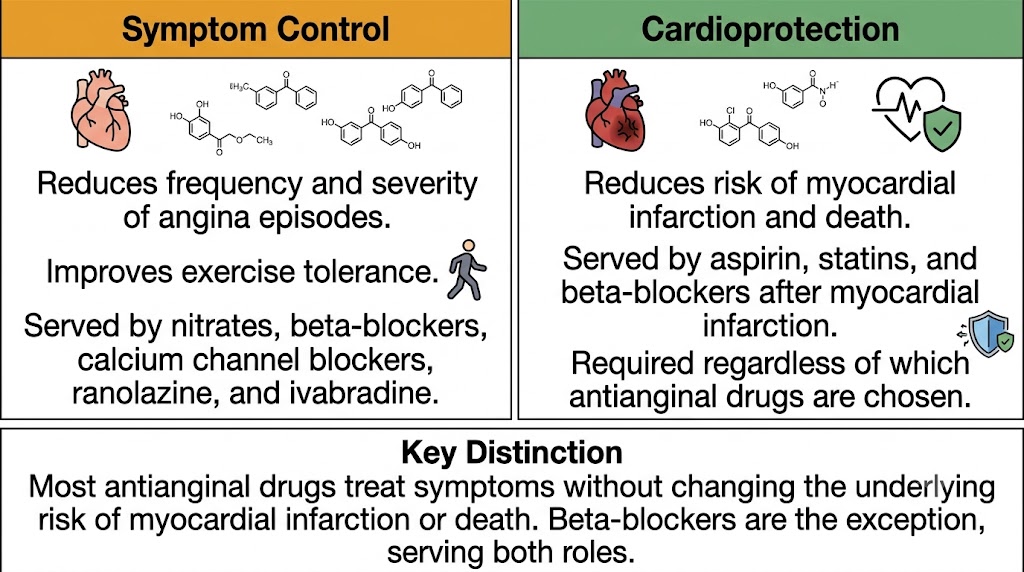
Module 6 of 7Treating a patient with stable angina actually involves pursuing two distinct goals at the same time, and understanding the difference between them clarifies why a typical angina patient ends up taking several different medications for several different reasons.
Most antianginal drugs treat symptoms without changing the underlying risk of myocardial infarction or death. Beta-blockers are the one class that serves both roles, since beyond their anti-ischemic effect they also carry a proven mortality benefit after myocardial infarction. This is why every patient with stable angina receives cardioprotective background therapy such as aspirin and a statin regardless of which specific antianginal drugs are chosen for symptom relief: the two prescribing decisions answer two different clinical questions.
Modules 2 through 5 each introduced the reasoning behind specific antianginal combinations. Stepping back, a simple logic governs how these agents are typically layered together in stable exertional angina.
A beta-blocker is typically the starting point, since it addresses two of the four hemodynamic levers at once and, for many patients, also provides cardioprotection. When a second agent is needed, a long-acting dihydropyridine calcium channel blocker is the preferred partner, for the complementary-mechanism reasons established in Module 4: the beta-blocker blunts the reflex tachycardia the calcium channel blocker would otherwise trigger, and neither drug compounds the other's effect on cardiac conduction.
If symptoms persist despite this combination, the non-hemodynamic agents from Module 5, ranolazine and ivabradine, become attractive next steps precisely because they add anti-ischemic benefit without compounding bradycardia or hypotension, the dose-limiting problems of the hemodynamic agents already in use.
Every combination decision in this chapter follows the same underlying logic: add a drug that targets a hemodynamic lever or mechanism not already addressed by the patient's current regimen, while avoiding combinations that suppress the same target twice, such as the beta-blocker plus non-dihydropyridine calcium channel blocker combination identified as contraindicated in Module 4.
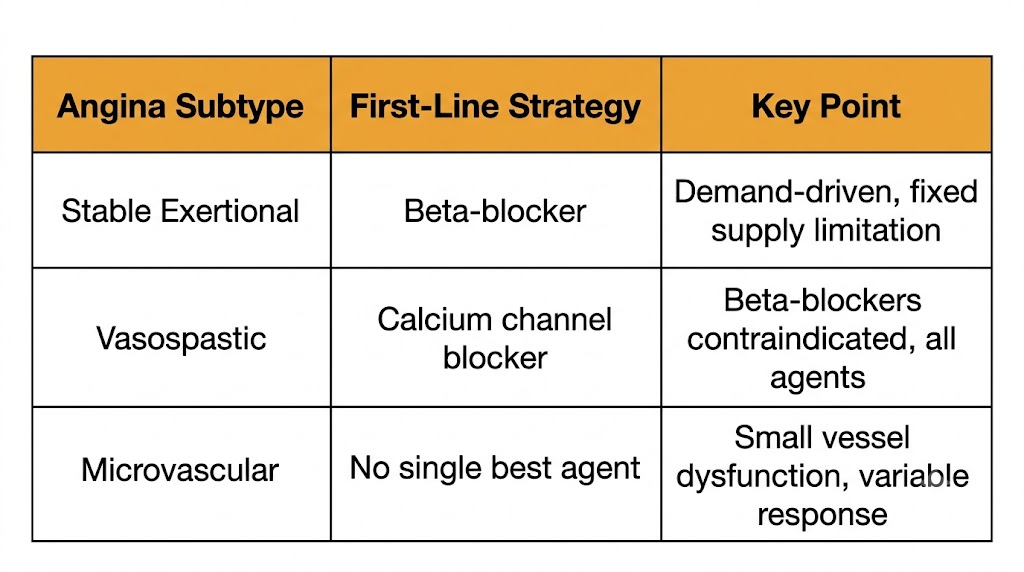
The most important lesson of this chapter, returned to one final time, is that angina is not a single disease with a single treatment algorithm. The three subtypes introduced in Module 1, stable, vasospastic, and microvascular angina, arise from different underlying physiology, and the appropriate drug strategy follows directly from that physiology.
Because vasospastic angina is a pure supply problem driven by coronary artery spasm rather than a demand problem, calcium channel blockers, not beta-blockers, are first-line therapy, since they directly counteract the calcium-mediated smooth muscle hyperreactivity responsible for spasm. Beta-blockers remain contraindicated for the mechanistic reason established in Module 3: unopposed alpha-1 vasoconstriction can precipitate or worsen the very spasm being treated.
Microvascular angina is mechanistically different again: the problem lies in small resistance vessels that fail to dilate adequately, rather than in a single large epicardial artery or its tone. Because the underlying physiology is less uniform and less completely understood than in the other two subtypes, no single drug class has demonstrated clear superiority, and management typically involves a trial of beta-blockers, calcium channel blockers, or both, with response that varies meaningfully between patients.
This subtype-specific reasoning is the thread connecting every module in this chapter: understanding the physiology of myocardial ischemia in Module 1 explains why each subsequent drug class works the way it does, and why no single antianginal algorithm applies to every patient with chest pain.
| Author / Organization | Title | Source |
|---|---|---|
| Chaitman BR, Pepine CJ, Parker JO, et al. | Effects of ranolazine with atenolol, amlodipine, or diltiazem on exercise tolerance and angina frequency in patients with severe chronic angina (CARISA) | JAMA, 2004 |
| Stone PH, Gratsiansky NA, Blokhin A, et al. | Antianginal efficacy of ranolazine when added to treatment with amlodipine (ERICA trial) | Journal of the American College of Cardiology, 2006 |
| Knuuti J, Wijns W, Saraste A, et al. | 2019 ESC Guidelines for the diagnosis and management of chronic coronary syndromes | European Heart Journal, 2020 |
| Fihn SD, Gardin JM, Abrams J, et al. | 2012 ACCF/AHA Guideline for the diagnosis and management of patients with stable ischemic heart disease | Journal of the American College of Cardiology, 2012 |
| Beltrame JF, Crea F, Kaski JC, et al. | International standardization of diagnostic criteria for vasospastic angina | European Heart Journal, 2017 |
| Fox K, Ford I, Steg PG, et al. | Ivabradine in stable coronary artery disease without clinical heart failure (SIGNIFY) | New England Journal of Medicine, 2014 |
| Swedberg K, Komajda M, Böhm M, et al. | Ivabradine and outcomes in chronic heart failure (SHIFT) | Lancet, 2010 |
| Salpeter SR, Ormiston TM, Salpeter EE. | Cardioselective beta-blockers for reversible airway disease | Cochrane Database of Systematic Reviews, 2002 |
| Crea F, Bairey Merz CN, Beltrame JF, et al. | The parallel tales of microvascular angina and heart failure with preserved ejection fraction | European Heart Journal, 2017 |
| MERIT-HF Study Group. | Effect of metoprolol CR/XL in chronic heart failure (MERIT-HF) | Lancet, 1999 |
| Boden WE, O'Rourke RA, Teo KK, et al. | Optimal medical therapy with or without percutaneous coronary intervention for stable coronary disease (COURAGE trial) | New England Journal of Medicine, 2007 |
| Maron DJ, Hochman JS, Reynolds HR, et al. | Initial invasive or conservative strategy for stable coronary disease (ISCHEMIA trial) | New England Journal of Medicine, 2020 |
| Devereaux PJ, Yang H, Yusuf S, et al. | Effects of extended-release metoprolol succinate in patients undergoing non-cardiac surgery (POISE trial) | Lancet, 2008 |