CHAPTER 9 ยท ANTIANGINAL DRUGS
Section 1
Why Cardioprotective Therapy Is Separate
A different set of drugs, addressing a different clinical goal.

Module 6 introduced the distinction between symptom-control therapy and cardioprotective therapy. This closing module covers the cardioprotective side of that equation in more depth: antiplatelet drugs, statins, and renin-angiotensin system inhibitors, the three drug classes that reduce the risk of myocardial infarction and death in coronary artery disease independent of any effect on angina symptoms.

Every patient with established coronary artery disease receives this cardioprotective background therapy, regardless of which antianginal drugs are ultimately chosen to control symptoms. The two prescribing decisions are made for different reasons and evaluated against different outcomes.


Section 2
Antiplatelet Therapy
Reducing the platelet contribution to plaque rupture and coronary thrombosis.

Atherosclerotic plaque is a continuous source of platelet activation, and the event that converts stable coronary artery disease into an acute myocardial infarction, plaque rupture, is immediately followed by platelet-driven clot formation. Antiplatelet therapy reduces this risk by interfering with platelet activation.

Aspirin: Irreversible Cyclooxygenase Inhibition

Aspirin irreversibly inhibits cyclooxygenase-1, the enzyme platelets use to produce thromboxane A2, a potent activator of platelet aggregation and vasoconstrictor. Because mature platelets lack a nucleus and cannot synthesize new enzyme, a single aspirin dose disables cyclooxygenase-1 for the entire remaining lifespan of each affected platelet, producing an antiplatelet effect that substantially outlasts the drug itself. Low-dose aspirin is the standard antiplatelet agent for nearly all patients with established coronary artery disease.

Clopidogrel: A Complementary Target

Clopidogrel works through an entirely different mechanism: it irreversibly blocks the platelet P2Y12 receptor, the receptor through which adenosine diphosphate normally promotes platelet aggregation. Because aspirin and clopidogrel act on two separate activation pathways, combining them produces a more complete blockade of platelet aggregation than either drug alone, which is the pharmacological rationale for dual antiplatelet therapy after an acute coronary event. In stable coronary artery disease without a recent acute event, clopidogrel is mainly used as an alternative to aspirin in patients who cannot tolerate it.
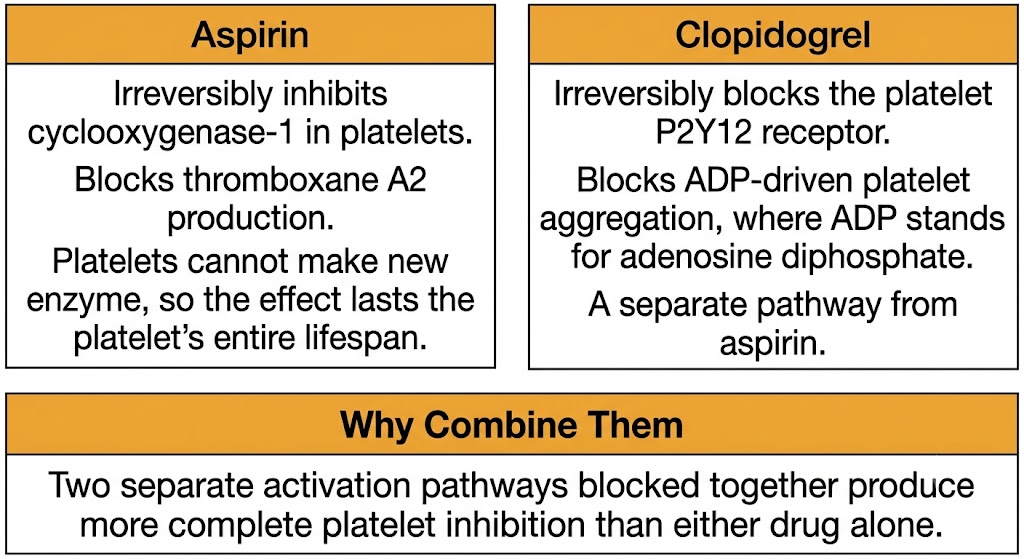
A two-panel diagram comparing aspirin, which irreversibly inhibits cyclooxygenase-1 and blocks thromboxane A2 production, against clopidogrel, which irreversibly blocks the platelet P2Y12 receptor, showing why combining the two pathways produces more complete platelet inhibition.
Aspirin and clopidogrel: complementary antiplatelet mechanisms.

Section 3
Statins
Lowering cholesterol synthesis to slow and stabilize atherosclerotic plaque.

Statins are the cornerstone of lipid-lowering therapy in coronary artery disease, and their benefit tracks closely with how much they lower low-density lipoprotein cholesterol.

Mechanism: Inhibiting Cholesterol Synthesis

Statins competitively inhibit hydroxymethylglutaryl-coenzyme A reductase, the rate-limiting enzyme in the liver's cholesterol synthesis pathway. With less cholesterol being made internally, liver cells respond by increasing the number of low-density lipoprotein receptors on their surface, pulling more low-density lipoprotein cholesterol out of the bloodstream. The net result is a dose-dependent fall in plasma low-density lipoprotein cholesterol, which is the primary driver of the cardiovascular benefit statins provide. Statins also have secondary, less central effects on blood vessel function and inflammation, though the bulk of their clinical benefit tracks with the magnitude of low-density lipoprotein reduction achieved.

High-Intensity Dosing as the Default

Because cardiovascular benefit correlates with the absolute degree of low-density lipoprotein reduction, current guidelines recommend high-intensity statin dosing as the starting point for nearly all patients with established coronary artery disease, rather than starting low and titrating up based on a specific target value.


Section 4
Renin-Angiotensin System Inhibition and Optimal Medical Therapy
Completing the cardioprotective regimen, and the chapter's final teaching point.
Angiotensin-Converting Enzyme Inhibitors and Angiotensin Receptor Blockers

Angiotensin-converting enzyme inhibitors and angiotensin receptor blockers reduce the activity of the renin-angiotensin-aldosterone system, lowering blood pressure and reducing the harmful cardiac and vascular remodeling that chronic angiotensin II exposure promotes. These agents are particularly valuable in patients with reduced ejection fraction, diabetes, or chronic kidney disease alongside their coronary artery disease, conditions in which renin-angiotensin-aldosterone system activity is especially harmful.

Optimal Medical Therapy: The Chapter's Closing Lesson

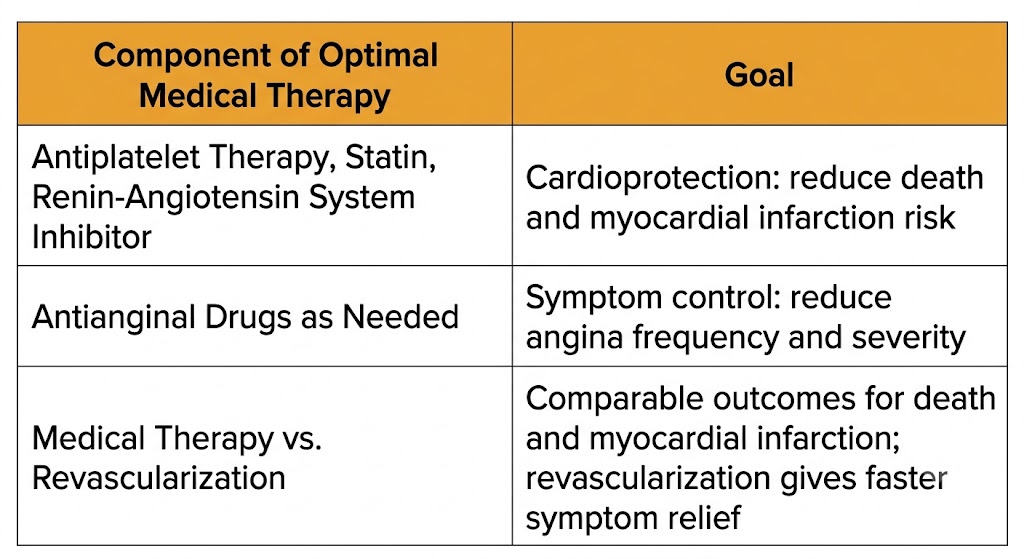
The complete regimen for a patient with stable coronary artery disease, combining antiplatelet therapy, a statin, a renin-angiotensin system inhibitor, and antianginal drugs as needed for symptoms, is collectively known as optimal medical therapy. A foundational finding in modern cardiology is that, in patients with stable coronary artery disease, optimal medical therapy alone produces outcomes for death and myocardial infarction that are comparable to adding percutaneous coronary intervention, the procedure used to open a narrowed coronary artery with a stent.

Revascularization does provide meaningfully better and faster relief of angina symptoms than medical therapy alone. The clinical implication is that every patient with stable coronary artery disease deserves a full trial of optimal medical therapy before revascularization is pursued for hard outcomes such as death or myocardial infarction, while recognizing that symptom relief and quality of life remain legitimate reasons to pursue revascularization in patients who remain limited despite medical therapy.

A reference table summarizing the components of optimal medical therapy in stable coronary artery disease and their goals, including the comparison between medical therapy and revascularization.
Components and goals of optimal medical therapy.
The Chapter's Central Theme, Restated

Every drug covered across this chapter, from the four hemodynamic levers in Module 1 through the cardioprotective agents in this final module, exists to serve one or both of two goals: relieving the symptoms of myocardial ischemia, or reducing the underlying risk of a future cardiovascular event. Understanding which goal each drug serves, and why, is the foundation for rational antianginal prescribing.


Suggested References
Author / Organization Title Source
Boden WE, O'Rourke RA, Teo KK, et al.Optimal medical therapy with or without percutaneous coronary intervention for stable coronary disease (COURAGE)New England Journal of Medicine, 2007
Maron DJ, Hochman JS, Reynolds HR, et al.Initial invasive or conservative strategy for stable coronary disease (ISCHEMIA)New England Journal of Medicine, 2020
Knuuti J, Wijns W, Saraste A, et al.2019 ESC Guidelines for the diagnosis and management of chronic coronary syndromesEuropean Heart Journal, 2020
Patrono C, Morais J, Baigent C, et al.Antiplatelet agents for the treatment and prevention of coronary atherothrombosisJournal of the American College of Cardiology, 2017
Antithrombotic Trialists' Collaboration.Collaborative meta-analysis of randomised trials of antiplatelet therapy for prevention of death, myocardial infarction, and stroke in high risk patientsBMJ, 2002
CAPRIE Steering Committee.A randomised, blinded, trial of clopidogrel versus aspirin in patients at risk of ischaemic events (CAPRIE)Lancet, 1996
Valgimigli M, Bueno H, Byrne RA, et al.2017 ESC focused update on dual antiplatelet therapy in coronary artery diseaseEuropean Heart Journal, 2018
Grundy SM, Stone NJ, Bailey AL, et al.2018 AHA/ACC guideline on the management of blood cholesterolJournal of the American College of Cardiology, 2019
Yusuf S, Sleight P, Pogue J, et al.Effects of an angiotensin-converting-enzyme inhibitor, ramipril, on cardiovascular events in high-risk patients (HOPE)New England Journal of Medicine, 2000
Fox KM; EUROPA Investigators.Efficacy of perindopril in reduction of cardiovascular events among patients with stable coronary artery disease (EUROPA)Lancet, 2003
Collins R, Armitage J, Parish S, et al.MRC/BHF Heart Protection Study of cholesterol lowering with simvastatin in 20,536 high-risk individualsLancet, 2002
Braunwald E, Domanski MJ, Fowler SE, et al.Angiotensin-converting-enzyme inhibition in stable coronary artery disease (PEACE)New England Journal of Medicine, 2004