Introduction to Medical Pharmacology
Module 4 — Class III Agents: Potassium Channel Blockers
AARR · Module 4 of 9Section 1
How Class III agents eliminate re-entrant circuits — and the paradox of reverse use-dependence
Class III antiarrhythmic agents prolong the cardiac action potential duration and effective refractory period by blocking the repolarizing potassium channels responsible for phase 3 of the action potential. Unlike Class I agents, they do not slow conduction velocity. Their antiarrhythmic mechanism is elimination of the excitable gap in re-entrant circuits: by prolonging refractoriness, the circulating wavefront encounters refractory tissue before it can complete another cycle, and the arrhythmia terminates.
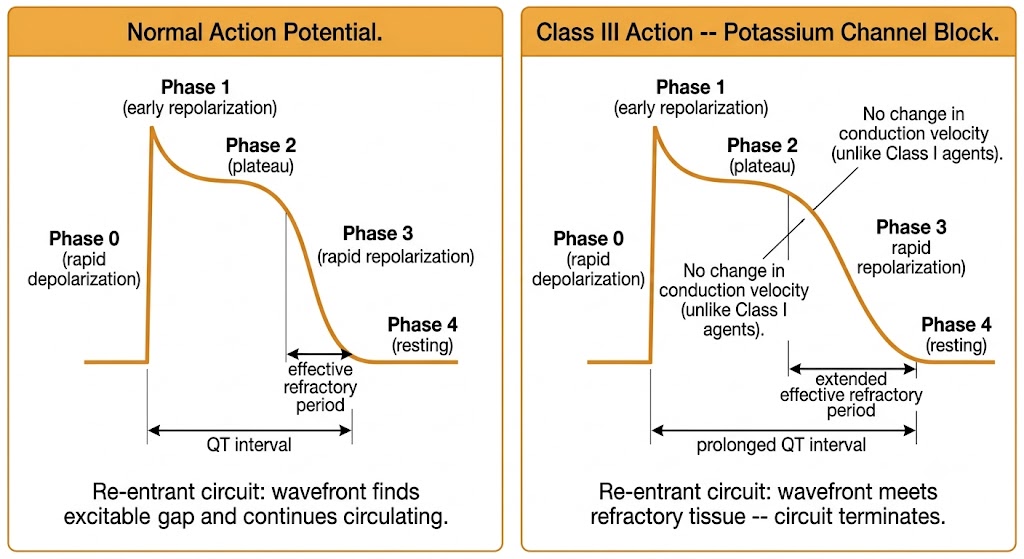
Because the QT interval on the surface electrocardiogram reflects the duration of ventricular depolarization and repolarization, anything that prolongs the action potential duration will also prolong the QT interval. All Class III agents prolong QT. This is both the mechanism of their antiarrhythmic efficacy — prolonged refractoriness — and the mechanism of their primary proarrhythmic risk. A sufficiently prolonged action potential can generate early afterdepolarizations during phase 3, which are the direct trigger for torsades de pointes, a potentially fatal polymorphic ventricular tachycardia.
Risk of torsades de pointes from Class III agents is greatest when QT prolongation is combined with slow heart rates, hypokalemia, hypomagnesemia, or female sex. These factors compound the proarrhythmic burden and should be actively managed in any patient receiving a Class III agent.
Most Class III agents — particularly those that block only the rapid repolarizing potassium channel — exhibit reverse use-dependence: their action potential duration prolongation is greatest at slow heart rates and diminishes as heart rate increases. This is paradoxical because the condition that maximizes action potential duration prolongation (slow rate) is also the condition most favorable for early afterdepolarization formation and torsades de pointes. Conversely, the condition that minimizes their protective effect (rapid rate during active tachycardia) is precisely when antiarrhythmic action is most needed.
Amiodarone is a notable exception. Its multi-channel mechanism — blocking sodium channels, calcium channels, beta-adrenergic receptors, and potassium channels simultaneously — produces more uniform action potential duration prolongation across heart rates, with comparatively less reverse use-dependence. This multi-channel profile is a major contributor to amiodarone's low torsades de pointes incidence despite substantial QT prolongation.
The Class III Paradox in One Sentence
Pure potassium channel blockers prolong the action potential most at slow rates — where torsades de pointes risk is highest — and least at fast rates — where re-entry protection is most needed. Amiodarone's multi-channel mechanism partially escapes this paradox.
Section 2
The broadest-spectrum antiarrhythmic — extraordinary efficacy, extraordinary complexity
Amiodarone is the most broadly effective antiarrhythmic drug in clinical use. Its efficacy spans virtually every arrhythmia type, and it is one of only two agents safe for rhythm control in heart failure with reduced ejection fraction. Understanding amiodarone requires systematic knowledge of both its pharmacokinetic peculiarities and its multi-organ toxicity profile.
Amiodarone does not fit within any single Vaughan Williams class — it spans all four. It blocks sodium channels (Class I effect: slows conduction in fast-response tissue), blocks beta-adrenergic receptors (Class II effect: slows sinoatrial rate and atrioventricular nodal conduction), blocks potassium channels (Class III effect: prolongs action potential duration and effective refractory period throughout the heart), and blocks calcium channels (Class IV effect: reduces atrioventricular nodal conduction and sinus rate).
This multi-channel profile explains two clinically important properties: first, it makes amiodarone effective across virtually all arrhythmia types; second, the calcium channel blockade counteracts the pro-early-afterdepolarization effect of prolonged action potential duration, resulting in a torsades de pointes incidence below 1% — far lower than any other Class III agent — despite producing substantial QT prolongation.
Amiodarone contains iodine (approximately 37 percent of its molecular weight), which drives both thyroid toxicity and erratic gastrointestinal absorption. It is extremely lipophilic, accumulating massively in adipose tissue, lung, liver, and myocardium. This tissue accumulation has two major consequences: loading doses are required to achieve effective concentrations, because simply starting a maintenance dose would take months to reach steady state; and the elimination half-life is 40 to 55 days, meaning that effects and drug interactions persist for weeks to months after the drug is discontinued.
Because of this extraordinarily long half-life, any toxicity that develops during amiodarone therapy will not resolve quickly after stopping the drug. Monitoring protocols must begin at initiation and continue through and after discontinuation.
For ventricular arrhythmias, intravenous amiodarone is first-line for hemodynamically stable ventricular tachycardia and for shock-refractory ventricular fibrillation in Advanced Cardiac Life Support protocols, where it is superior to lidocaine. For atrial fibrillation rhythm control, amiodarone is the most effective available agent and the one of two options (along with dofetilide) that is safe in patients with heart failure with reduced ejection fraction or significant structural heart disease. Given its toxicity burden, it is generally reserved for patients where other agents have failed or are contraindicated.
Amiodarone's iodine content and extreme lipophilicity drive toxicity across multiple organ systems. All toxicities increase with cumulative dose and treatment duration, making the lowest effective maintenance dose an active clinical goal.
Thyroid: The most common toxicity. Hypothyroidism is more frequent and is treated with levothyroxine supplementation without necessarily stopping amiodarone. Hyperthyroidism is less common but more dangerous; one form involves destructive thyroiditis requiring corticosteroids. Thyroid function testing every six months is mandatory for all patients on amiodarone.
Pulmonary: Interstitial pneumonitis occurs in 1 to 5 percent of patients per year and is potentially fatal. Annual chest radiograph and pulmonary function testing are required. New respiratory symptoms or radiographic infiltrates warrant computed tomography and pulmonary evaluation; confirmed pulmonary toxicity requires discontinuation and corticosteroids in severe cases.
Hepatic: Transaminase elevation is common; cirrhosis is rare. Liver function tests every six months; discontinue if transaminases rise significantly above the upper limit of normal.
Ophthalmic: Corneal microdeposits are nearly universal and are not a reason to stop the drug. Optic neuropathy is rare but vision-threatening and requires immediate discontinuation if it develops.
Dermatologic: Photosensitivity occurs in a majority of patients — sun protection is mandatory from the start of therapy. Blue-gray skin discoloration develops with prolonged use and is usually irreversible.
Cardiac: Bradycardia and atrioventricular block can occur. Torsades de pointes is rare (below 1%).
Amiodarone produces several clinically critical drug interactions that require active management:
Warfarin: Amiodarone substantially increases warfarin effect, raising the international normalized ratio by 30 to 50 percent. Reduce the warfarin dose by approximately one-third when amiodarone is started, and monitor the international normalized ratio closely for weeks. The interaction persists after amiodarone is stopped because of its long half-life.
Digoxin: Amiodarone reduces digoxin elimination, approximately doubling digoxin plasma levels. Halve the digoxin dose when amiodarone is added and recheck digoxin levels.
Statins (particularly simvastatin and lovastatin): Amiodarone inhibits the enzyme responsible for statin metabolism, raising statin levels and increasing the risk of myopathy and rhabdomyolysis. Avoid high-dose simvastatin; prefer pravastatin or rosuvastatin in patients on amiodarone.
Section 3
Combined Class II and Class III activity — rate slowing plus action potential duration prolongation
Sotalol combines two distinct antiarrhythmic mechanisms: beta-adrenergic receptor blockade (Class II) from one component, and potassium channel blockade with action potential duration prolongation (Class III) from both components. This dual mechanism produces rate slowing alongside effective refractory period extension, making it useful for both rate and rhythm control in atrial arrhythmias.
Sotalol is eliminated entirely by the kidneys without any hepatic metabolism. This makes renal function the critical determinant of sotalol exposure. Dose reduction is required as creatinine clearance falls, and sotalol is contraindicated in severe renal impairment because drug accumulation at reduced clearance produces dangerous QT prolongation. Renal function must be assessed before initiation and monitored during therapy.
Sotalol's pure potassium channel blocking component exhibits reverse use-dependence and carries a torsades de pointes risk of 2 to 4 percent, higher than amiodarone but lower than ibutilide. Risk is greatest with a baseline corrected QT interval above 500 milliseconds, renal impairment, hypokalemia, hypomagnesemia, bradycardia, and female sex.
Because of this risk, current guidelines require initiation or re-initiation of sotalol in a monitored setting with continuous telemetry for a minimum of three days. The corrected QT interval is checked after each dose during the initiation period; if it exceeds 500 milliseconds, the dose must be reduced or the drug discontinued.
Sotalol is used for rhythm control of atrial fibrillation and atrial flutter in patients with mild structural heart disease or coronary artery disease without severe left ventricular dysfunction, and for suppression of ventricular tachycardia and ventricular fibrillation in patients with implantable cardioverter-defibrillators as an adjunct to device therapy.
Sotalol is contraindicated in heart failure with significantly reduced ejection fraction (below 40 percent), because its beta-blocking component can worsen hemodynamics in this population. It is also contraindicated in severe asthma (beta-2 blockade), a baseline corrected QT interval above 450 milliseconds, and severe renal impairment.
Section 4
Selective potassium channel blockers for atrial fibrillation — oral and intravenous respectively
Dofetilide is a highly selective potassium channel blocker with no sodium channel, calcium channel, or adrenergic receptor activity. Its pharmacological selectivity produces predictable, dose-proportional QT prolongation. It is one of only two antiarrhythmic agents — along with amiodarone — demonstrated to be safe for rhythm control in patients with heart failure with reduced ejection fraction, based on trial data showing no increase in mortality in this population.
Dofetilide is eliminated primarily by the kidneys, and strict dose adjustment based on creatinine clearance is mandatory. Drugs that interfere with renal cation transport (including verapamil, cimetidine, and trimethoprim) increase dofetilide levels and are contraindicated.
All patients must be initiated on dofetilide in a facility capable of continuous cardiac monitoring for a minimum of three days, with the corrected QT interval checked after each dose. If the corrected QT interval exceeds 500 milliseconds at any point during initiation, the dose is reduced or the drug discontinued. This mandatory in-hospital initiation applies to every new course of dofetilide, including restarts after interruption.
Dofetilide and Amiodarone: The Two Safe Options in Heart Failure with Reduced Ejection Fraction
Among all Class III antiarrhythmic agents, only dofetilide and amiodarone are safe for rhythm control in patients with heart failure with reduced ejection fraction. Sotalol, ibutilide, and dronedarone are all contraindicated or carry unacceptable risk in this population. This is one of the highest-yield clinical distinctions in antiarrhythmic pharmacology.
Ibutilide is available only for intravenous administration and is used exclusively for pharmacologic cardioversion of recent-onset atrial fibrillation or atrial flutter to sinus rhythm. It is not used for maintenance of sinus rhythm. Its mechanism prolongs action potential duration rapidly and potently, terminating re-entrant atrial circuits.
Ibutilide carries the highest torsades de pointes risk of any Class III agent, at 4 to 8 percent. All patients must be monitored continuously for a minimum of four hours after administration or until the corrected QT interval returns to baseline, and resuscitation equipment must be immediately available. It is contraindicated in patients with a prolonged corrected QT interval at baseline, hypokalemia, hypomagnesemia, or a history of torsades de pointes.
Section 5
A non-iodinated amiodarone analogue — and how all five Class III agents compare
Dronedarone was developed as a safer alternative to amiodarone by removing the iodine content responsible for thyroid and pulmonary toxicity. It retains amiodarone's multi-channel pharmacological profile and shorter, more predictable pharmacokinetics — but two major trial findings established absolute contraindications that substantially limit its use.
Dronedarone is a non-iodinated benzofuran analogue of amiodarone with the same multi-channel mechanism (Classes I through IV) but a half-life of approximately 24 to 27 hours, much lower lipophilicity, and predictable pharmacokinetics. It does not cause thyroid or pulmonary toxicity. For appropriate patients, it offers a more manageable adverse effect profile than amiodarone.
Two randomized trials established its critical contraindications. In patients with severe heart failure with reduced ejection fraction or recently decompensated heart failure, dronedarone increased mortality compared to placebo. In patients with permanent atrial fibrillation, dronedarone increased mortality, stroke, and arrhythmia burden compared to placebo. These findings established two absolute contraindications: dronedarone must not be used in heart failure with reduced ejection fraction (or recently decompensated heart failure), and it must not be used in permanent atrial fibrillation. It is indicated only for paroxysmal or persistent atrial fibrillation in patients with preserved or mildly reduced ejection fraction and without recent decompensation.
Dronedarone inhibits enzymes and transporters responsible for digoxin and dabigatran elimination; both require dose adjustment or substitution when dronedarone is added.
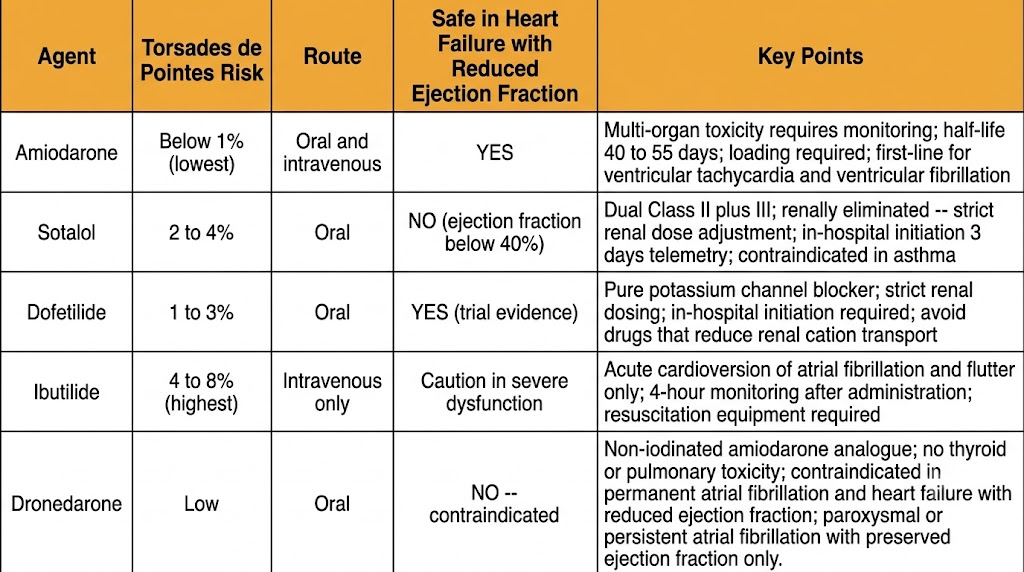
The five Class III agents in clinical use differ substantially in torsades de pointes risk, cardiac substrate safety, and practical prescribing requirements. Understanding these differences at the level of "which agent is safe in which patient" is the core clinical application of this module.
Safest torsades de pointes risk / Heart failure with reduced ejection fraction safe
Amiodarone and Dofetilide
Avoid in heart failure with reduced ejection fraction / Higher torsades de pointes risk
Sotalol, Ibutilide, and Dronedarone
| Author / Organization | Title | Source |
|---|---|---|
| Nerbonne JM, Kass RS | Molecular physiology of cardiac repolarization | Physiol Rev. 2005;85(4):1205–1253 |
| Roden DM | Drug-induced prolongation of the QT interval | N Engl J Med. 2004;350(10):1013–1022 |
| Siddoway LA | Amiodarone: guidelines for use and monitoring | Am Fam Physician. 2003;68(11):2189–2196 |
| Goldschlager N, Epstein AE, Naccarelli GV, et al | A practical guide for clinicians who treat patients with amiodarone: 2007 | Heart Rhythm. 2007;4(9):1250–1259 |
| Ernawati DK, Stafford L, Hughes JD | Amiodarone-induced pulmonary toxicity | Br J Clin Pharmacol. 2008;66(1):82–87 |
| Waldo AL, Camm AJ, deRuyter H, et al | Effect of d-sotalol on mortality in patients with left ventricular dysfunction after recent and remote myocardial infarction | Lancet. 1996;348(9019):7–12 |
| Torp-Pedersen C, Moller M, Bloch-Thomsen PE, et al | Dofetilide in patients with congestive heart failure and left ventricular dysfunction (DIAMOND-CHF) | N Engl J Med. 1999;341(12):857–865 |
| Hohnloser SH, Crijns HJ, van Eickels M, et al | Effect of dronedarone on cardiovascular events in atrial fibrillation (ATHENA) | N Engl J Med. 2009;360(7):668–678 |
| Kober L, Torp-Pedersen C, McMurray JJ, et al | Increased mortality after dronedarone therapy for severe heart failure (ANDROMEDA) | N Engl J Med. 2008;358(25):2678–2687 |
| Connolly SJ, Camm AJ, Halperin JL, et al | Dronedarone in high-risk permanent atrial fibrillation (PALLAS) | N Engl J Med. 2011;365(24):2268–2276 |
| January CT, Wann LS, Calkins H, et al | 2019 AHA/ACC/HRS focused update of the 2014 guideline for management of patients with atrial fibrillation | J Am Coll Cardiol. 2019;74(1):104–132 |