CHAPTER 35  ·  ANTIBACTERIAL AGENTS

Section 1

Chloramphenicol: Mechanism of Action and Antibacterial Spectrum

50S peptidyl transferase inhibition, bacteriostatic activity with notable exceptions, and the broad spectrum that includes anaerobes and intracellular organisms

Chloramphenicol is a broad-spectrum bacteriostatic antibiotic that blocks bacterial protein synthesis by binding to the 50S ribosomal subunit. Introduced in 1948 as the first synthetically produced broad-spectrum antibiotic, it was once the most widely used antibiotic worldwide. Its clinical role has since been dramatically narrowed in high-income countries by a rare but fatal toxicity, though it remains an essential medicine in low-resource settings and retains specific indications where its pharmacokinetic properties are difficult to match.

Mechanism of Action

Chloramphenicol binds reversibly to the 50S ribosomal subunit, blocking peptide chain elongation.

The binding site overlaps substantially with those of macrolides and lincosamides, which has two practical consequences. The overlap in binding region explains why these drug classes can antagonize each other in combination and why ribosomal modification resistance can confer cross-resistance to all three classes.

The effect is reversible and bacteriostatic against most organisms. However, chloramphenicol is bactericidal against Haemophilus influenzae, Neisseria meningitidis, and Streptococcus pneumoniae at clinical concentrations — an exception to its generally bacteriostatic character that is clinically relevant for meningitis treatment.

Antibacterial Spectrum

Chloramphenicol has a genuinely broad spectrum spanning aerobic Gram-positive and Gram-negative bacteria, anaerobes, and intracellular organisms including rickettsiae. This breadth distinguishes it from most other protein synthesis inhibitors.

Among Gram-negative organisms, it is active against H. influenzae, N. meningitidis, S. pneumoniae, many Enterobacteriaceae, and Salmonella typhi — though resistance to S. typhi has emerged substantially in endemic regions. Activity against anaerobes including Bacteroides fragilis makes it useful for polymicrobial infections in resource-limited settings. Chloramphenicol retains activity against rickettsial organisms, though doxycycline has supplanted it as the preferred agent for Rocky Mountain spotted fever due to superior outcomes. It does not have reliable activity against Pseudomonas aeruginosa or methicillin-resistant Staphylococcus aureus.
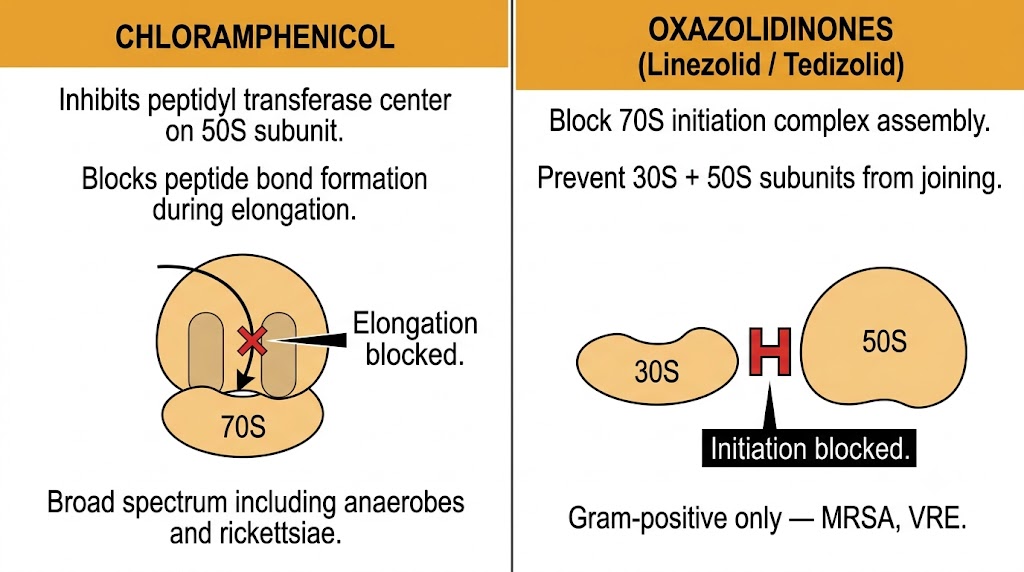
Two-panel diagram comparing chloramphenicol (blocks peptidyl transferase during elongation on the 70S ribosome) and oxazolidinones (block 30S and 50S subunits from joining to form the 70S initiation complex).
Figure 1. Mechanism comparison: chloramphenicol inhibits elongation at the peptidyl transferase center; oxazolidinones block initiation complex assembly. Generated with Gemini AI.

Section 2

Chloramphenicol: Pharmacokinetics and Gray Baby Syndrome

Excellent central nervous system penetration, hepatic glucuronidation, and the pharmacokinetic basis of neonatal toxicity

The most clinically relevant pharmacokinetic property of chloramphenicol is its exceptional penetration into the central nervous system — superior to most beta-lactam antibiotics and the basis for its historical role in bacterial meningitis. Its metabolism through hepatic glucuronidation and the immaturity of this pathway in neonates explain a distinct, potentially fatal toxicity seen in the youngest patients.

Absorption and Distribution

Chloramphenicol is well absorbed orally. For intravenous use it is administered as the chloramphenicol succinate prodrug, which requires hydrolysis by esterases to release the active form; this conversion is variable and can yield lower plasma levels than oral dosing. Chloramphenicol achieves cerebrospinal fluid concentrations of approximately 30 to 50% of simultaneous plasma concentrations even without meningeal inflammation, rising toward plasma levels when the meninges are inflamed. This degree of penetration is clinically distinctive. It also distributes freely into brain parenchyma, bile, and placental circulation.

Metabolism: Hepatic Glucuronidation

Chloramphenicol is metabolized primarily in the liver by glucuronosyltransferase enzymes, which conjugate it to an inactive glucuronide that is then renally excreted. Hepatic impairment prolongs the half-life and increases toxicity risk; dose reduction is required in significant liver disease. Serum level monitoring is recommended when chloramphenicol is used in neonates or patients with hepatic dysfunction.

Gray Baby Syndrome

In neonates, particularly premature infants, the hepatic glucuronidation pathway is immature and substantially underdeveloped. When neonates receive doses appropriate for older patients, chloramphenicol accumulates to toxic levels, producing gray baby syndrome — a potentially fatal toxicity characterized by abdominal distension, vomiting, refusal to feed, cyanosis, cardiovascular collapse, and a characteristic ashen-gray skin discoloration.

The underlying mechanism is inhibition of mitochondrial protein synthesis in cardiac and skeletal muscle, producing a direct myocardial depressant effect. This is the same mechanism by which chloramphenicol causes dose-dependent bone marrow suppression — the drug inhibits the mitochondrial ribosomes, which are structurally similar to bacterial 70S ribosomes. Gray baby syndrome can also occur in older patients receiving excessively high doses, though immature metabolism is the primary risk factor.

Gray Baby Syndrome — A Maturation Problem, Not an Intrinsic Neonatal Sensitivity

Gray baby syndrome occurs because neonatal hepatic glucuronidation is immature, not because chloramphenicol is inherently more toxic at any given plasma level. Standard adult doses produce toxic accumulation in neonates. When chloramphenicol must be used in neonates, doses must be substantially reduced and serum levels monitored, targeting peak concentrations below 25 micrograms per milliliter.


Section 3

Chloramphenicol: Adverse Effects and Clinical Role

Two mechanistically distinct bone marrow toxicities, cytochrome P450 drug interactions, and the narrow modern indications for systemic use

Chloramphenicol has two forms of bone marrow toxicity that are mechanistically unrelated and clinically very different. One is dose-dependent and reversible; the other is idiosyncratic, unpredictable, and potentially fatal. Together they have restricted systemic use in high-income countries to a small number of situations where no safer alternative exists.

Reversible Bone Marrow Suppression

Chloramphenicol produces dose-dependent, reversible suppression of all three hematopoietic cell lines through inhibition of mitochondrial protein synthesis in bone marrow precursor cells. This toxicity is predictable, occurs in a concentration-dependent fashion, and is fully reversible upon stopping the drug. It is detectable by serum level monitoring — plasma concentrations above approximately 25 micrograms per milliliter are associated with this effect.

Aplastic Anemia — Idiosyncratic and Irreversible

Chloramphenicol-associated aplastic anemia is an idiosyncratic reaction entirely unrelated to dose or plasma concentration. It occurs at a rate of approximately 1 in 25,000 to 1 in 40,000 treatment courses. The reaction typically presents weeks to months after drug exposure — often after the course is completed — making causality difficult to establish in retrospect.

The mechanism involves toxic effects of chloramphenicol metabolites on hematopoietic stem cells, producing irreversible destruction of the bone marrow. Mortality exceeds 50% without bone marrow transplantation or immunosuppressive therapy. Serum level monitoring has no impact on this reaction — it cannot be prevented or predicted by laboratory surveillance. This is the primary reason systemic chloramphenicol use has been curtailed in high-income countries.

Two Bone Marrow Toxicities — Do Not Confuse Them

Reversible suppression: dose-dependent, plasma level-related, affects all cell lines, fully reversible on stopping, detectable by monitoring. Aplastic anemia: idiosyncratic, unrelated to dose or plasma levels, presents weeks to months after exposure, irreversible stem cell destruction, mortality exceeding 50% without transplantation. Monitoring prevents the first; it has no effect on the second.

Drug Interactions via Cytochrome P450 Inhibition

Chloramphenicol is a potent inhibitor of cytochrome P450 enzymes including CYP2C19, which metabolizes phenytoin, warfarin, and other narrow-therapeutic-index drugs. Co-administration with phenytoin produces phenytoin toxicity — nystagmus, ataxia, and altered consciousness — through reduced phenytoin clearance. Warfarin anticoagulation is substantially enhanced. These interactions require close monitoring or avoidance of combination therapy.

Current Clinical Role

In high-income countries, systemic chloramphenicol is reserved for situations where no safer alternative exists: bacterial meningitis in patients with severe beta-lactam allergy who cannot receive cephalosporins; typhoid fever in regions with multidrug-resistant Salmonella typhi where alternatives are unavailable; and brain abscess, where its central nervous system penetration and anaerobic coverage are difficult to replicate. Topical chloramphenicol (eye drops and ointment) remains widely used for bacterial conjunctivitis without the systemic toxicity concerns. In low-income countries, oral and injectable chloramphenicol continue as essential medicines for meningitis, typhoid, and serious anaerobic infections where cost limits alternatives.


Section 4

Oxazolidinones: Mechanism of Action and Antibacterial Spectrum

Inhibition of the 70S initiation complex — a mechanism unique among clinical ribosomal inhibitors — with activity confined to Gram-positive organisms including methicillin-resistant Staphylococcus aureus and vancomycin-resistant Enterococcus

The oxazolidinones are a synthetic antibiotic class with a mechanism of action distinct from all prior ribosomal inhibitors. Linezolid, approved in 2000, was the first, providing an oral agent active against methicillin-resistant Staphylococcus aureus (MRSA) and vancomycin-resistant Enterococcus (VRE) at a time when treatment options for these organisms were extremely limited. Tedizolid, approved in 2014, is a second-generation agent with improved potency and tolerability.

Mechanism of Action — Initiation Block

Oxazolidinones bind the 50S ribosomal subunit and block assembly of the 70S initiation complex, preventing translation from beginning. This pre-initiation mechanism is distinct from all prior clinical ribosomal inhibitors, which act during the elongation phase after the complex is assembled.

Because the oxazolidinone binding site on the 50S subunit is distinct from those of macrolides, lincosamides, and chloramphenicol, ribosomal modification resistance to those classes does not confer cross-resistance to oxazolidinones.

The effect is bacteriostatic against staphylococci and enterococci. Against streptococci, linezolid can be bactericidal — an exception with clinical relevance for certain infections.

Antibacterial Spectrum

Oxazolidinones are active exclusively against Gram-positive bacteria. They have no clinically useful activity against Gram-negative organisms because they cannot efficiently penetrate the Gram-negative outer membrane. The spectrum includes MRSA, vancomycin-resistant Staphylococcus aureus, VRE (both Enterococcus faecalis and Enterococcus faecium), penicillin-resistant Streptococcus pneumoniae, Streptococcus pyogenes, and other streptococci.

Linezolid is also active against Mycobacterium tuberculosis and is used in regimens for extensively drug-resistant tuberculosis, exploiting its activity against mycobacterial 23S ribosomal ribonucleic acid. It has no meaningful activity against Gram-negative enteric bacteria, Pseudomonas aeruginosa, or anaerobic Gram-negative bacilli.


Section 5

Oxazolidinone Pharmacokinetics: Linezolid and Tedizolid

Complete oral bioavailability enabling intravenous-to-oral step-down, non-cytochrome P450 metabolism, and the once-daily pharmacokinetics of the prodrug tedizolid

Linezolid's pharmacokinetic profile is defined by two clinically important properties: essentially complete oral bioavailability that makes oral and intravenous dosing interchangeable, and a metabolic pathway that avoids cytochrome P450 enzymes, eliminating the enzyme-based drug interactions that complicate many other antibiotics. Tedizolid builds on this profile with once-daily dosing and improved tissue concentrations.

Linezolid Pharmacokinetics

Linezolid has approximately 100% oral bioavailability, making it one of the few antibiotics where oral and intravenous formulations are completely interchangeable without dose adjustment. A patient begun on intravenous linezolid can be switched to oral therapy the moment they can tolerate oral intake, with no change in drug exposure. This property reduces cost, eliminates the need for intravenous access, and enables earlier hospital discharge — a clinically significant advantage over vancomycin, which requires intravenous administration throughout treatment.

Linezolid distributes well into skin, soft tissue, lung, and bone. It achieves good cerebrospinal fluid penetration. Linezolid does not undergo cytochrome P450 metabolism and therefore has no cytochrome P450-mediated drug interactions. No dose adjustment is required for renal impairment. Dose adjustment is not required for mild to moderate hepatic impairment.

Linezolid Oral = Intravenous — Complete Interchangeability

With approximately 100% oral bioavailability, switching a patient from intravenous to oral linezolid produces identical drug exposure. This makes oral step-down therapy clinically equivalent to continued intravenous treatment — a property that has significant implications for hospital length of stay and cost of care, and one that no beta-lactam or vancomycin can match.

Tedizolid Pharmacokinetics

Tedizolid phosphate is a prodrug converted to the active form tedizolid after oral or intravenous administration. Its half-life is approximately 12 hours, supporting once-daily dosing — an advantage over linezolid's twice-daily regimen. Tedizolid concentrates in macrophages at levels exceeding plasma concentrations, enhancing activity against intracellular staphylococci. Tedizolid is more potent than linezolid, permitting a lower daily dose that reduces the cumulative mitochondrial exposure underlying many of linezolid's adverse effects. No dose adjustment is required for renal or moderate hepatic impairment.


Section 6

Oxazolidinone Adverse Effects, Clinical Indications, and Resistance

Myelosuppression from mitochondrial inhibition, serotonin syndrome from monoamine oxidase inhibition, peripheral and optic neuropathy with prolonged courses, linezolid's clinical niche, and 23S ribosomal ribonucleic acid mutation resistance

Linezolid's adverse effect profile is a direct consequence of its inhibition of human mitochondrial protein synthesis — the same mechanism responsible for its antibacterial activity. Duration-dependent toxicities constrain prolonged use, and monoamine oxidase inhibition creates a pharmacodynamic drug interaction risk with serotonergic medications. Tedizolid was designed to reduce these liabilities while preserving potency.

Myelosuppression

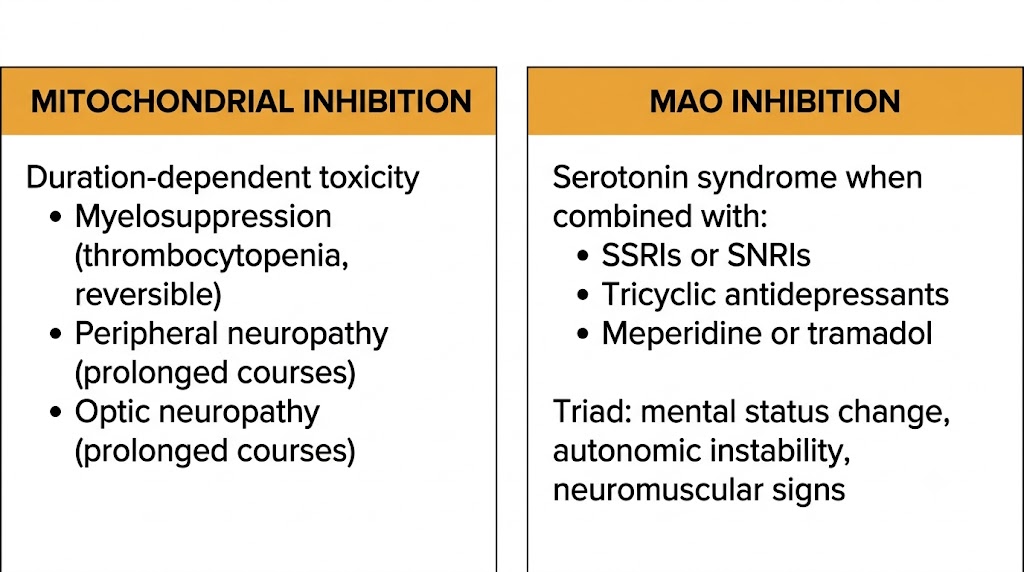
Linezolid causes reversible, dose- and duration-dependent suppression of all hematopoietic cell lines through inhibition of mitochondrial protein synthesis in bone marrow precursors — the same mechanism as chloramphenicol's reversible bone marrow suppression. Thrombocytopenia (low platelet count) is the most consistently observed effect and typically appears after 10 to 14 days of therapy. Anemia and low white blood cell counts can occur with prolonged courses. The suppression is fully reversible on stopping the drug. Weekly complete blood count monitoring is recommended for courses exceeding two weeks. Tedizolid produces significantly less myelosuppression than linezolid, attributed to its lower daily dose reducing cumulative mitochondrial exposure.

Serotonin Syndrome — Monoamine Oxidase Inhibition

Linezolid is a reversible, nonselective monoamine oxidase inhibitor. Monoamine oxidase metabolizes serotonin, dopamine, and norepinephrine in neurons and the gut. When linezolid is combined with serotonergic medications — selective serotonin reuptake inhibitors, serotonin-norepinephrine reuptake inhibitors, tricyclic antidepressants, meperidine, or tramadol — serotonin accumulates and can trigger serotonin syndrome. The classic triad includes mental status changes (agitation, confusion), autonomic instability (hyperthermia, diaphoresis, tachycardia, hypertension), and neuromuscular abnormalities (clonus, hyperreflexia, tremor, myoclonus). Serotonin syndrome can be life-threatening. Linezolid is contraindicated with concurrent use of selective serotonin reuptake inhibitors or serotonin-norepinephrine reuptake inhibitors unless adequate washout has occurred and the clinical need is compelling. Tedizolid also inhibits monoamine oxidase but appears to carry lower clinical risk of serotonin syndrome based on available data.

Peripheral and Optic Neuropathy

Prolonged linezolid therapy — generally courses exceeding four weeks, and particularly the months-long courses used for drug-resistant tuberculosis or chronic osteomyelitis — is associated with peripheral neuropathy and optic neuropathy. Both result from mitochondrial dysfunction in neurons. Peripheral neuropathy presents as distal paresthesias and sensory loss in a stocking-glove distribution; if not caught early, it can be irreversible. Optic neuropathy presents with progressive visual loss, color vision disturbance, and central scotoma, and can result in permanent vision impairment. Monthly ophthalmologic and neurological assessment is recommended for courses exceeding four weeks.

Two-panel diagram of linezolid adverse effects: left panel shows mitochondrial inhibition causing myelosuppression, peripheral neuropathy, and optic neuropathy; right panel shows MAO inhibition causing serotonin syndrome with SSRIs, SNRIs, tricyclic antidepressants, meperidine, and tramadol.
Figure 2. Linezolid adverse effects organized by mechanism: mitochondrial inhibition (duration-dependent toxicities) and MAO inhibition (serotonin syndrome risk). Generated with Gemini AI.
Clinical Indications for Linezolid

Linezolid is approved and widely used for MRSA pneumonia (including ventilator-associated pneumonia), complicated skin and soft tissue infections caused by MRSA, VRE infections, and as an oral option for osteomyelitis caused by MRSA. Clinical data support favorable outcomes with linezolid for MRSA pneumonia compared to vancomycin, attributed partly to better lung penetration and more predictable pharmacokinetics.

Linezolid is not recommended for MRSA bacteremia. Clinical data show inferior outcomes compared to vancomycin or daptomycin for bloodstream infections — a consequence of its bacteriostatic activity against staphylococci. The clinical contexts of MRSA pneumonia and MRSA bacteremia should not be conflated; the superior pneumonia data do not justify use in bacteremia.

Linezolid Is Bacteriostatic Against Staphylococci — Do Not Use for Bacteremia

The bacteriostatic activity of linezolid against Staphylococcus aureus, including MRSA, makes it inadequate for MRSA bacteremia and endocarditis, where bactericidal therapy is required. Vancomycin or daptomycin are the agents of choice for MRSA bloodstream infections. Linezolid's superiority in MRSA pneumonia does not extend to bacteremia; conflating these two clinical scenarios is a recognized prescribing error associated with treatment failure.

Resistance Mechanisms

Resistance to oxazolidinones among staphylococci and enterococci remains relatively uncommon but is increasing, particularly in Enterococcus faecium. The dominant mechanism is point mutations in the 23S ribosomal ribonucleic acid gene that reduce drug binding affinity. Because bacteria carry multiple copies of the 23S ribosomal ribonucleic acid gene, high-level resistance requires mutations in multiple gene copies simultaneously. Organisms with more copies can accumulate mutations progressively.

A transferable resistance gene originally identified in livestock staphylococci encodes a methyltransferase that modifies the ribosomal binding site, reducing binding of both chloramphenicol and oxazolidinones. This gene represents a clinically important cross-class resistance mechanism. Tedizolid retains activity against some linezolid-resistant organisms carrying single 23S ribosomal ribonucleic acid mutations but not against isolates carrying this transferable resistance gene.


Suggested References

Suggested References

Author / Organization Title Source
Falagas ME, Grammatikos AP, Michalopoulos A Potential of old-generation antibiotics to address current need for new antibiotics Expert Rev Anti Infect Ther. 2008;6(5):593–600
Schlunzen F, Zarivach R, Harms J, et al. Structural basis for the interaction of antibiotics with the peptidyl transferase centre in eubacteria Nature. 2001;413(6858):814–821
Bhutta ZA Current concepts in the diagnosis and treatment of typhoid fever BMJ. 2006;333(7558):78–82
Turton JA, Havard AC, Robinson S, et al. An assessment of chloramphenicol and thiamphenicol in the induction of aplastic anaemia in the BALB/c mouse Food Chem Toxicol. 2000;38(10):925–938
Holt DE, Hurley R, Harvey D A reappraisal of chloramphenicol metabolism: detection and quantification of metabolites in the sera of children J Antimicrob Chemother. 1995;35(1):115–127
Yunis AA Chloramphenicol toxicity: 25 years of research Am J Med. 1989;87(3N):44N–48N
Swaney SM, Aoki H, Ganoza MC, Shinabarger DL The oxazolidinone linezolid inhibits initiation of protein synthesis in bacteria Antimicrob Agents Chemother. 1998;42(12):3251–3255
Ippolito JA, Kanyo ZF, Wang D, et al. Crystal structure of the oxazolidinone antibiotic linezolid bound to the 50S ribosomal subunit J Med Chem. 2008;51(12):3353–3356
Wunderink RG, Niederman MS, Kollef MH, et al. Linezolid in methicillin-resistant Staphylococcus aureus nosocomial pneumonia: a randomized, controlled study Clin Infect Dis. 2012;54(5):621–629
Flanagan S, Minassian SL, Morris D, et al. Pharmacokinetics of tedizolid in subjects with renal or hepatic impairment Antimicrob Agents Chemother. 2014;58(11):6484–6491
Prokocimer P, De Anda C, Fang E, Mehra P, Das A Tedizolid phosphate vs linezolid for treatment of acute bacterial skin and skin structure infections: the ESTABLISH-1 randomized trial JAMA. 2013;309(6):559–569
Attassi K, Hershberger E, Alam R, Zervos MJ Thrombocytopenia associated with linezolid therapy Clin Infect Dis. 2002;34(5):695–698
Lawrence KR, Adra M, Gillman PK Serotonin toxicity associated with the use of linezolid: a review of postmarketing data Clin Infect Dis. 2006;42(11):1578–1583
Toh SM, Xiong L, Arias CA, et al. Acquisition of a natural resistance gene renders a clinical strain of methicillin-resistant Staphylococcus aureus resistant to the synthetic antibiotic linezolid Mol Microbiol. 2007;64(6):1506–1514
Mendes RE, Deshpande LM, Jones RN Linezolid update: stable in vitro activity following more than a decade of clinical use and summary of associated resistance mechanisms Drug Resist Updat. 2014;17(1–2):1–12