50S ribosomal inhibition, bacteriostatic mechanism, and spectrum across gram-positive, atypical, and selected gram-negative organisms
Macrolides are antibiotics built around a large macrocyclic lactone ring. They inhibit bacterial protein synthesis by binding to the 50S ribosomal subunit, blocking peptide chain elongation. Their activity against intracellular and atypical pathogens—organisms that do not respond to beta-lactams—gives them an indispensable role in respiratory and sexually transmitted infection management.
Macrolides bind reversibly to the 50S ribosomal subunit, blocking peptide chain elongation. The binding is reversible, making the effect bacteriostatic rather than bactericidal in most contexts. The mechanism is distinct from tetracyclines (which block aminoacyl-tRNA entry at the ribosomal acceptor site) and aminoglycosides (which cause mRNA misreading), meaning cross-resistance with those classes does not occur by default.
Macrolides also possess anti-inflammatory and immunomodulatory effects independent of their antimicrobial activity. Long-term low-dose azithromycin reduces exacerbation frequency in chronic obstructive pulmonary disease and non-cystic fibrosis bronchiectasis through suppression of neutrophil recruitment, cytokine production, and biofilm formation by colonizing pathogens.
Macrolides are active against gram-positive organisms including Streptococcus pyogenes, Streptococcus pneumoniae (where resistance has become prevalent), and susceptible Staphylococcus aureus. Their most important spectrum is against atypical intracellular pathogens: Mycoplasma pneumoniae, Chlamydophila pneumoniae, Legionella pneumophila, Chlamydia trachomatis, and Ureaplasma urealyticum. Among gram-negative organisms, azithromycin and clarithromycin have meaningful activity against Haemophilus influenzae, Moraxella catarrhalis, Bordetella pertussis, Helicobacter pylori (in combination), Campylobacter jejuni, and Mycobacterium avium complex. Macrolides do not have reliable activity against enteric gram-negative rods, Pseudomonas aeruginosa, or anaerobes.
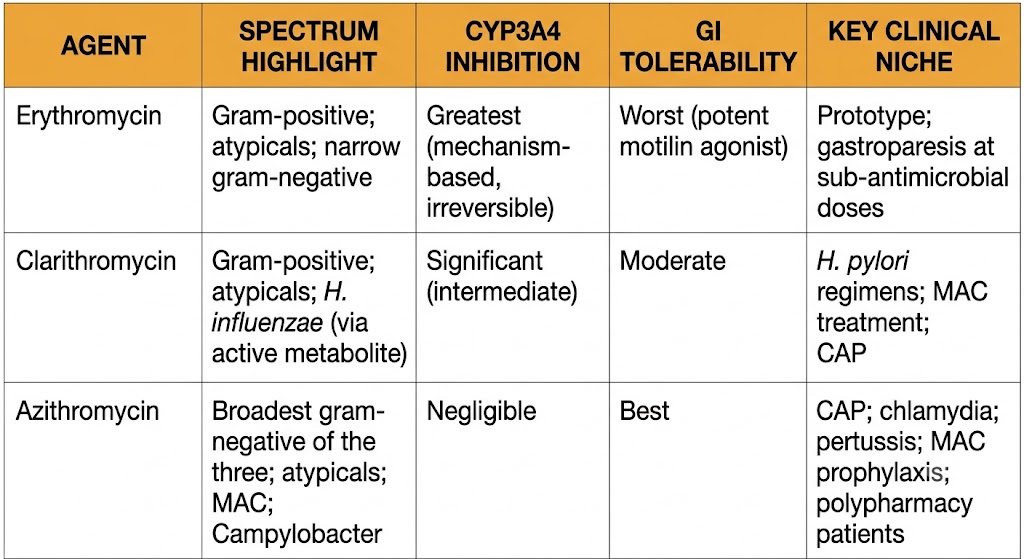
The three major macrolides differ in ways that matter clinically. Erythromycin, the prototype, has the narrowest gram-negative coverage and the highest susceptibility to acid degradation, limiting oral bioavailability. Clarithromycin improves on erythromycin with better Haemophilus influenzae coverage through its active metabolite (14-hydroxyclarithromycin) and superior acid stability. Azithromycin has the broadest gram-negative coverage of the three, including Haemophilus influenzae, Campylobacter, and Mycobacterium avium complex; its unique pharmacokinetics with extremely high intracellular tissue concentrations make it the most clinically versatile agent. Azithromycin is also the least potent inhibitor of cytochrome P450 3A4 (CYP3A4), making it the preferred choice in patients on multiple medications.
Oral bioavailability, azithromycin tissue accumulation, half-lives, and the hierarchy of CYP3A4 inhibition across the class
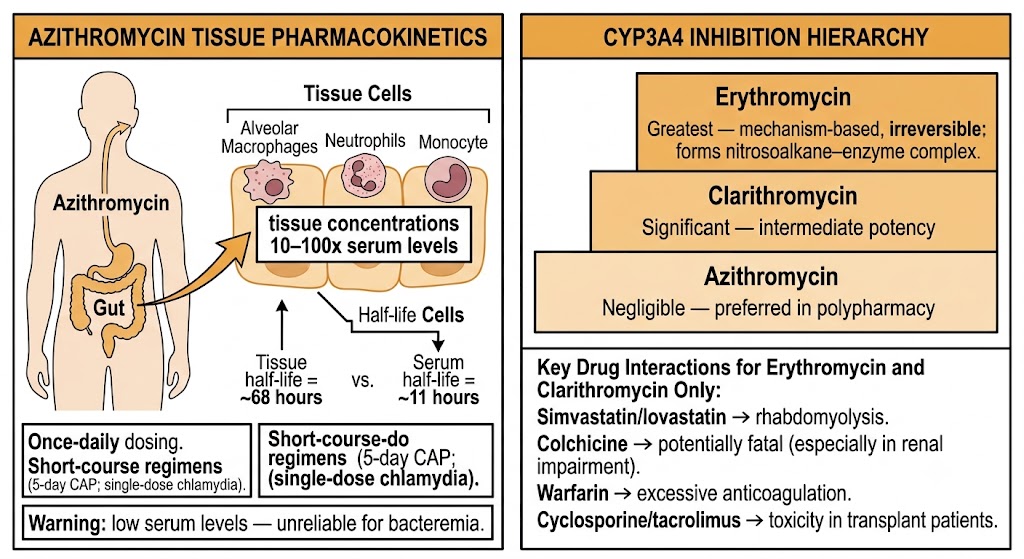
The pharmacokinetic profiles of the three major macrolides diverge substantially. Azithromycin's tissue pharmacokinetics are unique among antibiotics: tissue concentrations 10 to 100 times higher than serum, a tissue half-life of approximately 68 hours enabling short-course therapy, and negligible cytochrome P450 3A4 inhibition. Erythromycin and clarithromycin, by contrast, are potent cytochrome P450 3A4 inhibitors that create clinically significant drug interactions in polypharmacy patients.
Erythromycin is acid-labile, undergoing significant degradation in the stomach. Enteric-coated and ester formulations were developed to improve oral delivery, but bioavailability remains variable (approximately 35–65%). Its half-life of approximately 1.5–2 hours requires four-times-daily oral dosing. Erythromycin is a potent inhibitor of cytochrome P450 3A4 and is the most potent CYP3A4 inhibitor of the three major macrolides. The prokinetic effect of erythromycin (through motilin receptor agonism) has been exploited therapeutically at sub-antimicrobial doses for gastroparesis.
Clarithromycin is an acid-stable derivative of erythromycin with oral bioavailability of approximately 50–55% and a half-life of approximately 3–7 hours supporting twice-daily dosing. It is hepatically metabolized to an active 14-hydroxy metabolite that contributes to Haemophilus influenzae coverage. Clarithromycin is a significant cytochrome P450 3A4 inhibitor, intermediate in potency between erythromycin and azithromycin. Clinically important interactions include elevated simvastatin and lovastatin levels (myopathy risk), elevated colchicine levels (potentially fatal in renal impairment), increased warfarin effect, and elevated cyclosporine and tacrolimus concentrations in transplant recipients.
Oral bioavailability averages approximately 37%, but this figure is misleading: the drug is taken up avidly by cells crossing the gut wall and distributes into tissues before entering systemic circulation. Tissue concentrations reach 10 to 100 times concurrent serum levels, concentrated in alveolar macrophages, neutrophils, and monocytes. This produces a tissue half-life of approximately 68 hours, enabling once-daily dosing and short-course regimens (such as 5-day courses for respiratory infections or single-dose therapy for Chlamydia trachomatis urethritis). Because serum concentrations are substantially lower than tissue concentrations, azithromycin is unreliable for treating bacteremia.
Azithromycin produces negligible cytochrome P450 3A4 inhibition at clinical doses and is the preferred macrolide in patients taking cytochrome P450 3A4-sensitive medications. All three macrolides are eliminated primarily by hepatic metabolism and biliary excretion; azithromycin requires no dose adjustment for renal impairment.
When a macrolide is clinically indicated in a patient taking simvastatin, lovastatin, colchicine, warfarin, cyclosporine, or tacrolimus, azithromycin is the macrolide of choice. Erythromycin and clarithromycin carry a real risk of precipitating statin-induced rhabdomyolysis, potentially fatal colchicine toxicity (especially in renal impairment), supratherapeutic immunosuppressant levels in transplant patients, or excessive anticoagulation. The drug interaction risk is not theoretical—it is a leading cause of serious adverse events associated with this drug class.
Gastrointestinal motility effects, QTc prolongation, hepatotoxicity, ototoxicity, and the clinical consequences of CYP3A4 inhibition
Macrolide adverse effects span predictable gastrointestinal intolerance that limits adherence, serious cardiac rhythm disturbances from QT interval prolongation, and drug interactions mediated through cytochrome P450 3A4 (CYP3A4) inhibition that can cause severe toxicity in patients on concurrent medications. The adverse effect profile differs meaningfully across the three major agents.
Gastrointestinal intolerance is the most common reason for macrolide discontinuation and is most prominent with erythromycin. The mechanism is primarily pharmacological: macrolides, particularly erythromycin, are potent agonists of motilin receptors in the gastrointestinal tract. Motilin is an enteric hormone that stimulates gastric and small bowel smooth muscle contraction; macrolide activation of motilin receptors accelerates gastric emptying and increases intestinal peristalsis, producing nausea, vomiting, abdominal cramping, and diarrhea. This prokinetic effect has been deliberately exploited at sub-antimicrobial erythromycin doses for gastroparesis. Clarithromycin produces similar but less severe gastrointestinal effects. Azithromycin has the best tolerability of the three. Gastrointestinal intolerance is dose-dependent and can be reduced by taking macrolides with food, except for azithromycin immediate-release tablets, which should be taken on an empty stomach.
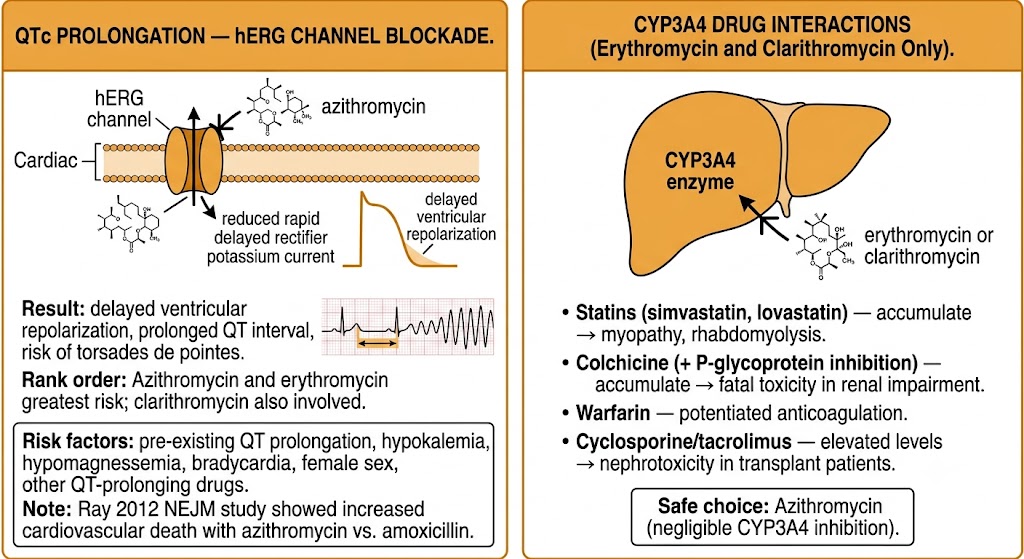
Macrolides prolong the cardiac QT interval by a direct effect on cardiac ion channels. This delays ventricular repolarization and increases risk of torsades de pointes, a potentially fatal polymorphic ventricular tachycardia. Among the three major macrolides, azithromycin and erythromycin carry the greatest QT-prolonging potential; clarithromycin is also associated with QT prolongation. Large observational studies have demonstrated an increased rate of cardiovascular death with azithromycin, concentrated in patients with pre-existing cardiovascular disease. Risk of macrolide-associated torsades de pointes is highest in patients with pre-existing QT prolongation, hypokalemia, hypomagnesemia, bradycardia, advanced age, female sex, or concurrent use of other QT-prolonging agents.
Erythromycin is associated with cholestatic hepatitis, a hypersensitivity reaction occurring most commonly with the estolate ester formulation, presenting with fever, right upper quadrant pain, elevated alkaline phosphatase and bilirubin, and eosinophilia, typically appearing 10–20 days after starting therapy. The estolate formulation has been largely withdrawn from clinical practice for this reason. Clarithromycin and azithromycin can also cause hepatotoxicity but less frequently, tending toward mixed or hepatocellular injury rather than pure cholestasis.
High-dose macrolide therapy—particularly intravenous erythromycin at doses above 4 grams per day—has been associated with reversible sensorineural hearing loss, tinnitus, and vestibular disturbance. The ototoxicity is dose-dependent and typically reverses within days to weeks of drug discontinuation, distinguishing it from aminoglycoside-associated ototoxicity, which is frequently permanent. Azithromycin ototoxicity has been reported predominantly in patients receiving high cumulative doses for Mycobacterium avium complex prophylaxis or treatment.
Statins metabolized by cytochrome P450 3A4—primarily simvastatin and lovastatin—accumulate to myotoxic levels when co-administered with erythromycin or clarithromycin, increasing risk of myopathy and rhabdomyolysis. Rosuvastatin and pravastatin, which are not cytochrome P450 3A4 substrates, are preferred alternatives during macrolide therapy.
Colchicine toxicity is a particularly serious interaction: in patients with renal impairment taking colchicine who receive clarithromycin or erythromycin, colchicine levels can reach lethal concentrations because macrolide inhibition of colchicine metabolism substantially raises colchicine levels. Warfarin anticoagulation is potentiated by macrolides through cytochrome P450 inhibition and possible reduction of gut flora that produce vitamin K. In transplant recipients, clarithromycin and erythromycin substantially elevate cyclosporine and tacrolimus levels, requiring dose reduction and close monitoring to prevent toxicity.
Concurrent administration of colchicine with clarithromycin or erythromycin can produce life-threatening colchicine toxicity, particularly in patients with any degree of renal impairment. Manifestations include severe gastrointestinal toxicity, bone marrow suppression, multi-organ failure, and death. This combination is contraindicated in patients with renal or hepatic impairment. When a macrolide is needed in a patient taking colchicine, azithromycin is the agent of choice.
Indication-by-indication agent selection, emerging resistance concerns, and the two dominant macrolide resistance mechanisms
Macrolides occupy a central role in community-acquired respiratory infections, sexually transmitted infections, atypical pneumonia, and mycobacterial disease. Resistance has eroded reliability against common pathogens including Streptococcus pneumoniae, Mycoplasma pneumoniae, and Neisseria gonorrhoeae in many regions, requiring integration of local resistance data into empiric prescribing decisions.
Macrolides are first-line agents for outpatient community-acquired pneumonia in previously healthy adults without recent antibiotic use or risk factors for drug-resistant Streptococcus pneumoniae. Their activity against both typical respiratory pathogens and atypical organisms (Mycoplasma pneumoniae, Chlamydophila pneumoniae, Legionella pneumophila) makes them suited for empiric monotherapy. Infectious Diseases Society of America and American Thoracic Society guidelines endorse macrolide monotherapy for outpatient community-acquired pneumonia in low-risk patients where macrolide resistance among pneumococcal isolates is below 25%. In higher-resistance regions, a respiratory fluoroquinolone is preferred. For hospitalized patients, a macrolide is combined with a beta-lactam to cover both typical and atypical organisms.
Azithromycin 1 gram as a single oral dose was the standard treatment for uncomplicated Chlamydia trachomatis infection for decades, exploiting its unique pharmacokinetics for sustained intracellular concentrations from a single dose. Updated Centers for Disease Control and Prevention guidelines now prefer doxycycline 100 mg twice daily for 7 days over single-dose azithromycin for uncomplicated chlamydia in non-pregnant patients, due to concerns about treatment failures and rising minimum inhibitory concentrations for Mycoplasma genitalium. Azithromycin remains preferred for chlamydia in pregnancy, where tetracyclines are contraindicated. Macrolides are no longer recommended as primary therapy for Neisseria gonorrhoeae due to widespread resistance.
Azithromycin is the preferred agent for pertussis (Bordetella pertussis) treatment and post-exposure prophylaxis, having displaced erythromycin due to superior tolerability and a shorter course. The standard regimen is azithromycin 500 mg on day 1 followed by 250 mg on days 2 through 5. Clarithromycin-based triple therapy (proton pump inhibitor, clarithromycin, and amoxicillin or metronidazole) remains a standard regimen for Helicobacter pylori eradication, though clarithromycin resistance exceeding 15–20% in many regions has prompted bismuth quadruple therapy as an alternative.
Clarithromycin and azithromycin are the cornerstone agents for Mycobacterium avium complex treatment and prophylaxis. For prophylaxis in patients with human immunodeficiency virus infection and CD4 T-cell counts below 50 cells per microliter, azithromycin 1200 mg once weekly is the preferred regimen. For active Mycobacterium avium complex treatment, clarithromycin 500 mg twice daily combined with ethambutol (with or without rifabutin) is the recommended regimen; azithromycin is used as an alternative in patients who cannot tolerate clarithromycin or have significant drug interactions. Macrolide monotherapy for Mycobacterium avium complex is contraindicated because it rapidly selects for macrolide resistance through point mutations in the 23S ribosomal RNA gene.
The predominant macrolide resistance mechanism in gram-positive bacteria is the macrolide-lincosamide-streptogramin B resistance phenotype, encoded by erm genes. The erm methylase modifies the ribosomal binding site, reducing affinity for macrolides, lincosamides (clindamycin), and streptogramin B simultaneously. This resistance can be constitutive (always expressed) or inducible (expressed only when the organism is exposed to a macrolide inducer). Inducible resistance is clinically critical: organisms that test susceptible to clindamycin but resistant to erythromycin may harbor inducible erm expression. The double-disk diffusion D-zone test detects this phenotype; a positive result predicts clindamycin failure in vivo and the organism should be reported as clindamycin-resistant. Erm genes are disseminated on plasmids and transposons among streptococci, staphylococci, and enterococci.
The M phenotype of macrolide resistance is mediated by an efflux pump specific to macrolides. Unlike macrolide-lincosamide-streptogramin B resistance, mef-mediated resistance does not confer cross-resistance to clindamycin or streptogramin B because they are not substrates for the mef pump. The M phenotype is particularly prevalent in Streptococcus pneumoniae in North America and produces low-level macrolide resistance. Both erm and mef resistance determinants are common in community Streptococcus pneumoniae isolates, with geographic variation in their relative prevalence.
Macrolide-resistant Mycoplasma pneumoniae has emerged as a significant clinical problem, particularly in Asia, where resistance rates in some series exceed 90% of community-acquired isolates. Resistance arises through mutations in the ribosomal RNA gene at the macrolide binding site. Doxycycline and respiratory fluoroquinolones are the alternatives for macrolide-resistant Mycoplasma pneumoniae in adults. Clinicians should consider this diagnosis in patients with atypical pneumonia not responding to macrolide therapy.
| Author / Organization | Title | Source |
|---|---|---|
| Leclercq R | Mechanisms of resistance to macrolides and lincosamides: nature of the resistance elements and their clinical implications | Clin Infect Dis. 2002;34(4):482-492 |
| Schlunzen F, Zarivach R, Harms J, et al. | Structural basis for the interaction of antibiotics with the peptidyl transferase centre in eubacteria | Nature. 2001;413(6858):814-821 |
| Parnham MJ, Erakovic Haber V, Giamarellos-Bourboulis EJ, Perletti G, Verleden GM, Vos R | Azithromycin: mechanisms of action and their relevance for clinical applications | Pharmacol Ther. 2014;143(2):225-245 |
| Rodvold KA | Clinical pharmacokinetics of clarithromycin | Clin Pharmacokinet. 1999;37(5):385-398 |
| Foulds G, Shepard RM, Johnson RB | The pharmacokinetics of azithromycin in human serum and tissues | J Antimicrob Chemother. 1990;25(Suppl A):73-82 |
| Periti P, Mazzei T, Mini E, Novelli A | Pharmacokinetic drug interactions of macrolides | Clin Pharmacokinet. 1992;23(2):106-131 |
| Dresser GK, Spence JD, Bailey DG | Pharmacokinetic-pharmacodynamic consequences and clinical relevance of cytochrome P450 3A4 inhibition | Clin Pharmacokinet. 2000;38(1):41-57 |
| Alvarez-Elcoro S, Enzler MJ | The macrolides: erythromycin, clarithromycin, and azithromycin | Mayo Clin Proc. 1999;74(6):613-634 |
| Ray WA, Murray KT, Meredith S, Narasimhulu SS, Hall K, Stein CM | Oral erythromycin and the risk of sudden death from cardiac causes | N Engl J Med. 2004;351(11):1089-1096 |
| Ray WA, Murray KT, Hall K, Arbogast PG, Stein CM | Azithromycin and the risk of cardiovascular death | N Engl J Med. 2012;366(20):1881-1890 |
| Mandell LA, Wunderink RG, Anzueto A, et al. | Infectious Diseases Society of America/American Thoracic Society consensus guidelines on the management of community-acquired pneumonia in adults | Clin Infect Dis. 2007;44(Suppl 2):S27-S72 |
| Workowski KA, Bachmann LH, Chan PA, et al. | Sexually transmitted infections treatment guidelines, 2021 | MMWR Recomm Rep. 2021;70(4):1-187 |
| Griffith DE, Aksamit T, Brown-Elliott BA, et al. | An official ATS/IDSA statement: diagnosis, treatment, and prevention of nontuberculous mycobacterial diseases | Am J Respir Crit Care Med. 2007;175(4):367-416 |
| Weisblum B | Erythromycin resistance by ribosome modification | Antimicrob Agents Chemother. 1995;39(3):577-585 |
| Roberts MC, Sutcliffe J, Courvalin P, Jensen LB, Rood J, Seppala H | Nomenclature for macrolide and macrolide-lincosamide-streptogramin B resistance determinants | Antimicrob Agents Chemother. 1999;43(12):2823-2830 |