30S ribosomal inhibition, bacteriostatic mechanism, and spectrum evolution from classical tetracyclines to glycylcyclines
Tetracyclines are broad-spectrum bacteriostatic antibiotics that inhibit bacterial protein synthesis by binding reversibly to the 30S ribosomal subunit, blocking aminoacyl-transfer RNA (tRNA) from entering the ribosomal acceptor site. The class has evolved from original natural tetracyclines through semisynthetic modifications to the glycylcyclines, engineered specifically to overcome the resistance mechanisms that had severely limited earlier agents.
Tetracyclines bind reversibly to the 30S ribosomal subunit, blocking aminoacyl-tRNA from entering the acceptor site and halting polypeptide chain elongation. This halts polypeptide chain elongation without damaging the ribosome. Because the effect is reversible, tetracyclines are classically bacteriostatic—clearance of the drug allows ribosomal function to resume. The same magnesium-chelating chemistry that enables drug entry also explains two major drug interactions: impaired oral absorption when co-administered with polyvalent cations, and deposition in calcified tissues.
First-generation tetracyclines (tetracycline, oxytetracycline) have significant oral absorption variability, short half-lives requiring multiple daily dosing, and are substantially impaired by food, dairy, and polyvalent cations. Their clinical use has been almost entirely displaced by second-generation agents. Second-generation agents (doxycycline, minocycline) have substantially improved pharmacokinetics: doxycycline has a half-life of approximately 18–22 hours supporting once-daily dosing, higher lipophilicity enabling better tissue penetration, and oral absorption that is much less impaired by food than first-generation agents.
Glycylcyclines (tigecycline) represent a structurally distinct third generation, structurally modified to overcome both tetracycline efflux pump resistance and ribosomal protection resistance, maintaining activity against organisms that carry these pumps. The result is broad activity against many multidrug-resistant gram-positive and gram-negative pathogens, anaerobes, and atypical organisms. Critical gaps: tigecycline has no reliable activity against Pseudomonas aeruginosa and reduced activity against Proteus, Providencia, and Morganella species due to intrinsic efflux pump expression in these organisms.
All tetracyclines cover atypical intracellular pathogens (Chlamydia, Mycoplasma, Rickettsia, Coxiella, Ehrlichia), spirochetes including Borrelia burgdorferi (Lyme disease), and many gram-positive and gram-negative organisms. Doxycycline adds clinical utility against Vibrio cholerae, Yersinia pestis, Brucella species, Francisella tularensis, and Bacillus anthracis. Tigecycline extends coverage to carbapenem-resistant Enterobacteriaceae and methicillin-resistant Staphylococcus aureus, but must not be used for Pseudomonas aeruginosa infections.
Tigecycline's broad multidrug-resistant coverage does not extend to Pseudomonas aeruginosa. Pseudomonas aeruginosa has constitutive expression of a multidrug efflux pump that efficiently extrudes tigecycline despite the structural modification that overcomes tetracycline-specific pumps. Similarly, Proteus mirabilis, Providencia stuartii, and Morganella morganii possess intrinsic efflux that renders tigecycline unreliable. Always verify susceptibility before using tigecycline for gram-negative infections.
Oral absorption, chelation interactions, elimination differences between agents, and antagonism with bactericidal drugs
The pharmacokinetics of tetracyclines vary considerably between generations. Doxycycline and minocycline provide reliable oral bioavailability and prolonged half-lives suited for outpatient use. Tigecycline is exclusively intravenous, with an enormous volume of distribution that concentrates drug in tissues while leaving relatively low plasma concentrations—a pharmacokinetic profile that shapes its clinical role and limitations.
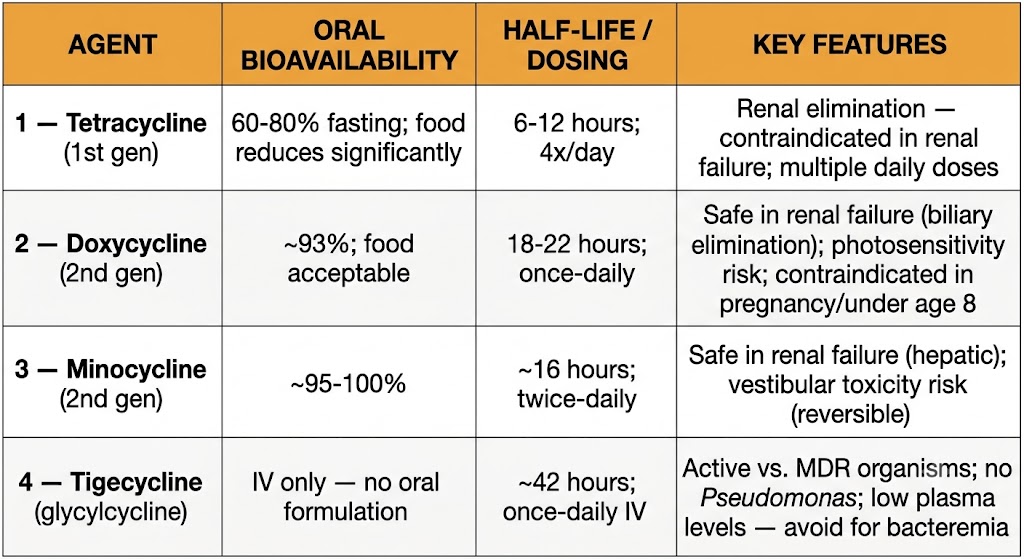
Classic tetracycline has oral bioavailability of approximately 60–80% under fasting conditions but drops substantially when taken with food, dairy, or polyvalent cation-containing products. Doxycycline achieves oral bioavailability of approximately 93% and, unlike tetracycline, is not significantly impaired by food—making it far more reliably absorbed in clinical practice. Minocycline approaches 95–100% oral bioavailability. Tigecycline cannot be administered orally and is available only as an intravenous formulation.
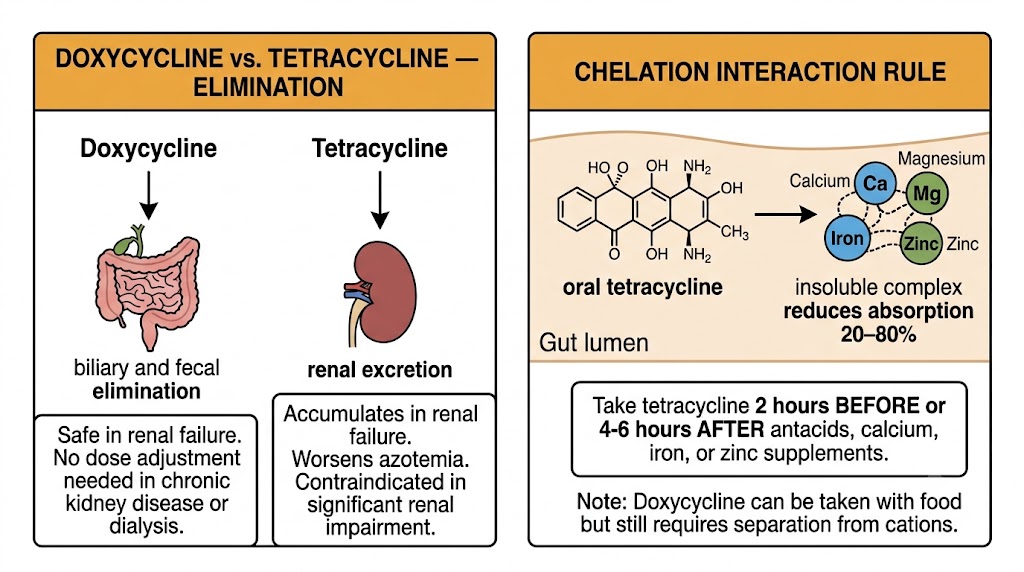
Calcium in dairy and supplements, magnesium and aluminum in antacids, iron in supplements, bismuth, and zinc all form insoluble chelate complexes with tetracyclines in the gastrointestinal lumen, reducing absorption. The standard management is to take oral tetracyclines at least two hours before or four to six hours after any polyvalent cation-containing product. Doxycycline can be taken with food but should still be separated in time from antacids, calcium supplements, and iron preparations.
Tetracycline is predominantly eliminated by renal excretion and accumulates dangerously in patients with renal failure, worsening azotemia through an anti-anabolic effect on protein metabolism. It is contraindicated in significant renal impairment. Doxycycline, by contrast, is eliminated primarily through biliary and intestinal secretion and does not accumulate in renal failure. It can be prescribed at standard doses in patients with advanced chronic kidney disease or on dialysis without dose adjustment. When a tetracycline is indicated in a patient with renal impairment, doxycycline is the agent of choice. Minocycline is also hepatically metabolized and does not require renal dose adjustment. Tigecycline requires dose reduction in severe hepatic impairment but not in renal impairment.
All tetracyclines achieve excellent tissue penetration. Tetracyclines concentrate in phagocytic cells (macrophages, neutrophils), which is pharmacokinetically essential for treating intracellular pathogens such as Rickettsia, Ehrlichia, and Chlamydophila . Minocycline has superior central nervous system penetration compared to doxycycline due to greater lipophilicity. Tigecycline has an exceptionally large volume of distribution (far exceeding total body water), with plasma concentrations after intravenous dosing being relatively low despite high tissue levels—which contributes to the inadequacy of tigecycline monotherapy for bacteremia.
Tetracyclines can antagonize bactericidal cell-wall-active agents (penicillins, cephalosporins, vancomycin) by halting bacterial growth, which these bactericidal drugs require to exert their lethal effects. This antagonism is most clinically relevant in infections requiring bactericidal therapy—bacterial meningitis, infective endocarditis—where tetracyclines should not be substituted for or combined with bactericidal antibiotics. Rifampin induces cytochrome P450 enzymes and reduces doxycycline plasma concentrations by approximately 50%; patients on rifampin-containing regimens who require doxycycline may need an alternative agent.
Gastrointestinal effects, photosensitivity, calcified tissue deposition, vestibular toxicity, and tigecycline-specific adverse effects
The tetracycline adverse effect profile spans common and manageable gastrointestinal effects to serious toxicities with irreversible consequences, particularly the deposition of drug in developing calcified tissues that makes the class contraindicated in pregnancy and in children under eight years of age.
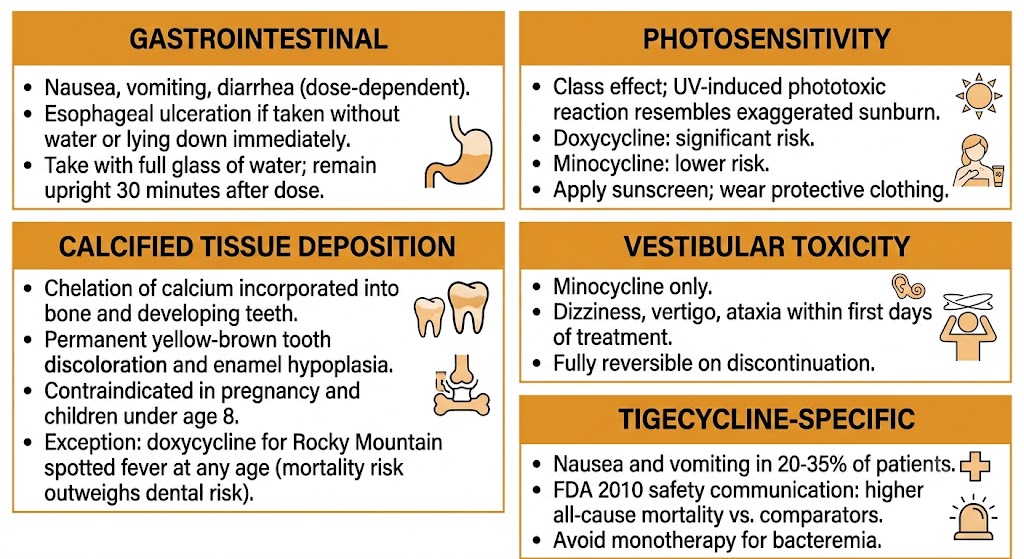
Nausea, vomiting, epigastric discomfort, and diarrhea occur in a dose-dependent fashion, more prominent with oral tetracycline than with doxycycline. Esophageal ulceration is a serious but preventable complication that occurs when a tetracycline capsule or tablet is taken with insufficient water and remains in contact with the esophageal mucosa, particularly if the patient lies down shortly after ingestion. Patients should take all oral tetracyclines with a full glass of water while sitting upright and remain upright for at least 30 minutes after dosing.
Photosensitivity is a class effect in which drug accumulated in skin is activated by ultraviolet light, causing phototoxic tissue damage. The reaction resembles an exaggerated sunburn in sun-exposed areas. Doxycycline has significant photosensitivity risk and patients must be counseled to apply broad-spectrum sunscreen, wear protective clothing, and avoid prolonged direct sun exposure. Patients using doxycycline for malaria prophylaxis in tropical climates or for chronic skin conditions require particularly thorough sun protection counseling. Minocycline has lower photosensitivity risk than doxycycline.
Tetracyclines chelate calcium ions and are incorporated into the calcium-phosphate matrix of bone and developing tooth enamel during periods of active calcification. In developing teeth, this produces permanent yellow-brown discoloration and enamel hypoplasia. This is the basis for the absolute contraindication in pregnancy and in children under eight years of age. All tetracyclines carry this contraindication. The one recognized exception, affirmed by both the American Academy of Pediatrics and the Centers for Disease Control and Prevention (CDC), is doxycycline use in children of any age for suspected Rocky Mountain spotted fever, where the mortality risk of untreated rickettsial disease vastly outweighs the risk of dental effects from a single short course.
Minocycline causes dose-related vestibular toxicity in a substantial proportion of patients, manifesting as dizziness, vertigo, ataxia, and nausea within the first few days of treatment. Unlike aminoglycoside vestibular toxicity, minocycline's vestibular effects are fully reversible on drug discontinuation. This has largely displaced minocycline from systemic indications in favor of doxycycline. Hepatotoxicity at standard oral doses is rare but can occur, particularly with pre-existing liver disease.
Tigecycline causes substantially higher rates of nausea and vomiting than conventional tetracyclines (approximately 20–35% of patients), manageable with antiemetic premedication and slower infusion rates. A Food and Drug Administration (FDA) safety communication in 2010 noted higher all-cause mortality in tigecycline-treated patients compared to comparator antibiotics across multiple indications, possibly due to lower cure rates in bacteremic patients where tigecycline's low plasma concentrations may be inadequate. This safety signal supports avoiding tigecycline monotherapy for bacteremia and using it cautiously in hospital-acquired pneumonia.
Doxycycline as the class workhorse, tigecycline for multidrug-resistant infections, and efflux and ribosomal protection resistance
Doxycycline has become the dominant tetracycline in clinical practice, combining broad spectrum, excellent oral bioavailability, once-daily dosing, safety in renal impairment, and activity against the widest range of intracellular and vector-borne pathogens. Tigecycline occupies a narrower role as an intravenous reserve agent for polymicrobial and multidrug-resistant infections.
Doxycycline is the drug of choice for rickettsial infections including Rocky Mountain spotted fever, epidemic typhus, ehrlichiosis, and anaplasmosis—infections where prompt initiation is life-saving. It is first-line for Lyme disease in adults, for Chlamydia trachomatis and nongonococcal urethritis, for Brucella infections (typically combined with rifampin), Coxiella burnetii (Q fever), Vibrio cholerae, and for prophylaxis and treatment of anthrax. In community-acquired pneumonia, doxycycline is a first-line alternative for outpatient management in patients without comorbidities, covering both typical and atypical organisms.
Malaria prophylaxis is a major global indication: doxycycline is recommended by the Centers for Disease Control and Prevention for prophylaxis in areas with chloroquine-resistant Plasmodium falciparum. It must not be used as monotherapy for acute malaria treatment but is used in combination with quinine or artesunate for multidrug-resistant falciparum malaria. Doxycycline is also widely used for acne vulgaris and rosacea, exploiting its anti-inflammatory properties at sub-antimicrobial doses.
Tigecycline is approved for complicated skin and soft tissue infections, complicated intra-abdominal infections, and community-acquired pneumonia. Its most valuable clinical role is in polymicrobial infections and infections caused by multidrug-resistant organisms including carbapenem-resistant Enterobacteriaceae, methicillin-resistant Staphylococcus aureus in non-bacteremic contexts, vancomycin-resistant Enterococcus, and extended-spectrum beta-lactamase-producing organisms resistant to most beta-lactams. Tigecycline should not be used as monotherapy for bacteremia given its low plasma concentrations, and combination therapy with another active agent is typically employed for serious multidrug-resistant infections.
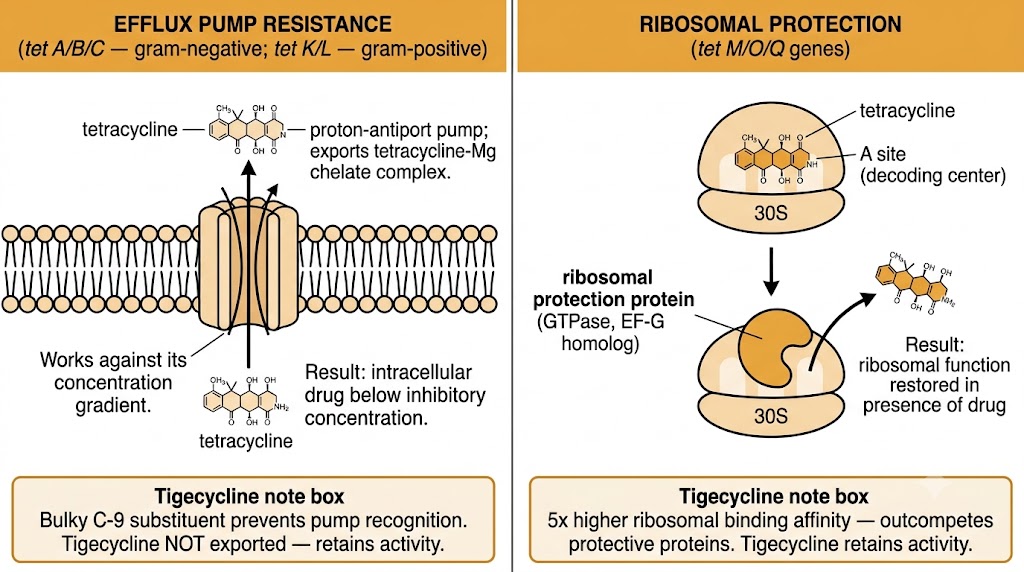
Efflux is the most widespread tetracycline resistance mechanism, mediated by membrane transport proteins encoded predominantly by tet genes on plasmids and transposons. These pumps actively export tetracycline-magnesium chelate complexes against their concentration gradient, reducing intracellular drug to sub-inhibitory levels. These efflux pumps are highly effective against tetracycline and doxycycline. Tigecycline evades these classical efflux pumps because its structural modification prevents recognition by these pumps—the primary structural basis for its activity against tetracycline-resistant organisms.
Ribosomal protection proteins bind to the ribosome and dislodge tetracycline from its binding site, restoring ribosomal function even in the presence of drug. They are widespread in streptococci, enterococci, and Bacteroides species. Tigecycline overcomes ribosomal protection resistance because its greater ribosomal binding affinity allows it to successfully compete with and displace these protective proteins.
Rocky Mountain spotted fever carries a case fatality rate exceeding 20% in untreated patients. Doxycycline is the treatment of choice at all ages, including children under eight, because the risk of death from untreated rickettsial disease vastly outweighs the risk of dental discoloration from a single short course. Both the American Academy of Pediatrics and the Centers for Disease Control and Prevention explicitly state that concern about dental effects should not delay doxycycline initiation when Rocky Mountain spotted fever is suspected. Treat first; do not wait for diagnostic confirmation in a clinically compatible presentation.
| Author / Organization | Title | Source |
|---|---|---|
| Chopra I, Roberts M | Tetracycline antibiotics: mode of action, applications, molecular biology, and epidemiology of bacterial resistance | Microbiol Mol Biol Rev. 2001;65(2):232-260 |
| Pioletti M, Schlunzen F, Harms J, et al. | Crystal structures of complexes of the small ribosomal subunit with tetracycline, edeine and IF3 | EMBO J. 2001;20(8):1829-1839 |
| Sum PE, Petersen P | Synthesis and structure-activity relationship of novel glycylcycline derivatives leading to the discovery of GAR-936 | Bioorg Med Chem Lett. 1999;9(10):1459-1462 |
| Petersen PJ, Jacobus NV, Weiss WJ, Sum PE, Testa RT | In vitro and in vivo antibacterial activities of a novel glycylcycline, the 9-t-butylglycylamido derivative of minocycline (GAR-936) | Antimicrob Agents Chemother. 1999;43(4):738-744 |
| Zhanel GG, Homenuik K, Nichol K, et al. | The glycylcyclines: a comparative review with the tetracyclines | Drugs. 2004;64(1):63-88 |
| Agwuh KN, MacGowan A | Pharmacokinetics and pharmacodynamics of the tetracyclines including glycylcyclines | J Antimicrob Chemother. 2006;58(2):256-265 |
| Stets R, Popescu M, Gonong JR, et al. | Omadacycline for community-acquired bacterial pneumonia | N Engl J Med. 2019;380(6):517-527 |
| Neuvonen PJ | Interactions with the absorption of tetracyclines | Drugs. 1976;11(1):45-54 |
| Cunha BA | Minocycline versus doxycycline in the treatment of Lyme neuroborreliosis | Clin Infect Dis. 2000;30(1):237-238 |
| Smith K, Leyden JJ | Safety of doxycycline and minocycline: a systematic review | Clin Ther. 2005;27(9):1329-1342 |
| Moffatt MF, Kaplan EL | Tetracyclines. In: Mandell GL, Bennett JE, Dolin R, eds. Principles and Practice of Infectious Diseases. 8th ed. | Philadelphia: Elsevier Churchill Livingstone; 2015:322-338 |
| Freinkel RK, Fiedler-Weiss VC | In vivo effects of tetracycline on bone mineral in the rat | J Invest Dermatol. 1965;45(2):62-65 |
| FDA Drug Safety Communication | FDA warns of increased risk of death with IV antibacterial Tygacil (tigecycline) and approves new boxed warning | US Food and Drug Administration; September 27, 2013 |
| Biggs HM, Behravesh CB, Bradley KK, et al. | Diagnosis and management of tickborne rickettsial diseases: Rocky Mountain spotted fever and other spotted fever group rickettsioses, ehrlichioses, and anaplasmosis — United States | MMWR Recomm Rep. 2016;65(2):1-44 |
| Roberts MC | Tetracycline resistance determinants: mechanisms of action, regulation of expression, genetic mobility, and distribution | FEMS Microbiol Rev. 1996;19(1):1-24 |
| Connell SR, Tracz DM, Nierhaus KH, Taylor DE | Ribosomal protection proteins and their mechanism of tetracycline resistance | Antimicrob Agents Chemother. 2003;47(12):3675-3681 |