CHAPTER 17  ·  ANTIDEPRESSANT DRUGS
Section 1

Tricyclic Antidepressants — Mechanism, Classification, and Adverse Effects

Dual reuptake inhibition plus off-target receptor binding — and why the receptor binding is what limits clinical use

Tricyclic antidepressants were the dominant treatment for depression for three decades before selective serotonin reuptake inhibitors displaced them. The displacement was driven not by inferior antidepressant efficacy but by a toxicity profile that makes them dangerous in overdose and poorly tolerated at therapeutic doses in many patients. They retain genuine clinical utility in neuropathic pain, migraine prophylaxis, and treatment-resistant depression.

Primary Mechanism

Tricyclic antidepressants inhibit both the serotonin and norepinephrine reuptake transporters, producing dual monoaminergic enhancement analogous to serotonin-norepinephrine reuptake inhibitors. This is the basis for their antidepressant efficacy. The critical pharmacological difference from modern serotonin-norepinephrine reuptake inhibitors is not the primary mechanism but the extent of off-target receptor binding: tricyclic antidepressants bind muscarinic acetylcholine receptors, histamine H1 receptors, and alpha-1 adrenergic receptors with potencies that produce substantial adverse effects at every therapeutic dose.

Tertiary versus Secondary Amines

Tricyclic antidepressants are classified as tertiary or secondary amines based on the chemical structure of their side chain, and this distinction has direct clinical consequences. Tertiary amines — amitriptyline, imipramine, clomipramine, doxepin — have stronger serotonin reuptake inhibition and substantially more anticholinergic, antihistaminic, and alpha-1 antagonist activity. They are harder to tolerate and more sedating. Secondary amines — nortriptyline, desipramine — are relatively more selective for norepinephrine reuptake, have less off-target receptor binding, and are better tolerated, particularly in elderly patients.

Several tertiary amines are metabolically converted to their secondary amine counterparts: amitriptyline is demethylated to nortriptyline, and imipramine is demethylated to desipramine. Both parent and active metabolite contribute to the clinical effect in patients taking the tertiary amine.

Off-Target Receptor Adverse Effects

Three receptor systems account for most tricyclic antidepressant adverse effects. Muscarinic receptor blockade produces the anticholinergic syndrome: dry mouth, constipation, urinary retention, blurred vision, tachycardia, and confusion or delirium in elderly patients. Urinary retention is a particular concern in elderly males with prostatic enlargement. Tricyclic antidepressants are listed on the Beers Criteria as inappropriate for routine use in older adults because of anticholinergic central nervous system effects — confusion, falls, and cognitive impairment.

Histamine H1 blockade produces sedation and weight gain. The sedation is most pronounced with tertiary amines and is the basis for low-dose doxepin's Food and Drug Administration approval specifically for insomnia. Alpha-1 adrenergic blockade produces orthostatic hypotension — the most dangerous cardiovascular adverse effect during chronic tricyclic antidepressant use — because it impairs the normal vasoconstriction that compensates for standing. Orthostatic hypotension causes syncope and falls, with consequent hip fractures and head injuries in elderly patients. Nortriptyline has the least alpha-1 antagonism of the commonly used tricyclic antidepressants and is the preferred choice when a tricyclic antidepressant is clinically indicated.
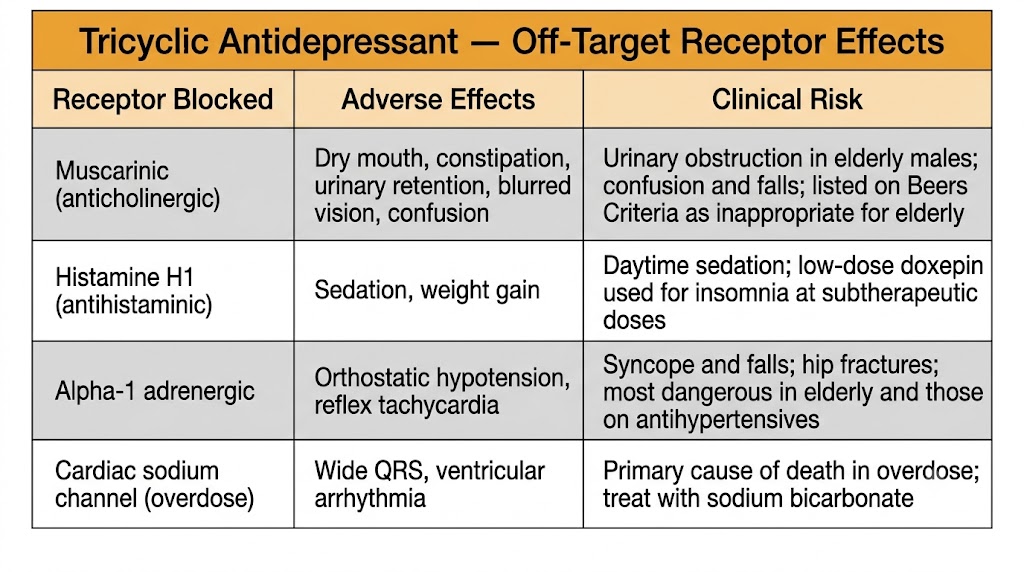
Table showing tricyclic antidepressant off-target receptor binding: muscarinic blockade causing anticholinergic effects, histamine H1 blockade causing sedation and weight gain, alpha-1 blockade causing orthostatic hypotension, and cardiac sodium channel blockade causing arrhythmia in overdose.
Tricyclic antidepressant off-target receptor effects: the four receptor systems responsible for adverse effects and overdose lethality. Figure generated by Gemini AI.
Specific Indications by Agent

Beyond depression, specific tricyclic antidepressants have established indications that remain clinically relevant. Amitriptyline and nortriptyline are first-line or second-line agents for neuropathic pain and migraine prophylaxis, through norepinephrine-mediated augmentation of descending pain inhibition. Clomipramine, with its especially potent serotonin reuptake inhibition among the tricyclic antidepressants, is the most efficacious pharmacological agent for obsessive-compulsive disorder and is reserved for cases refractory to selective serotonin reuptake inhibitors. Imipramine is approved for nocturnal enuresis in children.

Nortriptyline — Preferred Tricyclic Antidepressant

When a tricyclic antidepressant is clinically required, nortriptyline is the rational first choice: it has a well-characterized therapeutic plasma concentration range, relatively lower anticholinergic and alpha-1 antagonist activity than the tertiary amines, established efficacy in neuropathic pain and migraine prophylaxis, and better cardiovascular tolerability than amitriptyline or imipramine. Desipramine is an alternative with similar advantages but is less well-studied in pain indications.

Section 2

Tricyclic Antidepressant Overdose

Cardiac sodium channel blockade, QRS widening, and the specific interventions that distinguish tricyclic antidepressant overdose management from all other antidepressant overdoses

Tricyclic antidepressant overdose is one of the most dangerous presentations in toxicology. A quantity of drug representing only a few days' supply at therapeutic doses can be lethal. The lethality arises from cardiac sodium channel blockade producing life-threatening arrhythmias, compounded by central nervous system toxicity causing seizures that further destabilize an already compromised heart. Management is time-critical and requires interventions specific to this toxidrome.

Cardiac Sodium Channel Blockade

Tricyclic antidepressants block fast sodium channels in cardiac muscle, slowing the depolarization phase of the cardiac action potential. On the electrocardiogram, this produces a characteristic pattern: widening of the QRS complex and prolongation of the QTc interval. QRS duration greater than 100 milliseconds indicates significant toxicity and predicts seizure risk; QRS greater than 160 milliseconds is associated with high risk of ventricular arrhythmia including ventricular tachycardia and ventricular fibrillation. This sodium channel blockade is the primary cause of death in tricyclic antidepressant overdose.

Sodium bicarbonate is the cornerstone of tricyclic antidepressant overdose management. It works through two mechanisms: alkalinizing the blood reduces the drug's binding affinity for the sodium channel, and raising the serum sodium concentration helps overcome the channel block by increasing the electrochemical driving force for sodium entry. The clinical target is narrowing of the QRS complex toward baseline, with a target blood pH of approximately 7.45 to 7.55. Sodium bicarbonate should be given for any QRS widening above 100 milliseconds or in the presence of arrhythmia.

Central Nervous System Toxicity and Seizures

Tricyclic antidepressant overdose produces central nervous system toxicity through histamine and muscarinic receptor blockade and through direct lowering of the seizure threshold. The clinical sequence typically follows: initial anticholinergic syndrome (dry flushed skin, tachycardia, dilated pupils, urinary retention, agitation), then progressive sedation and central nervous system depression, then QRS widening on electrocardiogram, then seizures, then ventricular arrhythmia. This progression can occur within one to two hours of ingestion — tricyclic antidepressant overdose can deteriorate with alarming speed.

Benzodiazepines are first-line for tricyclic antidepressant-associated seizures. Phenytoin and fosphenytoin must be avoided: they have sodium channel-blocking properties that worsen cardiac toxicity. Hemodialysis is not effective for removing tricyclic antidepressants due to their very large volume of distribution — only a tiny fraction of total body drug is in the plasma compartment at any time. All patients with suspected tricyclic antidepressant overdose require continuous cardiac monitoring and immediate access to defibrillation.

Tricyclic Antidepressant Overdose — High-Yield Management Points

Sodium bicarbonate for QRS widening above 100 milliseconds or arrhythmia — do not wait for further deterioration. Benzodiazepines for seizures. Avoid phenytoin and fosphenytoin (worsen cardiac toxicity via sodium channel blockade). Hemodialysis is not effective. Rapid clinical deterioration is the rule — monitor continuously. The combination of wide QRS plus seizures plus hemodynamic instability is a tricyclic antidepressant overdose until proven otherwise.


Section 3

Monoamine Oxidase Inhibitors — Mechanism and Classification

How monoamine oxidase inhibitors block monoamine degradation, the two enzyme isoforms and their substrates, and why irreversible inhibition produces such a prolonged drug effect

Monoamine oxidase inhibitors work at a completely different step from reuptake inhibitors. Rather than blocking the reuptake transporter that removes monoamines from the synapse, they block the enzyme that degrades monoamines inside the neuron after reuptake. The result is the same — elevated monoamine availability — but the mechanism, the duration of effect, and the interaction profile are entirely different.

The Two Monoamine Oxidase Isoforms

Monoamine oxidase exists as two isoforms with overlapping but distinct substrate preferences. Monoamine oxidase A preferentially degrades serotonin and norepinephrine and is found in noradrenergic and serotonergic neurons, the intestinal mucosa, and the liver. Monoamine oxidase B preferentially degrades dopamine and phenylethylamine and is found in dopaminergic neurons, platelets, and glial cells. Tyramine — the dietary amine responsible for the dangerous food interaction — is metabolized predominantly by monoamine oxidase A in the gut and liver during first-pass extraction.

This isoform distribution has important clinical implications. Monoamine oxidase A inhibition is required for antidepressant effect (serotonin and norepinephrine are the relevant substrates). Monoamine oxidase A inhibition in the gut and liver is what eliminates the protective first-pass tyramine metabolism, creating the dietary tyramine interaction. Selective monoamine oxidase B inhibition at low doses — as with selegiline in Parkinson's disease — does not produce meaningful antidepressant effect and preserves enough gut monoamine oxidase A to handle normal dietary tyramine loads safely.

Irreversible versus Reversible Inhibition

The classical monoamine oxidase inhibitors — phenelzine, tranylcypromine, and isocarboxazid — form irreversible covalent bonds with the monoamine oxidase enzyme, permanently inactivating it. Recovery of monoamine oxidase activity after stopping an irreversible monoamine oxidase inhibitor depends entirely on the synthesis of new enzyme, a process that takes approximately two weeks. This is the pharmacological basis for the two-week washout period required after stopping an irreversible monoamine oxidase inhibitor before starting any serotonergic agent or indirect sympathomimetic: the drug effect persists long after the drug itself has been eliminated from plasma.

Selegiline in transdermal form (Emsam) delivers drug systemically while substantially reducing first-pass inhibition of gut and hepatic monoamine oxidase A, which is what eliminates dietary tyramine. At the lowest transdermal dose, dietary restrictions are not required because systemic monoamine oxidase A inhibition is insufficient to impair gut tyramine metabolism. At higher transdermal doses, some dietary restriction is still necessary. The two-week washout requirement applies to the transdermal formulation as well when stopping before starting serotonergic drugs.

Moclobemide — a reversible monoamine oxidase A inhibitor used in Europe, Canada, and Australia but not Food and Drug Administration-approved in the United States — has a substantially reduced dietary interaction risk due to its reversible binding. Its washout before serotonergic drugs is only 24 hours.

Monoamine Oxidase Inhibitor Washout Periods — Summary

After stopping an irreversible monoamine oxidase inhibitor: wait 2 weeks before starting any selective serotonin reuptake inhibitor, serotonin-norepinephrine reuptake inhibitor, or tricyclic antidepressant. After stopping a selective serotonin reuptake inhibitor or serotonin-norepinephrine reuptake inhibitor: wait 2 weeks before starting a monoamine oxidase inhibitor — except after stopping fluoxetine, which requires 5 weeks due to the long-acting active metabolite norfluoxetine. These washout periods are absolute requirements — the combination during the washout period can cause fatal serotonin syndrome.


Section 4

Tyramine Interaction, Dietary Restrictions, and Clinical Role

The mechanism of the tyramine pressor response, what foods and drugs must be avoided, and when monoamine oxidase inhibitors remain the most effective pharmacological option

The tyramine pressor response is the interaction that defines the clinical use of monoamine oxidase inhibitors. It is predictable, potentially fatal, and entirely preventable through dietary adherence and drug avoidance. Understanding its mechanism precisely is what allows a clinician to counsel patients accurately and to select monoamine oxidase inhibitors appropriately despite the interaction risk.

Mechanism of the Tyramine Pressor Response

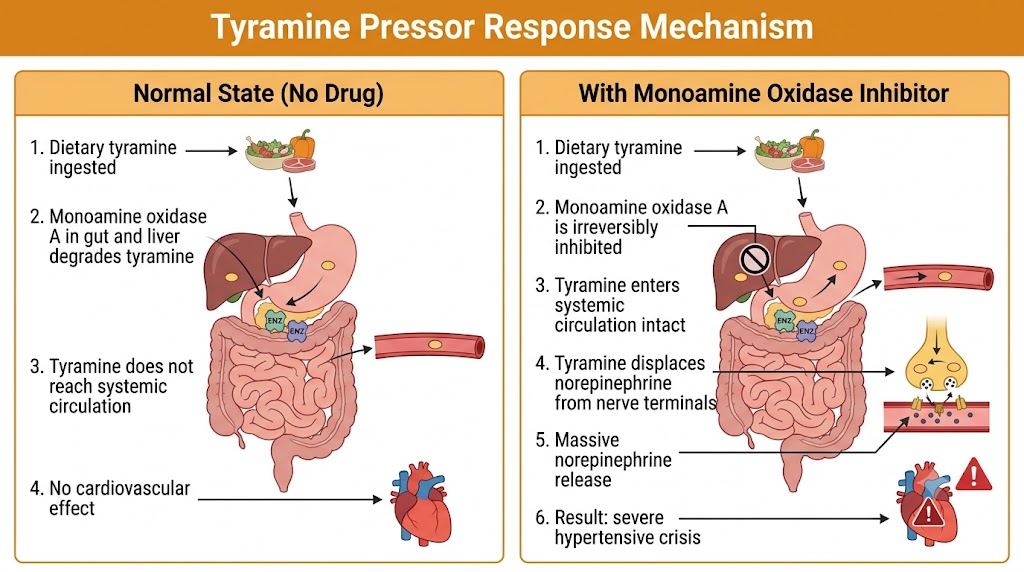
Tyramine is a dietary amine formed by bacterial breakdown of the amino acid tyrosine during fermentation and aging of foods. Normally, tyramine ingested from food is almost completely degraded by monoamine oxidase A in the intestinal lining and liver during first-pass metabolism — it never reaches systemic circulation in meaningful amounts. When monoamine oxidase A is irreversibly inhibited, this protective first-pass extraction fails entirely, and dietary tyramine enters systemic circulation intact.

Tyramine is an indirect sympathomimetic: it enters adrenergic nerve terminals via the norepinephrine reuptake transporter and displaces norepinephrine from vesicular storage into the synapse in massive quantities. The resulting surge of norepinephrine release causes a sudden and severe hypertensive crisis — the classic presentation is an abrupt, severe pounding headache, flushing, diaphoresis, nausea, and blood pressure sometimes exceeding 200/120 mmHg. Intracerebral hemorrhage is the most feared consequence. The severity of the crisis depends on the amount of tyramine ingested and how completely monoamine oxidase A is inhibited.

Two-panel comparison diagram showing the tyramine pressor response mechanism: normal state where monoamine oxidase A degrades tyramine in the gut and liver versus the monoamine oxidase inhibitor state where inhibited monoamine oxidase A allows tyramine to reach systemic circulation, displace norepinephrine from nerve terminals, and cause severe hypertensive crisis.
Tyramine pressor response mechanism: normal first-pass degradation by monoamine oxidase A versus the monoamine oxidase inhibitor state in which tyramine bypasses degradation and triggers massive norepinephrine release. Figure generated by Gemini AI.
Foods and Drugs to Avoid

Foods with high tyramine content that must be avoided during irreversible monoamine oxidase inhibitor treatment include aged cheeses (the highest-risk single food category — fresh cheeses such as cottage cheese, ricotta, and cream cheese are safe), cured and fermented meats such as salami and pepperoni, fermented and aged fish, soy sauce and other fermented soy products, certain wines (especially Chianti) and draft beer, sauerkraut, and fava bean pods. Fresh meats and unfermented dairy products are generally safe. Tyramine content within a food category varies with the degree of fermentation and aging — the older and more fermented, the higher the tyramine load.

Drug interactions that must be avoided include: all serotonergic agents (selective serotonin reuptake inhibitors, serotonin-norepinephrine reuptake inhibitors, tricyclic antidepressants, tramadol, meperidine — risk of serotonin syndrome); indirect sympathomimetics including pseudoephedrine, phenylephrine, and amphetamines (risk of additional hypertensive crisis through the same norepinephrine-displacement mechanism); and dextromethorphan.

Current Clinical Role

Despite their interaction burden, monoamine oxidase inhibitors retain an important and underappreciated clinical niche. They are the most effective pharmacological treatment for atypical depression — a subtype characterized by mood reactivity (mood brightens in response to positive events), hypersomnia, increased appetite with carbohydrate craving, leaden paralysis (a heavy feeling in limbs), and rejection sensitivity. Randomized controlled trials have demonstrated monoamine oxidase inhibitor superiority over tricyclic antidepressants and placebo specifically in atypical depression. For patients who have failed multiple adequate antidepressant trials across different classes — treatment-resistant depression — monoamine oxidase inhibitors are among the most powerful remaining pharmacological options.

The reluctance to prescribe monoamine oxidase inhibitors in current practice reflects appropriate caution about dietary and drug interactions, not a deficiency in antidepressant efficacy. In patients with atypical depression or treatment-resistant depression who can reliably follow dietary restrictions and carry a list of contraindicated medications, monoamine oxidase inhibitors represent a genuine and underused therapeutic resource. The selegiline transdermal patch is a reasonable consideration for patients who would benefit from a monoamine oxidase inhibitor but for whom strict dietary adherence is uncertain at the lowest effective dose.

Atypical Depression — Monoamine Oxidase Inhibitor Niche

Atypical depression features: mood reactivity, hypersomnia (increased sleep), hyperphagia (increased appetite), leaden paralysis, rejection sensitivity. Monoamine oxidase inhibitors are first-line for this subtype based on controlled trial evidence. Selective serotonin reuptake inhibitors and serotonin-norepinephrine reuptake inhibitors are less effective for atypical depression than for typical melancholic depression. Recognizing atypical depression and knowing that it responds preferentially to monoamine oxidase inhibitors is high-yield clinical pharmacology.


Suggested References
Author / Organization Title Source
Richelson E Pharmacology of antidepressants Mayo Clin Proc. 2001;76(5):511–527
Preskorn SH, Irwin HA Toxicity of tricyclic antidepressants: kinetics, mechanism, intervention J Clin Psychiatry. 1982;43(4):151–156
American Geriatrics Society 2023 updated AGS Beers Criteria for potentially inappropriate medication use in older adults J Am Geriatr Soc. 2023;71(7):2052–2081
Liebelt EL, Francis PD, Woolf AD ECG lead aVR versus QRS interval in predicting seizures and arrhythmias in acute tricyclic antidepressant toxicity Ann Emerg Med. 1995;26(2):195–201
Kerr GW, McGuffie AC, Wilkie S Tricyclic antidepressant overdose: a review Emerg Med J. 2001;18(4):236–241
Youdim MB, Edmondson D, Tipton KF The therapeutic potential of monoamine oxidase inhibitors Nat Rev Neurosci. 2006;7(4):295–309
Finberg JP, Rabey JM Inhibitors of MAO-A and MAO-B in psychiatry and neurology Front Pharmacol. 2016;7:340
Liebowitz MR, Quitkin FM, Stewart JW, et al. Antidepressant specificity in atypical depression Arch Gen Psychiatry. 1988;45(2):129–137
Stahl SM, Felker A Monoamine oxidase inhibitors: a modern guide to an unrequited class of antidepressants CNS Spectr. 2008;13(10):855–870
McCabe-Sellers BJ, Staggs CG, Bogle ML Tyramine in foods and monoamine oxidase inhibitor drugs: a crossroads where medicine, nutrition, pharmacy, and food technology intersect J Food Compost Anal. 2006;19(Suppl):S58–S65
Henkel V, Mergl R, Allgaier AK, et al. Treatment of atypical depression: meta-analysis of clinical studies Psychiatry Res. 2006;141(1):89–101
Stahl SM Stahl's Essential Psychopharmacology: Neuroscientific Basis and Practical Applications, 5th ed. Chapters 11–12 Cambridge University Press; 2021