CHAPTER 17  ·  ANTIDEPRESSANT DRUGS
Section 1

Vortioxetine and Vilazodone

Two newer agents that extend beyond simple serotonin transporter blockade — vortioxetine through multimodal serotonin receptor activity, vilazodone through serotonin-1A partial agonism

The agents in this module represent a pharmacological generation beyond the selective serotonin reuptake inhibitors. Rather than acting solely on the serotonin reuptake transporter, each adds receptor-level activity that distinguishes it mechanistically and, in some cases, clinically from the first-line agents covered in Module 2.

Vortioxetine — Multimodal Serotonergic Agent

Vortioxetine combines serotonin reuptake transporter inhibition with direct activity at multiple serotonin receptor subtypes. In addition to blocking the serotonin reuptake transporter, it acts as a full agonist at serotonin-1A receptors, a partial agonist at serotonin-1B receptors, and an antagonist at serotonin-1D, serotonin-3, and serotonin-7 receptors. This receptor combination produces effects on neurotransmission that go beyond those of a conventional selective serotonin reuptake inhibitor: by blocking serotonin-3 and serotonin-7 receptors on inhibitory interneurons, vortioxetine disinhibits the release of norepinephrine, dopamine, and acetylcholine in prefrontal and hippocampal circuits, providing a mechanistic basis for its claimed pro-cognitive effects.

Vortioxetine has been studied more extensively for cognitive effects than any other antidepressant, and clinical trial data support improvements in processing speed, attention, and executive function in patients with major depressive disorder. Whether this translates into clinically meaningful functional superiority over selective serotonin reuptake inhibitors remains debated, but the cognitive improvement appears at least partially independent of mood improvement.

Nausea is the most common adverse effect, dose-dependent and attenuating over the first one to two weeks. Starting at 5 mg for the first week before escalating to 10 or 20 mg reduces early nausea. Vortioxetine has a favorable sexual dysfunction profile compared to selective serotonin reuptake inhibitors — rates of sexual dysfunction in prospective trials are near placebo. It does not cause clinically significant weight gain, sedation, or QTc prolongation. It is metabolized primarily by cytochrome P450 2D6; potent cytochrome P450 2D6 inhibitors such as bupropion, fluoxetine, and paroxetine increase vortioxetine exposure and require dose reduction.
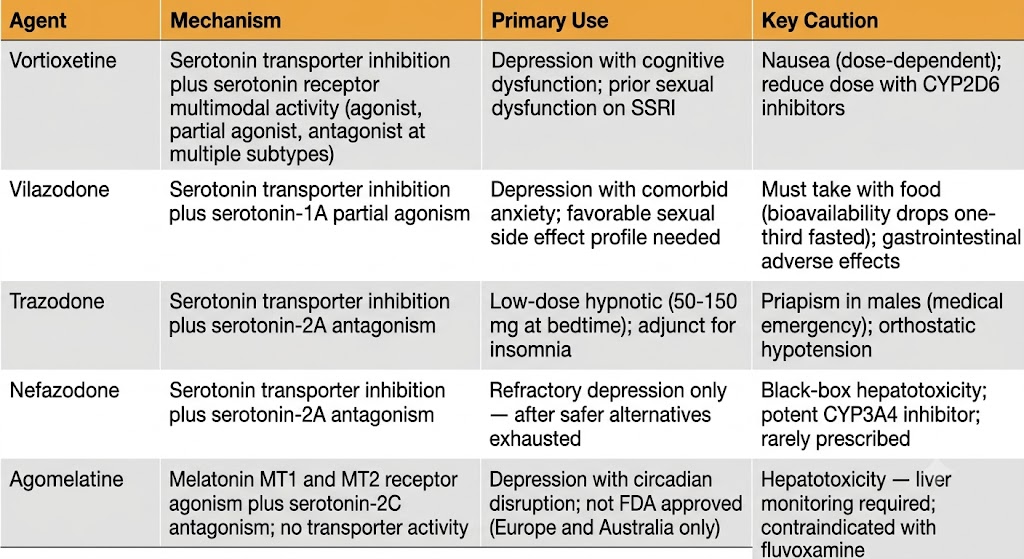
Comparison table of five newer antidepressants — vortioxetine, vilazodone, trazodone, nefazodone, and agomelatine — organized by mechanism, primary clinical use, and key caution.
Five newer antidepressants with novel receptor mechanisms: mechanism, primary clinical use, and key caution for each agent. Figure generated by Gemini AI.
Vilazodone — Serotonin Transporter Inhibition Plus Serotonin-1A Partial Agonism

Vilazodone was designed around a mechanistic hypothesis: by combining serotonin transporter blockade with direct partial agonism at the serotonin-1A receptor, it would simultaneously block serotonin reuptake and directly engage the presynaptic autoreceptors whose desensitization is required before full antidepressant response develops. The rationale was that direct serotonin-1A partial agonism might accelerate the receptor adaptation that underlies the therapeutic lag. Whether this translates into clinically demonstrable superiority over selective serotonin reuptake inhibitors has not been consistently shown in head-to-head trials, but the mechanism is pharmacologically distinct from conventional selective serotonin reuptake inhibitors.

The most clinically consequential pharmacokinetic feature of vilazodone is its food dependency. Bioavailability is approximately 72% when taken with food but falls to approximately 47% in the fasted state — a reduction large enough to meaningfully reduce drug exposure and potentially compromise efficacy. Patients must be explicitly instructed to take vilazodone with food at every dose. This is among the more clinically important food-drug interactions for any commonly prescribed antidepressant.

Gastrointestinal adverse effects — diarrhea, nausea, and vomiting — are the most common reason for early discontinuation with vilazodone, more prominent than with most selective serotonin reuptake inhibitors. A mandatory dose titration (10 mg for one week, then 20 mg for one week, then 40 mg target) reduces but does not eliminate these effects. Vilazodone has a favorable sexual dysfunction profile compared to selective serotonin reuptake inhibitors, attributed to its serotonin-1A partial agonism. It does not produce significant weight gain, sedation, or QTc prolongation.

Vilazodone — Food Requirement

Vilazodone must be taken with food at every dose. Bioavailability drops by approximately one-third in the fasted state. A patient taking vilazodone on an empty stomach may experience inadequate drug exposure and apparent treatment failure despite a correctly written prescription. Explicit counseling at the time of prescribing is mandatory.

Section 2

Trazodone and Nefazodone

Two serotonin antagonist and reuptake inhibitors — mechanistically related but sharply divergent in their safety profiles and clinical use

Trazodone and nefazodone share the serotonin antagonist and reuptake inhibitor pharmacological class — combining serotonin transporter blockade with serotonin-2A receptor antagonism. Despite this shared mechanism, their clinical roles could not be more different: trazodone is commonly used and generally safe, while nefazodone is rarely prescribed due to a post-marketing hepatotoxicity risk that resulted in market withdrawal of the branded product.

Trazodone — Mechanism and Primary Clinical Role

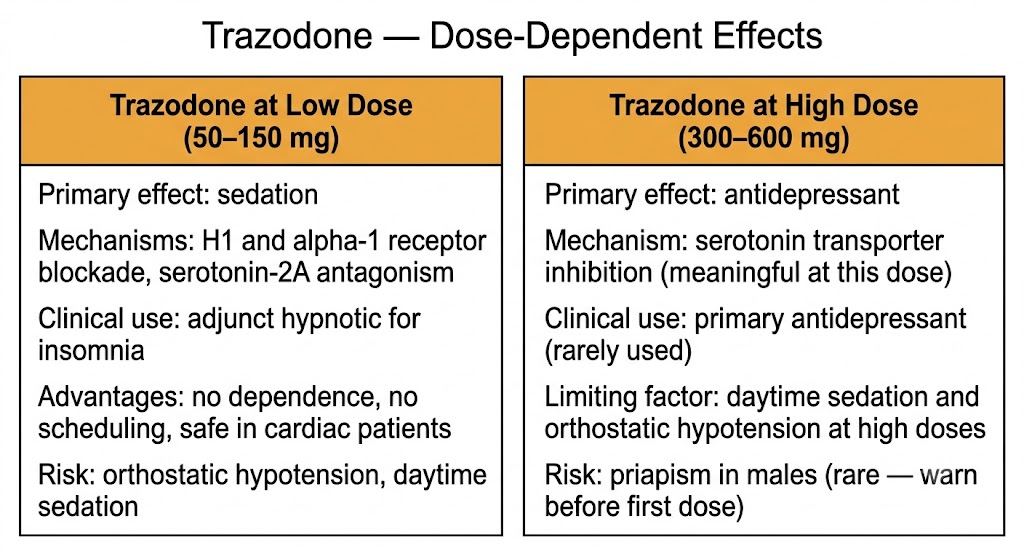
Trazodone inhibits the serotonin reuptake transporter and blocks serotonin-2A receptors. At the low doses most commonly prescribed in clinical practice (50 to 150 mg at bedtime), its most prominent pharmacodynamic effects are sedation — from histamine H1 and alpha-1 adrenergic receptor blockade — and promotion of slow-wave sleep from serotonin-2A antagonism. At these hypnotic doses, its serotonin transporter inhibition contributes minimally to net serotonergic enhancement. To produce meaningful antidepressant effect through serotonin transporter blockade, doses of 300 to 600 mg per day are required — doses at which tolerability problems, including daytime sedation and orthostatic hypotension, become limiting.

In current clinical practice, trazodone is primarily used as a non-scheduled hypnotic agent for insomnia comorbid with depression, rather than as a primary antidepressant. It is frequently combined with selective serotonin reuptake inhibitors or serotonin-norepinephrine reuptake inhibitors to address residual sleep disruption after adequate antidepressant response. Its advantages in this role include no risk of physical dependence, no scheduling requirement, no respiratory depression risk, and general safety in cardiac patients — making it preferable to benzodiazepines or sedating antihistamines in many patients.

Priapism is a rare but serious adverse effect of trazodone, occurring in approximately 1 in 6,000 male patients, mediated by alpha-1 adrenergic blockade in penile vasculature. Patients must be warned at initiation that prolonged erection is a medical emergency — delayed treatment can result in permanent erectile dysfunction. Orthostatic hypotension and excessive daytime sedation are the most common dose-limiting adverse effects.

Two-panel comparison showing trazodone dose-dependent effects: low dose (50 to 150 mg) produces sedation through H1 and alpha-1 blockade for hypnotic use, while high dose (300 to 600 mg) produces antidepressant effect through serotonin transporter inhibition.
Trazodone dose-dependent effects: hypnotic mechanism at low doses versus antidepressant mechanism at high doses. Figure generated by Gemini AI.
Nefazodone — Mechanism and Hepatotoxicity

Nefazodone shares trazodone's core mechanism — serotonin transporter inhibition plus serotonin-2A antagonism — but with a better tolerability profile in terms of sedation and orthostatic hypotension, because nefazodone has less alpha-1 adrenergic blocking activity than trazodone. Post-marketing surveillance identified a risk of severe idiosyncratic hepatotoxicity, including fulminant hepatic failure and fatal cases, at a rate estimated at 1 in 250,000 to 1 in 300,000 patient-years. The branded formulation was withdrawn from the United States market in 2004; generic nefazodone technically remains available with a black-box warning for hepatotoxicity, but prescribing is now rare and confined to patients with refractory depression who have exhausted safer alternatives.

Nefazodone is also a potent inhibitor of cytochrome P450 3A4, producing clinically significant interactions with any cytochrome P450 3A4-metabolized substrate. It substantially increases exposure to simvastatin and lovastatin (raising rhabdomyolysis risk), triazolam, alprazolam, and pimozide — combinations that are contraindicated. For Step 1, the two key facts about nefazodone are the black-box hepatotoxicity warning and the potent cytochrome P450 3A4 inhibition.

Nefazodone — Black-Box Warning

Nefazodone carries a black-box warning for life-threatening hepatic failure. The branded formulation (Serzone) was withdrawn from the United States market in 2004. Generic nefazodone remains technically available but is rarely prescribed. It is a potent cytochrome P450 3A4 inhibitor with multiple contraindicated combinations including simvastatin, lovastatin, triazolam, and alprazolam. Baseline and periodic liver function monitoring is mandatory before any use.


Section 3

Agomelatine

Melatonin receptor agonism plus serotonin-2C antagonism — an antidepressant with no monoamine transporter activity and a unique circadian mechanism

Agomelatine is mechanistically unlike every other antidepressant: it has no activity at the serotonin, norepinephrine, or dopamine reuptake transporters. Its antidepressant effect operates through melatonin receptor agonism — which directly addresses circadian rhythm disruption, a core feature of depression — combined with serotonin-2C receptor antagonism, which disinhibits dopamine and norepinephrine release in the prefrontal cortex. It is approved in Europe and Australia but not by the Food and Drug Administration in the United States.

Mechanism of Action

Agomelatine is an agonist at melatonin MT1 and MT2 receptors, which synchronize circadian rhythms by reinforcing the endogenous melatonin signal from the suprachiasmatic nucleus — the brain's master circadian clock. Disruption of sleep-wake cycle timing is a prominent and early feature of major depressive disorder; agomelatine directly targets this circadian disruption rather than addressing it secondarily. It simultaneously antagonizes serotonin-2C receptors, which normally exert inhibitory tone on dopaminergic and noradrenergic neurons in the prefrontal cortex. Blocking serotonin-2C receptors removes this inhibitory brake, increasing dopamine and norepinephrine release in frontal circuits and contributing to antidepressant and anxiolytic effects through a mechanism completely separate from any transporter.

Clinical Profile and Prescribing Constraints

Agomelatine consistently improves subjective sleep quality, reduces sleep latency, and normalizes sleep architecture without producing next-day sedation — a distinct advantage over sedating antidepressants. It produces no sexual dysfunction, no weight gain, and no discontinuation syndrome upon abrupt cessation, because none of these class effects are driven by the monoamine transporter mechanism that agomelatine lacks. Its efficacy for depression and anxiety symptoms in clinical trials is comparable to selective serotonin reuptake inhibitors and serotonin-norepinephrine reuptake inhibitors.

Agomelatine has two important prescribing constraints. First, it causes liver enzyme elevations in approximately 1 to 3 percent of patients, with rare cases of serious hepatotoxicity reported post-marketing — liver function testing is required at baseline and at regular intervals during treatment, and the drug is contraindicated in hepatic impairment. Second, it is metabolized primarily by cytochrome P450 1A2; strong cytochrome P450 1A2 inhibitors including fluvoxamine and ciprofloxacin markedly increase agomelatine exposure and are contraindicated. Agomelatine must be taken at bedtime to align with the normal melatonin window. It is not available in the United States but may be encountered in patients transferring care from European or Australian healthcare settings.

Agomelatine — Key Points for Step 1

Mechanism: melatonin MT1 and MT2 agonism plus serotonin-2C antagonism — no transporter activity. Not Food and Drug Administration-approved (available in Europe and Australia). No sexual dysfunction, no weight gain, no discontinuation syndrome. Hepatotoxicity risk — liver function monitoring required. Contraindicated with fluvoxamine and ciprofloxacin (cytochrome P450 1A2 inhibitors). Best clinical niche: depression with prominent sleep-wake cycle disruption.


Section 4

Clinical Summary — When to Use Each Agent

Translating the pharmacological distinctions of this module into patient-centered selection criteria

None of the agents in this module is a first-line antidepressant — that role belongs to selective serotonin reuptake inhibitors and serotonin-norepinephrine reuptake inhibitors. Each of these agents has a defined clinical niche where its particular receptor profile offers an advantage over first-line treatments.

Vortioxetine

Prefer vortioxetine when cognitive dysfunction is a prominent feature of depression — particularly when attention, processing speed, or executive function impairment persists after adequate mood response on a prior antidepressant. It is also a reasonable alternative for patients who experienced sexual dysfunction on a selective serotonin reuptake inhibitor or serotonin-norepinephrine reuptake inhibitor but were otherwise tolerating the drug well. Its higher cost relative to generic selective serotonin reuptake inhibitors is a practical consideration.

Vilazodone

Vilazodone occupies a narrow niche — it is most rationally considered in patients with major depressive disorder and comorbid generalized anxiety disorder, where its serotonin-1A partial agonism may contribute anxiolytic effects beyond those of a pure selective serotonin reuptake inhibitor. Patient counseling on the mandatory food requirement and the dose titration schedule is essential at every prescription.

Trazodone

Use trazodone at bedtime (50 to 150 mg) as an adjunct hypnotic in patients with depression and insomnia — particularly when benzodiazepines are contraindicated or undesirable. It is commonly added to a selective serotonin reuptake inhibitor or serotonin-norepinephrine reuptake inhibitor to address residual sleep disruption without adding sedating risk in the daytime. Warn male patients explicitly about priapism before the first dose.

Nefazodone and Agomelatine

Nefazodone should not be used when safer alternatives exist — the hepatotoxicity risk and cytochrome P450 3A4 interaction burden restrict its use to refractory cases with documented benefit in the individual patient. Agomelatine is primarily encountered in patients transferring care from countries where it is approved; recognize its mechanism and constraints rather than initiating it de novo in the United States.

Module 5 — High-Yield Summary

Vortioxetine: multimodal serotonin receptor activity, pro-cognitive, favorable sexual dysfunction profile, nausea is main adverse effect. Vilazodone: serotonin transporter plus serotonin-1A partial agonism, must take with food, gastrointestinal adverse effects. Trazodone: serotonin antagonist and reuptake inhibitor, used primarily as hypnotic at low doses, priapism risk in males. Nefazodone: black-box hepatotoxicity, cytochrome P450 3A4 inhibitor, rarely prescribed. Agomelatine: melatonin agonism plus serotonin-2C antagonism, not Food and Drug Administration-approved, hepatotoxicity monitoring required, no transporter-related adverse effects.


Suggested References
Author / Organization Title Source
Bang-Andersen B, Ruhland T, Jorgensen M, et al. Discovery of 1-[2-(2,4-dimethylphenylsulfanyl)phenyl]piperazine (Lu AA21004): a novel multimodal compound for the treatment of major depressive disorder J Med Chem. 2011;54(9):3206–3221
Mork A, Pehrson A, Brennum LT, et al. Pharmacological effects of Lu AA21004: a novel multimodal compound for the treatment of major depressive disorder J Pharmacol Exp Ther. 2012;340(3):666–675
McIntyre RS, Lophaven S, Olsen CK A randomized, double-blind, placebo-controlled study of vortioxetine on cognitive function in depressed adults Int J Neuropsychopharmacol. 2014;17(10):1557–1567
Stahl SM Vilazodone, a multifunctional serotonin agent for the treatment of major depressive disorder CNS Spectr. 2009;14(10):562–568
Fagiolini A, Comandini A, Catena Dell'Osso M, Kasper S Rediscovering trazodone for the treatment of major depressive disorder CNS Drugs. 2012;26(12):1033–1049
Choi S Nefazodone (Serzone) withdrawn because of hepatotoxicity CMAJ. 2003;169(11):1187
Millan MJ, Gobert A, Lejeune F, et al. The novel melatonin agonist agomelatine (S20098) is an antagonist at 5-hydroxytryptamine2C receptors, blockade of which enhances the activity of frontocortical dopaminergic and adrenergic pathways J Pharmacol Exp Ther. 2003;306(3):954–964
European Medicines Agency Valdoxan (agomelatine): summary of product characteristics. EMA/CHMP/478555/2008 EMA; 2009
Kasper S, Hajak G, Wulff K, et al. Efficacy of the novel antidepressant agomelatine on the circadian rest-activity cycle and depressive and anxiety symptoms in patients with major depressive disorder J Clin Psychiatry. 2010;71(2):109–120
Stahl SM Stahl's Essential Psychopharmacology: Neuroscientific Basis and Practical Applications, 5th ed. Chapter 7 Cambridge University Press; 2021
U.S. Food and Drug Administration Trintellix (vortioxetine) prescribing information. Revised 2023 FDA; 2023
U.S. Food and Drug Administration Serzone (nefazodone hydrochloride) prescribing information FDA; 2003