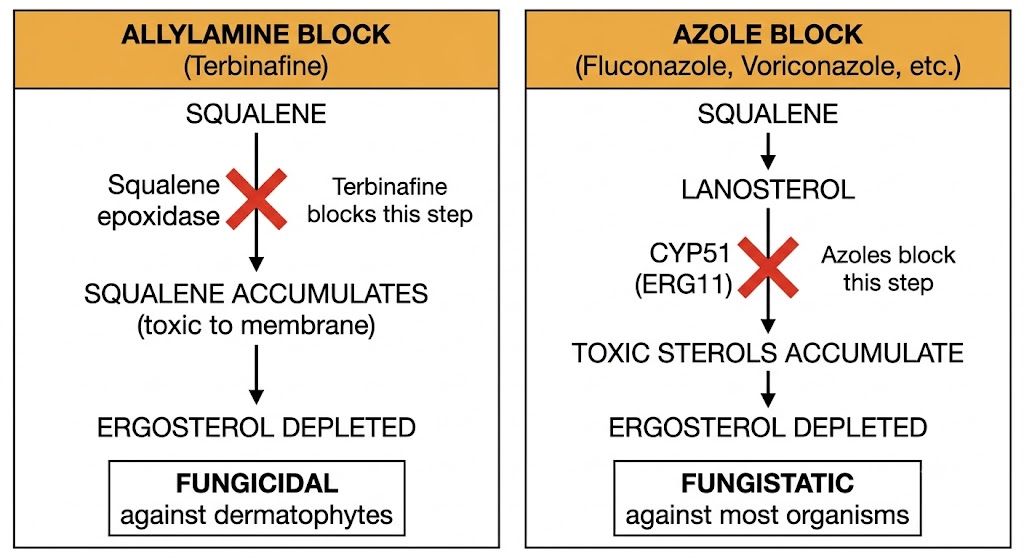
The allylamines are a class of synthetic antifungal agents that inhibit squalene epoxidase, an enzyme in the early ergosterol biosynthesis pathway. Unlike the azoles, which act downstream at lanosterol 14-alpha-demethylase, allylamines block a much earlier step, producing not only ergosterol depletion but also toxic accumulation of squalene. This dual mechanism makes allylamines fungicidal against dermatophytes — the primary pathogens for which this class is clinically used.
Squalene epoxidase catalyzes the conversion of squalene to squalene epoxide, the step immediately preceding lanosterol formation in the sterol biosynthesis pathway. Allylamines inhibit this enzyme non-competitively and selectively in fungi compared to the mammalian enzyme, providing the basis for selective antifungal toxicity. Inhibition produces two consequences simultaneously: ergosterol depletion, which disrupts fungal membrane function, and massive intracellular accumulation of squalene, which is directly toxic to the fungal cell membrane at high concentrations. The combination of ergosterol depletion and squalene toxicity produces fungicidal activity against dermatophytes at clinically achievable concentrations, in contrast to the fungistatic effect of azoles against the same organisms.
Terbinafine is the primary systemic allylamine in clinical use. It is well absorbed orally with bioavailability of approximately 70 percent after first-pass hepatic metabolism. It is highly lipophilic and extensively distributed into skin, nails, hair, and adipose tissue, achieving concentrations in these compartments that substantially exceed plasma concentrations. Nail concentrations persist for months after treatment completion because terbinafine is incorporated into the nail plate during growth and remains there even after plasma concentrations fall. This pharmacokinetic property is the basis for the relatively short treatment courses used in onychomycosis compared to older antifungals — the drug continues to work after the oral course ends. Terbinafine is metabolized by multiple hepatic cytochrome P450 (CYP) enzymes including CYP2D6 (cytochrome P450 2D6), CYP1A2 (cytochrome P450 1A2), CYP3A4, and CYP2C9. It inhibits CYP2D6, which is the basis for its clinically relevant interaction with drugs metabolized by that isoform, including tricyclic antidepressants, beta-blockers, and certain antiarrhythmics. Elimination is primarily renal, and dose reduction is recommended when creatinine clearance falls below 50 mL/min.
Terbinafine has excellent activity against dermatophytes — Trichophyton, Microsporum, and Epidermophyton species — the organisms responsible for tinea pedis (athlete's foot), tinea cruris (jock itch), tinea corporis (ringworm), tinea capitis (scalp ringworm), and onychomycosis (nail infection). It is fungicidal against these organisms and is the drug of choice for onychomycosis caused by dermatophytes, where it achieves higher cure rates and lower relapse rates than either azoles or griseofulvin in controlled trials. Activity against Candida species and molds is limited; terbinafine is not a broad-spectrum antifungal and should not be used for systemic or invasive fungal infections.
For dermatophyte onychomycosis, the standard oral course is 250 mg once daily for six weeks (fingernail) or 12 weeks (toenail). Topical terbinafine (one percent cream) is effective for tinea pedis, tinea corporis, and tinea cruris with one to two week courses. For tinea capitis, oral terbinafine is superior to griseofulvin against Trichophyton tonsurans — the dominant cause in the United States and sub-Saharan Africa — but griseofulvin retains an advantage for Microsporum canis tinea capitis, where terbinafine is less effective.
Terbinafine is generally well tolerated. Gastrointestinal (GI) effects — nausea, diarrhea, dyspepsia — are the most common adverse effects and are usually mild. Taste disturbance (dysgeusia) and loss of taste (ageusia) occur in approximately one percent of patients and are usually reversible on discontinuation but can persist for months. Hepatotoxicity is rare but has been reported; liver function test monitoring is recommended for courses extending beyond six weeks or in patients with pre-existing liver disease. A rare but serious adverse effect is drug-induced lupus erythematosus, which resolves on drug discontinuation. Naftifine is available as a topical formulation only and is used for superficial dermatophyte infections; it lacks clinically significant systemic absorption and systemic adverse effects.
Terbinafine is the preferred agent for dermatophyte onychomycosis: higher mycologic cure rates (70 to 80 percent vs. 40 to 60 percent for itraconazole), lower relapse rates, and fungicidal rather than fungistatic activity against dermatophytes. Itraconazole pulse therapy is an alternative when terbinafine is contraindicated (severe hepatic impairment) or not tolerated. Fluconazole is a third-line option. Griseofulvin is no longer recommended for onychomycosis given inferior efficacy compared to both terbinafine and itraconazole in head-to-head trials.
Flucytosine (5-fluorocytosine, abbreviated 5-FC) is a synthetic fluorinated pyrimidine antimetabolite with a narrow antifungal spectrum and a toxicity profile that makes it unsuitable for use as monotherapy. Its primary clinical role is in combination with amphotericin B for the induction treatment of cryptococcal meningitis, where the synergy between the two agents produces fungicidal activity superior to either drug alone.
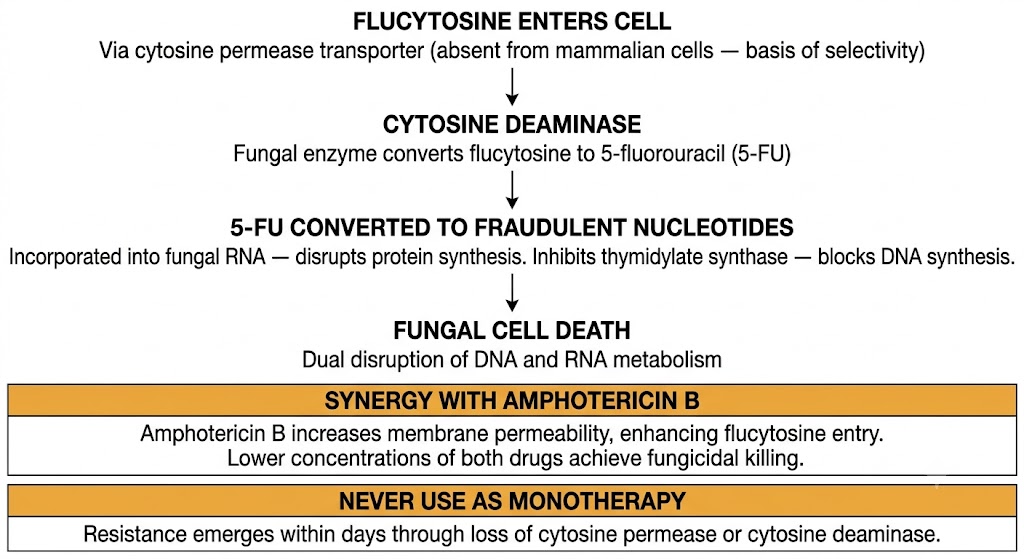
Flucytosine enters fungal cells through a cytosine permease transporter that is expressed in susceptible fungi but absent from mammalian cells — the basis for selective antifungal toxicity. Once inside the cell, flucytosine is deaminated by fungal cytosine deaminase to 5-fluorouracil (5-FU), which is then converted through the thymidylate synthase pathway to fraudulent nucleotides that are incorporated into fungal ribonucleic acid (RNA) and deoxyribonucleic acid (DNA). The 5-FU metabolites inhibit thymidylate synthase, blocking the synthesis of thymidine monophosphate required for DNA synthesis, and are incorporated into RNA as fraudulent bases that disrupt protein synthesis. This dual disruption of both DNA and RNA metabolism gives flucytosine fungicidal activity against susceptible organisms.
Mammalian cells lack significant cytosine deaminase activity and therefore do not convert flucytosine to 5-FU efficiently. However, gut bacteria can deaminate flucytosine to 5-FU in the gastrointestinal tract, and this systemic 5-FU exposure is the mechanistic basis for the bone marrow suppression and gastrointestinal toxicity that limit flucytosine use, particularly at high plasma concentrations.
Flucytosine is well absorbed orally, with bioavailability exceeding 90 percent. It distributes widely, achieving excellent penetration into the central nervous system (CNS) — cerebrospinal fluid (CSF) concentrations reach 60 to 80 percent of plasma concentrations — which supports its use in cryptococcal meningitis. Flucytosine is not significantly metabolized by the liver and is excreted almost entirely unchanged by the kidneys through glomerular filtration. This renal elimination route requires careful dose adjustment in patients with renal impairment: in patients with reduced creatinine clearance, flucytosine accumulates to toxic concentrations unless the dose or dosing interval is adjusted based on creatinine clearance. Because amphotericin B causes nephrotoxicity and reduces creatinine clearance, flucytosine concentrations typically rise during combination therapy and must be monitored closely.
The antifungal spectrum of flucytosine is narrow. It has meaningful activity against Cryptococcus neoformans, most Candida species, and Aspergillus species, but its clinical use is limited almost exclusively to cryptococcal meningitis in combination with amphotericin B. The combination is synergistic because amphotericin B increases fungal cell membrane permeability, which enhances flucytosine uptake by the cytosine permease system, allowing lower concentrations of both drugs to achieve fungicidal killing than either agent alone. Flucytosine monotherapy is not used clinically because resistance emerges rapidly — typically within days to weeks — through mutations that reduce cytosine deaminase expression or cytosine permease activity.
The 2022 World Health Organization (WHO) guidelines for cryptococcal meningitis in human immunodeficiency virus (HIV)-positive adults recommend a one-week induction regimen of liposomal amphotericin B plus flucytosine followed by fluconazole consolidation. Where liposomal amphotericin B is unavailable, amphotericin B deoxycholate plus flucytosine for one week remains an accepted alternative. The ACTA (Advancing Cryptococcal Meningitis Treatment for Africa) trial demonstrated that one-week amphotericin B plus flucytosine was superior to two-week amphotericin B monotherapy in reducing ten-week mortality, establishing the clinical evidence base for the combination.
Flucytosine toxicity is concentration-dependent and correlates with plasma trough concentrations above 100 mg/L (100 mcg/mL). The two dominant toxicities are bone marrow suppression and gastrointestinal toxicity. Bone marrow suppression manifests as leukopenia, thrombocytopenia, and less commonly anemia, and is mechanistically linked to 5-FU formation by gut bacteria with subsequent systemic exposure. Gastrointestinal toxicity includes nausea, vomiting, diarrhea, and abdominal cramping. Hepatotoxicity can also occur, manifesting as elevation of liver enzymes and bilirubin.
Therapeutic drug monitoring (TDM) is recommended when flucytosine is used: peak concentrations (measured two hours after an oral dose) should fall between 50 and 100 mg/L (50 to 100 mcg/mL), with the upper limit defining the toxicity threshold. In practice, full TDM is often not available in resource-limited settings where cryptococcal meningitis is most prevalent, and the one-week induction duration in current guidelines substantially reduces cumulative toxicity risk compared to the two-week courses used historically. Complete blood count (CBC) and liver function test monitoring twice weekly during flucytosine therapy is standard practice.
Toxicity is concentration-dependent: peak concentrations above 100 mg/L cause bone marrow suppression. Monitor peak concentration (two hours post-dose) — target 50 to 100 mg/L. Renal adjustment is mandatory: flucytosine accumulates when creatinine clearance falls, particularly during combination therapy with amphotericin B, which itself causes nephrotoxicity. Check complete blood count and liver function tests twice weekly. Never use flucytosine as monotherapy — resistance emerges rapidly within days to weeks through mutation.
Griseofulvin is a naturally occurring antifungal produced by Penicillium griseofulvum, with a mechanism entirely distinct from all other antifungal classes. It disrupts fungal mitosis by interacting with tubulin and inhibiting microtubule polymerization, and it has a unique pharmacokinetic property — selective concentration in keratinized tissues — that defined its clinical role for decades. Its use has narrowed substantially with the advent of terbinafine and itraconazole.
Griseofulvin binds to tubulin and inhibits microtubule polymerization in fungal cells, disrupting the mitotic spindle formation required for cell division. It also binds to keratin precursor proteins in host cells, which concentrates it in actively growing keratin — skin, hair, and nails. The antifungal effect is fungistatic: griseofulvin arrests fungal growth but does not kill existing organisms. New keratin formed during treatment contains drug, while infected keratin grows out and is shed. This growth-displacement mechanism requires prolonged treatment courses. Griseofulvin is active only against dermatophytes — Trichophyton, Microsporum, and Epidermophyton species — and has no activity against Candida, Aspergillus, or any non-dermatophyte organism.
Griseofulvin is available in two particle sizes: microsize and ultramicrosize. The ultramicrosize formulation provides approximately 1.5-fold greater bioavailability than the microsize formulation because of improved dissolution. Absorption of both formulations is significantly enhanced by a high-fat meal, and patients should be instructed to take griseofulvin with fatty food. Griseofulvin is metabolized by hepatic CYP enzymes and induces CYP3A4, which accelerates the metabolism of co-administered CYP3A4 substrates — including warfarin, oral contraceptives, and cyclosporine — reducing their plasma concentrations. The interaction with oral contraceptives is clinically significant and patients should be counseled to use additional contraceptive methods during griseofulvin therapy. Griseofulvin is teratogenic in animal models and should not be used during pregnancy.
Griseofulvin was for decades the only oral antifungal available for dermatophyte infections, but its use has been largely displaced by terbinafine and itraconazole, which offer higher cure rates, shorter treatment courses, and better tolerability for most indications. The one setting where griseofulvin retains a defined role is tinea capitis in children caused by Microsporum canis, where terbinafine is significantly less effective and griseofulvin remains a first-line option. For tinea capitis caused by Trichophyton tonsurans — the dominant cause in the United States — terbinafine is preferred but griseofulvin remains an acceptable alternative. Treatment courses for tinea capitis are typically six to eight weeks. For onychomycosis, griseofulvin requires 12 to 18 months of treatment with cure rates well below those of terbinafine, and it is no longer recommended as a first-line or second-line option for nail infections in current guidelines.
Adverse effects include headache (the most common complaint, occurring in approximately 15 percent of patients), gastrointestinal disturbances, photosensitivity reactions, and rarely drug-induced lupus erythematosus. Griseofulvin has a disulfiram-like reaction with alcohol, producing flushing, tachycardia, and nausea, and patients should be warned to avoid alcohol consumption during therapy.
Tinea capitis (scalp ringworm) in children: first-line for Microsporum canis tinea capitis, where terbinafine is less effective. Acceptable alternative for Trichophyton tonsurans tinea capitis where terbinafine is preferred. Take with a high-fat meal (enhances absorption). Treatment course: six to eight weeks. Warn patients about alcohol (disulfiram-like reaction) and counsel female patients on oral contraceptive failure risk. Do not use in pregnancy (teratogenic in animals). Not recommended for onychomycosis given inferior efficacy and long treatment duration compared to terbinafine.
The three drug classes in this module occupy distinct, non-overlapping clinical niches defined by their mechanisms, spectra, and pharmacokinetic properties. Understanding how to match drug to indication requires integrating all three dimensions.
Terbinafine is the antifungal of choice for dermatophyte infections requiring systemic treatment: onychomycosis (12-week toenail course), tinea capitis caused by Trichophyton tonsurans, and refractory tinea corporis or tinea pedis that fails topical therapy. Its fungicidal mechanism against dermatophytes and its unique pharmacokinetic concentration in keratinized tissues make it more effective than any other available agent for these organisms. The primary reason not to use terbinafine is severe hepatic impairment, which slows its metabolism and increases hepatotoxicity risk, or significant CYP2D6 interaction concerns in patients on narrow-therapeutic-index CYP2D6-metabolized drugs.
Flucytosine should never be used as monotherapy. Its sole established clinical role is as a partner drug in the amphotericin B plus flucytosine induction regimen for cryptococcal meningitis. In settings where both drugs are available, this combination should be used for all patients with cryptococcal meningitis at the induction phase, as the mortality benefit compared to monotherapy or azole-alone regimens is established by randomized controlled trials. The one-week induction duration in current WHO guidelines substantially reduces cumulative flucytosine toxicity while preserving the mortality benefit. In settings where flucytosine is unavailable, high-dose fluconazole or a two-week liposomal amphotericin B course is an inferior but sometimes necessary alternative.
Griseofulvin's clinical role has contracted to a single primary indication: tinea capitis in pediatric patients, particularly those with Microsporum canis infection, where terbinafine performs poorly. Outside this niche, there is no indication where griseofulvin is a preferred first-line agent over terbinafine or itraconazole in adult patients. Its long treatment courses, CYP3A4-inducing drug interactions, teratogenicity concern, and disulfiram-like alcohol reaction collectively make it an agent to reach for only when the indication specifically demands it.
Allylamines (terbinafine): inhibit squalene epoxidase — ergosterol depletion plus squalene toxicity — fungicidal against dermatophytes. Drug of choice for onychomycosis (12 weeks for toenail) and tinea capitis from Trichophyton tonsurans. Inhibits CYP2D6 — check interactions with tricyclics, beta-blockers, antiarrhythmics. Flucytosine: enters fungal cells via cytosine permease, converted to 5-fluorouracil, blocks DNA and RNA synthesis. Narrow spectrum; used only in combination with amphotericin B for cryptococcal meningitis induction. Never use as monotherapy — resistance emerges rapidly. Monitor peak concentrations (target 50 to 100 mg/L) and renal function. Griseofulvin: inhibits microtubule polymerization, fungistatic. Active only against dermatophytes. Retained role: tinea capitis in children (Microsporum canis). CYP3A4 inducer — reduces warfarin, oral contraceptives, cyclosporine. Take with fatty food. Avoid in pregnancy. Disulfiram-like reaction with alcohol.
| Author / Organization | Title | Source |
|---|---|---|
| Ryder NS | The mechanism of action of terbinafine | Clin Exp Dermatol. 1989;14(2):98-100 |
| Balfour JA, Faulds D | Terbinafine: a review of its pharmacodynamic and pharmacokinetic properties, and therapeutic potential in superficial mycoses | Drugs. 1992;43(2):259-284 |
| Gupta AK, Chow M, Daniel CR, et al. | Treatments of tinea pedis | Dermatol Clin. 2003;21(3):431-462 |
| Vermes A, Guchelaar HJ, Dankert J | Flucytosine: a review of its pharmacology, clinical indications, pharmacokinetics, toxicity and drug interactions | J Antimicrob Chemother. 2000;46(2):171-179 |
| Andes D, Pascual A, Marchetti O | Antifungal therapeutic drug monitoring: established and emerging indications | Antimicrob Agents Chemother. 2009;53(1):24-34 |
| Molloy SF, Kanyama C, Heyderman RS, et al. | Antifungal combinations for treatment of cryptococcal meningitis in Africa | N Engl J Med. 2018;378(11):1004-1017 |
| World Health Organization | Guidelines for Diagnosing, Preventing and Managing Cryptococcal Disease Among Adults, Adolescents and Children Living with HIV | Geneva: WHO; 2022 |
| Gupta AK, Cooper EA | Update in antifungal therapy of dermatophytosis | Mycopathologia. 2008;166(5-6):353-367 |
| Elewski BE, Caceres HW, DeLeon L, et al. | Terbinafine hydrochloride oral granules versus oral griseofulvin suspension in children with tinea capitis: results of two randomized, investigator-blinded, multicenter, international, controlled trials | J Am Acad Dermatol. 2008;59(1):41-54 |
| Perfect JR, Dismukes WE, Dromer F, et al. | Clinical practice guidelines for the management of cryptococcal disease: 2010 update by the Infectious Diseases Society of America | Clin Infect Dis. 2010;50(3):291-322 |