CHAPTER 7 · ANTIHYPERTENSIVE DRUGS

Section 1

Definition and Classification

Diagnostic thresholds, guideline frameworks, and the distinction between primary and secondary hypertension

Hypertension is defined by sustained elevation of blood pressure above thresholds associated with meaningful increases in cardiovascular risk. The two major guideline frameworks in current use differ on where that threshold is set, and second-year students need to recognize both.

Blood Pressure Classification

The 2017 American College of Cardiology/American Heart Association guidelines lowered the threshold for hypertension to 130/80 millimeters of mercury, based on outcome data showing that cardiovascular risk rises continuously from levels well below 140/90. Under this framework, the old "prehypertension" category was eliminated and replaced with two stages.

Category Systolic (mm Hg) Diastolic (mm Hg)
NormalBelow 120Below 80
Elevated120–129Below 80
Stage 1 Hypertension130–13980–89
Stage 2 Hypertension140 or above90 or above
Hypertensive CrisisAbove 180and/or above 120

European guidelines (the 2018 European Society of Cardiology/European Society of Hypertension joint guidelines, updated by the 2023 European Society of Hypertension guidelines) retain the traditional 140/90 millimeters of mercury threshold for diagnosing hypertension. They classify readings of 130–139/85–89 as "high normal" rather than Stage 1 hypertension. Treatment decisions in either framework depend on total cardiovascular risk, not blood pressure level alone.

Primary Versus Secondary Hypertension

Primary (essential) hypertension accounts for roughly 90 to 95 percent of all hypertension. It has no single identifiable cause and reflects the interaction of genetic predisposition, lifestyle, and environmental factors over time. Treatment is pharmacological management of the blood pressure itself rather than removal of an underlying cause.

Secondary hypertension accounts for 5 to 10 percent of cases but carries special clinical importance: when the underlying cause is identified and treated, blood pressure can be substantially reduced or normalized without lifelong antihypertensive therapy. Every student should recognize the major secondary causes and their clinical clues.

Most Common Secondary Cause

Renal Parenchymal Disease

  • Chronic kidney disease, glomerulonephritis, polycystic kidney disease
  • Mechanism: sodium retention and renin-angiotensin-aldosterone system activation
  • Clue: reduced estimated glomerular filtration rate or proteinuria on evaluation

Renovascular

Renal Artery Stenosis

  • Atherosclerotic (older patients) or fibromuscular dysplasia (young women)
  • Mechanism: reduced renal perfusion drives renin release and angiotensin II elevation
  • Clue: refractory hypertension; acute kidney injury when angiotensin converting enzyme inhibitor or angiotensin receptor blocker is started

Most Common Endocrine Cause

Primary Aldosteronism

  • Autonomous aldosterone secretion from adrenal adenoma or bilateral hyperplasia
  • Mechanism: excess aldosterone promotes sodium retention and potassium excretion
  • Clue: hypokalemia, suppressed renin, elevated aldosterone-to-renin ratio

Adrenal Tumor

Pheochromocytoma

  • Catecholamine-secreting tumor of the adrenal medulla or sympathetic ganglia
  • Mechanism: episodic massive release of epinephrine and norepinephrine
  • Classic triad: episodic headache, diaphoresis, and palpitations; elevated plasma metanephrines confirm

Drug-Induced

Medication-Related Hypertension

  • Nonsteroidal anti-inflammatory drugs: sodium retention via prostaglandin inhibition
  • Oral contraceptives: renin-angiotensin-aldosterone system stimulation via estrogen
  • Calcineurin inhibitors (cyclosporine, tacrolimus), sympathomimetics, erythropoietin
  • Always review the medication list before labeling hypertension as primary

Sleep Disorder

Obstructive Sleep Apnea

  • Intermittent hypoxemia drives sympathetic nervous system activation and aldosterone excess
  • Strong association with resistant hypertension (blood pressure uncontrolled on three or more drugs)
  • Continuous positive airway pressure therapy can reduce blood pressure
Isolated Systolic Hypertension

Isolated systolic hypertension is defined as systolic blood pressure at or above 140 millimeters of mercury with diastolic blood pressure below 90. It is the dominant pattern in patients over 60 years of age and reflects age-related loss of arterial compliance. As the aorta stiffens, the pulse wave reflected from peripheral vessels returns earlier in systole, augmenting systolic pressure while diastolic pressure remains stable or falls. Isolated systolic hypertension carries substantial risk for stroke and heart failure with preserved ejection fraction and should not be dismissed as a normal consequence of aging. Drug selection and blood pressure targets in this population are covered in Module 10.


Section 2

Pathophysiology of Primary Hypertension

The renin-angiotensin-aldosterone system, sympathetic overactivation, renal sodium handling, and vascular remodeling

Blood pressure equals cardiac output multiplied by total peripheral resistance. Understanding which of these two variables is elevated in a given patient — and why — is the direct basis for rational drug selection. In primary hypertension, several interacting mechanisms are operative simultaneously, and they are the pharmacological targets of every antihypertensive drug class covered in this chapter.

The Renin-Angiotensin-Aldosterone System

The renin-angiotensin-aldosterone system is the dominant neurohormonal regulator of blood pressure and volume homeostasis, and it is the target of the most widely used antihypertensive drug classes — angiotensin converting enzyme inhibitors, angiotensin receptor blockers, and aldosterone antagonists.

The pathway works as follows. Renin is released from juxtaglomerular cells in the kidney in response to three stimuli: reduced renal perfusion pressure, decreased sodium delivery to the macula densa, and beta-1 adrenergic receptor stimulation. Renin cleaves angiotensinogen (produced by the liver) into angiotensin I, a biologically inactive decapeptide. Angiotensin converting enzyme, found mainly on pulmonary vascular endothelium, converts angiotensin I to angiotensin II.

Angiotensin II acts on angiotensin II type 1 receptors to produce four clinically important effects: vasoconstriction of arterioles (raising total peripheral resistance), stimulation of aldosterone release from the adrenal cortex, increased sympathetic nervous system activity, and promotion of vascular and myocardial remodeling over time. The combined result is elevated blood pressure and, with sustained activation, target organ damage. A tissue renin-angiotensin-aldosterone system operating locally within the heart, vessels, and kidney amplifies these effects independently of circulating angiotensin II levels.

Renin-Angiotensin-Aldosterone System Pathway — Key Steps

Angiotensinogen (liver) → Renin → Angiotensin I → Angiotensin converting enzyme (lung) → Angiotensin II → Angiotensin II type 1 receptor → Vasoconstriction + Aldosterone release + Sympathetic activation + Remodeling

Aldosterone acts on mineralocorticoid receptors in the renal collecting duct to promote sodium reabsorption and potassium excretion, expanding plasma volume and further elevating blood pressure.
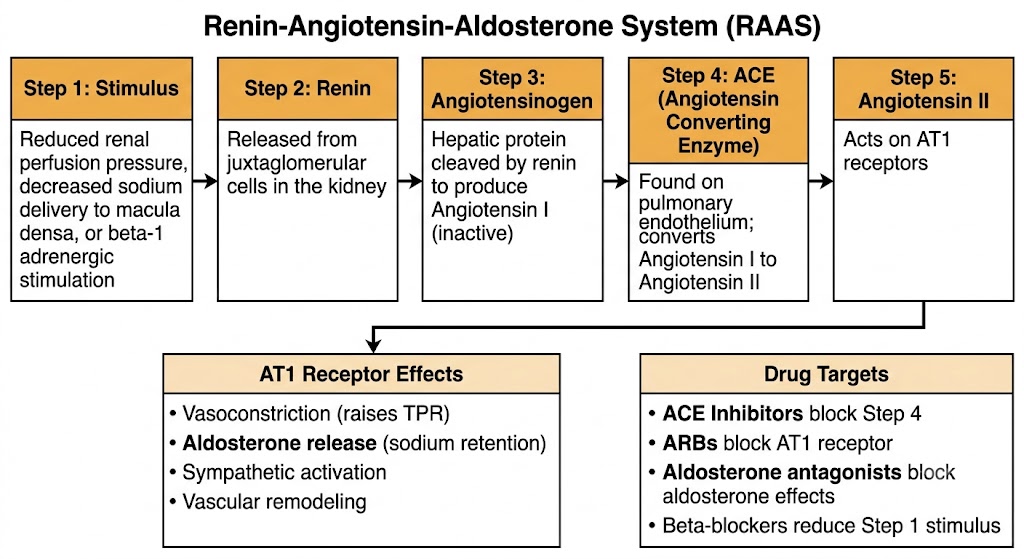
Flow diagram showing the five steps of the renin-angiotensin-aldosterone system pathway, from stimulus through renin, angiotensinogen, angiotensin converting enzyme, and angiotensin II, with downstream AT1 receptor effects and drug target annotations.
Renin-angiotensin-aldosterone system pathway showing sequential steps from stimulus to angiotensin II and downstream pharmacological targets. Source: AI-generated figure (Gemini). Educational use.
Sympathetic Nervous System Overactivation

Sympathetic nervous system overactivation contributes to hypertension through multiple simultaneous mechanisms: increased heart rate and myocardial contractility raise cardiac output; vasoconstriction of resistance arterioles increases total peripheral resistance; renal vasoconstriction reduces renal blood flow; and direct stimulation of juxtaglomerular cells via beta-1 receptors drives further renin release, creating a feed-forward loop with the renin-angiotensin-aldosterone system.

Sympathetic overactivation is particularly prominent in younger patients with hypertension, in obesity-related hypertension, and in hypertension associated with obstructive sleep apnea. Beta-blockers target this mechanism directly by reducing heart rate, contractility, and renin release. Alpha-1 blockers and centrally acting agents such as clonidine address different aspects of sympathetic overactivation, as covered in Module 5.

Renal Sodium Handling

The kidney ultimately determines long-term blood pressure by regulating sodium and water balance. In a healthy individual, a rise in blood pressure produces a brisk increase in sodium excretion (natriuresis), which reduces plasma volume and returns blood pressure toward normal. In hypertension, this pressure-natriuresis relationship is shifted: the kidney retains sodium at blood pressure levels that should trigger excretion, maintaining a higher blood pressure set point.

This resetting is driven by renin-angiotensin-aldosterone system and sympathetic nervous system activation, which together increase tubular sodium reabsorption. Diuretics work by overriding this reset — they force natriuresis pharmacologically, reducing plasma volume and shifting the operating pressure downward. Salt sensitivity (a more pronounced blood pressure response to dietary sodium) is particularly common in older adults, patients with chronic kidney disease, and Black patients.

Vascular Remodeling and Endothelial Dysfunction

Sustained hypertension produces structural changes in resistance arterioles — thickening of the vessel wall with a narrowed lumen — that increase total peripheral resistance even when the original neurohormonal stimulus is pharmacologically controlled. This structural remodeling helps explain why hypertension becomes progressively harder to control over decades and why some patients require multiple drug classes to reach target blood pressure.

The endothelium normally produces nitric oxide, a vasodilatory and antiplatelet molecule. In hypertension, oxidative stress reduces nitric oxide bioavailability, shifting the vascular tone toward sustained vasoconstriction and creating a prothrombotic environment. This endothelial dysfunction precedes structural damage and contributes to cardiovascular risk beyond elevated blood pressure alone.

Section 3

Target Organ Damage

Cardiovascular, cerebrovascular, renal, and ophthalmologic consequences of sustained hypertension

Hypertension injures multiple organ systems simultaneously through the combined effects of elevated mechanical pressure and neurohormonal activation. Recognizing the pattern of target organ damage is clinically important for risk stratification and for understanding why certain antihypertensive drug classes provide benefit beyond blood pressure reduction alone.

Cardiovascular Consequences

The heart responds to chronic pressure overload by hypertrophying — the left ventricular wall thickens, a process called left ventricular hypertrophy. This is both an adaptive response to elevated afterload and an independent risk factor for arrhythmia, diastolic dysfunction, heart failure with preserved ejection fraction, and sudden cardiac death. Sustained hypertension is the leading attributable risk factor for heart failure with preserved ejection fraction, and it also contributes to heart failure with reduced ejection fraction through coronary artery disease and direct myocardial injury. Atrial fibrillation risk rises with left ventricular hypertrophy and left atrial enlargement, which are direct consequences of chronic pressure overload.

Coronary artery disease is accelerated by hypertension through endothelial dysfunction, which promotes atherosclerotic plaque formation and reduces the vessel's capacity to dilate in response to increased demand. This is why antihypertensive therapy reduces myocardial infarction risk, and why renin-angiotensin-aldosterone system inhibitors provide additional cardioprotection beyond blood pressure lowering.

Cerebrovascular Consequences

Hypertension is the single most important modifiable risk factor for stroke, contributing to both ischemic and hemorrhagic events. Chronic elevation of blood pressure damages small penetrating cerebral arteries, producing lacunar infarcts and white matter changes that impair cognition over time. In hypertensive emergencies (blood pressure above 180/120 with acute target organ damage), rapid uncontrolled pressure elevation can overwhelm cerebral autoregulation, causing vasogenic edema — a syndrome of hypertensive encephalopathy with headache, confusion, and sometimes seizure.

Renal Consequences

The kidney is both a target and a driver of hypertension. Sustained elevated pressure damages afferent arterioles and glomeruli (hypertensive nephrosclerosis), reducing the filtering surface and impairing sodium excretion — which in turn worsens blood pressure control in a self-reinforcing cycle. Microalbuminuria (small amounts of albumin in urine not detectable on standard dipstick) is an early marker of hypertensive renal injury and independently predicts cardiovascular risk.

Ophthalmologic and Vascular Consequences

Hypertensive retinopathy ranges from mild arteriovenous nicking (where thickened arterioles compress crossing venules) to severe findings including flame hemorrhages, cotton-wool spots (indicating retinal ischemia), and papilledema (seen in malignant hypertension). Funduscopic examination provides a direct window into the severity and chronicity of hypertension-related vascular damage.

Hypertension is the primary modifiable risk factor for both aortic aneurysm and aortic dissection. Persistent high intraluminal pressure, combined with the structural weakening caused by medial degeneration, creates conditions for progressive aortic enlargement and catastrophic acute events.

Left Ventricular Hypertrophy Regression — Clinical Significance

Antihypertensive therapy — particularly with renin-angiotensin-aldosterone system inhibitors — can cause regression of left ventricular hypertrophy. This regression is associated with improved cardiovascular outcomes beyond what blood pressure reduction alone would predict, suggesting that direct anti-trophic effects of these drugs contribute to their organ-protective benefit.


Section 4

Hemodynamic Framework for Drug Selection

The cardiac output × total peripheral resistance framework as the basis for rational antihypertensive drug class selection

Every antihypertensive drug acts by reducing either cardiac output or total peripheral resistance — or both. Understanding which mechanism is dominant in a given patient, and which drug class targets that mechanism, is the foundation of rational pharmacological management. This framework is revisited in each subsequent module as clinical rationale for drug selection and combination therapy.

The Blood Pressure Equation

Blood pressure equals cardiac output multiplied by total peripheral resistance. Cardiac output is itself the product of stroke volume and heart rate. Any intervention that reduces cardiac output, total peripheral resistance, or both will lower blood pressure. The art of antihypertensive therapy lies in matching the drug's hemodynamic mechanism to the mechanism driving elevated blood pressure in a particular patient.

In younger patients with hypertension, especially those with high resting heart rates or hyperkinetic circulation, elevated cardiac output from sympathetic overactivation is often the dominant mechanism. In older patients with established hypertension, elevated total peripheral resistance from vascular remodeling and neurohormonal activation is typically predominant. These differences predict differential drug responsiveness.

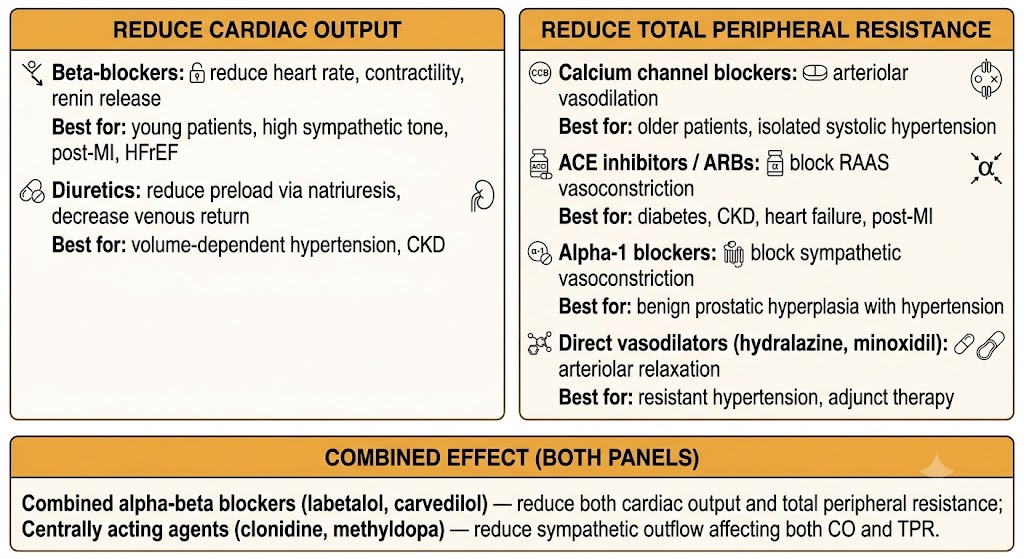
Two-panel diagram showing antihypertensive drug classes organized by hemodynamic target: left panel shows drugs that reduce cardiac output (beta-blockers, diuretics) and right panel shows drugs that reduce total peripheral resistance (calcium channel blockers, ACE inhibitors, ARBs, alpha-1 blockers, direct vasodilators), with a shared bottom panel for combined-effect agents.
Antihypertensive drug classes organized by primary hemodynamic target: cardiac output reduction versus total peripheral resistance reduction. Source: AI-generated figure (Gemini). Educational use.
Drug Classes and Their Hemodynamic Targets
Drug Class Primary Hemodynamic Target Best-Suited Clinical Context
Beta-blockers Reduce cardiac output (heart rate and contractility) and renin release Young patients; high sympathetic tone; post-myocardial infarction; heart failure with reduced ejection fraction
Calcium channel blockers, angiotensin converting enzyme inhibitors, angiotensin receptor blockers, alpha-1 blockers Reduce total peripheral resistance via vasodilation Established hypertension; older patients; elevated total peripheral resistance predominates
Diuretics Reduce preload via natriuresis (decreased venous return and cardiac output) Volume-dependent hypertension; chronic kidney disease; adjunct to renin-angiotensin-aldosterone system inhibition
Combined alpha-beta blockers (labetalol, carvedilol) Reduce both cardiac output and total peripheral resistance Hypertensive emergencies; heart failure with reduced ejection fraction; both elevated cardiac output and elevated total peripheral resistance are operative
Centrally acting agents (clonidine, methyldopa) Reduce sympathetic outflow, lowering both cardiac output and peripheral resistance Resistant hypertension; hypertension in pregnancy (methyldopa)
Direct vasodilators (hydralazine, minoxidil) Directly relax arteriolar smooth muscle, reducing total peripheral resistance Resistant hypertension; adjunct when other classes are insufficient

Treatment Decision Framework

The decision to initiate pharmacotherapy depends on both the blood pressure level and the patient's overall cardiovascular risk. A patient with Stage 1 hypertension (130–139/80–89 millimeters of mercury) and established coronary artery disease warrants immediate drug therapy. The same blood pressure in a low-risk individual may be managed with lifestyle modification alone before pharmacotherapy is started. Treatment targets and comorbidity-specific drug selection are addressed in Modules 6 through 11.

Lifestyle modifications — dietary sodium restriction, the Dietary Approaches to Stop Hypertension eating pattern, weight loss, aerobic exercise, alcohol moderation, and smoking cessation — reduce blood pressure meaningfully and should accompany pharmacotherapy at all stages. They are not an alternative to pharmacotherapy in high-risk patients.


Suggested References
Author / Organization Title Source
Whelton PK, Carey RM, Aronow WS, et al. 2017 ACC/AHA guideline for the prevention, detection, evaluation, and management of high blood pressure in adults J Am Coll Cardiol. 2018;71(19):e127–e248
Mancia G, Kreutz R, Brunstrom M, et al. 2023 ESH guidelines for the management of arterial hypertension J Hypertens. 2023;41(12):1874–2071
NCD Risk Factor Collaboration Worldwide trends in hypertension prevalence and progress in treatment and control from 1990 to 2019 Lancet. 2021;398(10304):957–980
Oparil S, Acelajado MC, Bakris GL, et al. Hypertension Nat Rev Dis Primers. 2018;4:18014
Guyton AC Blood pressure control — special role of the kidneys and body fluids Science. 1991;252(5014):1813–1816
Carey RM, Muntner P, Bosworth HB, Whelton PK Prevention and control of hypertension: JACC health promotion series J Am Coll Cardiol. 2018;72(11):1278–1293
Schmieder RE End organ damage in hypertension Dtsch Arztebl Int. 2010;107(49):866–873
Williams B, Mancia G, Spiering W, et al. 2018 ESC/ESH guidelines for the management of arterial hypertension Eur Heart J. 2018;39(33):3021–3104
Brewster LM, van Montfrans GA, Kleijnen J Systematic review: antihypertensive drug therapy in Black patients Ann Intern Med. 2004;141(8):614–627
Pimenta E, Calhoun DA Primary aldosteronism: diagnosis and treatment J Clin Hypertens. 2006;8(12):887–893
Drager LF, Togeiro SM, Polotsky VY, Lorenzi-Filho G Obstructive sleep apnea: a cardiometabolic risk in obesity and the metabolic syndrome J Am Coll Cardiol. 2013;62(7):569–576
Touyz RM, Schiffrin EL Reactive oxygen species in vascular biology: implications in hypertension Histochem Cell Biol. 2004;122(4):339–352
Lifton RP, Gharavi AG, Geller DS Molecular mechanisms of human hypertension Cell. 2001;104(4):545–556
Funder JW, Carey RM, Mantero F, et al. The management of primary aldosteronism: case detection, diagnosis, and treatment — an Endocrine Society clinical practice guideline J Clin Endocrinol Metab. 2016;101(5):1889–1916
Ferrario CM Role of angiotensin II in cardiovascular disease — therapeutic implications of more than a century of research J Renin Angiotensin Aldosterone Syst. 2006;7(1):3–14