Introduction to Medical Pharmacology
Module 2 — Hypertension: Diagnosis, Evaluation & Secondary Causes
AHTN · Module 2 of 11Section 1
Accurate diagnosis requires confirming sustained elevation, excluding secondary causes, and stratifying cardiovascular risk
A single elevated blood pressure reading does not establish a diagnosis of hypertension. Accurate diagnosis requires averaging at least two readings on at least two separate visits, using correct technique, and confirming that the elevation is real and persistent rather than situational. How blood pressure is measured — and where — affects diagnosis, treatment thresholds, and monitoring.
Standard office measurement requires the patient to be seated quietly for five minutes, with no caffeine or exercise within thirty minutes. Two readings taken one to two minutes apart are averaged. Both arms are measured at the first visit; a difference greater than 15 millimeters of mercury between arms warrants vascular evaluation for subclavian stenosis or coarctation.
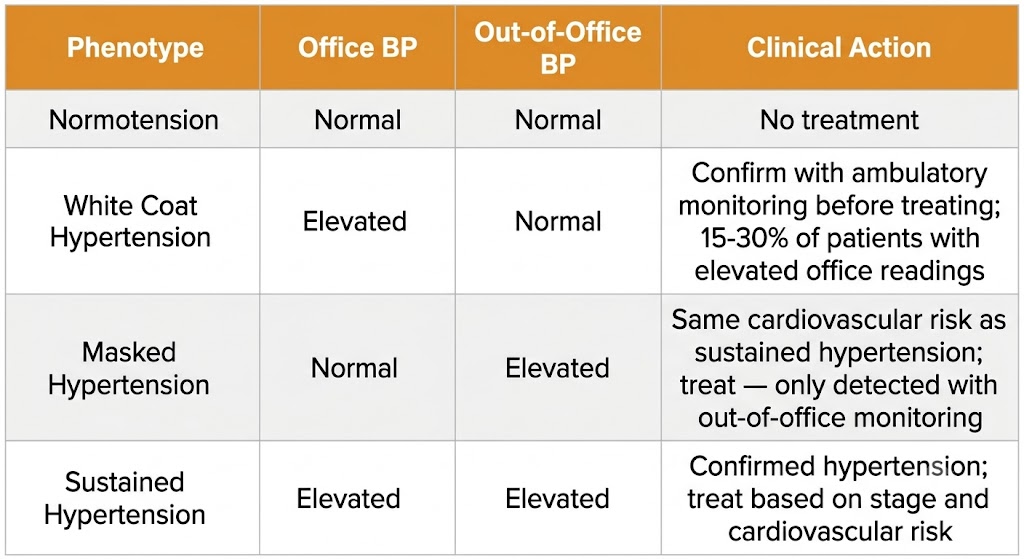
Out-of-office measurement has become an essential part of diagnosis. Ambulatory blood pressure monitoring provides 24-hour continuous readings and is the most accurate predictor of cardiovascular outcome — more so than office measurement alone. Home blood pressure monitoring using a validated automated device is an accessible alternative. Both methods identify BP phenotypes that office measurement alone cannot distinguish.
Comparing office and out-of-office readings defines four clinically meaningful phenotypes. Recognizing these phenotypes prevents both over-treatment (white coat hypertension) and dangerous under-detection (masked hypertension).
The clinical evaluation of a newly diagnosed hypertensive patient serves to identify secondary causes and confirm the absence of target organ damage that would alter drug selection. The medication history deserves particular attention: nonsteroidal anti-inflammatory drugs, oral contraceptives, decongestants, calcineurin inhibitors, stimulants, and erythropoietin are all common causes of drug-induced blood pressure elevation that can be missed without a systematic review.
Physical examination findings that directly influence pharmacological management include a renal artery bruit (suggesting renovascular hypertension and affecting the safety of renin-angiotensin-aldosterone system inhibitors), fundoscopic changes (grading hypertensive retinopathy and indicating treatment urgency), and signs of hormonal excess such as central adiposity and striae (suggesting Cushing syndrome). Baseline laboratory work — serum creatinine, electrolytes, urinalysis, and lipid panel — establishes kidney function, potassium level (critical for diuretic and renin-angiotensin-aldosterone system inhibitor safety), and cardiovascular risk before drugs are started.
Section 2
Identifying treatable causes and understanding how each cause shapes drug selection and contraindications
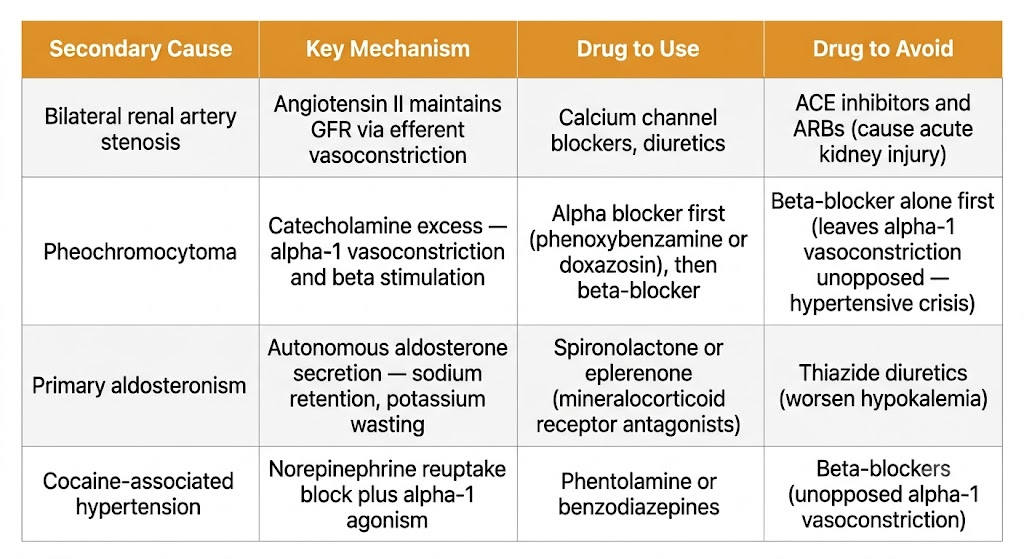
Secondary hypertension accounts for 5 to 10 percent of all hypertension but is overrepresented in patients with resistant hypertension, where it may account for 30 to 40 percent of cases. Each secondary cause has a specific pharmacological implication — either a drug class that is particularly effective because it targets the underlying mechanism, or a drug class that is contraindicated because it worsens the underlying physiology.
Renal artery stenosis reduces perfusion pressure distal to the stenosis, activating renin release and producing renin-dependent hypertension. In unilateral renal artery stenosis, angiotensin converting enzyme inhibitors and angiotensin receptor blockers effectively lower blood pressure. However, in bilateral renal artery stenosis — or stenosis to a solitary functioning kidney — these drugs are contraindicated.
The reason is mechanistic: angiotensin II maintains glomerular filtration by constricting the efferent arteriole, which preserves intraglomerular pressure when the afferent arteriole is already stenosed. Blocking angiotensin II in this setting removes the only mechanism sustaining filtration, causing a precipitous and potentially irreversible fall in glomerular filtration rate. A clinical clue is acute kidney injury occurring shortly after starting an angiotensin converting enzyme inhibitor or angiotensin receptor blocker in a patient with refractory hypertension — this pattern should prompt evaluation for bilateral renal artery stenosis. In confirmed cases, calcium channel blockers, diuretics, or centrally acting agents are used instead.
Primary aldosteronism is the most common endocrine cause of hypertension and the most common surgically correctable cause. Autonomous aldosterone secretion drives sodium retention, potassium wasting, and renin suppression. The clinical clue is hypokalemia (often spontaneous, without diuretic use) combined with refractory hypertension, though many patients are normokalemic.
Pharmacological treatment is targeted to the mechanism. Mineralocorticoid receptor antagonists directly block the aldosterone receptor in the renal collecting duct. Spironolactone is the first-line medical agent, started at low doses and titrated upward. Its primary adverse effects reflect its non-selectivity: it also blocks androgen and progesterone receptors, causing gynecomastia, breast tenderness, and menstrual irregularities. Eplerenone is a selective mineralocorticoid receptor antagonist that avoids these off-target hormonal effects and is preferred in men with sexual or hormonal side effects from spironolactone. Both agents require monitoring of serum potassium, particularly in patients with chronic kidney disease. Thiazide diuretics should be avoided as first-line agents in primary aldosteronism because they further worsen the existing hypokalemia.
Pheochromocytoma — The Alpha-Before-Beta Rule
Pheochromocytoma and paraganglioma secrete catecholamines (epinephrine and norepinephrine). The classic presentation is episodic headache, diaphoresis, and palpitations — a triad triggered by catecholamine surges. Plasma free metanephrines are the preferred initial biochemical test, as catecholamines are produced continuously within the tumor even between episodes.
The critical pharmacological rule: alpha-adrenoceptor blockade must be established before beta-blockade. If a beta-blocker is given first, it removes beta-2-mediated vasodilation while leaving alpha-1 vasoconstriction unopposed — this can precipitate a severe or fatal hypertensive crisis. Phenoxybenzamine (non-selective, irreversible alpha blocker) or doxazosin (selective alpha-1 blocker) is started 10 to 14 days before surgery. Beta-blockade for heart rate control is added only after adequate alpha blockade is confirmed.
Cocaine-associated hypertensive crisis follows the same principle: beta-blockers are contraindicated. Phentolamine (alpha blocker) or benzodiazepines are used instead.
Drug-induced hypertension is common and frequently unrecognized. A systematic medication review is essential before labeling hypertension as primary.
Mechanism: Sodium Retention
Nonsteroidal Anti-inflammatory Drugs
Mechanism: RAAS Activation
Estrogen-Containing Oral Contraceptives
Mechanism: Renal Vasoconstriction
Calcineurin Inhibitors (Cyclosporine, Tacrolimus)
Mechanism: Sympathomimetic
Decongestants, Amphetamines, Cocaine
| Cause | Key Mechanism | Pharmacological Implication |
|---|---|---|
| Cushing Syndrome | Cortisol activates mineralocorticoid receptors; increases angiotensinogen; sympathetic stimulation | Treat underlying cause first; spironolactone useful for mineralocorticoid excess component; exogenous glucocorticoid dose reduction when feasible |
| Obstructive Sleep Apnea | Intermittent hypoxemia drives sympathetic activation and aldosterone excess | Continuous positive airway pressure lowers BP modestly (2–3 mm Hg); mineralocorticoid receptor antagonists particularly effective in resistant hypertension with obstructive sleep apnea; avoid opioids and benzodiazepines (worsen apnea) |
| Hypothyroidism | Low thyroid hormone increases peripheral vascular resistance (diastolic hypertension) | Thyroid hormone replacement normalizes BP; standard antihypertensives as adjunct |
| Renal Parenchymal Disease | Sodium retention and renin-angiotensin-aldosterone system activation from reduced nephron mass | Angiotensin converting enzyme inhibitors or angiotensin receptor blockers first-line with proteinuria (renoprotective); loop diuretics preferred when estimated glomerular filtration rate below 30 mL/min |
Section 3
When to initiate pharmacotherapy and evidence-based targets that govern every subsequent module
Treatment decisions are based on both the blood pressure level and the patient's total cardiovascular risk profile. These thresholds and targets are the clinical framework against which every drug class in the following modules is evaluated — understanding them here makes the drug-specific evidence base in later modules meaningful.
For Stage 1 hypertension (130–139/80–89 millimeters of mercury), pharmacotherapy is indicated when the 10-year cardiovascular risk is at or above 10 percent, or when established cardiovascular disease, chronic kidney disease, or diabetes mellitus is present. In lower-risk patients, lifestyle modification is tried first with reassessment at three to six months.
For Stage 2 hypertension (at or above 140/90 millimeters of mercury), pharmacotherapy is recommended for all patients. When blood pressure is at or above 160/100, combination therapy is typically started from the outset rather than a single drug, because monotherapy rarely achieves target at these levels.
The 2017 American College of Cardiology/American Heart Association guidelines recommend a target below 130/80 millimeters of mercury for patients with established cardiovascular disease or a 10-year cardiovascular risk at or above 10 percent, and consider this target reasonable for most adults treated with pharmacotherapy.
The SPRINT trial (2015) provided the key evidence base for intensive blood pressure control. It compared a systolic target below 120 millimeters of mercury against a standard target below 140 in patients without diabetes. The intensive group had a 25 percent reduction in composite cardiovascular events and a 27 percent reduction in all-cause mortality. This trial reinforced the current guideline target of below 130/80 for high-risk patients.
In patients with diabetes, the target below 130/80 is also recommended, though the evidence for going below 120 is weaker — the ACCORD trial in diabetic patients showed a stroke reduction but no significant benefit on the primary cardiovascular endpoint with intensive control.
Lifestyle Modifications — Meaningful Blood Pressure Reduction
Lifestyle modifications reduce blood pressure meaningfully and should accompany pharmacotherapy at all stages. The Dietary Approaches to Stop Hypertension eating pattern can reduce systolic blood pressure by approximately 11 millimeters of mercury in hypertensive patients. Sodium restriction below 2.3 grams per day reduces systolic blood pressure by 5 to 6 millimeters of mercury. Aerobic exercise reduces systolic blood pressure by 5 to 8 millimeters of mercury. Weight loss, alcohol moderation, and smoking cessation each provide additional benefit. These interventions are additive — patients on maximum pharmacotherapy who also make lifestyle changes achieve better blood pressure control than either approach alone.
The four drug classes with the strongest evidence base for reducing cardiovascular morbidity and mortality in primary hypertension form the foundation of all treatment algorithms: angiotensin converting enzyme inhibitors, angiotensin receptor blockers, calcium channel blockers (dihydropyridine class), and thiazide and thiazide-like diuretics. These classes are covered in detail in Modules 3 and 4. Beta-blockers, alpha-blockers, centrally acting agents, and direct vasodilators occupy specific niches addressed in Module 5. Treatment strategy, combination therapy, and resistant hypertension are covered in Module 6.
| Author / Organization | Title | Source |
|---|---|---|
| Whelton PK, Carey RM, Aronow WS, et al. | 2017 ACC/AHA guideline for the prevention, detection, evaluation, and management of high blood pressure in adults | J Am Coll Cardiol. 2018;71(19):e127–e248 |
| Mancia G, Kreutz R, Brunstrom M, et al. | 2023 ESH guidelines for the management of arterial hypertension | J Hypertens. 2023;41(12):1874–2071 |
| Stergiou GS, Palatini P, Parati G, et al. | 2021 European Society of Hypertension practice guidelines for office and out-of-office blood pressure measurement | J Hypertens. 2021;39(7):1293–1302 |
| Lenders JW, Duh QY, Eisenhofer G, et al. | Pheochromocytoma and paraganglioma: an Endocrine Society clinical practice guideline | J Clin Endocrinol Metab. 2014;99(6):1915–1942 |
| Kidney Disease: Improving Global Outcomes (KDIGO) Blood Pressure Work Group | KDIGO 2021 clinical practice guideline for the management of blood pressure in chronic kidney disease | Kidney Int. 2021;99(3S):S1–S87 |
| ASTRAL Investigators; Wheatley K, Ives N, Gray R, et al. | Revascularization versus medical therapy for renal-artery stenosis (ASTRAL) | N Engl J Med. 2009;361(20):1953–1962 |
| Cooper CJ, Murphy TP, Cutlip DE, et al. | Stenting and medical therapy for atherosclerotic renal-artery stenosis (CORAL) | N Engl J Med. 2014;370(1):13–22 |
| Funder JW, Carey RM, Mantero F, et al. | The management of primary aldosteronism: case detection, diagnosis, and treatment — an Endocrine Society clinical practice guideline | J Clin Endocrinol Metab. 2016;101(5):1889–1916 |
| Drager LF, Togeiro SM, Polotsky VY, Lorenzi-Filho G | Obstructive sleep apnea: a cardiometabolic risk in obesity and the metabolic syndrome | J Am Coll Cardiol. 2013;62(7):569–576 |
| Appel LJ, Moore TJ, Obarzanek E, et al. | A clinical trial of the effects of dietary patterns on blood pressure (DASH trial) | N Engl J Med. 1997;336(16):1117–1124 |
| SPRINT Research Group; Wright JT Jr, Williamson JD, Whelton PK, et al. | A randomized trial of intensive versus standard blood-pressure control | N Engl J Med. 2015;373(22):2103–2116 |
| ACCORD Study Group; Cushman WC, Evans GW, Byington RP, et al. | Effects of intensive blood-pressure control in type 2 diabetes mellitus | N Engl J Med. 2010;362(17):1575–1585 |
| Jamerson K, Weber MA, Bakris GL, et al. | Benazepril plus amlodipine or hydrochlorothiazide for hypertension in high-risk patients (ACCOMPLISH) | N Engl J Med. 2008;359(23):2417–2428 |
| Carey RM, Muntner P, Bosworth HB, Whelton PK | Prevention and control of hypertension: JACC health promotion series | J Am Coll Cardiol. 2018;72(11):1278–1293 |
| Nieman LK, Biller BM, Findling JW, et al. | The diagnosis of Cushing syndrome: an Endocrine Society clinical practice guideline | J Clin Endocrinol Metab. 2008;93(5):1526–1540 |
| Calhoun DA, Jones D, Textor S, et al. | Resistant hypertension: diagnosis, evaluation, and treatment — a scientific statement from the American Heart Association | Hypertension. 2008;51(6):1403–1419 |