Introduction to Medical Pharmacology
Module 3 — ACE Inhibitors & Angiotensin Receptor Blockers
AHTN · Module 3 of 11Section 1
Mechanism, compelling indications, adverse effects, and contraindications
Angiotensin converting enzyme inhibitors are among the most widely prescribed drugs in medicine. Their target — the renin-angiotensin-aldosterone system — is the dominant neurohormonal driver of hypertension and cardiovascular remodeling, making these agents disease-modifying therapies with outcome benefits that extend well beyond blood pressure reduction alone.
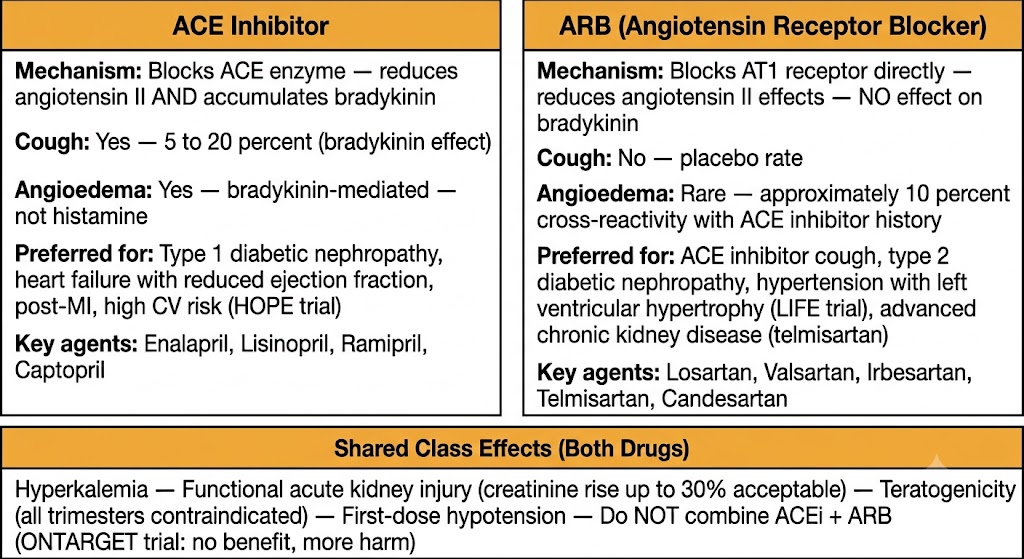
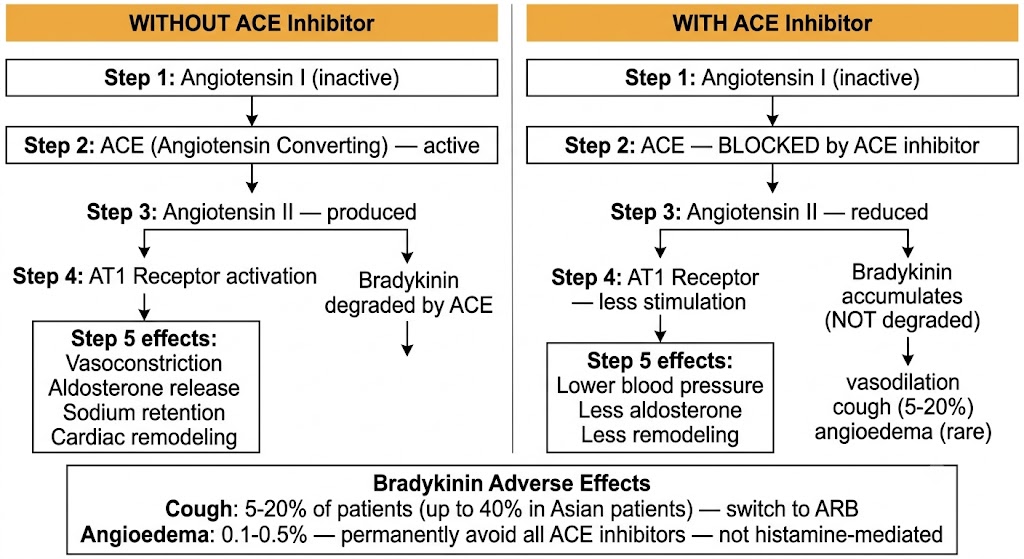
Angiotensin converting enzyme is a zinc-containing enzyme with two physiologically important substrates. First, it converts angiotensin I to angiotensin II — the potent vasoconstrictor that drives blood pressure elevation, aldosterone release, sodium retention, and cardiac and renal remodeling. Second, it is the principal enzyme that degrades bradykinin, a vasodilatory and natriuretic peptide.
Angiotensin converting enzyme inhibitors block both of these functions simultaneously. The primary antihypertensive and organ-protective mechanism is the reduction of angiotensin II. The accumulation of bradykinin provides additional vasodilation — but also underlies the two most clinically important adverse effects of this class: dry cough and angioedema. The net hemodynamic effect is reduced total peripheral resistance with no reflex tachycardia, and modest reduction in both preload and afterload that is particularly beneficial in heart failure.
Most angiotensin converting enzyme inhibitors are prodrugs requiring hepatic conversion to their active form — the exceptions are captopril and lisinopril, which are active as administered. Lisinopril is water-soluble and excreted renally unchanged, making it the preferred agent when hepatic function is impaired. Fosinopril has dual elimination through both the kidney and liver, making it the preferred angiotensin converting enzyme inhibitor in advanced chronic kidney disease where renal clearance is severely reduced. Most other agents require dose reduction as estimated glomerular filtration rate falls. Ramipril has the broadest outcome trial evidence base across multiple indications.
A compelling indication is an evidence-based outcome benefit independent of blood pressure lowering. Angiotensin converting enzyme inhibitors have compelling indications in several settings where they reduce mortality or organ damage beyond what would be expected from blood pressure reduction alone.
Heart Failure
Heart Failure with Reduced Ejection Fraction
Post-Myocardial Infarction
Left Ventricular Dysfunction After MI
Diabetic Nephropathy
Type 1 Diabetes with Proteinuria
High Cardiovascular Risk
Without Heart Failure (HOPE Trial)
The two angiotensin converting enzyme inhibitor-specific adverse effects — dry cough and angioedema — both result from bradykinin accumulation and distinguish this class from angiotensin receptor blockers.
Dry Cough — Bradykinin Mechanism
Dry, non-productive cough occurs in 5 to 20 percent of patients overall and up to 30 to 40 percent in patients of Asian descent due to pharmacogenomic variation in bradykinin metabolism. The mechanism is bradykinin accumulation in the respiratory tract stimulating sensory nerve fibers. Onset is typically within one to four weeks but can be delayed. Management requires switching to an angiotensin receptor blocker — angiotensin receptor blockers do not accumulate bradykinin and have cough rates comparable to placebo.
Angioedema — Life-Threatening, Bradykinin-Mediated
Angioedema affects approximately 0.1 to 0.5 percent of patients overall, with rates three to four times higher in Black patients. The mechanism is bradykinin-mediated increased vascular permeability in subcutaneous and submucosal tissues — this is not histamine-mediated, which explains why antihistamines and epinephrine have limited efficacy. Laryngeal involvement is life-threatening. All angiotensin converting enzyme inhibitors must be permanently avoided after this event. Angiotensin receptor blockers may be cautiously used when a compelling indication exists, as approximately 10 percent of patients with angiotensin converting enzyme inhibitor angioedema may also experience angioedema with angiotensin receptor blockers.
Class adverse effects shared with angiotensin receptor blockers include hyperkalemia (from reduced aldosterone production — monitor potassium one to two weeks after initiation), functional acute kidney injury (from efferent arteriolar dilation — a rise in creatinine of up to 30 percent is expected and acceptable; above 30 percent warrants dose reduction), and first-dose hypotension (more pronounced in volume-depleted or high-renin states). Teratogenicity is a black-box warning for both classes — all trimesters of pregnancy are contraindicated, as the fetal renin-angiotensin-aldosterone system is critical for normal renal development.
Section 2
Mechanism, clinically important agent distinctions, compelling indications, and adverse effects
Angiotensin receptor blockers are selective, competitive antagonists of the angiotensin II type 1 receptor. They share most of the organ-protective benefits of angiotensin converting enzyme inhibitors while eliminating the bradykinin-mediated adverse effects — no cough, no bradykinin angioedema — making them the best-tolerated major antihypertensive drug class.
Angiotensin receptor blockers block the angiotensin II type 1 receptor directly, preventing all angiotensin II-mediated effects: vasoconstriction, aldosterone release, sodium retention, sympathetic facilitation, and myocardial and glomerular remodeling. Because they do not inhibit angiotensin converting enzyme activity, bradykinin is not accumulated — this is the mechanistic basis for the absence of cough and bradykinin-mediated angioedema.
Blocking angiotensin II type 1 receptor-mediated feedback inhibition of renin leads to a reactive rise in circulating angiotensin II. This elevated angiotensin II then preferentially stimulates angiotensin II type 2 receptors, which exert counterregulatory vasodilatory and anti-fibrotic effects. The net hemodynamic profile is essentially identical to angiotensin converting enzyme inhibitors: reduced total peripheral resistance, modest natriuresis, no reflex tachycardia.
Unique Property
Losartan — Uricosuric Effect
Renal Elimination Avoided
Telmisartan — Biliary Elimination
Type 2 Diabetic Nephropathy
Irbesartan — Food and Drug Administration Approved
Unique Adverse Effect
Olmesartan — Sprue-Like Enteropathy
Angiotensin receptor blockers share most compelling indications with angiotensin converting enzyme inhibitors and are specifically the first-line choice when angiotensin converting enzyme inhibitors are not tolerated due to cough or angioedema.
In heart failure with reduced ejection fraction in angiotensin converting enzyme inhibitor-intolerant patients, candesartan (CHARM-Alternative trial) and valsartan (Val-HeFT trial) are the evidence-based alternatives. In type 2 diabetic nephropathy, irbesartan and losartan have Food and Drug Administration approval for renoprotection. In hypertension with left ventricular hypertrophy, losartan was superior to atenolol in the LIFE trial for both left ventricular hypertrophy regression and stroke reduction — a finding that contributed to beta-blockers falling out of first-line status for hypertension.
Angiotensin receptor blockers share the class effects of angiotensin converting enzyme inhibitors that arise from angiotensin II type 1 receptor blockade itself: hyperkalemia, functional acute kidney injury, first-dose hypotension, and teratogenicity. These require the same monitoring and carry the same contraindications as angiotensin converting enzyme inhibitors. What angiotensin receptor blockers do not cause is bradykinin accumulation — so no dry cough and no bradykinin-mediated angioedema. Cough rates with angiotensin receptor blockers are comparable to placebo, making them the definitive switch when angiotensin converting enzyme inhibitor cough is intolerable.
Section 3
When to choose each class, why dual renin-angiotensin-aldosterone system blockade is avoided, and monitoring requirements
For most clinical purposes, angiotensin converting enzyme inhibitors and angiotensin receptor blockers produce equivalent blood pressure reduction and comparable cardiovascular and renal outcomes. The choice between them is driven by tolerability, specific comorbidities, and which class has the strongest trial evidence for a particular indication.
Prefer ACE Inhibitor When
ACEi Is First-Line
Prefer ARB When
ARB Is First-Line
Dual Renin-Angiotensin-Aldosterone System Blockade — Do Not Combine ACEi + ARB
Combining an angiotensin converting enzyme inhibitor with an angiotensin receptor blocker was hypothesized to provide additive organ protection. The evidence refutes this. The ONTARGET trial (2008) showed that ramipril plus telmisartan produced no additional cardiovascular benefit compared with either agent alone, but caused significantly more hypotension, syncope, acute kidney injury, and hyperkalemia. The VA NEPHRON-D trial (2013) in type 2 diabetic nephropathy was terminated early due to excess acute kidney injury and hyperkalemia with dual blockade and no renal outcome benefit.
Do not combine angiotensin converting enzyme inhibitors and angiotensin receptor blockers. The combination increases harm without adding benefit. Similarly, avoid triple renin-angiotensin-aldosterone system blockade combining angiotensin converting enzyme inhibitor, angiotensin receptor blocker, and aldosterone antagonist.
Monitoring After Initiation or Dose Increase
Creatinine and estimated glomerular filtration rate: check one to two weeks after initiation and after each dose increase. A rise of up to 30 percent from baseline is expected and acceptable — this reflects the mechanism of renoprotection, not nephrotoxicity. Above 30 percent: reduce dose and identify precipitating factors (volume depletion, nonsteroidal anti-inflammatory drugs). Above 50 percent: hold the drug.
Potassium: check one to two weeks after initiation. Potassium 5.0 to 5.5 mEq/L: reduce dose and review diet and interacting medications. Above 5.5 mEq/L: hold the drug.
Sick-day guidance: advise patients to temporarily hold their angiotensin converting enzyme inhibitor or angiotensin receptor blocker (and any diuretics) during acute illnesses with volume depletion — vomiting, diarrhea, or fever with poor oral intake — to prevent acute kidney injury.
| Author / Organization | Title | Source |
|---|---|---|
| Whelton PK, Carey RM, Aronow WS, et al. | 2017 ACC/AHA guideline for the prevention, detection, evaluation, and management of high blood pressure in adults | J Am Coll Cardiol. 2018;71(19):e127–e248 |
| Mancia G, Kreutz R, Brunstrom M, et al. | 2023 ESH guidelines for the management of arterial hypertension | J Hypertens. 2023;41(12):1874–2071 |
| Ferrario CM | Role of angiotensin II in cardiovascular disease — therapeutic implications of more than a century of research | J Renin Angiotensin Aldosterone Syst. 2006;7(1):3–14 |
| The CONSENSUS Trial Study Group | Effects of enalapril on mortality in severe congestive heart failure | N Engl J Med. 1987;316(23):1429–1435 |
| GISSI-3 Investigators | Effects of lisinopril and transdermal glyceryl trinitrate singly and together on 6-week mortality and ventricular function after acute myocardial infarction | Lancet. 1994;343(8906):1115–1122 |
| Yusuf S, Sleight P, Pogue J, et al. | Effects of an angiotensin-converting-enzyme inhibitor, ramipril, on cardiovascular events in high-risk patients (HOPE trial) | N Engl J Med. 2000;342(3):145–153 |
| Fox KM; EUROPA Investigators | Efficacy of perindopril in reduction of cardiovascular events among patients with stable coronary artery disease (EUROPA) | Lancet. 2003;362(9386):782–788 |
| Lewis EJ, Hunsicker LG, Bain RP, Rohde RD | The effect of angiotensin-converting-enzyme inhibition on diabetic nephropathy | N Engl J Med. 1993;329(20):1456–1462 |
| Gruppo Italiano di Studi Epidemiologici in Nefrologia (GISEN) | Randomised placebo-controlled trial of effect of ramipril on decline in GFR and risk of terminal renal failure in proteinuric, non-diabetic nephropathy (REIN trial) | Lancet. 1997;349(9069):1857–1863 |
| Bullo M, Tschumi S, Bucher BS, Bianchetti MG, Simonetti GD | Pregnancy outcome following exposure to angiotensin-converting enzyme inhibitors or angiotensin receptor antagonists | Hypertension. 2012;60(2):444–450 |
| Dahlof B, Devereux RB, Kjeldsen SE, et al. | Cardiovascular morbidity and mortality in the Losartan Intervention For Endpoint reduction in hypertension study (LIFE) | Lancet. 2002;359(9311):995–1003 |
| Brenner BM, Cooper ME, de Zeeuw D, et al. | Effects of losartan on renal and cardiovascular outcomes in patients with type 2 diabetes and nephropathy (RENAAL) | N Engl J Med. 2001;345(12):861–869 |
| Cohn JN, Tognoni G; Valsartan Heart Failure Trial Investigators | A randomized trial of the angiotensin-receptor blocker valsartan in chronic heart failure (Val-HeFT) | N Engl J Med. 2001;345(23):1667–1675 |
| Lewis EJ, Hunsicker LG, Clarke WR, et al. | Renoprotective effect of the angiotensin-receptor antagonist irbesartan in patients with nephropathy due to type 2 diabetes (IDNT) | N Engl J Med. 2001;345(12):851–860 |
| Parving HH, Lehnert H, Brochner-Mortensen J, et al. | The effect of irbesartan on the development of diabetic nephropathy in patients with type 2 diabetes (IRMA-2) | N Engl J Med. 2001;345(12):870–878 |
| Granger CB, McMurray JJ, Yusuf S, et al. | Effects of candesartan in patients with chronic heart failure and reduced left-ventricular systolic function intolerant to ACE inhibitors (CHARM-Alternative) | Lancet. 2003;362(9386):772–776 |
| Yusuf S, Teo KK, Pogue J, et al. | Telmisartan, ramipril, or both in patients at high risk for vascular events (ONTARGET) | N Engl J Med. 2008;358(15):1547–1559 |
| Fried LF, Emanuele N, Zhang JH, et al. | Combined angiotensin inhibition for the treatment of diabetic nephropathy (VA NEPHRON-D) | N Engl J Med. 2013;369(20):1892–1903 |
| Parving HH, Brenner BM, McMurray JJ, et al. | Cardiorenal end points in a trial of aliskiren for type 2 diabetes (ALTITUDE) | N Engl J Med. 2012;367(23):2204–2213 |