Introduction to Medical Pharmacology
Module 11 — Hypertension with Comorbid Cardiovascular Disease
AHTN · Module 11 of 11Section 1
HFrEF four-pillar guideline-directed medical therapy, the critical CCB distinction, and HFpEF emerging evidence
In patients with established cardiovascular disease, antihypertensive therapy is no longer simply about lowering blood pressure — it is about selecting agents whose mechanisms simultaneously address the hypertension and the underlying disease. Nowhere is this more powerfully expressed than in heart failure, where four specific drug classes reduce mortality through mechanisms far beyond blood pressure reduction alone.
Heart failure with reduced ejection fraction (left ventricular ejection fraction at or below 40 percent) is managed with four pillars of guideline-directed medical therapy, each with proven mortality benefit and each contributing antihypertensive effect as an added property.
Pillar 1 — Angiotensin pathway inhibition: Sacubitril-valsartan is preferred — the PARADIGM-HF trial demonstrated superiority over enalapril with 20 percent reduction in cardiovascular mortality and heart failure hospitalization. An angiotensin converting enzyme inhibitor or angiotensin receptor blocker is used when sacubitril-valsartan is not tolerated or affordable. Critical rule: sacubitril-valsartan must never be combined with an angiotensin converting enzyme inhibitor; a 36-hour washout from any angiotensin converting enzyme inhibitor is required before initiation to prevent angioedema.
Pillar 2 — Beta-blocker: Three agents have proven mortality benefit in heart failure with reduced ejection fraction. Carvedilol (COPERNICUS: 35 percent mortality reduction in severe heart failure with reduced ejection fraction), metoprolol succinate (MERIT-HF: 34 percent mortality reduction), and bisoprolol (CIBIS-II: 34 percent mortality reduction). Must be started at lowest dose when stable and uptitrated slowly — never initiated during acute decompensation.
Pillar 3 — Mineralocorticoid receptor antagonist: Spironolactone (RALES trial: 30 percent mortality reduction) or eplerenone (EMPHASIS-HF: 37 percent reduction in cardiovascular mortality and heart failure hospitalization in mild heart failure with reduced ejection fraction). Indicated when ejection fraction is at or below 35 percent already on pillar 1 and pillar 2 therapy. Contraindicated when potassium is above 5.0 mEq/L, creatinine above 2.5 mg/dL in men or above 2.0 mg/dL in women, or estimated glomerular filtration rate below 30 mL/min.
Pillar 4 — SGLT2 inhibitor: Dapagliflozin (DAPA-HF: 26 percent reduction in composite of cardiovascular death, heart failure hospitalization, or urgent heart failure visit regardless of diabetes status) and empagliflozin (EMPEROR-Reduced) are Class I guideline-directed medical therapy. Provide a modest additional antihypertensive effect of 3 to 5 millimeters of mercury systolic.
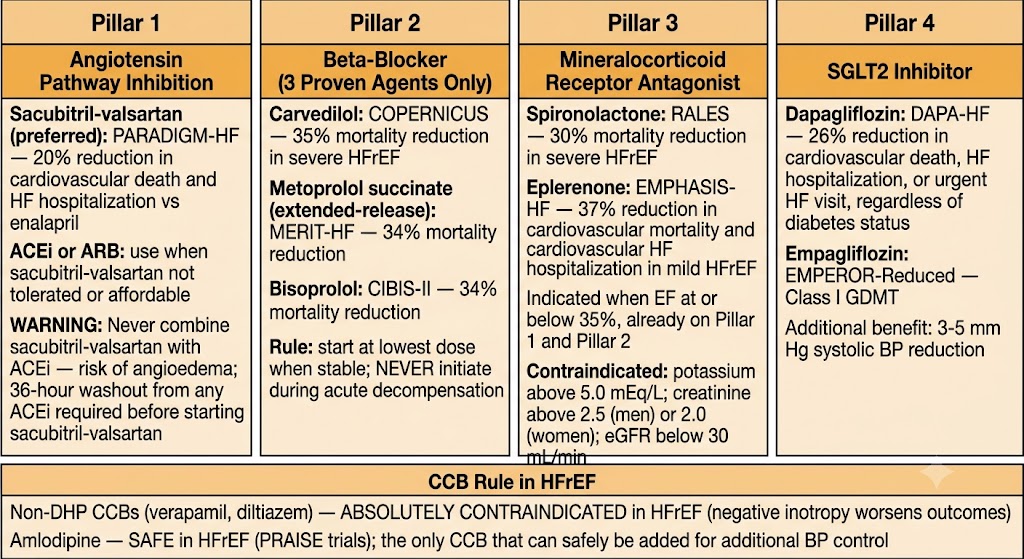
Non-dihydropyridine calcium channel blockers (verapamil, diltiazem) are absolutely contraindicated in heart failure with reduced ejection fraction — their negative inotropy worsens systolic function and outcomes. Dihydropyridine calcium channel blockers — specifically amlodipine — are safe in heart failure with reduced ejection fraction: the PRAISE trials demonstrated amlodipine does not worsen heart failure outcomes, and it is the only calcium channel blocker that can safely be added to guideline-directed medical therapy when additional blood pressure control is needed.
Heart failure with preserved ejection fraction (ejection fraction at or above 50 percent with heart failure symptoms) is predominantly driven by hypertension — pressure overload causing concentric left ventricular hypertrophy, myocardial fibrosis, and diastolic dysfunction. Effective blood pressure control to below 130/80 millimeters of mercury is the most powerful intervention. Unlike heart failure with reduced ejection fraction, heart failure with preserved ejection fraction lacks robust evidence for specific mortality-reducing drug classes. Renin-angiotensin-aldosterone system inhibitors are recommended for blood pressure control and left ventricular hypertrophy regression. Finerenone (FINEARTS-HF trial, 2024) showed significant benefit and is emerging as a preferred mineralocorticoid receptor antagonist. SGLT2 inhibitors (EMPEROR-Preserved, DELIVER) significantly reduced cardiovascular death and heart failure hospitalization and are now Class I or IIa guideline-directed medical therapy for heart failure with preserved ejection fraction regardless of diabetes status. Loop and thiazide diuretics provide essential symptomatic volume management.
Section 2
Remodeling prevention, anti-ischemic drug selection, the J-curve, and agents to avoid
Following myocardial infarction, antihypertensive therapy serves the dual purpose of blood pressure control and prevention of adverse cardiac remodeling. In stable coronary artery disease, certain antihypertensives provide simultaneous blood pressure control and anti-ischemic benefit. The J-curve phenomenon — excessive diastolic lowering impairing coronary perfusion — is most clinically relevant in these populations.
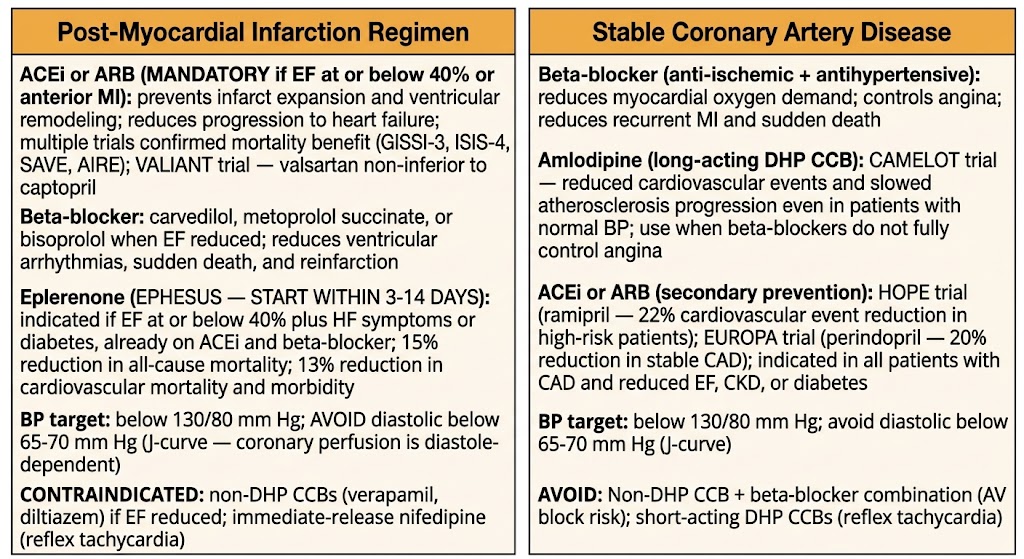
Angiotensin converting enzyme inhibitor or angiotensin receptor blocker: Mandatory when ejection fraction is at or below 40 percent or following anterior myocardial infarction. Reduce infarct expansion and ventricular remodeling through angiotensin II suppression and prevent progression to heart failure. Multiple landmark trials confirmed mortality reduction (GISSI-3, ISIS-4, SAVE, AIRE). Angiotensin receptor blockers are acceptable in angiotensin converting enzyme inhibitor-intolerant patients — the VALIANT trial demonstrated valsartan non-inferior to captopril post-myocardial infarction.
Beta-blocker: Reduces sympathetic activation following myocardial infarction — ventricular arrhythmias, sudden death, and reinfarction. Carvedilol, metoprolol succinate, or bisoprolol when ejection fraction is reduced.
Eplerenone (EPHESUS trial): Initiated within 3 to 14 days post-myocardial infarction in patients with ejection fraction at or below 40 percent and either heart failure symptoms or diabetes, already on angiotensin converting enzyme inhibitor and beta-blocker. Reduced all-cause mortality by 15 percent and cardiovascular mortality and morbidity by 13 percent. This is a time-specific indication — early initiation in the post-myocardial infarction window.
Agents to Avoid Post-Myocardial Infarction
Non-dihydropyridine CCBs (verapamil, diltiazem): contraindicated if ejection fraction is reduced — negative inotropy worsens systolic function.
Short-acting dihydropyridine CCBs (immediate-release nifedipine): contraindicated — reflex tachycardia increases myocardial oxygen demand and cardiac workload in the acute and early post-myocardial infarction period.
In stable coronary artery disease, blood pressure control and anti-ischemic therapy are addressed simultaneously through drug selection. Beta-blockers reduce myocardial oxygen demand through heart rate reduction and decreased contractility, controlling anginal episodes and reducing recurrent myocardial infarction and sudden death. Long-acting dihydropyridine calcium channel blockers (amlodipine, long-acting nifedipine) produce coronary arteriolar vasodilation reducing anginal episodes — the CAMELOT trial demonstrated amlodipine reduced cardiovascular events and slowed atherosclerosis progression even in patients with normal or mildly elevated blood pressure, supporting its use when beta-blockers do not fully control angina. Angiotensin converting enzyme inhibitors or angiotensin receptor blockers provide secondary prevention benefit — the HOPE trial (ramipril, 22 percent cardiovascular event reduction) and EUROPA trial (perindopril, 20 percent reduction) support their use in all patients with coronary artery disease and reduced ejection fraction, chronic kidney disease, diabetes, or other compelling indications.
The combination of non-dihydropyridine calcium channel blockers with beta-blockers is contraindicated in coronary artery disease — both suppress the sinoatrial and atrioventricular nodes producing severe bradycardia, heart block, and additive negative inotropy. Short-acting dihydropyridine calcium channel blockers are also avoided — reflex tachycardia increases myocardial oxygen demand. The J-curve: avoid reducing diastolic blood pressure below 65 to 70 millimeters of mercury in patients with significant coronary stenosis — coronary perfusion occurs primarily during diastole and inadequate diastolic pressure distal to a stenosis causes ischemia.
Section 3
Rate control agent selection in atrial fibrillation, upstream RAAS prevention, aortic dissection dP/dt rule, peripheral arterial disease, and evidence-based targets across comorbidities
The final clinical synthesis: antihypertensive agent selection in atrial fibrillation, aortic disease, and peripheral arterial disease, followed by the integrated blood pressure targets that apply across all cardiovascular comorbidities. The consistent theme is that agent selection matters as much as the target achieved — mechanism-driven pharmacotherapy, not blood pressure number alone, defines optimal management.
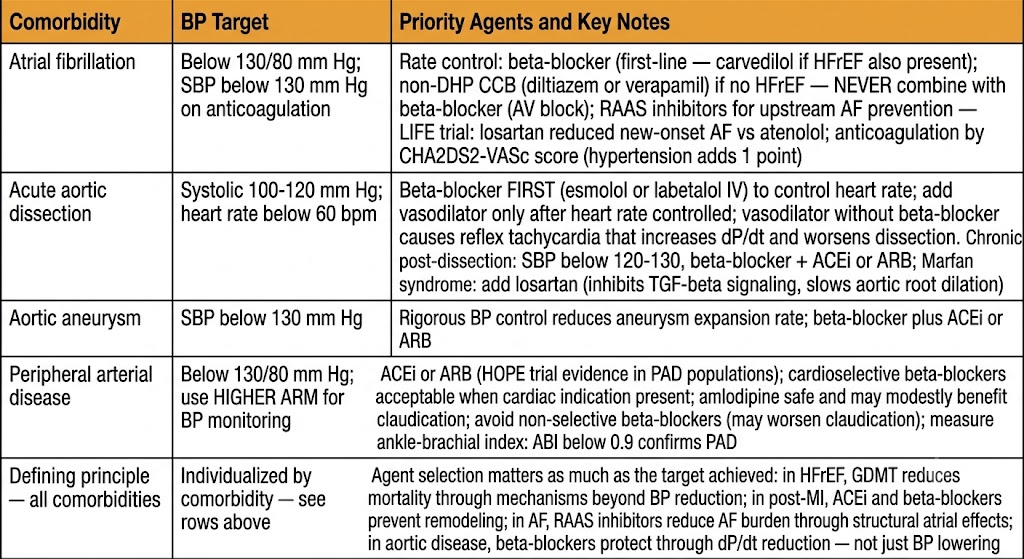
Hypertension is the most common modifiable risk factor for atrial fibrillation, driving left ventricular hypertrophy, left atrial enlargement, interstitial fibrosis, and renin-angiotensin-aldosterone system activation — the structural and electrical substrate for atrial fibrillation. Approximately 60 to 80 percent of patients with atrial fibrillation have hypertension as a comorbidity.
For rate control, beta-blockers (metoprolol, bisoprolol, carvedilol) are first-line in most patients — they provide both rate control and antihypertensive benefit, and carvedilol serves dual roles as rate control agent and guideline-directed medical therapy when heart failure with reduced ejection fraction coexists. Non-dihydropyridine calcium channel blockers (diltiazem, verapamil) provide effective rate control through atrioventricular nodal slowing and antihypertensive benefit — but are absolutely contraindicated when heart failure with reduced ejection fraction is present. Must not be combined with beta-blockers due to additive atrioventricular block and bradycardia risk. Diltiazem is generally preferred over verapamil for fewer drug interactions and less constipation.
For upstream atrial fibrillation prevention, renin-angiotensin-aldosterone system inhibitors reduce risk of new-onset and recurrent atrial fibrillation by preventing atrial fibrosis through angiotensin II-mediated transforming growth factor beta inhibition and reducing left atrial size. The LIFE trial demonstrated losartan significantly reduced new-onset atrial fibrillation compared with atenolol in hypertensive left ventricular hypertrophy patients. For antithrombotic therapy, the CHA₂DS₂-VASc score guides anticoagulation; hypertension adds one point. Target systolic below 130 millimeters of mercury in patients with atrial fibrillation on anticoagulation to reduce intracranial hemorrhage risk.
In acute aortic dissection, simultaneously reduce blood pressure and heart rate to reduce the rate of aortic wall pressure rise (dP/dt). Beta-blockade first (intravenous esmolol or labetalol; target heart rate below 60 beats per minute) — vasodilators are added only after heart rate is controlled because vasodilation without rate control causes reflex tachycardia that increases dP/dt and propagates the dissection. Targets: systolic blood pressure 100 to 120 millimeters of mercury as rapidly as safely possible. For chronic post-dissection management, target systolic below 120 to 130 millimeters of mercury using beta-blockers as preferred agents, with angiotensin converting enzyme inhibitors or angiotensin receptor blockers for additional aortic wall protection. In Marfan syndrome, losartan has evidence for slowing aortic root dilation through inhibition of angiotensin II-mediated transforming growth factor beta signaling and is used alongside beta-blockers.
In peripheral arterial disease, renin-angiotensin-aldosterone system inhibitors are the preferred antihypertensive agents — the HOPE trial enrolled significant peripheral arterial disease populations, demonstrating cardiovascular event reduction. Cardioselective beta-blockers are acceptable in peripheral arterial disease when a compelling cardiac indication exists — meta-analyses have not confirmed clinically significant worsening of claudication with cardioselective agents. The ankle-brachial index should be routinely measured; use the higher arm blood pressure for antihypertensive monitoring when significant peripheral arterial disease is present.
| Comorbidity | BP Target | Priority Drug Classes | Key Caution |
|---|---|---|---|
| HFrEF | Below 130/80 mm Hg; avoid systolic below 90 in severe HFrEF | Sacubitril-valsartan or ACEi or ARB + beta-blocker (carvedilol, metoprolol succinate, bisoprolol) + MRA + SGLT2 inhibitor; amlodipine safe for additional BP control | Non-DHP CCBs absolutely contraindicated |
| HFpEF | Below 130/80 mm Hg | RAAS inhibitors; SGLT2 inhibitors (Class I or IIa); finerenone (FINEARTS-HF); diuretics for symptoms | No single class proven to reduce mortality |
| Post-myocardial infarction | Below 130/80 mm Hg; avoid diastolic below 65–70 mm Hg | ACEi or ARB (mandatory if EF at or below 40%); beta-blocker; eplerenone if EF at or below 40% plus HF symptoms or diabetes | Non-DHP CCBs and immediate-release nifedipine contraindicated if EF reduced |
| Stable CAD | Below 130/80 mm Hg; avoid diastolic below 65–70 mm Hg (J-curve) | Beta-blocker (anti-ischemic + antihypertensive); amlodipine (CAMELOT); ACEi or ARB for secondary prevention | Non-DHP CCB + beta-blocker: AV block risk; short-acting DHP CCBs: reflex tachycardia |
| Atrial fibrillation | Below 130/80 mm Hg; SBP below 130 on anticoagulation | Beta-blocker (rate control + antihypertensive); non-DHP CCB if no HFrEF; RAAS inhibitor for upstream AF prevention | Non-DHP CCB absolutely contraindicated in HFrEF; never combine non-DHP CCB + beta-blocker |
| Aortic dissection (acute) | Systolic 100–120 mm Hg; heart rate below 60 bpm | Beta-blocker first (esmolol or labetalol IV); add vasodilator only after heart rate controlled | Vasodilator without beta-blocker causes reflex tachycardia, increases dP/dt |
| Peripheral arterial disease | Below 130/80 mm Hg; use higher-arm BP for monitoring | ACEi or ARB (HOPE trial evidence); cardioselective beta-blockers acceptable with cardiac indication | Non-selective beta-blockers may worsen claudication |
| Author / Organization | Title | Source |
|---|---|---|
| Whelton PK, Carey RM, Aronow WS, et al. | 2017 ACC/AHA guideline for the prevention, detection, evaluation, and management of high blood pressure in adults | J Am Coll Cardiol. 2018;71(19):e127–e248 |
| Mancia G, Kreutz R, Brunstrom M, et al. | 2023 ESH guidelines for the management of arterial hypertension | J Hypertens. 2023;41(12):1874–2071 |
| Heidenreich PA, Bozkurt B, Aguilar D, et al. | 2022 AHA/ACC/HFSA guideline for the management of heart failure | J Am Coll Cardiol. 2022;79(17):e263–e421 |
| McMurray JJ, Packer M, Desai AS, et al. | Angiotensin-neprilysin inhibition versus enalapril in heart failure (PARADIGM-HF) | N Engl J Med. 2014;371(11):993–1004 |
| Packer M, Coats AJ, Fowler MB, et al. | Effect of carvedilol on survival in severe chronic heart failure (COPERNICUS) | N Engl J Med. 2001;344(22):1651–1658 |
| MERIT-HF Study Group | Effect of metoprolol CR/XL in chronic heart failure (MERIT-HF) | Lancet. 1999;353(9169):2001–2007 |
| CIBIS-II Investigators and Committees | The Cardiac Insufficiency Bisoprolol Study II (CIBIS-II): a randomised trial | Lancet. 1999;353(9146):9–13 |
| Pitt B, Zannad F, Remme WJ, et al. | The effect of spironolactone on morbidity and mortality in patients with severe heart failure (RALES) | N Engl J Med. 1999;341(10):709–717 |
| Zannad F, McMurray JJ, Krum H, et al. | Eplerenone in patients with systolic heart failure and mild symptoms (EMPHASIS-HF) | N Engl J Med. 2011;364(1):11–21 |
| McMurray JJV, Solomon SD, Inzucchi SE, et al. | Dapagliflozin in patients with heart failure and reduced ejection fraction (DAPA-HF) | N Engl J Med. 2019;381(21):1995–2008 |
| O'Gara PT, Kushner FG, Ascheim DD, et al. | 2013 ACCF/AHA guideline for the management of ST-elevation myocardial infarction | J Am Coll Cardiol. 2013;61(4):e78–e140 |
| Pitt B, Remme W, Zannad F, et al. | Eplerenone, a selective aldosterone blocker, in patients with left ventricular dysfunction after myocardial infarction (EPHESUS) | N Engl J Med. 2003;348(14):1309–1321 |
| Yusuf S, Sleight P, Pogue J, et al. | Effects of an angiotensin-converting-enzyme inhibitor, ramipril, on cardiovascular events in high-risk patients (HOPE trial) | N Engl J Med. 2000;342(3):145–153 |
| Dahlof B, Devereux RB, Kjeldsen SE, et al. | Cardiovascular morbidity and mortality in the Losartan Intervention For Endpoint reduction in hypertension study (LIFE) | Lancet. 2002;359(9311):995–1003 |
| Pieske B, Tschope C, de Boer RA, et al. | How to diagnose heart failure with preserved ejection fraction: the HFA-PEFF diagnostic algorithm | Eur Heart J. 2019;40(40):3297–3317 |