Introduction to Medical Pharmacology
Module 10 — Hypertension in the Elderly & Isolated Systolic Hypertension
AHTN · Module 10 of 11Section 1
Arterial stiffness, isolated systolic hypertension, and the trials that established treatment benefit in the elderly and very elderly
Hypertension in older adults is qualitatively different from hypertension in younger patients. The dominant pattern — isolated systolic hypertension — is driven by arterial stiffness rather than the neurohormonal mechanisms that predominate in younger hypertensives. Treatment is strongly supported by clinical trial evidence showing substantial reductions in stroke, heart failure, and cardiovascular mortality, yet it requires careful individualization to avoid adverse effects that disproportionately affect older patients.
The aging vasculature undergoes progressive structural changes that reduce aortic compliance. Elastin fibers fragment and are replaced by stiffer collagen; advanced glycation end products cross-link collagen molecules; medial calcification adds further rigidity; and endothelial dysfunction reduces nitric oxide-mediated vasodilation. Under normal conditions, the compliant aorta expands during systole to absorb part of the stroke volume (the Windkessel effect) and recoils during diastole to maintain diastolic pressure and coronary perfusion. In the stiff aging aorta, this buffering is lost: systolic blood pressure rises markedly because the pressure wave is no longer damped, and diastolic blood pressure falls because elastic recoil is absent. The result is isolated systolic hypertension — systolic at or above 140 with diastolic below 90 millimeters of mercury — the dominant pattern in patients over 60 years.
Pulse pressure (systolic minus diastolic) exceeding 60 to 70 millimeters of mercury predicts particularly high cardiovascular event rates. Systolic blood pressure is a more powerful predictor of cardiovascular risk than diastolic blood pressure in patients over 50 to 55 years old. The therapeutic goal is to lower systolic blood pressure while avoiding a disproportionate fall in diastolic — reducing diastolic below 65 to 70 millimeters of mercury in patients with established coronary artery disease risks impairing coronary perfusion (the J-curve phenomenon).
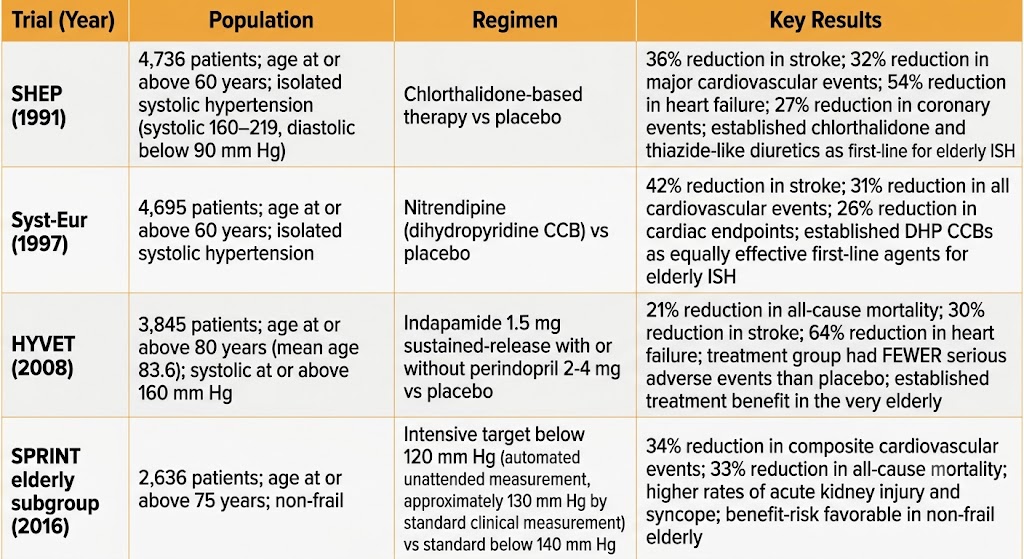
The SHEP trial (Systolic Hypertension in the Elderly Program, 1991) enrolled 4,736 patients aged 60 or above with isolated systolic hypertension and randomized them to chlorthalidone-based therapy versus placebo. Active treatment produced a 36 percent reduction in stroke, 32 percent reduction in major cardiovascular events, 54 percent reduction in heart failure, and 27 percent reduction in coronary events — establishing that treating isolated systolic hypertension in the elderly provides substantial cardiovascular protection and confirming chlorthalidone as a cornerstone agent.
The Syst-Eur trial (1997) enrolled 4,695 patients aged 60 or above with isolated systolic hypertension and randomized them to nitrendipine (a dihydropyridine calcium channel blocker) versus placebo, producing a 42 percent reduction in stroke and 31 percent reduction in all cardiovascular events — establishing dihydropyridine calcium channel blockers as equally effective first-line agents for elderly isolated systolic hypertension.
The HYVET trial (Hypertension in the Very Elderly, 2008) enrolled 3,845 patients aged 80 or above (mean age 83.6 years) and randomized them to indapamide with or without perindopril versus placebo. Active treatment produced a 30 percent reduction in stroke, a 21 percent reduction in all-cause mortality, and a 64 percent reduction in heart failure — with the critical finding that the treatment group had fewer serious adverse events than placebo, demonstrating that antihypertensive treatment in the very elderly is safe. HYVET established the evidence base for treating patients aged 80 or above, with indapamide plus perindopril as the evidence-based regimen.
The SPRINT elderly subgroup (2,636 patients aged 75 or above) showed that intensive systolic blood pressure control below 120 millimeters of mercury by automated unattended measurement reduced composite cardiovascular events by 34 percent and all-cause mortality by 33 percent in non-frail elderly patients — at the cost of higher rates of acute kidney injury, syncope, and electrolyte disturbances. Note that SPRINT's automated unattended measurement yields readings approximately 5 to 10 millimeters of mercury lower than standard clinical measurement, so the 120 millimeters of mercury target corresponds to approximately 130 millimeters of mercury by standard measurement.
Section 2
Guideline targets by age, frailty-adjusted individualization, preferred agents, and drugs to use with caution or avoid
Blood pressure targets in the elderly must be individualized by age and frailty status. Drug selection is shaped by the unique physiology of elderly isolated systolic hypertension — low-renin, volume-dependent — which favors thiazide-like diuretics and dihydropyridine calcium channel blockers over renin-angiotensin-aldosterone system inhibitors as first-line agents. Several drug classes carry increased risk of falls, cognitive impairment, and orthostatic hypotension in this population and should be used with particular caution.
The American College of Cardiology/American Heart Association 2017 guidelines recommend below 130/80 millimeters of mercury for community-dwelling ambulatory adults aged 65 or above, with individualization based on comorbidities, life expectancy, and tolerability. The 2023 European Society of Hypertension guidelines take a more graduated approach: for ages 65 to 79, the recommended systolic target is 130 to 139 millimeters of mercury; for age 80 or above, the initial target is 140 to 149 millimeters of mercury, with lower targets of 130 to 139 pursued only if well tolerated.
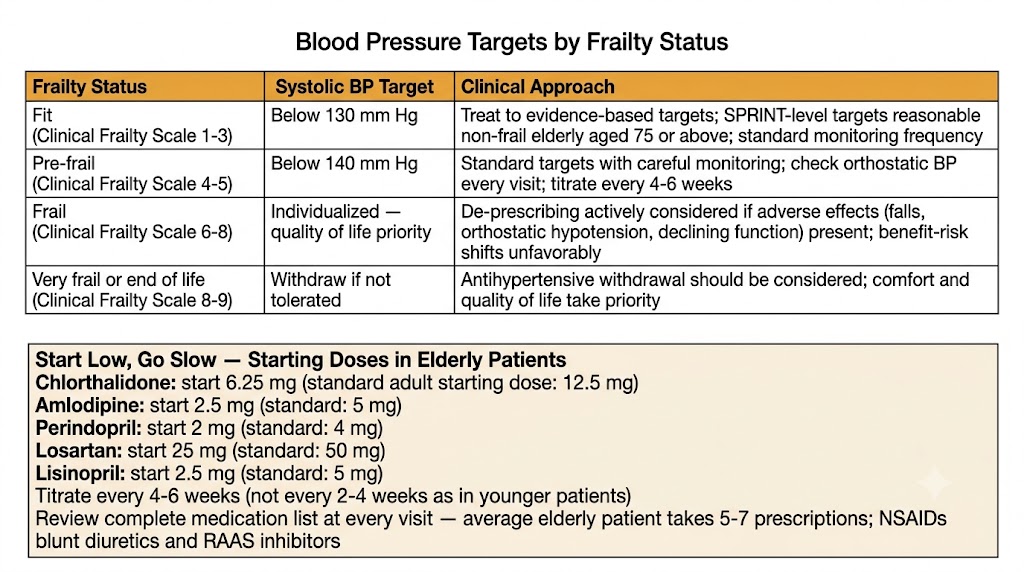
Frailty significantly modifies the benefit-risk calculation. For fit elderly patients (Clinical Frailty Scale 1 to 3), evidence supports targeting below 130 millimeters of mercury systolic. For pre-frail patients (Clinical Frailty Scale 4 to 5), standard targets below 140 millimeters of mercury with careful monitoring are appropriate. For frail patients (Clinical Frailty Scale 6 to 8), targets should be individualized with focus on quality of life and symptom burden — de-prescribing should be actively considered when multiple antihypertensives are producing adverse effects. For very frail or end-of-life patients, withdrawal of antihypertensives should be considered when not tolerated.
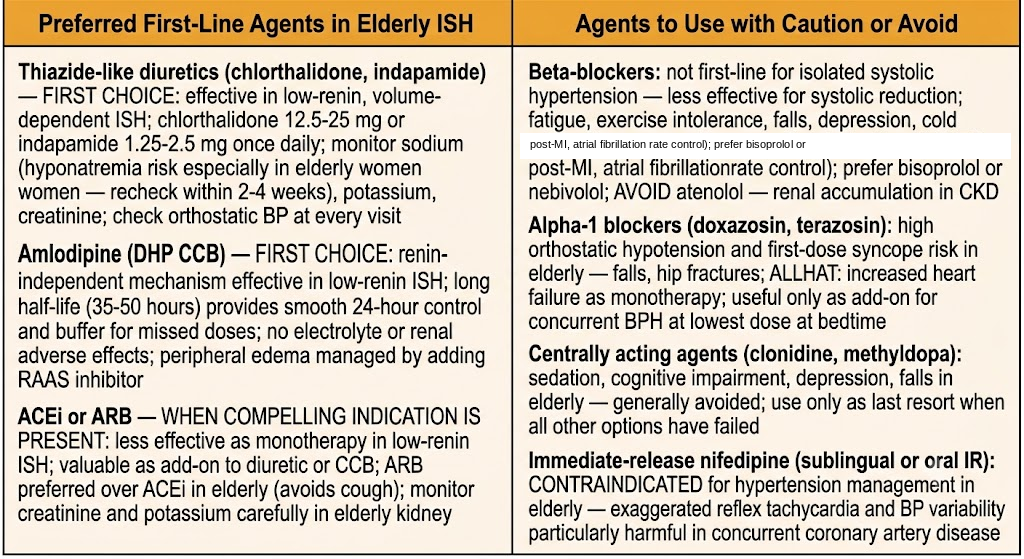
Thiazide-like diuretics (chlorthalidone, indapamide): The most effective agents for elderly isolated systolic hypertension, anchored by SHEP (chlorthalidone) and HYVET (indapamide) trial evidence. Particularly effective in the low-renin, volume-dependent hypertension typical of elderly patients. Preferred doses: chlorthalidone 12.5 to 25 mg or indapamide 1.25 to 2.5 mg once daily. Monitor sodium closely — hyponatremia risk is higher in elderly women; recheck sodium within 2 to 4 weeks of initiation. Check orthostatic blood pressure at every visit.
Dihydropyridine calcium channel blockers (amlodipine, long-acting nifedipine): Highly effective for isolated systolic hypertension through a renin-independent mechanism, validated by Syst-Eur. No dose adjustment required; no adverse renal, metabolic, or electrolyte effects. Amlodipine is preferred for its long half-life (35 to 50 hours) providing smooth 24-hour blood pressure control and a pharmacokinetic buffer for occasional missed doses. Peripheral edema (more pronounced in elderly) can be managed by combining with a renin-angiotensin-aldosterone system inhibitor.
Renin-angiotensin-aldosterone system inhibitors (angiotensin converting enzyme inhibitors, angiotensin receptor blockers): Appropriate when compelling indications are present — chronic kidney disease with proteinuria, heart failure with reduced ejection fraction, post-myocardial infarction, diabetic nephropathy. Less effective as monotherapy in elderly isolated systolic hypertension (low-renin states) but valuable as add-on to diuretic or calcium channel blocker. Angiotensin receptor blockers preferred over angiotensin converting enzyme inhibitors in elderly patients where cough would be particularly problematic. Monitor creatinine and potassium carefully — the elderly kidney is more susceptible to functional acute kidney injury.
Section 3
Orthostatic hypotension, pharmacokinetic changes, cognitive effects, and the start-low-go-slow principle
Managing hypertension in the elderly requires attention to several considerations that do not arise in the same way for younger patients. Orthostatic hypotension, age-related pharmacokinetic changes, cognitive effects of certain agents, and the risk of adverse effects from too-rapid dose titration require a specifically adapted clinical approach.
Orthostatic hypotension is defined as a fall in systolic blood pressure of at or above 20 millimeters of mercury or diastolic blood pressure of at or above 10 millimeters of mercury within 3 minutes of standing from a supine or seated position. Its prevalence is approximately 20 percent of community-dwelling elderly patients, rising above 50 percent in institutionalized elderly, and is associated with approximately twice the risk of falls, syncope, and cardiovascular events. All antihypertensives can worsen orthostatic hypotension — alpha-1 blockers, loop diuretics, and calcium channel blockers are most problematic.
Blood pressure must be checked in both sitting and standing positions at every visit in elderly hypertensive patients. Management includes review and simplification of the antihypertensive regimen, optimization of dose timing (avoid diuretics in the evening), ensuring adequate hydration, compression stockings, advice on slow positional changes, and avoidance of alcohol. Cognitively neutral agents with least orthostatic effect — amlodipine, chlorthalidone, angiotensin receptor blockers — should be preferred.
Glomerular filtration rate declines approximately 1 mL/min per year after age 40. Renally excreted drugs accumulate — atenolol, lisinopril, and low-molecular-weight heparins require dose reduction. Serum creatinine alone overestimates renal function in the elderly because reduced muscle mass lowers creatinine production — the CKD-EPI equation should be used. Reduced hepatic blood flow and first-pass metabolism increase the bioavailability of hepatically metabolized agents including labetalol, metoprolol, propranolol, and nifedipine. Lipophilic drugs have larger volumes of distribution and longer effective half-lives in the elderly due to increased body fat relative to lean mass. Reduced plasma albumin increases the free fraction of highly protein-bound drugs. Lipophilic drugs cross the blood-brain barrier more readily in aging, increasing central nervous system sensitivity to sedating effects of clonidine, methyldopa, and lipophilic beta-blockers.
In elderly patients — particularly those who are frail or have multiple comorbidities — a conservative initiation strategy is essential. Begin at half the standard starting dose when possible: chlorthalidone 6.25 mg, amlodipine 2.5 mg, perindopril 2 mg. Titrate slowly every 4 to 6 weeks rather than every 2 to 4 weeks, and add second agents only after confirming tolerance and stability of the first. The complete medication list should be reviewed at every visit — the average elderly hypertensive patient takes 5 to 7 prescription medications, and drug-drug interactions are a major source of adverse effects including additive hypotension, acute kidney injury, and hyperkalemia. Nonsteroidal anti-inflammatory drugs, frequently taken for musculoskeletal pain, antagonize both diuretics and renin-angiotensin-aldosterone system inhibitors and must be specifically identified at every medication review.
In frail elderly patients experiencing falls, orthostatic hypotension, or declining quality of life attributable to antihypertensive therapy, withdrawal or dose reduction (de-prescribing) should be actively considered rather than reflexively avoided. The benefit-risk calculation for intensive blood pressure lowering shifts unfavorably as frailty advances — quality of life and functional status become primary goals.
Cognitive Effects of Antihypertensives in the Elderly
Hypertension itself is a major modifiable risk factor for dementia — treating hypertension preserves cognitive function. However, certain agents carry cognitive risks in the elderly. Lipophilic beta-blockers (metoprolol, propranolol) cause fatigue, sleep disturbance, and mild cognitive effects at high doses. Centrally acting agents (clonidine, methyldopa) cause sedation, confusion, and falls. Excessive blood pressure lowering (systolic below 110 to 120 millimeters of mercury in patients with cerebral small vessel disease or prior stroke) may paradoxically impair cerebral perfusion. Cognitively neutral preferred agents: amlodipine, chlorthalidone, angiotensin receptor blockers.
| Author / Organization | Title | Source |
|---|---|---|
| Whelton PK, Carey RM, Aronow WS, et al. | 2017 ACC/AHA guideline for the prevention, detection, evaluation, and management of high blood pressure in adults | J Am Coll Cardiol. 2018;71(19):e127–e248 |
| Mancia G, Kreutz R, Brunstrom M, et al. | 2023 ESH guidelines for the management of arterial hypertension | J Hypertens. 2023;41(12):1874–2071 |
| SHEP Cooperative Research Group | Prevention of stroke by antihypertensive drug treatment in older persons with isolated systolic hypertension (SHEP) | JAMA. 1991;265(24):3255–3264 |
| Staessen JA, Fagard R, Thijs L, et al. | Randomised double-blind comparison of placebo and active treatment for older patients with isolated systolic hypertension (Syst-Eur) | Lancet. 1997;350(9080):757–764 |
| Beckett NS, Peters R, Fletcher AE, et al. | Treatment of hypertension in patients 80 years of age or older (HYVET) | N Engl J Med. 2008;358(18):1887–1898 |
| SPRINT Research Group; Wright JT Jr, Williamson JD, Whelton PK, et al. | A randomized trial of intensive versus standard blood-pressure control (SPRINT) | N Engl J Med. 2015;373(22):2103–2116 |
| Fried LP, Tangen CM, Walston J, et al. | Frailty in older adults: evidence for a phenotype | J Gerontol A Biol Sci Med Sci. 2001;56(3):M146–M156 |
| Dahlof B, Devereux RB, Kjeldsen SE, et al. | Cardiovascular morbidity and mortality in the Losartan Intervention For Endpoint reduction in hypertension study (LIFE) | Lancet. 2002;359(9311):995–1003 |
| Williamson JD, Supiano MA, Applegate WB, et al. | Intensive vs standard blood pressure control and cardiovascular disease outcomes in adults aged 75 years or older (SPRINT elderly subgroup) | JAMA. 2016;315(24):2673–2682 |
| Gangavati A, Hajjar I, Quach L, et al. | Hypertension, orthostatic hypotension, and the risk of falls in a community-dwelling elderly population | J Am Geriatr Soc. 2011;59(3):383–389 |
| ALLHAT Officers and Coordinators | Major outcomes in high-risk hypertensive patients randomized to ACE inhibitor or calcium channel blocker vs diuretic (ALLHAT) | JAMA. 2002;288(23):2981–2997 |
| Aronow WS, Fleg JL, Pepine CJ, et al. | ACCF/AHA 2011 expert consensus document on hypertension in the elderly | J Am Coll Cardiol. 2011;57(20):2037–2114 |