Introduction to Medical Pharmacology
Module 9 — Hypertension in Pregnancy
AHTN · Module 9 of 11Section 1
Chronic hypertension, gestational hypertension, preeclampsia, HELLP, and eclampsia
Hypertensive disorders of pregnancy complicate approximately 10 percent of all pregnancies and are among the leading causes of maternal and perinatal morbidity and mortality worldwide. Understanding the classification is the clinical foundation — because each category carries different risks, triggers different management decisions, and has different implications for fetal monitoring.
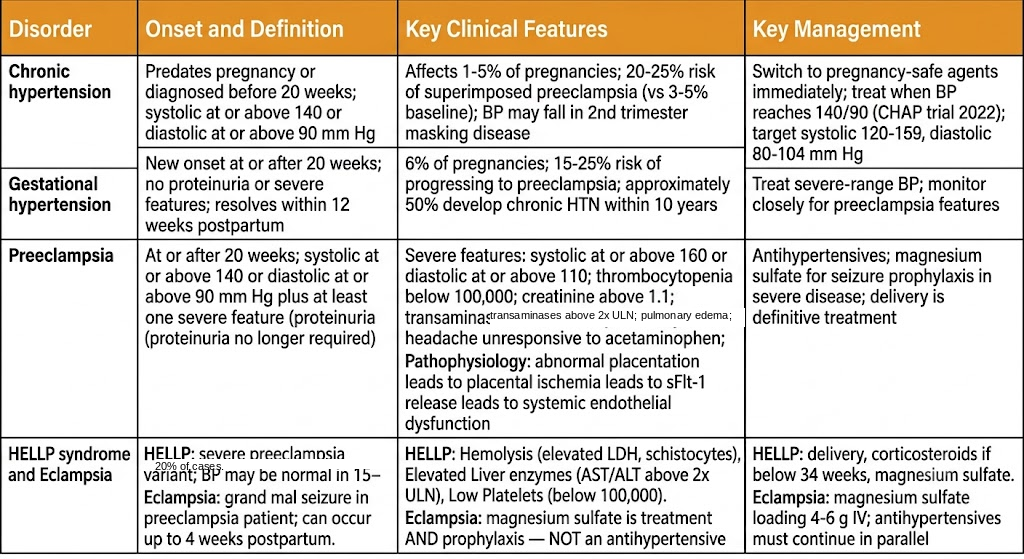
Chronic hypertension is defined as hypertension predating pregnancy or diagnosed before 20 weeks of gestation (systolic at or above 140 or diastolic at or above 90 millimeters of mercury). It affects approximately 1 to 5 percent of pregnancies in the United States. Patients with chronic hypertension carry a 20 to 25 percent risk of superimposed preeclampsia — substantially higher than the 3 to 5 percent baseline risk in normotensive women. Blood pressure often falls physiologically in the second trimester, which may allow dose reduction of antihypertensive medications. All antihypertensive medications must be switched to pregnancy-safe agents before or immediately upon confirmed pregnancy.
Gestational hypertension is new-onset hypertension at or after 20 weeks of gestation without proteinuria or other features of preeclampsia. It accounts for approximately 6 percent of pregnancies and resolves within 12 weeks postpartum by definition. Women with gestational hypertension have a 15 to 25 percent risk of progressing to preeclampsia and approximately 50 percent develop chronic hypertension within 10 years — making gestational hypertension a marker of long-term cardiovascular risk.
Preeclampsia is new-onset hypertension at or after 20 weeks accompanied by one or more of: proteinuria at or above 300 mg per 24 hours; thrombocytopenia (platelet count below 100,000 per microliter); renal insufficiency (creatinine above 1.1 mg/dL or doubling without other explanation); impaired liver function (transaminases twice the upper limit of normal with or without right upper quadrant pain); pulmonary edema; or new-onset headache unresponsive to acetaminophen or visual disturbances. Critically, proteinuria is no longer required for diagnosis when other severe features are present.
The pathophysiology begins with abnormal placentation — failure of trophoblastic invasion of the spiral arteries causes placental ischemia, which drives release of anti-angiogenic factors (soluble fms-like tyrosine kinase-1) that inhibit vascular endothelial growth factor. Systemic endothelial dysfunction follows: vasoconstriction, increased vascular permeability, platelet activation, and coagulation cascade activation. Severe features of preeclampsia (any one qualifies for the severe designation) include systolic at or above 160 or diastolic at or above 110 millimeters of mercury on two readings at least 4 hours apart, thrombocytopenia, creatinine above 1.1 mg/dL, transaminases above twice the upper limit of normal, pulmonary edema, or new-onset headache unresponsive to acetaminophen.
HELLP syndrome is a severe variant of preeclampsia characterized by hemolysis (microangiopathic hemolytic anemia with elevated lactate dehydrogenase and schistocytes on smear), elevated liver enzymes (above twice the upper limit of normal), and low platelets (below 100,000 per microliter; severe below 50,000). An important diagnostic caveat: blood pressure may be only mildly elevated or even normal in 15 to 20 percent of HELLP cases — diagnosis requires vigilance beyond blood pressure measurement. Delivery is the definitive treatment.
Eclampsia is new-onset grand mal seizure in a woman with preeclampsia without another identifiable cause. It can occur antepartum, intrapartum, or postpartum — up to 48 hours after delivery in most cases, and rarely up to 4 weeks postpartum. Magnesium sulfate is the agent of choice for both seizure prophylaxis in severe preeclampsia and for treatment of eclamptic seizures. It is not an antihypertensive — blood pressure management with appropriate agents must proceed in parallel.
Section 2
Physiological blood pressure changes in pregnancy, the CHAP trial, first-line oral agents, and absolutely contraindicated drugs
Blood pressure management in pregnancy is uniquely constrained. Lowering blood pressure too little risks maternal stroke and placental abruption. Lowering it too much risks reduced uteroplacental perfusion — the placenta has no autoregulation and flow is directly dependent on maternal blood pressure. Several of the most effective drug classes used in the general population are absolutely contraindicated.
Blood pressure normally falls during pregnancy. Progesterone-mediated vasodilation causes a fall in systemic vascular resistance in the first trimester, reaching its nadir in the second trimester — systolic falls 5 to 10 millimeters of mercury and diastolic falls 10 to 15 millimeters of mercury below preconception levels. This nadir can mask pre-existing hypertension and obscure early preeclampsia development. Blood pressure then rises toward preconception levels in the third trimester. In the postpartum period, blood pressure may surge further on days 3 to 5 due to mobilization of extravascular fluid and loss of placental vasodilatory prostaglandins.
For severe-range hypertension (systolic at or above 160 or diastolic at or above 110 millimeters of mercury), urgent antihypertensive treatment within 30 to 60 minutes is required to prevent maternal hemorrhagic stroke and placental abruption. This is a medical emergency and treatment must not be delayed.
For non-severe hypertension, the CHAP trial (Chronic Hypertension and Pregnancy, 2022) randomized 2,408 pregnant women with mild chronic hypertension to active treatment (target below 140/90 millimeters of mercury) versus standard care (treatment only when blood pressure reached 160/105). Active treatment reduced the primary composite outcome — preeclampsia with severe features, medically indicated preterm birth before 35 weeks, placental abruption, or fetal/neonatal death — by 18 percent, without increasing the risk of small for gestational age birth. Based on CHAP, current American College of Obstetricians and Gynecologists guidance recommends treating chronic hypertension in pregnancy when systolic reaches 140 or diastolic reaches 90 millimeters of mercury, targeting systolic 120 to 159 and diastolic 80 to 104 millimeters of mercury. Normal blood pressure targets below 120/80 should not be pursued in pregnancy due to uteroplacental perfusion risk.
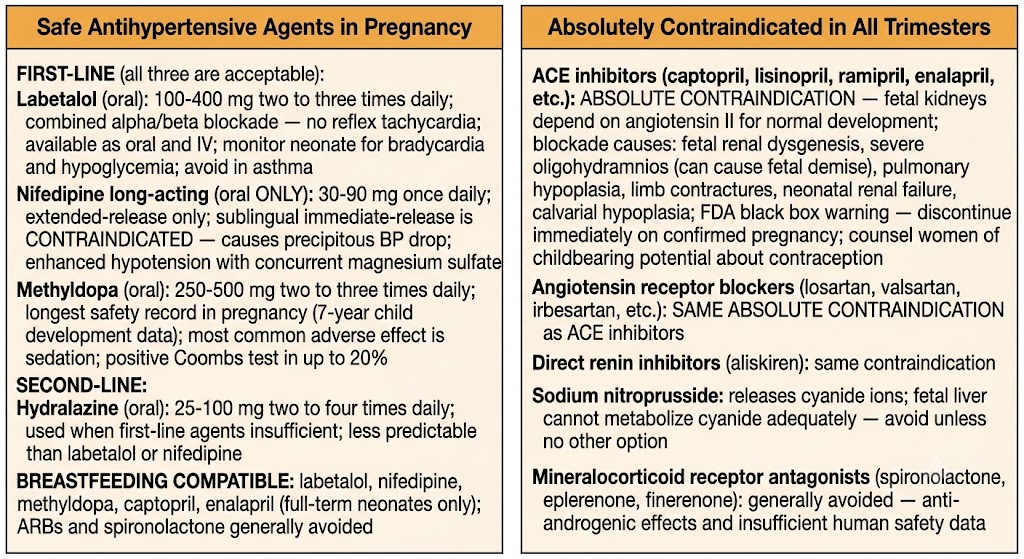
Labetalol (oral): A combined non-selective beta-blocker and alpha-1 blocker, labetalol reduces blood pressure through both vasodilation and reduced cardiac output and systemic vascular resistance. Dosing is 100 to 400 mg two to three times daily. Its key advantage is the absence of reflex tachycardia owing to dual blockade. Available in both oral and intravenous formulations, providing dual utility for chronic management and acute severe episodes. Monitor neonate for bradycardia and hypoglycemia. Avoid in asthma.
Nifedipine (long-acting, oral): A dihydropyridine calcium channel blocker, long-acting nifedipine reduces systemic vascular resistance through arteriolar vasodilation. Dosing is 30 to 90 mg once daily using extended-release formulations only. Only long-acting oral formulations should be used — immediate-release nifedipine given sublingually is contraindicated due to risk of precipitous hypotension and fetal distress. When used concurrently with magnesium sulfate, enhanced hypotension is possible because magnesium has calcium channel blocking properties; this combination is used clinically but requires close monitoring.
Methyldopa (oral): A prodrug converted to alpha-methyl-norepinephrine in the central nervous system, methyldopa reduces central sympathetic outflow through alpha-2 agonism. Dosing is 250 to 500 mg two to three times daily. It has the longest safety track record of any antihypertensive in pregnancy — long-term follow-up data extending to 7 years have demonstrated no adverse effects on child development. Limitations include sedation and fatigue (the most common reason for discontinuation), positive Coombs test in up to 20 percent of patients, and rare hepatotoxicity.
Absolutely Contraindicated in Pregnancy
Angiotensin converting enzyme inhibitors and angiotensin receptor blockers: absolutely contraindicated in all trimesters. Fetal kidneys depend on angiotensin II for normal development. Blockade causes fetal renal dysgenesis, oligohydramnios (which can be severe and lead to fetal demise), pulmonary hypoplasia, limb contractures, neonatal renal failure, and calvarial hypoplasia. The Food and Drug Administration black box warning requires immediate discontinuation on confirmed pregnancy. Women of childbearing potential must be counseled about contraception and switched immediately to a safe agent.
Sodium nitroprusside: releases cyanide ions during metabolism. The fetal liver has limited cyanide metabolism capacity — avoid unless no other option exists.
Direct renin inhibitors (aliskiren): carry the same contraindication as angiotensin converting enzyme inhibitors and angiotensin receptor blockers.
Section 3
Intravenous protocols for acute hypertension, magnesium sulfate toxicity monitoring, and breastfeeding-compatible agents
Acute severe hypertension in pregnancy — systolic at or above 160 or diastolic at or above 110 millimeters of mercury — is a medical emergency requiring treatment within 30 to 60 minutes. Magnesium sulfate is the cornerstone of seizure prophylaxis in severe preeclampsia but is not an antihypertensive — its toxicity monitoring requires specific clinical vigilance.
Intravenous labetalol: 20 mg over 2 minutes; if inadequate, 40 mg after 10 minutes, then 80 mg every 10 minutes (maximum cumulative dose 300 mg per episode). Onset 5 to 10 minutes; duration 3 to 6 hours. Advantages include titratable response, no reflex tachycardia, extensive obstetric experience. Avoid in asthma, significant bradycardia, and decompensated heart failure; monitor to avoid maternal heart rate below 60 beats per minute.
Oral nifedipine (immediate-release, swallowed — not sublingual): 10 mg orally, repeated in 20 to 30 minutes if blood pressure remains severe, to a maximum of 30 mg per episode. Onset 20 to 30 minutes. The critical distinction: this is immediate-release nifedipine given by mouth and swallowed — sublingual administration produces a precipitous, unpredictable blood pressure drop and is contraindicated. Concurrent magnesium sulfate use may enhance hypotension.
Intravenous hydralazine: 5 to 10 mg bolus, repeated every 20 to 30 minutes (maximum 20 mg per episode). Onset is variable and less predictable (10 to 30 minutes). Associated with more adverse effects including reflex tachycardia, headache, and flushing. Considered third-line when labetalol and nifedipine are unavailable or contraindicated. American College of Obstetricians and Gynecologists considers all three acceptable first-line options.
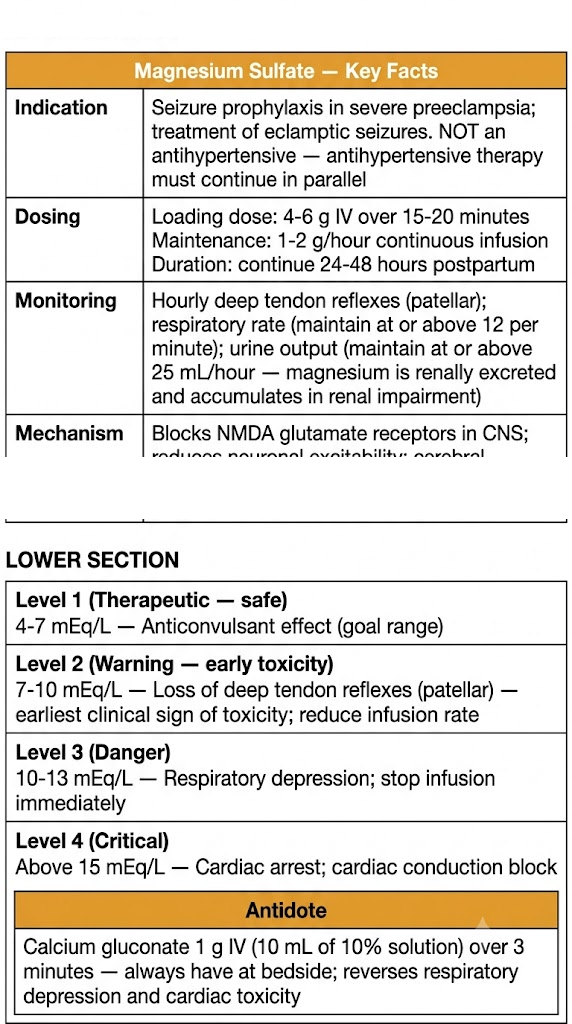
Magnesium sulfate is the cornerstone of seizure prophylaxis in severe preeclampsia and treatment of eclamptic seizures. Its anticonvulsant mechanism involves blockade of N-methyl-D-aspartate glutamate receptors, reduction of neuronal excitability, and cerebral vasodilation. It causes a modest secondary blood pressure reduction insufficient for antihypertensive management — dedicated antihypertensive therapy must proceed in parallel.
Dosing: loading dose of 4 to 6 g intravenous over 15 to 20 minutes, followed by maintenance of 1 to 2 g per hour continuous infusion, continued for 24 to 48 hours postpartum. The therapeutic window is narrow: therapeutic range 4 to 7 mEq/L; loss of deep tendon reflexes (patellar) occurs at 7 to 10 mEq/L (earliest clinical sign of toxicity); respiratory depression occurs at 10 to 13 mEq/L; cardiac arrest above 15 mEq/L. Monitoring requires hourly assessment of deep tendon reflexes, respiratory rate (maintain at or above 12 breaths per minute), and urine output (maintain at or above 25 mL per hour — magnesium is renally excreted and accumulates in renal impairment). The antidote is calcium gluconate 1 g intravenous (10 mL of 10 percent solution) over 3 minutes.
Blood pressure may surge in the first 3 to 5 days postpartum due to mobilization of extravascular fluid into the intravascular compartment (particularly pronounced after magnesium sulfate infusion) and loss of placental vasodilatory prostaglandins. Women with severe preeclampsia require blood pressure monitoring for at least 72 hours after delivery. Postpartum eclampsia can occur up to 4 weeks after delivery — patients must be educated to present immediately for severe headache, visual changes, or confusion.
Most antihypertensives used in pregnancy are compatible with breastfeeding. Preferred agents include labetalol (low breast milk transfer), long-acting nifedipine (low transfer, no adverse neonatal effects), and methyldopa. An important postpartum shift: captopril and enalapril specifically are compatible with breastfeeding in full-term neonates due to low breast milk transfer — avoid in premature neonates due to reduced renal clearance. Women who stopped angiotensin converting enzyme inhibitors during pregnancy can resume a breastfeeding-compatible agent postpartum if indicated for renoprotection. Angiotensin receptor blockers have insufficient breastfeeding safety data and are generally avoided while breastfeeding.
Long-Term Cardiovascular Risk After Hypertensive Disorders of Pregnancy
Women who have had preeclampsia carry substantially elevated lifetime cardiovascular risk: twice the lifetime risk of cardiovascular disease, four times the risk of hypertension, twice the risk of stroke, and significantly elevated risk of chronic kidney disease. These women should be identified, counseled about their long-term risk, and followed with regular cardiovascular risk screening and blood pressure monitoring. Hypertensive disorders of pregnancy are now recognized as a cardiovascular risk marker equivalent in significance to other established risk factors.
| Author / Organization | Title | Source |
|---|---|---|
| American College of Obstetricians and Gynecologists | Gestational Hypertension and Preeclampsia: ACOG Practice Bulletin No. 222 | Obstet Gynecol. 2020;135(6):e237–e260 |
| Magee LA, Maguire PJ, Bhatt M, et al. | ISSHP classification, diagnosis, and management recommendations for international practice | Pregnancy Hypertens. 2022;27:148–169 |
| Tita AT, Szychowski JM, Boggess K, et al. | Treatment for mild chronic hypertension during pregnancy (CHAP trial) | N Engl J Med. 2022;386(19):1781–1792 |
| Cockburn J, Moar VA, Ounsted M, Redman CW | Final report of study on hypertension during pregnancy: the effects of specific treatment on the growth and development of the children | Lancet. 1982;1(8273):647–649 |
| Bullo M, Tschumi S, Bucher BS, Bianchetti MG, Simonetti GD | Pregnancy outcome following exposure to angiotensin-converting enzyme inhibitors or angiotensin receptor antagonists | Hypertension. 2012;60(2):444–450 |
| Magee LA, von Dadelszen P, Rey E, et al. | Less-tight versus tight control of hypertension in pregnancy (CHIPS trial) | N Engl J Med. 2015;372(5):407–417 |
| Hale TW, Rowe HE | Medications and Mothers' Milk. 17th ed. | Springer Publishing; 2017 |
| Whelton PK, Carey RM, Aronow WS, et al. | 2017 ACC/AHA guideline for the prevention, detection, evaluation, and management of high blood pressure in adults | J Am Coll Cardiol. 2018;71(19):e127–e248 |
| Mol BWJ, Roberts CT, Thangaratinam S, et al. | Pre-eclampsia | Lancet. 2016;387(10022):999–1011 |
| Sibai BM | Diagnosis, controversies, and management of the syndrome of hemolysis, elevated liver enzymes, and low platelet count | Obstet Gynecol. 2004;103(5 Pt 1):981–991 |
| Mancia G, Kreutz R, Brunstrom M, et al. | 2023 ESH guidelines for the management of arterial hypertension | J Hypertens. 2023;41(12):1874–2071 |
| Brown MA, Magee LA, Kenny LC, et al. | Hypertensive disorders of pregnancy: ISSHP classification, diagnosis, and management recommendations for international practice | Hypertension. 2018;72(1):24–43 |
| Bramham K, Parnell B, Nelson-Piercy C, et al. | Chronic hypertension and pregnancy outcomes: systematic review and meta-analysis | BMJ. 2014;348:g2301 |