Introduction to Medical Pharmacology
Module 8 — Hypertension in Diabetes Mellitus
AHTN · Module 8 of 11Section 1
How diabetes drives hypertension and the evidence base for treatment targets
Hypertension and diabetes mellitus co-exist in approximately 70 to 80 percent of patients with type 2 diabetes, and each condition dramatically amplifies the cardiovascular and renal risk conferred by the other. The risk of myocardial infarction, stroke, heart failure, and end-stage renal disease is multiplicative rather than simply additive. Optimal management requires selecting antihypertensive agents that confer independent cardiorenal protection while avoiding those that worsen metabolic parameters.
In type 2 diabetes, insulin resistance is the central driver. Compensatory hyperinsulinemia activates the sympathetic nervous system, increases cardiac output, and promotes renal sodium retention through upregulated sodium-hydrogen exchanger activity in the proximal tubule. Adipose tissue — particularly visceral fat — expresses all renin-angiotensin-aldosterone system components, and angiotensin II worsens insulin resistance by inhibiting insulin receptor signaling in skeletal muscle, creating a bidirectional feedback between renin-angiotensin-aldosterone system activation and insulin resistance. Hyperglycemia directly damages endothelium through advanced glycation end products that quench nitric oxide and stiffen arteries. Obstructive sleep apnea is highly prevalent in type 2 diabetes and independently drives hypertension through sympathetic activation and aldosterone excess.
In type 1 diabetes, hypertension develops primarily through the nephropathy pathway. Patients are typically normotensive before microalbuminuria develops. Glomerular hyperfiltration in early diabetic nephropathy initiates intraglomerular hypertension, which leads to microalbuminuria, then to overt nephropathy, and eventually to systemic hypertension as nephron mass is lost. This explains why renin-angiotensin-aldosterone system inhibition initiated at the microalbuminuria stage can prevent progression to overt nephropathy and attenuate the development of systemic hypertension.
The ACCORD blood pressure trial (2010) is the key evidence base for targets in type 2 diabetes. Randomizing 4,733 patients to a systolic target below 120 versus below 140 millimeters of mercury, intensive control produced a 41 percent reduction in stroke but no significant reduction in the primary cardiovascular composite endpoint, with significantly more acute kidney injury, hypotension, hypokalemia, and bradycardia in the intensive group. The practical implication is that a target below 130/80 millimeters of mercury captures most of the stroke benefit with a more manageable adverse event profile, while targeting below 120 millimeters of mercury is not routinely recommended.
American College of Cardiology/American Heart Association 2017 guidelines and American Diabetes Association standards both recommend below 130/80 millimeters of mercury for most patients with diabetes and hypertension. Below 140/90 is acceptable if lower targets cannot be achieved without excessive medication burden. In elderly patients or those with established coronary artery disease, avoid diastolic blood pressure below 65 to 70 millimeters of mercury due to the risk of reduced coronary perfusion.
Section 2
Metabolic effects of each class and the rationale for preferred agent selection
Drug selection in diabetic hypertension requires balancing antihypertensive efficacy, cardiorenal protection, and metabolic consequences. Renin-angiotensin-aldosterone system inhibitors and calcium channel blockers are metabolically favorable and form the cornerstone of therapy. Thiazides and beta-blockers carry metabolic caveats that require specific dosing and agent selection strategies.
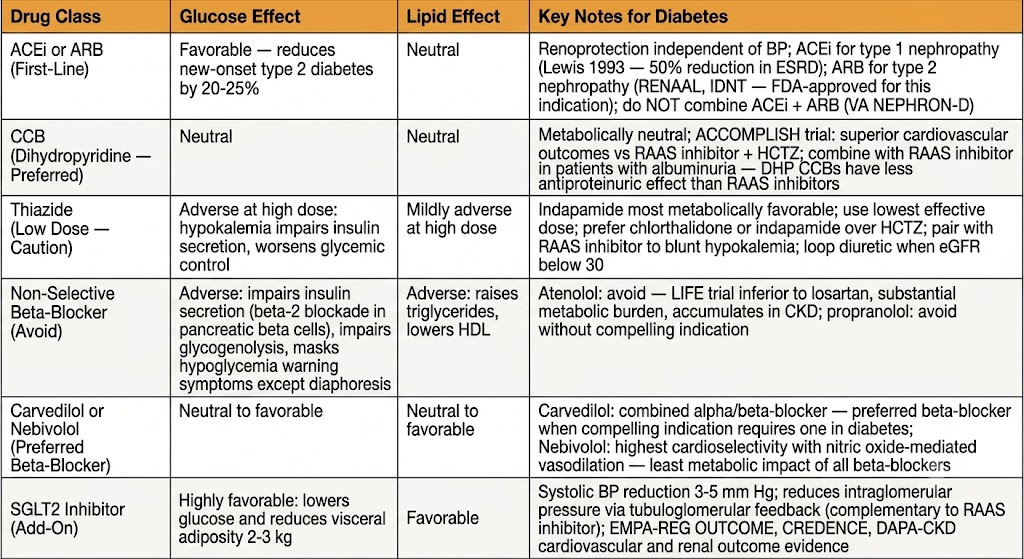
Angiotensin converting enzyme inhibitors or angiotensin receptor blockers are the preferred first-line agents in most patients with diabetes, particularly when any degree of albuminuria is present. They reduce intraglomerular pressure through efferent arteriolar dilation, providing renoprotection independent of blood pressure lowering. They also reduce the incidence of new-onset type 2 diabetes versus beta-blockers and thiazides by approximately 20 to 25 percent, reflecting improved insulin receptor signaling when angiotensin II-mediated interference is removed.
Angiotensin converting enzyme inhibitors are preferred in type 1 diabetic nephropathy — the Lewis et al. (1993) captopril trial established 50 percent reduction in doubling of serum creatinine and end-stage renal disease. Angiotensin receptor blockers are preferred in type 2 diabetic nephropathy — the RENAAL (losartan) and Irbesartan Diabetic Nephropathy Trial (irbesartan) trials have Food and Drug Administration approval for this indication. Either class is appropriate for hypertension without significant proteinuria when tolerability and cost guide selection. Dual renin-angiotensin-aldosterone system blockade combining angiotensin converting enzyme inhibitor plus angiotensin receptor blocker is contraindicated — the VA NEPHRON-D trial showed excess acute kidney injury and hyperkalemia with no benefit.
Calcium channel blockers are metabolically neutral — no adverse effects on glucose metabolism, insulin sensitivity, or lipids — and highly effective in diabetic hypertension. Amlodipine is the preferred dihydropyridine calcium channel blocker, supported by the ACCOMPLISH trial demonstrating superior cardiovascular outcomes versus renin-angiotensin-aldosterone system inhibitor plus hydrochlorothiazide. Calcium channel blockers are equally effective in Black patients with diabetes as in other groups. In patients with significant albuminuria, dihydropyridine calcium channel blockers have less antiproteinuric effect than renin-angiotensin-aldosterone system inhibitors and should be combined with rather than substituted for renin-angiotensin-aldosterone system inhibitors.
Thiazide and thiazide-like diuretics are effective in diabetic hypertension but require careful attention to metabolic effects. At low doses — chlorthalidone 12.5 mg, hydrochlorothiazide 12.5 to 25 mg, indapamide 1.25 mg — glucose effects are acceptable and manageable. Indapamide has the most favorable metabolic profile and is essentially glucose-neutral at standard doses. At higher doses, hypokalemia impairs insulin secretion from pancreatic beta cells, worsening glycemic control. The practical approach is to use the lowest effective dose, prefer chlorthalidone or indapamide over hydrochlorothiazide, and pair with a renin-angiotensin-aldosterone system inhibitor to blunt hypokalemia. Loop diuretics are required when estimated glomerular filtration rate falls below 30 mL/min.
Beta-blockers carry important metabolic risks in diabetes through beta-2 blockade: impaired insulin secretion from pancreatic beta cells, impaired glycogenolysis delaying hypoglycemia recovery, and masking of most hypoglycemic warning symptoms (diaphoresis is preserved because it is cholinergically mediated). Non-selective agents also raise triglycerides and lower high-density lipoprotein.
Beta-blockers remain indicated when a compelling indication exists — heart failure with reduced ejection fraction, post-myocardial infarction, atrial fibrillation rate control, or angina. When required in a patient with diabetes, agent selection matters significantly. Carvedilol (combined alpha/beta-blocker) is metabolically neutral to favorable and does not worsen insulin resistance — the preferred choice in most patients with diabetes needing a beta-blocker. Nebivolol (cardioselective with nitric oxide-mediated vasodilation) has the least metabolic impact of all beta-blockers. Bisoprolol has acceptable glucose effect at standard doses with once-daily simplicity. Atenolol should be avoided — the LIFE trial demonstrated inferior cardiovascular outcomes versus losartan, it carries a substantial metabolic burden, and it accumulates in chronic kidney disease.
Section 3
Sodium-glucose cotransporter 2 inhibitors and glucagon-like peptide-1 receptor agonists — mechanisms and landmark trial evidence
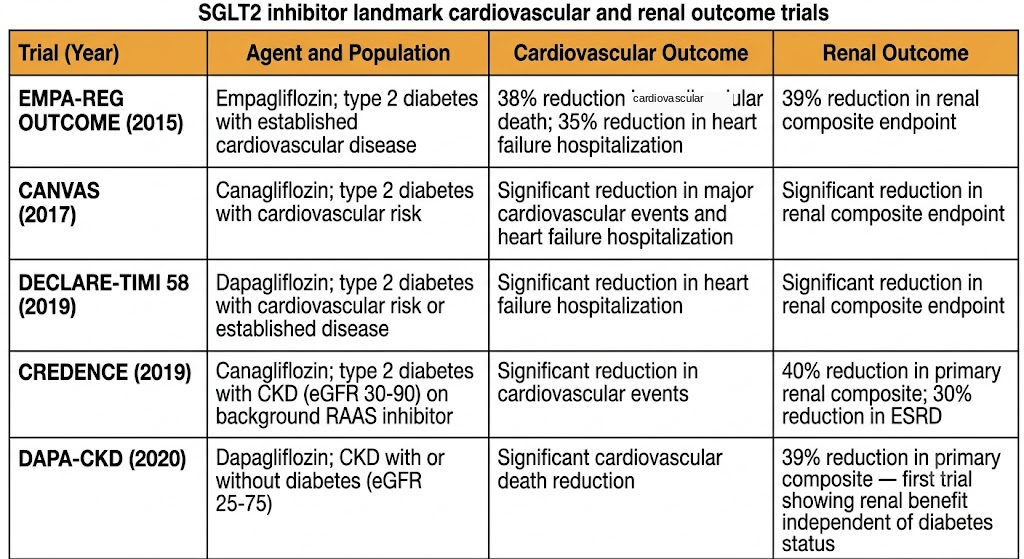
Two relatively new drug classes used primarily for glucose lowering in type 2 diabetes also reduce blood pressure and provide independent cardiovascular and renal outcome benefits that have transformed the pharmacological management of diabetic hypertension. They are now considered essential partners to renin-angiotensin-aldosterone system inhibitors in most patients with type 2 diabetes and cardiovascular disease, heart failure, or chronic kidney disease.
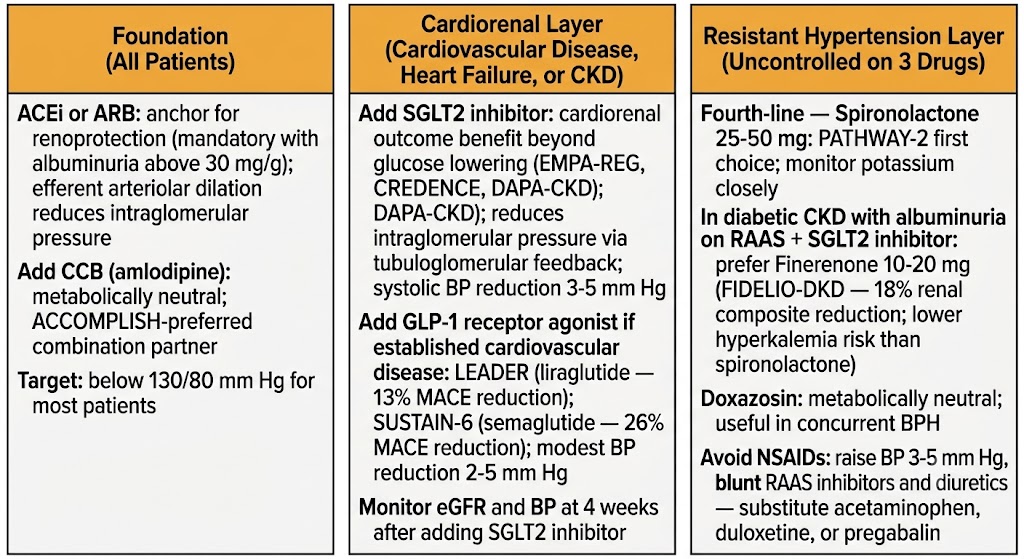
Sodium-glucose cotransporter 2 inhibitors block the sodium-glucose cotransporter 2 in the proximal tubule, reducing glucose and sodium co-reabsorption and promoting osmotic diuresis and natriuresis. Their antihypertensive effect is modest — systolic blood pressure reduction of approximately 3 to 5 millimeters of mercury — but their cardiovascular and renal benefits extend far beyond blood pressure lowering. Increased distal sodium delivery to the macula densa restores tubuloglomerular feedback, causing afferent arteriolar constriction and reducing intraglomerular pressure — a mechanism complementary to renin-angiotensin-aldosterone system inhibition. They also reduce visceral adiposity by 2 to 3 kilograms and modestly suppress renin-angiotensin-aldosterone system activity through natriuresis-induced volume reduction.
When added to existing antihypertensive regimens, the additional natriuretic effect may cause volume depletion and symptomatic hypotension, particularly in elderly patients or those already on loop diuretics or thiazides. Reducing the diuretic dose when adding a sodium-glucose cotransporter 2 inhibitor should be considered if volume depletion is a concern. An initial estimated glomerular filtration rate dip of 5 to 10 percent is expected and acceptable, reflecting reduced intraglomerular pressure rather than nephrotoxicity — analogous to the creatinine rise with renin-angiotensin-aldosterone system inhibitor initiation.
Glucagon-like peptide-1 receptor agonists — including semaglutide, liraglutide, and dulaglutide — provide modest antihypertensive benefit through significant weight reduction, direct renal natriuresis via glucagon-like peptide-1 receptors, and nitric oxide-mediated vasodilation. Mean systolic blood pressure reduction is approximately 2 to 5 millimeters of mercury. Their primary value in patients with diabetic hypertension is cardiovascular outcome benefit: the LEADER trial (liraglutide, 2016) showed 13 percent reduction in major adverse cardiovascular events; the SUSTAIN-6 trial (semaglutide, 2016) showed 26 percent reduction. These agents are recommended as add-on therapy in type 2 diabetes with established cardiovascular disease or high cardiovascular risk, independently of glycemic control levels.
Section 4
Higher prevalence, specific drivers, and fourth-line agent selection
Patients with type 2 diabetes have a higher prevalence of resistant hypertension than the non-diabetic hypertensive population. Multiple diabetes-specific mechanisms contribute, and management requires attention to these specific drivers alongside the general resistant hypertension evaluation framework from Module 6.
Diabetes-specific drivers of resistance include greater salt sensitivity and volume retention from renal sodium avidity; higher prevalence of aldosterone excess (including primary aldosteronism and hyperaldosteronism from insulin resistance); obstructive sleep apnea present in approximately 80 percent of patients with resistant hypertension and particularly prevalent in obese patients with type 2 diabetes; more complex medication regimens with adherence challenges; and chronic kidney disease-related volume retention. Nonsteroidal anti-inflammatory drugs are frequently used in diabetic patients for peripheral neuropathy pain and musculoskeletal comorbidities — they raise blood pressure by 3 to 5 millimeters of mercury on average and blunt both diuretic and renin-angiotensin-aldosterone system inhibitor efficacy. Reviewing all medications for this interaction is essential.
Spironolactone 25 to 50 mg daily remains the most effective fourth-line agent per the PATHWAY-2 trial and should be the first choice when tolerated — potassium requires close monitoring. Eplerenone should be substituted if gynecomastia or sexual dysfunction occurs with spironolactone. In type 2 diabetic chronic kidney disease with residual albuminuria on renin-angiotensin-aldosterone system inhibitor plus sodium-glucose cotransporter 2 inhibitor, finerenone 10 to 20 mg is the preferred mineralocorticoid receptor antagonist given its dual cardiovascular and renal outcome evidence from FIDELIO-DKD and FIGARO-DKD with lower hyperkalemia risk than steroidal agents. Doxazosin is an alternative fourth-line agent that is metabolically neutral and beneficial in men with concurrent benign prostatic hyperplasia. Bisoprolol or nebivolol should be considered if a beta-blocker indication exists and one is not already prescribed.
Nonsteroidal Anti-Inflammatory Drug Avoidance in Diabetic Hypertension
Nonsteroidal anti-inflammatory drugs are frequently prescribed for neuropathic pain and musculoskeletal comorbidities in patients with diabetes. They raise blood pressure by 3 to 5 millimeters of mercury on average, blunt the efficacy of diuretics and renin-angiotensin-aldosterone system inhibitors, and increase the risk of acute kidney injury in the setting of concurrent renin-angiotensin-aldosterone system inhibition. Preferred alternatives: acetaminophen for general pain; duloxetine or pregabalin for neuropathic pain; topical diclofenac gel for localized musculoskeletal pain (substantially lower systemic absorption than oral agents).
| Author / Organization | Title | Source |
|---|---|---|
| Whelton PK, Carey RM, Aronow WS, et al. | 2017 ACC/AHA guideline for the prevention, detection, evaluation, and management of high blood pressure in adults | J Am Coll Cardiol. 2018;71(19):e127–e248 |
| American Diabetes Association | Standards of Medical Care in Diabetes — 2024 | Diabetes Care. 2024;47(Suppl 1):S1–S321 |
| Sowers JR, Epstein M, Frohlich ED | Diabetes, hypertension, and cardiovascular disease: an update | Hypertension. 2001;37(4):1053–1059 |
| Mogensen CE, Christensen CK, Vittinghus E | The stages in diabetic renal disease | Diabetes. 1983;32(Suppl 2):64–78 |
| UK Prospective Diabetes Study Group | Tight blood pressure control and risk of macrovascular and microvascular complications in type 2 diabetes: UKPDS 38 | BMJ. 1998;317(7160):703–713 |
| Hansson L, Zanchetti A, Carruthers SG, et al. | Effects of intensive blood-pressure lowering and low-dose aspirin in patients with hypertension (HOT randomised trial) | Lancet. 1998;351(9118):1755–1762 |
| ACCORD Study Group; Cushman WC, Evans GW, Byington RP, et al. | Effects of intensive blood-pressure control in type 2 diabetes mellitus (ACCORD BP) | N Engl J Med. 2010;362(17):1575–1585 |
| SPRINT Research Group; Wright JT Jr, Williamson JD, Whelton PK, et al. | A randomized trial of intensive versus standard blood-pressure control (SPRINT) | N Engl J Med. 2015;373(22):2103–2116 |
| Williams B, Mancia G, Spiering W, et al. | 2018 ESC/ESH guidelines for the management of arterial hypertension | Eur Heart J. 2018;39(33):3021–3104 |
| Mancia G, Kreutz R, Brunstrom M, et al. | 2023 ESH guidelines for the management of arterial hypertension | J Hypertens. 2023;41(12):1874–2071 |
| Zinman B, Wanner C, Lachin JM, et al. | Empagliflozin, cardiovascular outcomes, and mortality in type 2 diabetes (EMPA-REG OUTCOME) | N Engl J Med. 2015;373(22):2117–2128 |
| Perkovic V, Jardine MJ, Neal B, et al. | Canagliflozin and renal outcomes in type 2 diabetes and nephropathy (CREDENCE) | N Engl J Med. 2019;380(24):2295–2306 |
| Marso SP, Daniels GH, Brown-Frandsen K, et al. | Liraglutide and cardiovascular outcomes in type 2 diabetes (LEADER) | N Engl J Med. 2016;375(4):311–322 |
| Heerspink HJL, Stefansson BV, Correa-Rotter R, et al. | Dapagliflozin in patients with chronic kidney disease (DAPA-CKD) | N Engl J Med. 2020;383(15):1436–1446 |
| Bakris GL, Agarwal R, Anker SD, et al. | Effect of finerenone on chronic kidney disease outcomes in type 2 diabetes (FIDELIO-DKD) | N Engl J Med. 2020;383(23):2219–2229 |