CHAPTER 41  ·  ANTI-INFLAMMATORY DRUGS
Section 1

Gastrointestinal Toxicity — Mechanisms, Risk, and Prevention

Prostaglandin-dependent mucosal protection, the systemic mechanism of NSAID gastropathy, risk stratification, and co-therapy strategies

Abbreviations used in this module: nonsteroidal anti-inflammatory drug (NSAID), cyclooxygenase (COX), prostaglandin E2 (PGE2), prostacyclin (PGI2), thromboxane A2 (TXA2), lipoxygenase (LOX), aspirin-exacerbated respiratory disease (AERD), proton pump inhibitor (PPI), estimated glomerular filtration rate (eGFR), angiotensin-converting enzyme (ACE), angiotensin receptor blocker (ARB), selective serotonin reuptake inhibitor (SSRI), chronic kidney disease (CKD).

Gastrointestinal toxicity is the most common clinically significant adverse effect of NSAID therapy. The mechanism is well understood, risk stratification is evidence-based, and preventive strategies substantially reduce but do not eliminate the risk. The key insight is that NSAID gastropathy is a systemic pharmacological effect of prostaglandin suppression — not a local irritant effect of the drug touching the mucosa.

Mechanism of NSAID Gastropathy

The gastric mucosa is protected by a set of COX-1-dependent mechanisms. PGE2 and PGI2 produced constitutively by gastric epithelial and submucosal cells stimulate mucus and bicarbonate secretion, maintain mucosal blood flow through vasodilation, inhibit parietal cell acid secretion, and promote epithelial repair after injury. When NSAIDs suppress COX-1, all four components of mucosal defense are simultaneously impaired. The mucosa becomes vulnerable to acid, bile salts, and Helicobacter pylori.

This mechanism is systemic, not topical. Enteric-coated formulations prevent the drug tablet from contacting the stomach lining directly, but they do not prevent systemic COX-1 suppression once absorbed. Parenteral NSAIDs cause the same rate of gastric mucosal injury as oral formulations. This means that coating or route of administration cannot protect the stomach — only prostaglandin replacement (misoprostol) or COX-2-selective inhibition address the underlying mechanism.

NSAID-associated gastrointestinal injury spans a spectrum: subclinical erosions visible on endoscopy in a large proportion of regular NSAID users; clinically significant peptic ulcers; and serious complications including bleeding, perforation, and obstruction. A dangerous feature is that ulcer pain is often absent — NSAIDs suppress the prostaglandin-mediated sensitization that normally makes ulcers painful, so serious gastrointestinal bleeding may occur without warning symptoms.

Risk Stratification

Several factors independently and multiplicatively increase gastrointestinal complication risk. A prior peptic ulcer or gastrointestinal bleed is the strongest single risk factor. Age above 65 years is an independent risk factor, reflecting reduced mucosal regenerative capacity and higher comorbidity burden. Concurrent use of anticoagulants or corticosteroids with NSAIDs markedly amplifies risk — the combination of a corticosteroid and an NSAID increases peptic ulcer risk roughly tenfold over either agent alone. High NSAID doses and the simultaneous use of two NSAIDs (including the combination of a standard NSAID with low-dose aspirin) carry higher risk than standard monotherapy. Helicobacter pylori infection synergizes with NSAID use; testing for and eradicating it before long-term NSAID therapy is warranted in high-risk patients.
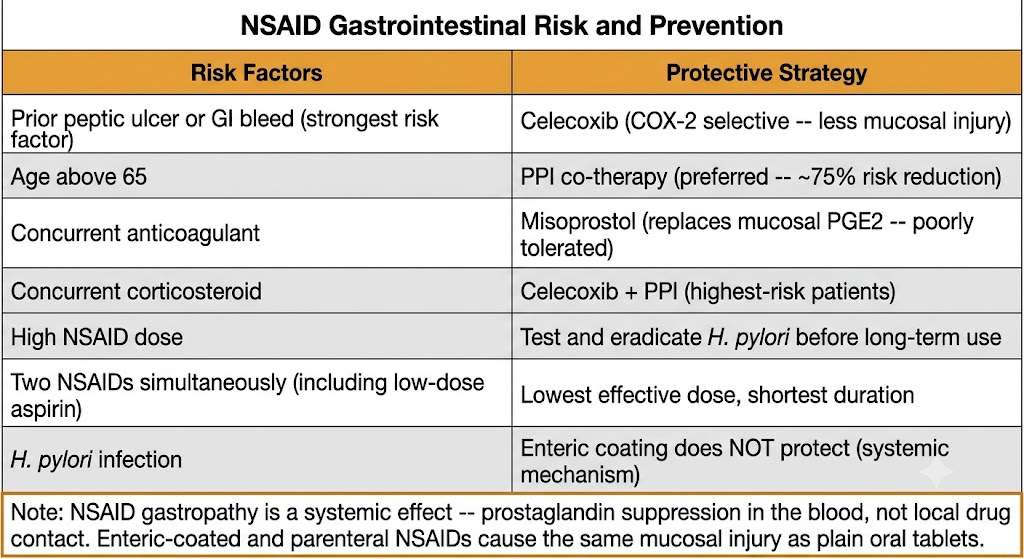
Two-column reference table: left column lists NSAID gastrointestinal risk factors including prior peptic ulcer or GI bleed, age above 65, concurrent anticoagulant, concurrent corticosteroid, high NSAID dose, two NSAIDs simultaneously including low-dose aspirin, and H. pylori infection; right column lists protective strategies including celecoxib, PPI co-therapy, misoprostol, H. pylori eradication, and lowest effective dose for shortest duration.
NSAID gastrointestinal risk factors and protective strategies. Figure generated with Gemini AI for educational use.
Prevention Strategies

Three pharmacological strategies reduce NSAID-associated gastrointestinal toxicity. Selective COX-2 inhibition with celecoxib causes substantially less gastric and duodenal mucosal injury than nonselective NSAIDs, but its gastroprotective advantage is lost when patients also take low-dose aspirin, because aspirin suppresses COX-1 in the gastric mucosa.

PPI co-therapy is the most effective and best-tolerated strategy for patients who require nonselective NSAIDs. PPIs reduce the relative risk of endoscopic ulcers by approximately 75% and are preferred over misoprostol in most clinical settings because of substantially better tolerability. Misoprostol, a synthetic prostaglandin E1 analogue, directly replaces the mucosal prostaglandin depleted by NSAIDs and was the first proven gastroprotective agent; its use is limited by dose-dependent diarrhea and abdominal cramping. For patients at the highest gastrointestinal risk, combining a selective COX-2 inhibitor with a PPI provides the greatest protection.

High GI Risk — Trigger for Protective Co-therapy

Any one of these warrants gastroprotective co-therapy: prior peptic ulcer or gastrointestinal bleed; age above 65; concurrent anticoagulant; concurrent corticosteroid; high NSAID dose; two NSAIDs simultaneously (including low-dose aspirin). Strategy: celecoxib alone, or nonselective NSAID plus PPI. Highest risk: celecoxib plus PPI. Test and treat Helicobacter pylori before starting long-term NSAID therapy in high-risk patients.

Section 2

Cardiovascular and Renal Toxicity

PGI2/TXA2 vascular balance, cardiovascular risk across the COX selectivity spectrum, renal prostaglandin physiology, and the triple whammy

Cardiovascular risk and renal toxicity are class-wide properties of NSAIDs, but they arise through distinct mechanisms and differ in their relationship to COX selectivity. Cardiovascular risk is greatest with selective COX-2 inhibitors and tracks with COX-2 selectivity and dose. Renal toxicity is independent of COX selectivity because both isoforms contribute to renal prostaglandin synthesis.

Cardiovascular Risk — The PGI2/TXA2 Imbalance

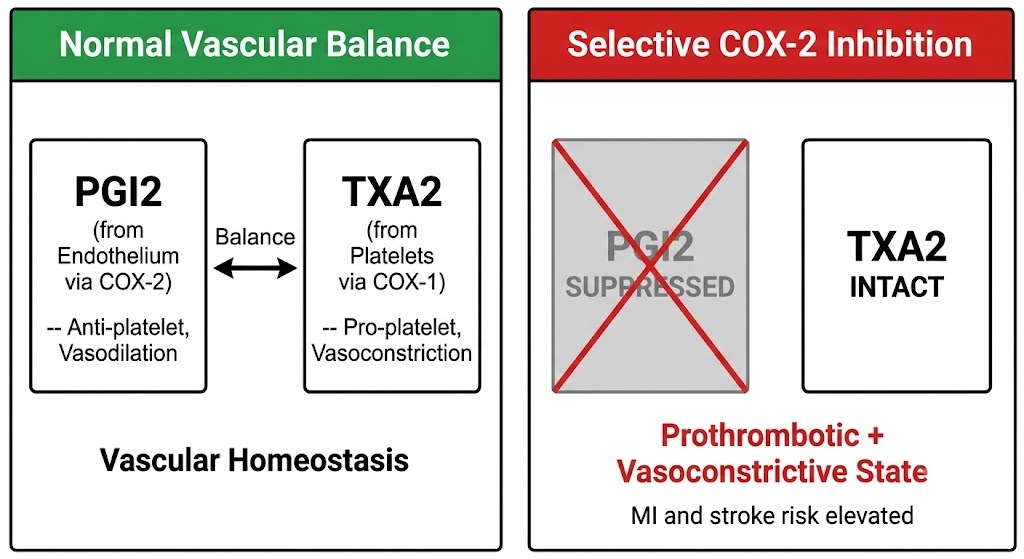
Vascular endothelium constitutively expresses COX-2 as its source of PGI2 — a prostanoid that inhibits platelet aggregation, promotes vasodilation, and limits smooth muscle proliferation. Platelets produce TXA2 exclusively via COX-1, which promotes aggregation and vasoconstriction. Under physiological conditions these two opposing prostanoids maintain vascular homeostasis.

Selective COX-2 inhibition suppresses endothelial PGI2 while leaving platelet TXA2 fully intact. The resulting prostanoid imbalance is prothrombotic and vasoconstrictive, raising the risk of myocardial infarction, ischemic stroke, and sudden cardiac death. This mechanism was identified on pharmacological grounds before clinical trial evidence confirmed it, making the cardiovascular signal a predicted consequence rather than a surprise finding.

Nonselective NSAIDs at high doses also carry meaningful cardiovascular risk. Large meta-analyses show that high-dose diclofenac and high-dose ibuprofen increase major vascular events to a degree comparable to selective COX-2 inhibitors. Naproxen has the most favorable cardiovascular profile among commonly used NSAIDs — its long half-life produces sustained COX-1 inhibition with a partial antiplatelet effect — and is the preferred NSAID in patients with cardiovascular risk factors. All NSAIDs carry a class-wide black box warning for cardiovascular risk.

Two-panel comparison diagram: left panel Normal Vascular Balance shows PGI2 from endothelium via COX-2 balanced against TXA2 from platelets via COX-1, maintaining vascular homeostasis; right panel Selective COX-2 Inhibition shows PGI2 suppressed with a red X while TXA2 remains intact, resulting in a prothrombotic and vasoconstrictive state with elevated MI and stroke risk.
PGI2/TXA2 vascular balance: normal equilibrium versus selective COX-2 inhibition producing a prothrombotic state. Figure generated with Gemini AI for educational use.
Renal Toxicity — Prostaglandin-Dependent Perfusion

In healthy, euvolemic patients, renal prostaglandins play a minor role in maintaining glomerular filtration, and NSAIDs cause only trivial and transient reductions in kidney function. The clinical picture changes entirely in physiologically stressed states. In heart failure, cirrhosis with ascites, nephrotic syndrome, volume depletion from any cause, and chronic kidney disease, the kidney becomes dependent on prostaglandin-mediated vasodilation of the afferent arteriole to maintain adequate perfusion pressure in the face of elevated angiotensin II and catecholamines. NSAID-mediated prostaglandin suppression removes this vasodilatory buffer, allowing afferent arteriolar constriction and a rapid fall in glomerular filtration rate.

Beyond acute kidney injury, NSAIDs cause sodium and water retention (by removing prostaglandin-mediated opposition to tubular sodium reabsorption), can induce hyperkalemia (by reducing aldosterone-stimulating prostaglandins and blocking potassium excretion), and consistently blunt antihypertensive drug efficacy through sodium retention and vasoconstriction.

The Triple Whammy

The combination of an NSAID, a renin-angiotensin-aldosterone system inhibitor (ACE inhibitor or ARB), and a diuretic is one of the highest-risk drug combinations in ambulatory medicine for precipitating acute kidney injury. Each drug attacks a different component of renal perfusion pressure: the NSAID removes prostaglandin-dependent afferent arteriolar dilation; the ACE inhibitor or ARB blocks angiotensin II-dependent efferent arteriolar constriction (which normally maintains the glomerular pressure gradient that drives filtration); and the diuretic reduces circulating volume and renal perfusion pressure. Together they can produce a severe and rapid decline in glomerular filtration rate. Studies have demonstrated dramatically elevated risk of acute kidney injury hospitalization with this combination. It should be avoided; when unavoidable, renal function and electrolytes must be monitored within one to two weeks of initiation.

Cardiovascular Risk Hierarchy

Highest cardiovascular risk: selective COX-2 inhibitors (celecoxib; rofecoxib and valdecoxib withdrawn). Intermediate risk: high-dose diclofenac, high-dose ibuprofen. Lowest risk among NSAIDs: naproxen. Principle: risk is proportional to COX-2 selectivity and dose. In patients with established cardiovascular disease or multiple risk factors, naproxen is the preferred NSAID when one is required. All NSAIDs should be used at the lowest effective dose for the shortest duration.


Section 3

Platelet Effects, AERD, and Drug Interactions

Reversible versus irreversible COX-1 inhibition, perioperative management, AERD pathophysiology, and the high-yield drug interaction profile

All non-aspirin NSAIDs inhibit platelet COX-1 reversibly, meaning platelet function recovers as plasma drug levels fall. This distinguishes them from aspirin and determines perioperative management. AERD represents a pharmacogenomic interaction between COX-1 inhibition and the lipoxygenase pathway that affects a clinically important subset of asthma patients.

Reversible Platelet Inhibition and Perioperative Management

Because non-aspirin NSAIDs inhibit COX-1 reversibly, platelet TXA2 synthesis recovers once plasma drug concentrations fall below the inhibitory threshold. The clinical duration of platelet inhibition therefore corresponds approximately to the drug's plasma half-life. Short-acting agents — ibuprofen, diclofenac, ketorolac — restore platelet function within 24 hours of the last dose. Long-acting agents — naproxen (half-life 12 to 17 hours), piroxicam (half-life 30 to 86 hours) — may suppress platelet function for two to four days after the last dose.

For elective procedures carrying significant bleeding risk, non-aspirin NSAIDs should be held for approximately five half-lives. This means 24 hours for most short-acting NSAIDs and three to five days for naproxen. Aspirin, because its inhibition is irreversible, requires seven to ten days before platelet function is fully restored through platelet renewal — though in many clinical situations the bleeding risk of stopping aspirin in a patient on it for secondary cardiovascular prevention outweighs the procedural bleeding risk, and aspirin continuation is preferred.

Aspirin-Exacerbated Respiratory Disease

AERD — also called Samter triad — is defined by asthma, chronic rhinosinusitis with nasal polyps, and acute respiratory reactions triggered by aspirin or any COX-1 inhibiting NSAID. It affects approximately 10 to 20% of adults with asthma and up to 30% of those with coexisting nasal polyps.

The pathophysiology centers on two converging defects in eicosanoid biology. These patients have constitutively elevated leukotriene production from the LOX pathway and deficient PGE2-mediated suppression of mast cell and eosinophil activation. When any COX-1 inhibiting NSAID is taken, even the baseline restraint provided by PGE2 is removed, and simultaneously, more arachidonic acid is diverted from the blocked COX pathway into the already overactive LOX pathway. The resulting surge of cysteinyl leukotrienes triggers bronchoconstriction, rhinorrhea, and urticaria within 30 to 180 minutes of ingestion.

Celecoxib does not inhibit COX-1 at therapeutic doses and therefore does not trigger leukotriene shunting. It is the preferred NSAID when analgesic or anti-inflammatory therapy is required in a patient with confirmed or suspected AERD. Acetaminophen at standard doses is generally safe in these patients.

Drug Interactions

Anticoagulants. NSAIDs combined with warfarin or direct oral anticoagulants increase gastrointestinal bleeding risk approximately two- to four-fold through two simultaneous mechanisms: COX-1 inhibition impairs platelet function, and COX-1 suppression in the gastric mucosa creates bleeding-prone erosions. When this combination cannot be avoided, PPI co-therapy and the shortest necessary NSAID duration are mandatory.

Antihypertensives. NSAIDs attenuate the blood pressure-lowering efficacy of ACE inhibitors, ARBs, thiazide and loop diuretics, and beta-blockers through sodium retention and direct vasoconstriction. Calcium channel blockers are relatively resistant because their mechanism does not depend on prostaglandin pathways. Blood pressure monitoring and antihypertensive dose adjustment are appropriate when NSAIDs are added to a stable antihypertensive regimen.

Lithium. NSAIDs reduce renal lithium clearance by suppressing renal prostaglandins that normally oppose tubular sodium (and lithium) reabsorption. Lithium levels can rise 10 to 60% depending on the NSAID. Because lithium has a narrow therapeutic index, lithium concentrations should be checked within five to seven days of starting or stopping an NSAID in a patient taking lithium.

Methotrexate. At high oncology doses (above 50 mg per square meter per cycle), NSAIDs impair renal methotrexate excretion by competing for tubular secretion transporters and by reducing renal blood flow, causing prolonged and elevated methotrexate exposure with risk of severe myelosuppression and mucositis. NSAIDs should not be used within 24 hours of a high-dose methotrexate infusion. At the lower weekly doses used for rheumatoid arthritis and psoriasis, the interaction is less severe but still warrants monitoring.

SSRIs. SSRIs deplete platelet serotonin by blocking its reuptake; since platelets cannot synthesize serotonin de novo, chronic SSRI use substantially impairs serotonin-dependent platelet activation. NSAIDs simultaneously impair TXA2-dependent platelet activation. The combined suppression of two independent platelet pathways produces additive dysfunction and a disproportionate increase in gastrointestinal bleeding risk. Patients requiring both an SSRI and chronic NSAID therapy should receive PPI gastroprotection.

Drug Interaction Summary

NSAIDs + anticoagulants: 2–4× gastrointestinal bleed risk — use PPI, minimize duration. Triple whammy (NSAID + ACE inhibitor or ARB + diuretic): acute kidney injury — avoid; monitor creatinine if unavoidable. NSAIDs + lithium: raise levels 10–60% — check levels within 5–7 days. NSAIDs + high-dose methotrexate: impaired excretion — do not use within 24 hours. NSAIDs + SSRIs: additive gastrointestinal bleeding — use PPI. NSAIDs + antihypertensives: 3–5 mmHg average rise in blood pressure — monitor and adjust.


Section 4

Special Populations — Pregnancy, Elderly, CKD, and Cirrhosis

Gestational-age-dependent NSAID risks, age-related vulnerability, renal and hepatic impairment considerations, and topical NSAID as a safer alternative

Several patient populations face disproportionate NSAID toxicity through mechanisms that are pharmacologically predictable. Managing NSAIDs safely in these groups requires understanding the specific vulnerability each population carries and substituting safer alternatives when available.

Pregnancy

NSAID risk in pregnancy is gestational-age dependent. In the first trimester, NSAID use has been associated with modest increases in miscarriage risk in some studies; absolute risk from brief exposure is low, but avoidance is prudent. From 20 weeks onward, the FDA has warned that NSAID use may cause fetal renal dysfunction leading to oligohydramnios — reduced amniotic fluid from decreased fetal urine output — with prolonged use. Ultrasound monitoring of amniotic fluid is recommended if NSAID therapy continues beyond 20 weeks.

In the third trimester, NSAIDs are strongly contraindicated because PGE2 maintains fetal ductal arteriosus patency through receptor-mediated vasodilation. COX inhibition from week 28 onward can cause premature closure of the ductus arteriosus, leading to fetal right ventricular pressure overload and potentially hydrops. Acetaminophen is the preferred analgesic at all trimesters. Low-dose aspirin (81 mg per day) is an exception to NSAID avoidance in pregnancy: it is recommended throughout pregnancy under obstetric supervision for preeclampsia prevention in high-risk patients, where its benefit clearly outweighs risk at this antiplatelet dose.

Elderly Patients

Patients 65 and older accumulate multiple NSAID risk factors simultaneously: renal reserve declines with age even without diagnosed CKD (serum creatinine alone underestimates this because reduced muscle mass generates less creatinine); gastric mucosal regenerative capacity diminishes; polypharmacy increases the likelihood of triple whammy combinations and anticoagulant co-prescription; and centrally penetrant NSAIDs such as indomethacin cause more pronounced cognitive effects, dizziness, and fall risk in this age group. Guidelines recommend avoiding oral nonselective NSAIDs in patients 65 and older when effective alternatives exist. Topical diclofenac gel (1% or 1.5% formulations) provides clinically effective local analgesia for hand and knee osteoarthritis with minimal systemic absorption, largely avoiding gastrointestinal, cardiovascular, and renal risks — it is the preferred NSAID formulation in elderly patients who need localized joint pain relief.

Chronic Kidney Disease and Cirrhosis

NSAIDs should be avoided in patients with an eGFR below 30 mL per minute per 1.73 m² (CKD stage G4 and G5). In patients with eGFR 30 to 60 mL per minute per 1.73 m² (CKD stage G3), short-term NSAID use at the lowest effective dose requires close monitoring of renal function, blood pressure, and fluid status. Calculating eGFR rather than relying on serum creatinine alone is mandatory before prescribing NSAIDs in any patient where renal function is uncertain — elderly, cachectic, and malnourished patients may have severely reduced GFR with normal-appearing creatinine due to low muscle mass.

In hepatic cirrhosis with portal hypertension, renal prostaglandins are essential for maintaining kidney perfusion against the background of intense systemic vasoconstriction and low effective arterial blood volume. NSAIDs in this setting can precipitate acute kidney injury and hepatorenal syndrome. Additionally, cirrhotic patients have reduced platelet counts from hypersplenism, impaired coagulation factor synthesis, and portal hypertensive gastropathy — all compounding the gastrointestinal and bleeding risks of NSAIDs. NSAIDs are generally contraindicated in patients with Child-Pugh B or C cirrhosis. Acetaminophen at a reduced maximum dose (2 g per day) is a safer analgesic choice in patients with liver disease than NSAIDs.

Avoid NSAIDs Entirely In

Pregnancy at or beyond 20 weeks (FDA warning; ductus arteriosus risk from 28 weeks). eGFR below 30 mL per minute per 1.73 m². Decompensated heart failure. Child-Pugh B or C cirrhosis. Active peptic ulcer disease. Confirmed AERD (use celecoxib instead). In elderly patients: favor topical diclofenac for localized joint pain; avoid oral nonselective NSAIDs unless no alternative and gastroprotection is provided.


Suggested References
Author / Organization Title Source
Lanas A, Chan FKL Peptic ulcer disease Lancet. 2017;390(10094):613-624
Sostres C, Gargallo CJ, Lanas A Nonsteroidal anti-inflammatory drugs and upper and lower gastrointestinal mucosal damage Arthritis Res Ther. 2013;15(Suppl 3):S3
Lanza FL, Chan FK, Quigley EM; American College of Gastroenterology Guidelines for prevention of NSAID-related ulcer complications Am J Gastroenterol. 2009;104(3):728-738
FitzGerald GA Coxibs and cardiovascular disease N Engl J Med. 2004;351(17):1709-1711
Bhala N, Emberson J, Merhi A, et al; CNT Collaboration Vascular and upper gastrointestinal effects of non-steroidal anti-inflammatory drugs: meta-analyses of individual participant data from randomised trials Lancet. 2013;382(9894):769-779
American Geriatrics Society 2023 updated AGS Beers Criteria for potentially inappropriate medication use in older adults J Am Geriatr Soc. 2023;71(7):2052-2081
Whelton A Nephrotoxicity of nonsteroidal anti-inflammatory drugs: physiologic foundations and clinical implications Am J Med. 1999;106(5B):13S-24S
Lapi F, Azoulay L, Yin H, Nessim SJ, Suissa S Concurrent use of diuretics, angiotensin converting enzyme inhibitors, and angiotensin receptor blockers with non-steroidal anti-inflammatory drugs and risk of acute kidney injury BMJ. 2013;346:e8525
Boelsterli UA Diclofenac-induced liver injury: a paradigm of idiosyncratic drug toxicity Toxicol Appl Pharmacol. 2003;192(3):307-322
Patrono C, Baigent C Role of aspirin in primary prevention of cardiovascular disease Nat Rev Cardiol. 2019;16(11):675-686
Stevenson DD, Sanchez-Borges M, Szczeklik A Classification of allergic and pseudoallergic reactions to drugs that inhibit cyclooxygenase enzymes Ann Allergy Asthma Immunol. 2001;87(3):177-180
Rainsford KD Anti-inflammatory drugs in the 21st century Subcell Biochem. 2007;42:3-27
Bloor M, Paech M Nonsteroidal anti-inflammatory drugs during pregnancy and the initiation of lactation Anesth Analg. 2013;116(5):1063-1075