Chapter 11  ·  Antilipidemic Drugs

Section 1

Muscle Toxicity — Spectrum, Risk Factors, and Management

The most common reason for statin discontinuation, and how to manage it systematically

Muscle-related complaints are the most common reason patients discontinue statin therapy, yet genuine statin-attributable muscle toxicity is substantially less common than patient-reported rates suggest. A large proportion of reported muscle symptoms in clinical practice reflect the nocebo effect — symptoms arising from negative expectations rather than direct drug toxicity. Distinguishing real toxicity from nocebo effect is a core clinical skill, and a systematic management approach allows most patients to continue some form of statin therapy.
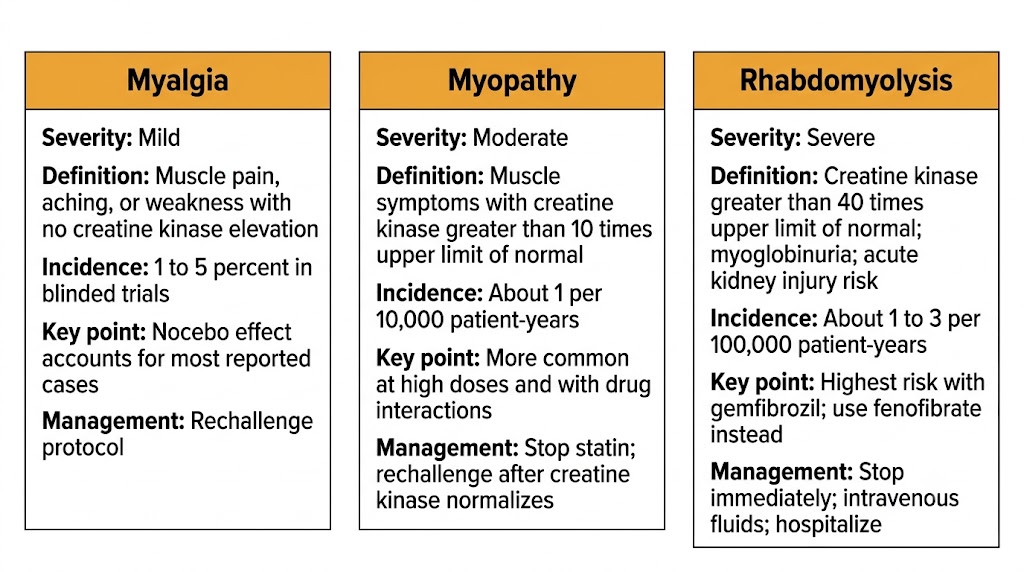
Three-panel spectrum diagram showing statin-associated muscle toxicity progressing from myalgia (mild, no creatine kinase elevation, nocebo effect accounts for most cases) through myopathy (creatine kinase greater than 10 times upper limit of normal, about 1 per 10,000 patient-years) to rhabdomyolysis (creatine kinase greater than 40 times upper limit of normal, myoglobinuria, acute kidney injury risk, highest risk with gemfibrozil).
The clinical spectrum of statin-associated muscle toxicity from myalgia through myopathy to rhabdomyolysis, with defining features and management principles for each level. Figure generated by Gemini AI.

The Clinical Spectrum of Muscle Toxicity

Statin-associated muscle toxicity spans a spectrum from mild to life-threatening. Myalgia is the most common presentation: muscle pain, aching, tenderness, or weakness without elevation of creatine kinase. Randomized controlled trials show rates of one to five percent, not significantly different from placebo in blinded conditions, while open-label studies report much higher rates reflecting the substantial nocebo contribution.

Myopathy refers to muscle symptoms accompanied by creatine kinase elevation greater than ten times the upper limit of normal. This is uncommon in clinical practice at about one per ten thousand patient-years. Rhabdomyolysis is the severe end of the spectrum: creatine kinase elevation greater than forty times the upper limit of normal, myoglobinuria, and risk of acute kidney injury. Rhabdomyolysis from currently marketed statins is rare at roughly one to three per hundred thousand patient-years, and fatal cases are extremely uncommon.

A rare but important separate entity is statin-associated autoimmune myopathy, an immune-mediated condition that persists or worsens after statin discontinuation rather than resolving. It requires specialist evaluation and immunosuppressive therapy, not statin rechallenge. Any patient with progressive proximal muscle weakness or persistently elevated creatine kinase weeks after stopping a statin should be referred for specialist evaluation rather than managed as routine statin-associated muscle symptoms.

Risk Factors for Muscle Toxicity

Patient-level risk factors include advanced age, female sex, low body weight, hypothyroidism (treated or untreated), renal impairment, hepatic impairment, personal or family history of muscle disease, and high-intensity physical activity. Drug-level risk factors include high statin dose, lipophilic statins at high doses, and co-administration of agents that raise statin plasma concentrations — particularly strong cytochrome P450 3A4 inhibitors with atorvastatin or simvastatin, and gemfibrozil with any statin.

The Nocebo Effect

Blinded crossover studies in patients with prior self-reported statin intolerance have demonstrated that the majority of muscle symptom burden during statin therapy can be replicated during placebo periods. This quantifies a substantial nocebo component: symptoms driven by negative expectations and media-amplified beliefs about statin harm rather than by direct pharmacological toxicity. This finding has a direct clinical implication: most patients who have stopped statins for perceived muscle symptoms can successfully restart if the nocebo component is addressed through careful patient education and blinded rechallenge strategies.
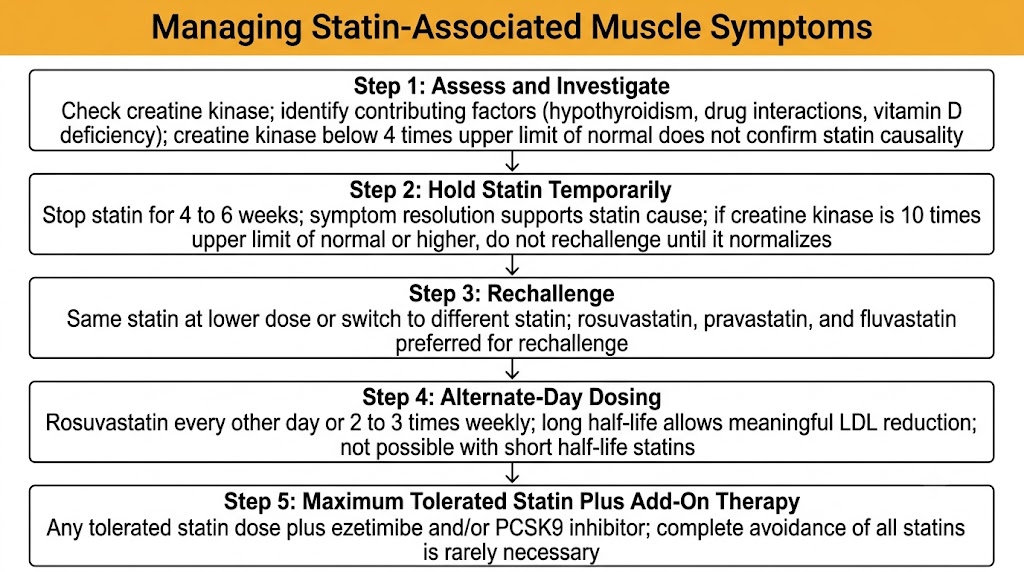
Five-step vertical flow diagram for managing statin-associated muscle symptoms: step 1 assess and check creatine kinase, step 2 hold statin for 4 to 6 weeks, step 3 rechallenge with same or different statin, step 4 try alternate-day rosuvastatin, step 5 use maximum tolerated statin plus ezetimibe and/or PCSK9 inhibitor.
Stepwise management approach for statin-associated muscle symptoms, from initial assessment through rechallenge and combination therapy. Figure generated by Gemini AI.

Stepwise Management of Statin-Associated Muscle Symptoms

Step 1: Assess symptom severity and check creatine kinase. Identify and correct contributing factors such as hypothyroidism, new interacting drugs, and vitamin D deficiency. A creatine kinase below four times the upper limit of normal in a symptomatic patient does not confirm statin causality.

Step 2: Hold the statin temporarily for four to six weeks. Resolution of symptoms supports statin causality; persistence suggests an alternative cause. If creatine kinase is ten times the upper limit of normal or higher with symptoms, discontinue and do not rechallenge until creatine kinase normalizes.

Step 3: Rechallenge with the same or a different statin at a lower dose. Rosuvastatin, pravastatin, and fluvastatin are commonly preferred for rechallenge given their somewhat lower reported rates of muscle symptoms.

Step 4: Consider alternate-day dosing. Rosuvastatin given every other day or two to three times per week exploits its long half-life to provide meaningful low-density lipoprotein cholesterol reduction with a reduced daily drug burden. This strategy is not viable with short-half-life statins such as simvastatin or pravastatin.

Step 5: Accept the maximum tolerated statin intensity and add non-statin therapy. The combination of even low-dose statin plus ezetimibe can achieve moderate low-density lipoprotein cholesterol reduction in genuinely statin-intolerant patients. A proprotein convertase subtilisin/kexin type 9 inhibitor added to any tolerated statin dose can achieve substantial further reduction. Complete avoidance of all statins is rarely necessary.

Rhabdomyolysis — When to Stop Immediately

Discontinue the statin immediately and do not rechallenge if the patient develops: creatine kinase greater than ten times the upper limit of normal with significant muscle symptoms; dark or cola-colored urine (myoglobinuria); acute kidney injury in the context of muscle symptoms. Rhabdomyolysis requires hospitalization, aggressive intravenous fluid resuscitation, and monitoring for acute kidney injury. The gemfibrozil-statin combination is the highest-risk drug pairing for rhabdomyolysis and should be avoided; use fenofibrate instead if a fibrate is needed alongside statin therapy.
Section 2

Hepatotoxicity — Evidence versus Myth

Why routine liver function test monitoring is no longer recommended

The belief that statins commonly cause serious liver injury has been substantially overstated for decades, generating outdated monitoring practices that persist despite evidence to the contrary. True clinically significant statin hepatotoxicity is rare, and routine periodic liver function test monitoring does not detect or prevent it.

True Statin Hepatotoxicity Is Rare

Idiosyncratic drug-induced liver injury from statins occurs at roughly one to three per hundred thousand patient-years — comparable to many other commonly prescribed medications. Clinically significant liver failure attributable to statins has not been demonstrated at rates above placebo in any large randomized trial. Asymptomatic transaminase elevations above three times the upper limit of normal occur in about half a percent to three percent of statin-treated patients in a dose-dependent pattern, but these typically resolve spontaneously with dose reduction or discontinuation and do not predict progression to clinical hepatitis or liver failure.

Routine Monitoring Is No Longer Required

For decades, prescribers were instructed to obtain liver function tests every three to six months during statin therapy. In 2012, the Food and Drug Administration revised statin prescribing information to eliminate this requirement, concluding that routine liver function test monitoring does not detect or prevent serious liver injury and that the burden, patient anxiety, and unnecessary statin discontinuation it generates are not justified by the evidence.

Current practice: obtain a baseline alanine aminotransferase before starting statin therapy. Routine follow-up liver function tests are not recommended unless the patient develops symptoms of hepatotoxicity — jaundice, right upper quadrant pain, unusual fatigue, or dark urine — or unless significant liver disease was present at baseline.

Statins and Liver Disease

Statins are not contraindicated in non-alcoholic fatty liver disease. Evidence suggests statins may be hepatoprotective in this condition, reducing hepatic inflammation while also addressing the markedly elevated cardiovascular risk that accompanies it. Statins should be used cautiously in patients with active hepatic disease or persistent transaminase elevations greater than three times the upper limit of normal at baseline, and are contraindicated in decompensated cirrhosis. In compensated chronic liver disease with near-normal transaminases, statins can generally be used at standard doses with appropriate monitoring.

The Monitoring Rule — Simple and Evidence-Based

Baseline alanine aminotransferase before starting: YES. Routine periodic liver function tests during therapy: NO. Check liver function tests only if the patient develops symptoms of liver injury. Do not withhold statins from patients with non-alcoholic fatty liver disease — the cardiovascular benefit is real and the hepatotoxicity risk is not.


Section 3

New-Onset Diabetes

A real but modest risk that does not outweigh the cardiovascular benefit

Statin therapy increases the risk of new-onset type 2 diabetes. This is a real pharmacological effect, not a monitoring artifact, and it is mechanism-related — inhibition of 3-hydroxy-3-methylglutaryl coenzyme A reductase itself contributes to the diabetogenic effect. However, the absolute increase in diabetes risk is modest and is vastly outweighed by the cardiovascular benefit in every patient group studied.

Magnitude and Mechanism

High-intensity statin therapy increases new-onset diabetes risk by approximately ten to twelve percent relative to placebo. In absolute terms, this translates to roughly one additional case of diabetes per 250 to 500 patients treated for four years. The risk is dose-dependent, and higher-intensity regimens carry greater diabetogenic risk than moderate-intensity regimens.

The mechanism involves multiple pathways: impaired glucose transporter expression in skeletal muscle and adipose tissue, reduced insulin secretion from pancreatic beta cells, and increased hepatic glucose production. Mendelian randomization studies using naturally occurring genetic variants that reduce 3-hydroxy-3-methylglutaryl coenzyme A reductase activity confirm that this effect is intrinsic to the mechanism of enzyme inhibition, not a drug-specific effect of individual statins.

Who Is at Risk

Statin-associated new-onset diabetes occurs almost exclusively in patients who already carry conventional risk factors for diabetes: impaired fasting glucose, metabolic syndrome, obesity, and older age. Patients without any pre-diabetes risk factors have negligible absolute risk. This means the new-onset diabetes risk is concentrated in exactly the population that already needs dietary counseling, lifestyle modification, and fasting glucose monitoring regardless of statin therapy.

Clinical Implication — Benefit Far Outweighs Risk

For every one additional case of diabetes attributable to statin therapy in a high-risk population, statin therapy prevents approximately five cardiovascular events in that same population. Current guidelines do not recommend withholding statins from patients at risk for diabetes. New-onset diabetes that develops on statin therapy should be managed with standard diabetes care — not with statin discontinuation. Clinicians should counsel at-risk patients about the modest incremental risk, reinforce lifestyle modification, and monitor fasting glucose annually.

Key Rule — Do Not Discontinue Statins for New-Onset Diabetes

A patient who develops diabetes while on statin therapy has not suffered net harm from the statin — they have gained substantially more cardiovascular protection than the modest incremental diabetes risk they incurred. Manage the diabetes; continue the statin.


Section 4

Special Populations and Monitoring

Prescribing principles for chronic kidney disease, pregnancy, the elderly, and monitoring recommendations

Statin prescribing in several specific populations requires adjusted thinking about benefit-risk balance, dose selection, and monitoring. In most cases the cardiovascular benefit is preserved and the barriers to treatment are lower than commonly assumed.

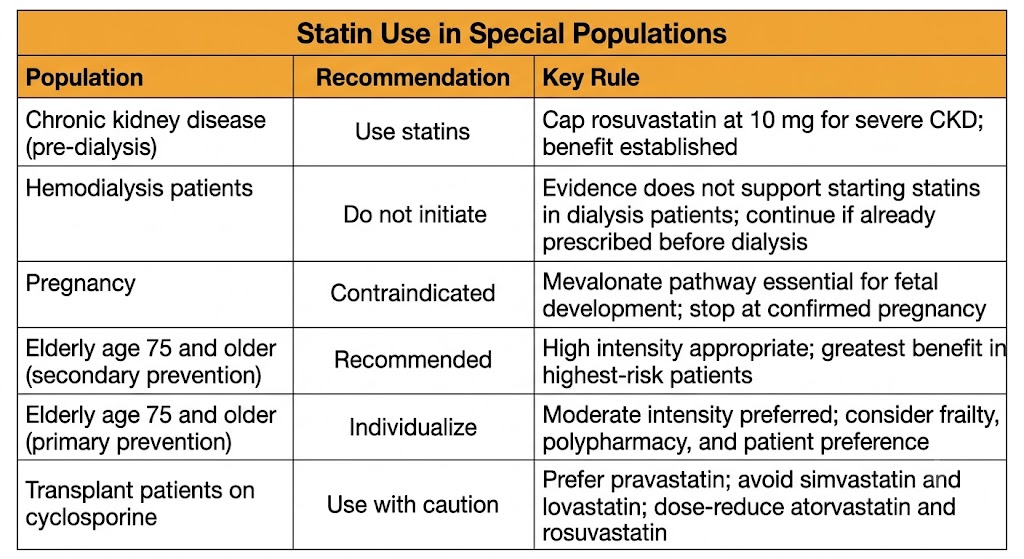
Reference table showing statin prescribing recommendations in six special populations: pre-dialysis chronic kidney disease (use statins, cap rosuvastatin at 10 mg for severe CKD), hemodialysis (do not initiate), pregnancy (contraindicated, mevalonate pathway essential for fetal development), elderly secondary prevention (high intensity recommended), elderly primary prevention (individualize, moderate intensity preferred), and transplant patients on cyclosporine (prefer pravastatin, avoid simvastatin and lovastatin).
Statin prescribing recommendations in special populations with key rules for each group. Figure generated by Gemini AI.

Chronic Kidney Disease

Chronic kidney disease is a strong, independent cardiovascular risk enhancer, and statin therapy reduces cardiovascular events in patients with chronic kidney disease who are not yet on dialysis. This benefit is established by large randomized trial evidence. However, statins do not appear to reduce cardiovascular events in patients already receiving hemodialysis, based on neutral results from dedicated dialysis trials. The current guideline recommendation is to use statins in pre-dialysis chronic kidney disease patients; initiating statins in patients already on dialysis is not supported by the evidence, though continuing statin therapy in patients who were already on it before starting dialysis is reasonable.

Dosing: most statins do not require dose adjustment for mild to moderate chronic kidney disease. For severe chronic kidney disease (estimated glomerular filtration rate below 30 milliliters per minute per 1.73 square meters), rosuvastatin should be capped at 10 milligrams per day. Simvastatin at high doses should be avoided in severe chronic kidney disease.

Pregnancy

Statins are contraindicated in pregnancy. Cholesterol and isoprenoid intermediates produced by the mevalonate pathway are essential for fetal organogenesis, neural myelination, and steroid hormone synthesis during development. Statin inhibition of this pathway during pregnancy carries theoretical teratogenic risk, and the conservative recommendation is categorical avoidance throughout pregnancy and breastfeeding. Women of childbearing potential on statin therapy should use reliable contraception and discontinue statins promptly upon confirmed pregnancy. In women with familial hypercholesterolemia who are planning pregnancy, statins are paused from conception through breastfeeding completion.

Elderly Patients (Age 75 and Older)

For secondary prevention in patients aged 75 and older with established atherosclerotic cardiovascular disease, high-intensity statin therapy is recommended. Absolute cardiovascular benefit is greatest in those at highest baseline risk, and this age group carries very high absolute risk. For primary prevention in patients aged 75 and older without established cardiovascular disease, the decision is more nuanced: life expectancy, comorbidity burden, polypharmacy interactions, frailty, and patient preferences all factor into shared decision-making. Moderate-intensity statin (rather than high-intensity) is a reasonable default in very elderly primary prevention patients given altered pharmacokinetics and increased susceptibility to muscle toxicity.

Transplant Recipients

Post-transplant cardiovascular disease is the leading cause of death beyond the first year after solid organ transplantation, making statin therapy a high priority in this population. The major pharmacokinetic challenge is cyclosporine, which potently inhibits both cytochrome P450 3A4 and hepatic uptake transporters, raising the plasma concentrations of virtually every statin. Pravastatin and fluvastatin have the most established safety records in patients on cyclosporine and are preferred for kidney and heart transplant recipients on cyclosporine-based regimens. Simvastatin and lovastatin should be avoided. Atorvastatin and rosuvastatin can be used at reduced doses with monitoring.

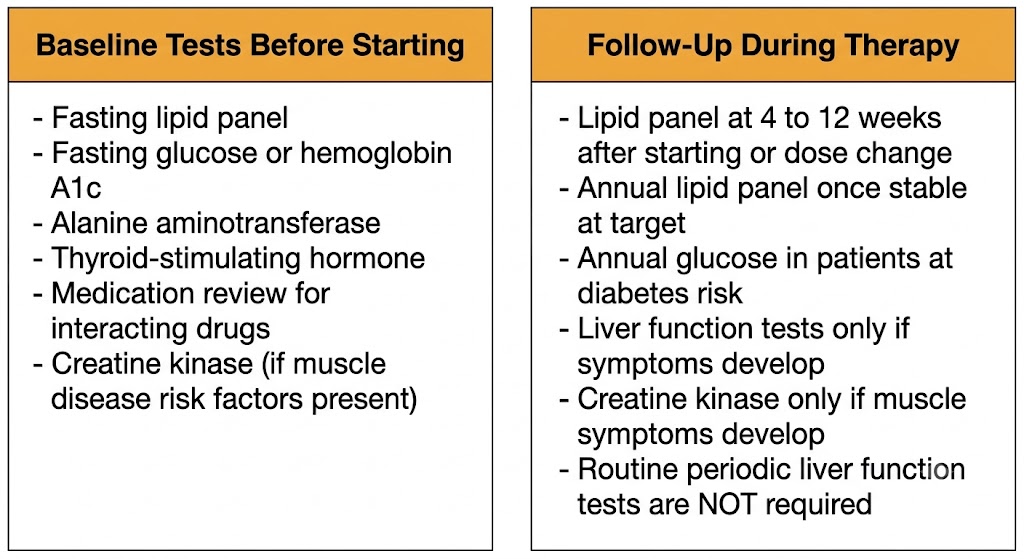
Two-panel monitoring reference showing baseline tests before starting statin therapy on the left (fasting lipid panel, fasting glucose or hemoglobin A1c, alanine aminotransferase, thyroid-stimulating hormone, medication review, creatine kinase if indicated) and follow-up monitoring during therapy on the right (lipid panel at 4 to 12 weeks, annual lipid panel once stable, annual glucose in at-risk patients, liver function tests and creatine kinase only if symptoms develop, routine periodic liver function tests not required).
Evidence-based monitoring for statin therapy showing required baseline tests and follow-up intervals. Figure generated by Gemini AI.

Monitoring — Baseline and Follow-Up

Before initiating statin therapy, obtain a fasting lipid panel, fasting glucose or hemoglobin A1c (to establish pre-diabetes or diabetes status and create a baseline), alanine aminotransferase (to exclude active hepatic disease), and thyroid-stimulating hormone (hypothyroidism both elevates cardiovascular risk and predisposes to muscle toxicity). Review the full medication list for drugs that raise statin concentrations. Creatine kinase at baseline is recommended for patients with muscle disease risk factors but is not required for all patients.

Follow-up: repeat the fasting lipid panel four to twelve weeks after starting therapy or changing dose to assess the low-density lipoprotein cholesterol response. Once stable, annual lipid monitoring is appropriate. Routine periodic liver function tests are not required. Creatine kinase should be checked only if muscle symptoms develop. Fasting glucose or hemoglobin A1c should be monitored at least annually in patients at risk for diabetes.

Evening Dosing for Short-Half-Life Statins

Hepatic cholesterol synthesis peaks between midnight and 2 a.m. For short-half-life statins — simvastatin, lovastatin, pravastatin, and fluvastatin — evening dosing times the peak plasma concentration to coincide with maximal synthetic activity, maximizing efficacy. For long-half-life statins — atorvastatin, rosuvastatin, and pitavastatin — timing is less critical and morning dosing is equally effective. When adherence is a concern, morning dosing of long-half-life statins may be preferable in patients with complex evening polypharmacy regimens.


Suggested References
Author / Organization Title Source
Wood FA, Howard JP, Finegold JA, et al. N-of-1 trial of a statin, placebo, or no treatment to assess side effects. N Engl J Med. 2020;383(22):2182–2184
Stroes ES, Thompson PD, Corsini A, et al; European Atherosclerosis Society Consensus Panel. Statin-associated muscle symptoms: impact and practical management. Eur Heart J. 2015;36(17):1012–1022
Bays H, Cohen DE, Chalasani N, Harrison SA; The National Lipid Association’s Statin Safety Task Force. An assessment by the Statin Liver Safety Task Force: 2014 update. J Clin Lipidol. 2014;8(3 Suppl):S47–S57
Sattar N, Preiss D, Murray HM, et al. Statins and risk of incident diabetes: a collaborative meta-analysis of randomised statin trials. Lancet. 2010;375(9716):735–742
Baigent C, Landray MJ, Reith C, et al; SHARP Investigators. The effects of lowering LDL cholesterol with simvastatin plus ezetimibe in patients with chronic kidney disease (Study of Heart and Renal Protection): a randomised placebo-controlled trial. Lancet. 2011;377(9784):2181–2192
Ridker PM, Danielson E, Fonseca FA, et al; JUPITER Study Group. Rosuvastatin to prevent vascular events in men and women with elevated C-reactive protein. N Engl J Med. 2008;359(21):2195–2207
Bateman BT, Hernandez-Diaz S, Fischer MA, et al. Statins and congenital malformations: cohort study. BMJ. 2015;350:h1035
Grundy SM, Stone NJ, Bailey AL, et al. 2018 AHA/ACC Guideline on the Management of Blood Cholesterol. J Am Coll Cardiol. 2019;73(24):e285–e350
Wiggins BS, Saseen JJ, Page RL 2nd, et al. Recommendations for management of clinically significant drug-drug interactions with statins and select agents used in patients with cardiovascular disease. Circulation. 2016;134(21):e468–e495
Cholesterol Treatment Trialists Collaboration; Baigent C, Blackwell L, et al. Efficacy and safety of more intensive lowering of LDL cholesterol: a meta-analysis of data from 170,000 participants in 26 randomised trials. Lancet. 2010;376(9753):1670–1681