CHAPTER 14  ·  GENERAL ANESTHESIA

Section 1

Introduction: Mechanism of Inhalational Anesthetic Action

How volatile agents and nitrous oxide produce unconsciousness at the receptor level

The inhalational anesthetics share the clinical goal of producing reversible unconsciousness but differ substantially in their pharmacokinetic properties, organ system effects, and toxicity profiles. Understanding these differences drives agent selection for specific clinical situations.

The primary molecular mechanism of volatile halogenated agents is potentiation of the gamma-aminobutyric acid type A receptor, a ligand-gated chloride channel that mediates inhibitory neurotransmission throughout the central nervous system. By enhancing chloride conductance and hyperpolarizing neurons, volatile agents suppress cortical and subcortical circuits responsible for consciousness. Nitrous oxide acts through a different primary mechanism — antagonism of N-methyl-D-aspartate glutamate receptors — which explains both its analgesic properties and its distinct clinical profile compared to the halogenated agents.

Anesthetic potency correlates with lipid solubility (the Meyer-Overton correlation), reflected in the oil:gas partition coefficient: more lipid-soluble agents are more potent and have lower minimum alveolar concentration values. This empirical relationship is now understood to reflect binding at lipophilic sites on membrane proteins rather than bulk membrane dissolution.


Section 2

Halothane

High hepatotoxicity risk and catecholamine sensitization distinguish halothane from modern agents

Halothane is a halogenated alkane largely displaced in high-resource settings by newer agents but still widely used in low-income countries because of its availability and low cost. Its pharmacology is important both historically and for clinicians practicing in resource-limited environments.

Pharmacokinetic Properties

Halothane has the highest blood:gas partition coefficient of the volatile agents in common use (approximately 2.4), making it the most blood-soluble and producing the slowest rate of rise in alveolar partial pressure — and therefore the slowest induction and emergence. Approximately 20% of the absorbed dose undergoes hepatic metabolism, the highest metabolic fraction of any volatile agent, generating reactive intermediates that are central to its hepatotoxicity.

Cardiovascular Effects

Halothane is a potent myocardial depressant. It reduces cardiac output, heart rate, and blood pressure in a dose-dependent manner. Unlike isoflurane, which causes vasodilation and a compensatory reflex tachycardia, halothane directly suppresses the sinoatrial node and produces bradycardia.

Halothane sensitizes the myocardium to catecholamine-induced arrhythmias — a unique and clinically important property not shared by modern agents. Ventricular arrhythmias can occur at relatively low epinephrine doses during halothane anesthesia, limiting the use of epinephrine-containing local anesthetics during halothane-based anesthesia.

Hepatotoxicity

Halothane hepatotoxicity is the most important adverse effect of this agent and exists in two distinct forms. Type I (mild) hepatotoxicity is a transient, self-limited elevation in liver enzymes occurring in a substantial minority of patients — likely due to direct toxicity from reductive metabolites produced in areas of relative hepatic hypoxia. Type II (severe) hepatotoxicity is immune-mediated halothane hepatitis, a rare but potentially fatal fulminant hepatic necrosis that occurs on repeat exposure. The mechanism involves hepatic metabolism of halothane to trifluoroacetyl chloride, which covalently binds to hepatic proteins; these trifluoroacetylated proteins act as neoantigens, triggering an immune response on re-exposure. Risk factors include multiple exposures, female sex, obesity, and middle age. Halothane hepatitis carries a high mortality rate.
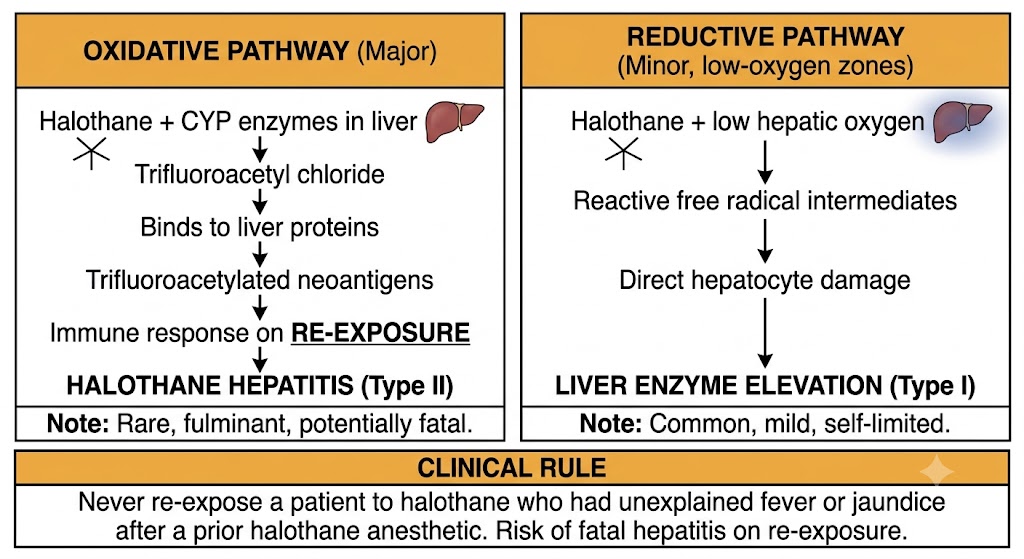
Two-panel diagram of halothane hepatotoxicity mechanisms: left panel shows the oxidative pathway producing trifluoroacetyl chloride that binds to liver proteins creating trifluoroacetylated neoantigens, triggering immune-mediated Type II halothane hepatitis on re-exposure; right panel shows the reductive pathway producing reactive free radicals causing direct hepatocyte damage and Type I liver enzyme elevation. A shared clinical rule box below states never to re-expose a patient with prior unexplained fever or jaundice after halothane anesthesia.
Halothane hepatotoxicity: oxidative (immune-mediated) and reductive (direct) metabolic pathways. Figure generated by Gemini AI.

Halothane: High-Yield Adverse Effects

Catecholamine sensitization — ventricular arrhythmias with epinephrine; unique to halothane among volatile agents.

Immune-mediated hepatitis — trifluoroacetylated liver proteins trigger immune response on re-exposure; rare but potentially fatal.

Uterine relaxation — dose-dependent; useful for obstetric procedures requiring uterine relaxation but risks uterine atony and postpartum hemorrhage.

Increases intracranial pressure — cerebral vasodilation; avoid in neurosurgery and elevated intracranial pressure states.

Section 3

Nitrous Oxide

A gas-phase agent with analgesic properties, unique contraindications, and important toxicity

Nitrous oxide is unique among inhalational anesthetics: it is a gas at room temperature (stored as a liquid under pressure), it has analgesic properties that the volatile halogenated agents lack, and its minimum alveolar concentration of approximately 104% means it cannot produce surgical anesthesia alone at atmospheric pressure. It is always used as part of a combined anesthetic, where it reduces the required concentration of the co-administered volatile agent (minimum alveolar concentration additivity).

Mechanism and Analgesic Properties

The primary anesthetic mechanism of nitrous oxide is N-methyl-D-aspartate receptor antagonism, shared with ketamine. This is distinct from the gamma-aminobutyric acid type A potentiation of the volatile halogenated agents. Nitrous oxide's N-methyl-D-aspartate antagonism also underlies its significant analgesic properties, making it useful for procedural analgesia at sub-anesthetic concentrations (50% inspired mixture).

Cardiovascular Effects

Nitrous oxide has mild sympathomimetic cardiovascular effects, maintaining or slightly increasing heart rate, blood pressure, and cardiac output. This is in contrast to the myocardial depression of volatile agents, making nitrous oxide a useful adjunct in patients with limited cardiovascular reserve. In patients with severely depleted catecholamine stores, however, the direct myocardial depressant effect may be unmasked.

Expansion of Air-Filled Spaces

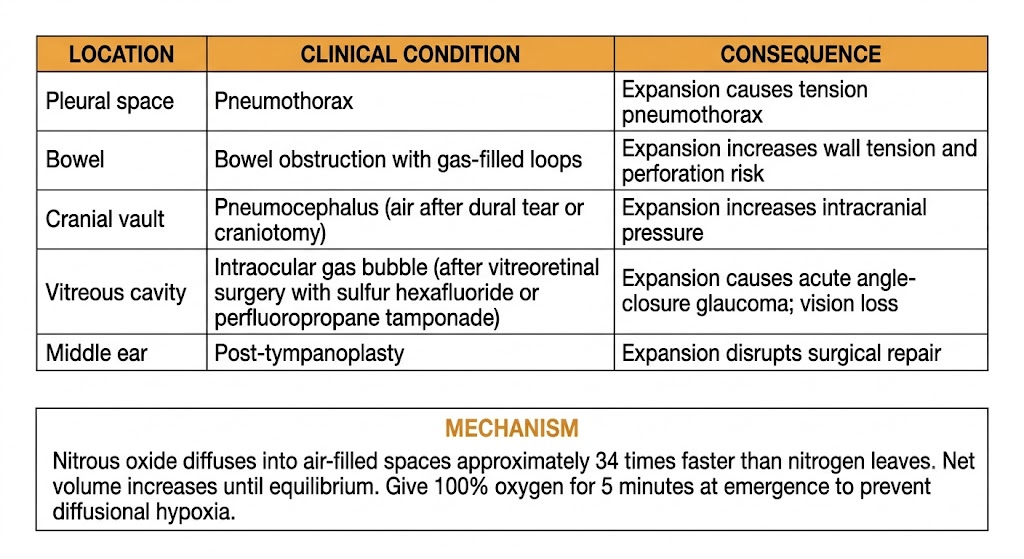
Nitrous oxide diffuses into air-filled body cavities approximately 34 times faster than nitrogen leaves them, causing progressive expansion of any closed gas-containing space. This produces several important contraindications.

Three-column reference table of nitrous oxide contraindications due to air-filled space expansion, listing five locations (pleural space, bowel, cranial vault, vitreous cavity, middle ear) with the associated clinical conditions and consequences of nitrous oxide-induced expansion. A mechanism rule box below explains the 34-times-faster diffusion rate compared to nitrogen and advises 100% oxygen at emergence to prevent diffusional hypoxia.
Nitrous oxide contraindications: air-filled body cavities at risk of expansion and clinical consequences. Figure generated by Gemini AI.

Nitrous Oxide: Contraindications Due to Air-Filled Space Expansion

Pneumothorax — nitrous oxide expands the pneumothorax, potentially causing tension physiology.

Bowel obstruction — expansion of gas-filled bowel loops increases bowel wall tension and perforation risk.

Pneumocephalus — air in the cranial vault (after dural tear or craniotomy) expands, increasing intracranial pressure.

Intraocular gas bubbles — following vitreoretinal surgery using sulfur hexafluoride or perfluoropropane gas tamponade; expansion can cause acute glaucoma and vision loss. Contraindication persists for weeks after surgery until gas is fully absorbed.

Middle ear dysfunction — particularly after tympanoplasty; expansion of middle ear air space can disrupt the surgical repair.

Vitamin B12 and Methionine Synthase Inhibition

Nitrous oxide irreversibly oxidizes the cobalt ion of vitamin B12, inactivating methionine synthase. This enzyme is required for the conversion of homocysteine to methionine and for normal thymidylate (deoxyribonucleotide) synthesis. Acute inhibition impairs deoxyribonucleic acid synthesis. With single exposures this is transient and subclinical, but repeated or prolonged exposures can produce megaloblastic anemia and subacute combined degeneration of the spinal cord — a syndrome identical to that of nutritional vitamin B12 deficiency. Nitrous oxide must be avoided in patients with pre-existing vitamin B12 deficiency and used cautiously with drugs that also inhibit folate metabolism.

Additional Considerations

Nitrous oxide increases the incidence of postoperative nausea and vomiting in a duration-dependent manner and is a component of postoperative nausea and vomiting risk reduction strategies in high-risk patients. It is not a triggering agent for malignant hyperthermia — a critical distinction from the volatile halogenated agents. Diffusional hypoxia at emergence is covered in Module 1.


Section 4

Desflurane

Fastest emergence among halogenated agents; airway irritant precluding inhalational induction

Key Properties

Desflurane has the lowest blood:gas partition coefficient of the halogenated volatile agents (approximately 0.42), producing the fastest alveolar partial pressure equilibration and the most rapid induction and emergence. This property makes it particularly valuable in ambulatory surgery and any setting where fast, predictable awakening is a priority. Its near-room-temperature boiling point (22.8 degrees Celsius) requires a specialized heated, pressurized vaporizer.

Desflurane undergoes less than 0.02% hepatic metabolism — the lowest of any volatile agent — and produces negligible inorganic fluoride, accounting for its freedom from hepatotoxic and nephrotoxic metabolite concerns.

Airway Irritation

Desflurane is a significant airway irritant at induction concentrations, commonly provoking coughing, breath-holding, laryngospasm, and bronchospasm. It is therefore not suitable for inhalational induction and is always administered for maintenance only after intravenous induction. Use with caution in patients with reactive airways disease.

Cardiovascular and Environmental Notes

Rapid increases in desflurane concentration cause transient sympathetic activation — tachycardia and hypertension — mediated by pulmonary irritant receptor stimulation. Desflurane concentration should therefore be increased gradually, particularly in patients with coronary artery disease. At stable maintenance concentrations, the cardiovascular profile is similar to isoflurane. Desflurane has the highest global warming potential of any anesthetic agent and has been withdrawn or restricted in several countries on environmental grounds.


Section 5

Isoflurane

The most widely used volatile agent globally; favorable safety profile and low cost

Key Properties

Isoflurane has a blood:gas partition coefficient of approximately 1.4 — intermediate between halothane and sevoflurane — producing a moderately rapid induction and emergence. It undergoes approximately 0.2% hepatic metabolism, producing inorganic fluoride and trifluoroacetic acid at levels insufficient to cause clinically significant organ toxicity. This near-metabolic inertness was a major safety advantage over halothane when isoflurane was introduced.

Cardiovascular Effects

Isoflurane is a peripheral vasodilator. It reduces systemic vascular resistance and blood pressure, and unlike halothane (which directly suppresses the sinoatrial node and causes bradycardia), isoflurane triggers a baroreceptor-mediated reflex tachycardia. Cardiac output is relatively preserved. Myocardial contractility is only minimally depressed at clinical doses, making isoflurane substantially less cardiotoxic than halothane. Isoflurane does not sensitize the myocardium to catecholamine-induced arrhythmias.

Central Nervous System Effects

Isoflurane reduces cerebral metabolic rate and at doses of 1.5 to 2 minimum alveolar concentration produces burst suppression on electroencephalography — a property sometimes exploited during neurosurgical procedures requiring temporary vascular occlusion. It causes less cerebral vasodilation and less intracranial pressure elevation than halothane, and the rise in intracranial pressure is more readily blunted by hyperventilation, giving isoflurane a more favorable neurosurgical profile.


Section 6

Enflurane

Largely withdrawn; remembered for its unique epileptogenic potential

Enflurane is a halogenated ether largely withdrawn from clinical practice in high-income countries, having been superseded by isoflurane, sevoflurane, and desflurane. Its pharmacology is important primarily because of two high-yield properties.

Enflurane: Two High-Yield Properties

Epileptogenic potential — the only volatile anesthetic with clinically significant epileptogenic activity. At high concentrations (greater than approximately 2 minimum alveolar concentration) or in the presence of hypocapnia, enflurane produces electroencephalographic spike-and-wave activity and can induce generalized tonic-clonic seizures. Contraindicated in patients with seizure disorders. This property was a primary reason for its replacement by isoflurane and sevoflurane, which do not share it.

Fluoride production — approximately 2 to 5% of enflurane undergoes hepatic metabolism, generating inorganic fluoride ions at levels that can transiently impair renal concentrating ability, particularly after prolonged administration. This was a precursor to the sevoflurane/compound A nephrotoxicity debate.

Enflurane's blood:gas partition coefficient is approximately 1.9 and its minimum alveolar concentration is approximately 1.68%. Its cardiovascular profile is broadly similar to isoflurane — peripheral vasodilation with compensatory tachycardia, modest myocardial depression, and no significant catecholamine sensitization.


Section 7

Sevoflurane

Agent of choice for pediatric inhalational induction; important emergence agitation risk in children

Sevoflurane has largely replaced halothane in high-resource settings as the preferred agent for inhalational induction, particularly in pediatric patients. Its combination of low blood solubility (blood:gas partition coefficient approximately 0.65), a pleasant non-pungent odor, potent bronchodilation, and hemodynamic stability at induction doses makes it ideal for mask induction without intravenous access.

Pharmacokinetic Properties

The minimum alveolar concentration of sevoflurane is approximately 2.0% in oxygen. Approximately 3 to 5% of the absorbed dose undergoes hepatic metabolism — higher than isoflurane or desflurane — generating inorganic fluoride and hexafluoroisopropanol. Despite serum fluoride levels that can transiently rise above thresholds historically associated with nephrotoxicity from other agents, clinically significant renal dysfunction from sevoflurane has not been convincingly demonstrated in clinical practice.

Compound A

Sevoflurane degrades in contact with carbon dioxide absorbents (soda lime) at low fresh gas flow rates to produce compound A, a vinyl ether that causes dose-dependent nephrotoxicity in rats. Human nephrotoxicity from compound A has not been demonstrated in clinical studies, and regulatory agencies in most countries permit low-flow sevoflurane anesthesia. Nevertheless, caution is advised in patients with pre-existing renal impairment undergoing prolonged procedures at very low fresh gas flows.

Cardiovascular and Respiratory Effects

Sevoflurane causes dose-dependent reductions in blood pressure and systemic vascular resistance similar to isoflurane. It does not sensitize the myocardium to catecholamine-induced arrhythmias and does not cause the sympathetic activation on rapid concentration increase seen with desflurane, making it more suitable for inhalational induction. Sevoflurane is the preferred volatile agent in patients with asthma or reactive airways disease, largely replacing halothane for this indication in high-resource settings.

Emergence Agitation in Pediatric Patients

A clinically important adverse effect of sevoflurane is emergence agitation — also called emergence delirium — occurring particularly in young children (peak incidence ages 2 to 5). It presents as inconsolable crying, thrashing, disorientation, and failure to recognize caregivers in the immediate post-anesthetic period, typically resolving within 15 to 30 minutes. The mechanism is incompletely understood but is related to the rapid offset of sevoflurane sedation before full cortical reintegration occurs.

Effective prevention strategies include midazolam premedication, a small dose of propofol at emergence, fentanyl before awakening, adequate multimodal analgesia, and dexmedetomidine near the end of the procedure. Emergence agitation is distinct from postoperative delirium in elderly adults, which involves different pathophysiology and a more prolonged course.


Section 8

Comparative Summary of Inhalational Agents

Key pharmacological parameters and distinguishing properties across agents

Agent Blood:Gas Coefficient Minimum Alveolar Concentration Induction Speed Distinguishing Property Key Adverse Effect / Contraindication
Desflurane ~0.42 (lowest halogenated) ~6–7% Fastest emergence Airway irritant — cannot use for induction; requires heated vaporizer Sympathetic activation on rapid concentration increase; highest global warming potential
Nitrous oxide ~0.47 ~104% Very fast Analgesic (N-methyl-D-aspartate antagonism); cannot produce surgical anesthesia alone Expands air-filled spaces; vitamin B12 inactivation; postoperative nausea and vomiting; not a malignant hyperthermia trigger
Sevoflurane ~0.65 ~2.0% Fast Non-pungent; preferred for pediatric induction; best bronchodilator among modern agents Compound A nephrotoxicity (low-flow); emergence agitation in children
Isoflurane ~1.4 ~1.17% Moderate Most widely used worldwide; peripheral vasodilation with reflex tachycardia Minimal hepatotoxicity; mild intracranial pressure increase
Enflurane ~1.9 ~1.68% Slow Only volatile agent with epileptogenic potential Contraindicated in seizure disorders; fluoride nephrotoxicity; largely withdrawn
Halothane ~2.4 (highest) ~0.75% Slowest Highest potency; catecholamine sensitization; still used in low-resource settings Immune-mediated hepatitis on re-exposure; myocardial depression; bradycardia; increases intracranial pressure

Clinical Selection Summary

Pediatric inhalational induction: sevoflurane — non-pungent, fast, hemodynamically stable.

Fastest emergence (long cases): desflurane — lowest tissue solubility, minimal accumulation.

Reactive airways / asthma: sevoflurane preferred; halothane acceptable in resource-limited settings.

Malignant hyperthermia susceptibility: nitrous oxide only (no volatile halogenated agent of any kind) or total intravenous anesthesia.

Seizure disorder: avoid enflurane absolutely; sevoflurane and isoflurane preferred.

Resource-limited settings: halothane and nitrous oxide remain in use where modern agents are unavailable.


Suggested References
Author / Organization Title Source
Miller RD, ed. Miller's Anesthesia, 8th ed. Chapters 26, 27 Philadelphia: Elsevier; 2015
Eger EI 2nd Anesthetic Uptake and Action Baltimore: Williams & Wilkins; 1974
Johnston RR, Eger EI 2nd, Wilson C A comparative interaction of epinephrine with enflurane, isoflurane, and halothane in man Anesth Analg. 1976;55(5):709–712
Emmanouil DE, Quock RM Advances in understanding the actions of nitrous oxide Anesth Prog. 2007;54(1):9–18
Stoelting RK, Hillier SC Pharmacology and Physiology in Anesthetic Practice, 4th ed. Philadelphia: Lippincott Williams & Wilkins; 2006
Weiskopf RB, et al. Rapid increase in desflurane concentration is associated with greater transient cardiovascular stimulation than with rapid increases in isoflurane concentration in humans Anesthesiology. 1994;80(5):1035–1045
Voss LJ, et al. The howling cortex: seizures and general anesthetic drugs Anesth Analg. 2008;107(5):1689–1703
Kharasch ED Sevoflurane and renal toxicity Curr Opin Anaesthesiol. 1998;11(4):377–381
Njoku D, et al. Biotransformation of halothane, enflurane, isoflurane, and desflurane to trifluoroacetylated liver proteins Anesth Analg. 1997;84(1):173–178
Rosenberg H, et al. Malignant hyperthermia: a review Orphanet J Rare Dis. 2015;10:93
Peyton PJ, Wu CY Nitrous oxide-related postoperative nausea and vomiting depends on duration of exposure Anesthesiology. 2014;120(5):1137–1145
Franks NP Molecular targets underlying general anaesthesia Br J Pharmacol. 2006;147(Suppl 1):S72–S81
Flood P, Rathmell JP, Shafer SL, eds. Stoelting's Pharmacology and Physiology in Anesthetic Practice, 5th ed. Philadelphia: Wolters Kluwer; 2015