CHAPTER 38  ·  ANTIPARASITIC DRUGS
Section 1
Metronidazole and the Nitroimidazole Class
Anaerobic activation, protozoal and antibacterial spectrum, resistance, and the disulfiram-like reaction

Metronidazole is the prototype nitroimidazole, active against anaerobic and microaerophilic organisms through a mechanism of reductive bioactivation that depends on the low-oxygen environment of its target organisms. Its selectivity for anaerobes over mammalian cells is mechanistically based, not incidental.

Mechanism of Action

Metronidazole is a prodrug. In anaerobic and microaerophilic organisms, reduced electron-carrier proteins — ferredoxin in anaerobic bacteria and Giardia, pyruvate:ferredoxin oxidoreductase in Trichomonas and Entamoeba — donate electrons to the nitro group of metronidazole, generating a reactive nitroso radical anion. This radical causes deoxyribonucleic acid strand breaks and inhibits nucleic acid synthesis, killing the organism. Aerobic mammalian cells lack these low-potential electron donors and cannot activate the drug, which is the basis for its selective toxicity. Tinidazole is a second-generation nitroimidazole with the same mechanism but a longer half-life, allowing single-dose treatment of several indications where metronidazole requires multi-day courses.

Antiprotozoal Spectrum

The principal protozoal targets are Giardia lamblia (giardiasis), Entamoeba histolytica (intestinal and extraintestinal amebiasis), and Trichomonas vaginalis (trichomoniasis). For amebic liver abscess, metronidazole is the treatment of choice and must always be followed by a luminal agent — either diloxanide furoate or iodoquinol — to eliminate intestinal cyst carriage. Metronidazole penetrates poorly into the intestinal lumen at therapeutic tissue concentrations, so luminal cysts survive and serve as a source of relapse and transmission if not separately treated.

Antibacterial Spectrum and Key Drug Interactions

Metronidazole has broad activity against anaerobic bacteria including Bacteroides fragilis, Clostridium species, fusobacteria, and anaerobic gram-positive cocci. It has no activity against aerobic or facultative organisms and must be combined with agents covering aerobic gram-negatives in polymicrobial infections. It is used in intra-abdominal infections, pelvic inflammatory disease, bacterial vaginosis, aspiration pneumonia, and brain abscess.

The most important adverse effect at the Step 1 level is the disulfiram-like reaction with alcohol: metronidazole inhibits acetaldehyde dehydrogenase, causing acetaldehyde accumulation when ethanol is ingested, producing flushing, nausea, vomiting, and tachycardia. Patients must avoid all alcohol during treatment and for 48 hours after the last dose. Metronidazole also inhibits cytochrome P450 2C9 (CYP2C9), potentiating warfarin anticoagulation. Peripheral neuropathy occurs with prolonged high-dose use. A metallic taste is common.

Resistance

Metronidazole resistance in Trichomonas vaginalis is clinically significant, mediated by decreased nitroreductase activity and upregulation of oxygen scavenging that prevents drug activation. Resistance in Giardia and Entamoeba remains uncommon. Low-level Trichomonas resistance is sometimes overcome by higher doses; tinidazole may retain activity against low-level resistant strains.
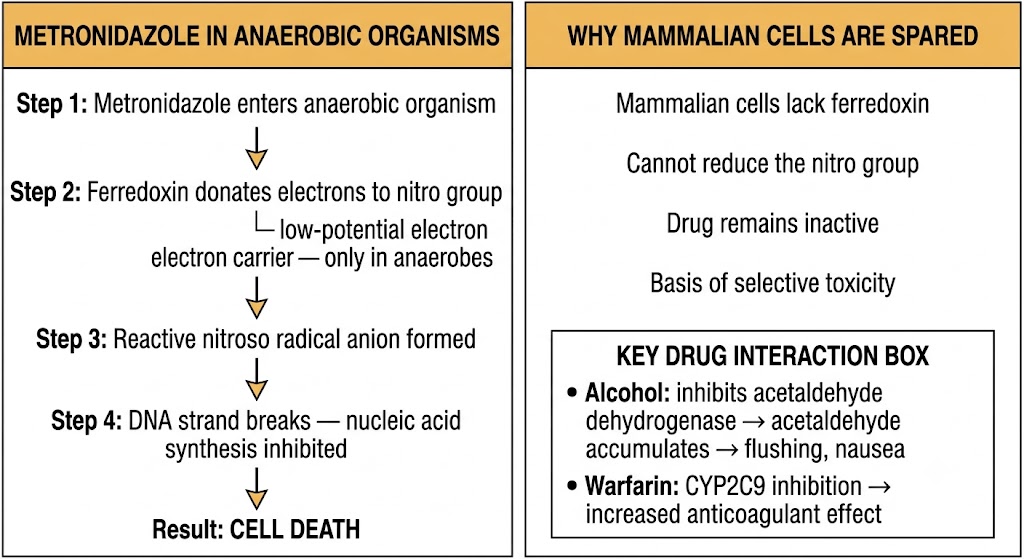
Two-panel diagram showing metronidazole mechanism in anaerobic organisms (ferredoxin reduction generating reactive nitroso radical causing DNA strand breaks) versus why mammalian cells are spared, plus drug interactions with alcohol and warfarin.
Figure 1. Metronidazole mechanism of action and selectivity. Generated with Gemini AI for educational use.
Nitroimidazole Clinical Anchors

Mechanism: anaerobic reductive activation by ferredoxin → deoxyribonucleic acid strand breaks. Spectrum: Giardia, Entamoeba, Trichomonas; anaerobic bacteria. Amebic liver abscess: metronidazole clears tissue infection, but must add luminal agent (diloxanide or iodoquinol) to eliminate intestinal cysts. Disulfiram-like reaction with alcohol — avoid alcohol during treatment and 48 hours after. Inhibits CYP2C9 → potentiates warfarin. Tinidazole: same mechanism, longer half-life, single-dose for some indications.
Section 2
African Trypanosomiasis
Stage-dependent treatment, blood-brain barrier penetration as the pharmacological divide, and the nifurtimox-eflornithine combination therapy regimen

Human African trypanosomiasis (sleeping sickness), caused by Trypanosoma brucei gambiense (West and Central Africa, over 95 percent of cases) and Trypanosoma brucei rhodesiense (East Africa), is uniformly fatal without treatment. Drug selection is entirely determined by disease stage, because the central nervous system stage demands drugs that penetrate the blood-brain barrier — a requirement that defines entirely different drug classes for each stage.

Disease Staging and Its Pharmacological Consequence

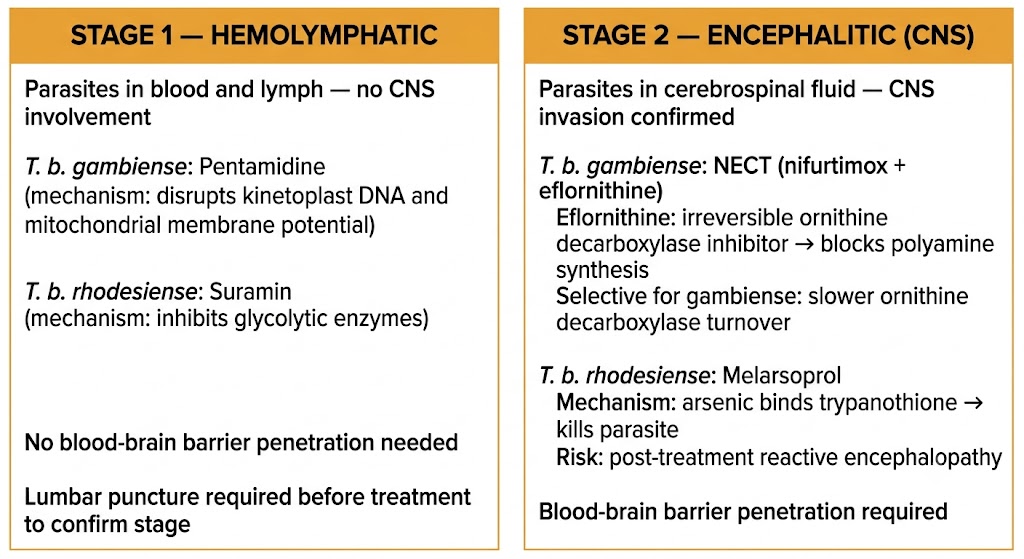
Stage 1 (hemolymphatic) involves blood and lymph parasitemia without central nervous system involvement. Stage 2 (encephalitic) is defined by central nervous system invasion, confirmed by cerebrospinal fluid pleocytosis or the presence of trypanosomes in cerebrospinal fluid. This staging distinction is the single most important determinant of drug choice: stage 1 drugs need not cross the blood-brain barrier, while stage 2 treatment requires central nervous system-penetrating agents. Lumbar puncture for staging is therefore mandatory in all cases before treatment begins.

Stage 1 Treatment

Pentamidine is the first-line agent for stage 1 Trypanosoma brucei gambiense infection. It accumulates in trypanosome mitochondria and disrupts kinetoplast deoxyribonucleic acid structure and mitochondrial membrane potential. It does not cross the blood-brain barrier and is ineffective in stage 2 disease. Key toxicities include severe hypoglycemia (direct pancreatic beta-cell stimulation followed by exhaustion), nephrotoxicity, and hypotension.

Suramin is used for stage 1 Trypanosoma brucei rhodesiense. It inhibits multiple glycolytic enzymes essential to trypanosome energy production. It is given intravenously, binds extensively to plasma proteins, and does not cross the blood-brain barrier. Its principal toxicity is nephrotoxicity.

Stage 2 Treatment — the Nifurtimox-Eflornithine Combination Therapy Regimen

Eflornithine is an irreversible inhibitor of ornithine decarboxylase, the rate-limiting enzyme in polyamine biosynthesis. Polyamines are essential for trypanosome cell division. Trypanosoma brucei gambiense has a much slower turnover of ornithine decarboxylase than Trypanosoma brucei rhodesiense, so irreversible inhibition is sustained far longer in gambiense infections — this accounts for the species-selective efficacy of eflornithine. It crosses the blood-brain barrier and is used for stage 2 Trypanosoma brucei gambiense disease. The nifurtimox-eflornithine combination therapy (NECT) regimen combines oral nifurtimox with a shortened eflornithine course, achieving equivalent efficacy with reduced drug burden. NECT is now the World Health Organization standard of care for stage 2 Trypanosoma brucei gambiense human African trypanosomiasis.

Melarsoprol is an organoarsenic compound active against both subspecies in stage 2 disease. It kills trypanosomes by reacting with trypanothione — the parasite-specific dithiol redox molecule — through its trivalent arsenic moiety, inhibiting trypanothione reductase and disrupting parasite redox homeostasis. Despite its efficacy, melarsoprol causes post-treatment reactive encephalopathy in a significant minority of treated patients, with high fatality among those affected. It has been largely replaced for Trypanosoma brucei gambiense by NECT but remains used for Trypanosoma brucei rhodesiense stage 2 disease.

Fexinidazole, a nitroimidazole approved by the European Medicines Agency in 2018, is the first all-oral regimen effective for both stages of Trypanosoma brucei gambiense human African trypanosomiasis and is progressively replacing NECT where healthcare infrastructure allows.

Two-panel diagram comparing Stage 1 hemolymphatic human African trypanosomiasis treatment (pentamidine for T. b. gambiense, suramin for T. b. rhodesiense) with Stage 2 encephalitic treatment requiring blood-brain barrier penetration (NECT for T. b. gambiense, melarsoprol for T. b. rhodesiense).
Figure 2. Human African trypanosomiasis stage-dependent treatment. Generated with Gemini AI for educational use.
Human African Trypanosomiasis Treatment Framework

Stage determination by cerebrospinal fluid examination is mandatory before treatment. Stage 1 Trypanosoma brucei gambiense: pentamidine. Stage 1 Trypanosoma brucei rhodesiense: suramin. Stage 2 Trypanosoma brucei gambiense: nifurtimox-eflornithine combination therapy (NECT) — World Health Organization standard. Stage 2 Trypanosoma brucei rhodesiense: melarsoprol. Eflornithine selective for gambiense: ornithine decarboxylase turnover is slower, so irreversible inhibition lasts longer. Melarsoprol: post-treatment reactive encephalopathy risk — largely replaced for gambiense by NECT.


Section 3
Chagas Disease
Benznidazole and nifurtimox — mechanisms, stage-dependent efficacy, and treatment limitations

Chagas disease, caused by Trypanosoma cruzi and transmitted by triatomine insects in Latin America, progresses from an acute phase with high-level parasitemia to a chronic phase in which parasites persist at low density in cardiac and gastrointestinal tissue. Treatment efficacy is strongly stage-dependent: drug therapy is most effective in the acute phase and in children, and provides uncertain benefit for established chronic cardiomyopathy.

Benznidazole — Mechanism and Clinical Use

Benznidazole is the preferred first-line agent for Chagas disease. It is a nitroimidazole derivative that undergoes reductive activation by Trypanosoma cruzi nitroreductases, generating reactive intermediates that cause oxidative and nitrosative damage to parasite deoxyribonucleic acid, proteins, and lipids. It achieves high parasitological cure rates in the acute phase, including congenitally acquired infection in neonates, where treatment is strongly indicated. In the chronic phase, benznidazole reduces parasite detection by polymerase chain reaction (PCR) but has not been shown to reduce cardiac events or mortality in patients with established cardiomyopathy, as demonstrated in the BENEFIT (Benznidazole Evaluation for Interrupting Trypanosomiasis) trial. Current guidelines nonetheless recommend treatment for patients with chronic indeterminate or early cardiac disease up to a certain age, recognizing that PCR negativity may provide long-term benefit not captured in shorter trials.

Key adverse effects of benznidazole are dermatological reactions (pruritic rash, common and often manageable), peripheral neuropathy (dose- and duration-dependent, typically reversible), and bone marrow suppression. Both benznidazole and nifurtimox are teratogenic and contraindicated in pregnancy.

Nifurtimox — Mechanism and Role

Nifurtimox is a nitrofuran compound that undergoes one-electron reduction by Trypanosoma cruzi to generate superoxide and other reactive oxygen species that overwhelm the parasite trypanothione antioxidant system. It is used as a second-line agent for Chagas disease when benznidazole is not tolerated, and — at a different dose and in combination with eflornithine — for stage 2 Trypanosoma brucei gambiense human African trypanosomiasis (NECT). Pediatric patients tolerate both agents substantially better than adults, reinforcing the emphasis on treating acute and congenitally acquired disease in children.

Chagas Disease Treatment Framework

Benznidazole: first-line; nitroimidazole prodrug activated by Trypanosoma cruzi nitroreductases. Highly effective in acute phase and congenital disease. Chronic cardiomyopathy: reduces PCR positivity but not proven to prevent cardiac death (BENEFIT trial). Nifurtimox: second-line; nitrofuran generating reactive oxygen species; also used in NECT for human African trypanosomiasis stage 2. Both agents: teratogenic — contraindicated in pregnancy. Trypanothione system: shared target across Trypanosoma and Leishmania species — melarsoprol, nifurtimox, antimonials, and eflornithine all exploit this pathway.


Section 4
Leishmaniasis
Liposomal amphotericin B, miltefosine, pentavalent antimonials, and pentamidine — disease-form-specific treatment selection

Leishmaniasis spans three clinical forms with different treatment priorities: visceral leishmaniasis (kala-azar), caused by Leishmania donovani and Leishmania infantum, which is uniformly fatal if untreated; cutaneous leishmaniasis; and mucocutaneous leishmaniasis. Drug selection depends on disease form, geographic region (which determines both species and resistance patterns), and patient immune status.

Liposomal Amphotericin B

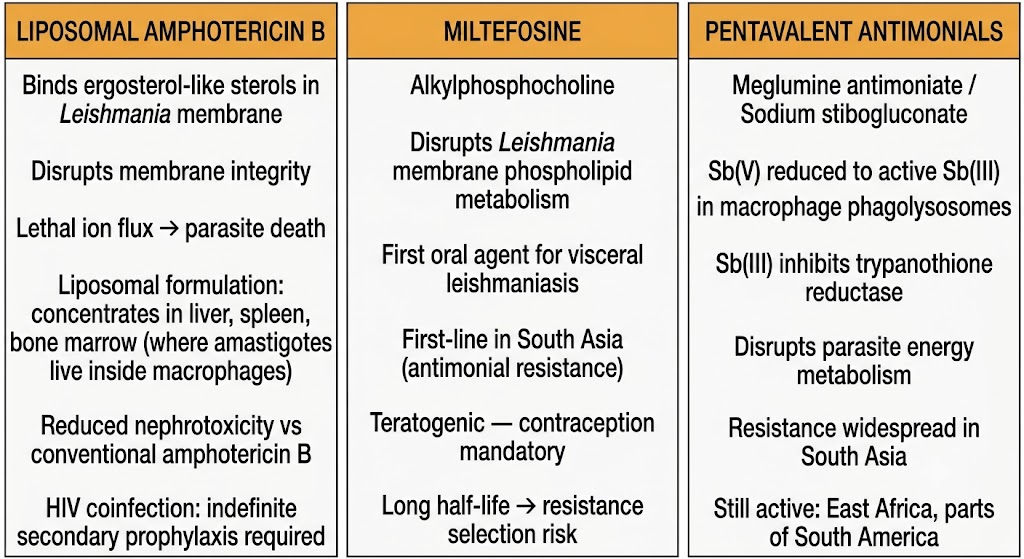
Liposomal amphotericin B is the treatment of choice for visceral leishmaniasis in immunocompetent patients. The leishmanicidal mechanism exploits ergosterol-like sterols in the Leishmania membrane: the drug binds these sterols, disrupts membrane integrity, and causes lethal ion flux. The liposomal formulation concentrates in the reticuloendothelial system — liver, spleen, and bone marrow — precisely where Leishmania amastigotes reside within macrophages, while minimizing the nephrotoxicity that limits conventional amphotericin B. In human immunodeficiency virus (HIV)-coinfected patients, visceral leishmaniasis relapse rates without secondary prophylaxis approach 100 percent, because the fundamental driver is loss of immune control; indefinite secondary prophylaxis with liposomal amphotericin B is required in this population.

Miltefosine

Miltefosine is the first oral agent with proven efficacy against visceral leishmaniasis. Originally developed as an anticancer agent, it is an alkylphosphocholine that disrupts Leishmania membrane phospholipid composition and apoptotic signaling. It is highly effective for visceral leishmaniasis in South Asia, where pentavalent antimonial resistance is widespread, and for cutaneous leishmaniasis caused by several South American species. Its long tissue half-life carries a risk of subtherapeutic drug levels at the end of the treatment course, potentially contributing to resistance selection. Miltefosine is teratogenic — effective contraception is mandatory during and for several months after treatment given the drug's prolonged tissue persistence. Nausea and vomiting are the most common adverse effects and are reduced by taking the drug with food.

Pentavalent Antimonials and Pentamidine

Meglumine antimoniate and sodium stibogluconate are pentavalent antimony compounds that were long the mainstay of leishmaniasis treatment. Their mechanism involves reduction of pentavalent antimony to the active trivalent form within macrophage phagolysosomes, where trivalent antimony inhibits trypanothione reductase and disrupts Leishmania energy metabolism. Serious toxicities include pancreatitis, hepatotoxicity, corrected QT interval prolongation, and nephrotoxicity. In South Asia, antimonial resistance in Leishmania donovani has reached levels that render these agents effectively obsolete for visceral leishmaniasis there; they retain utility in East Africa and parts of South America.

Pentamidine acts against Leishmania by accumulating in the parasite mitochondria and disrupting kinetoplast deoxyribonucleic acid structure and mitochondrial membrane potential — the same mechanism as in human African trypanosomiasis. It is used for cutaneous leishmaniasis caused by Leishmania guyanensis in South America and as a second-line agent for visceral leishmaniasis. Its major toxicity is severe hypoglycemia from direct pancreatic beta-cell effects, followed by diabetes mellitus with prolonged use.

Three-panel comparison of leishmaniasis drugs: liposomal amphotericin B, miltefosine, and pentavalent antimonials, showing mechanisms, regional indications, and key toxicities.
Figure 3. Leishmaniasis drug mechanisms and regional selection. Generated with Gemini AI for educational use.
First-Line — Visceral
Liposomal Amphotericin B
  • Binds Leishmania membrane sterols → lethal ion flux
  • Liposomal formulation targets reticuloendothelial system
  • Reduced nephrotoxicity vs conventional amphotericin B
  • HIV coinfection: indefinite secondary prophylaxis required
First Oral Agent
Miltefosine
  • Alkylphosphocholine — disrupts membrane phospholipid metabolism
  • First-line for visceral leishmaniasis in South Asia
  • Teratogenic — contraception mandatory during and after treatment
  • Long tissue half-life: resistance selection risk
Leishmaniasis Treatment Selection

Visceral leishmaniasis (immunocompetent): liposomal amphotericin B first-line globally. South Asia visceral leishmaniasis: miltefosine (antimonial resistance widespread). East Africa visceral leishmaniasis: antimonials still active; combination strategies used. Cutaneous leishmaniasis: species- and region-dependent — miltefosine for South American species; antimonials for Old World species. Pentamidine: cutaneous leishmaniasis (Leishmania guyanensis); severe hypoglycemia risk. HIV coinfection: higher drug requirements; secondary prophylaxis essential.


Section 5
Toxoplasmosis
Pyrimethamine-sulfadiazine sequential folate blockade, folinic acid rescue, and prophylaxis in the immunocompromised host

Toxoplasma gondii is an obligate intracellular parasite. In immunocompetent individuals primary infection is usually subclinical. Clinically significant disease occurs principally in three settings: reactivation of latent tissue cysts in immunocompromised patients (especially those with HIV infection and low cluster of differentiation 4 lymphocyte counts), congenital infection acquired transplacentally during primary maternal infection, and ocular toxoplasmosis causing chorioretinitis.

Pyrimethamine-Sulfadiazine — Sequential Folate Blockade

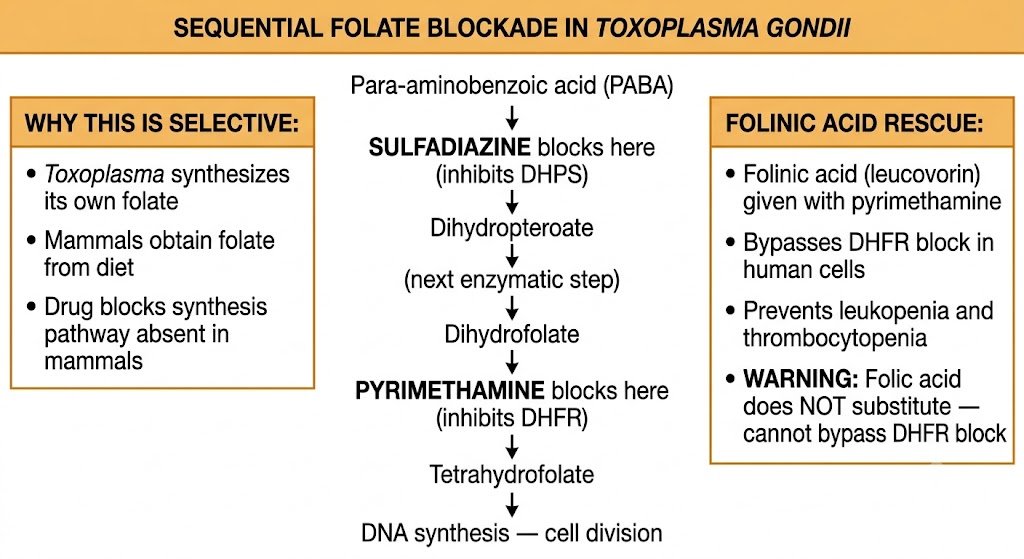
The standard treatment for toxoplasmic encephalitis combines pyrimethamine and sulfadiazine in a regimen that exploits sequential blockade of the Toxoplasma folate synthesis pathway. Sulfadiazine is a sulfonamide that competitively inhibits dihydropteroate synthase (DHPS), blocking an early step in parasite folate synthesis. Pyrimethamine inhibits dihydrofolate reductase (DHFR), blocking a downstream step. Because Toxoplasma synthesizes its own folate — unlike mammals, which rely on dietary folate — this sequential double blockade produces synergistic antiparasitic activity while mammalian cells are protected by dietary folinic acid supplementation.

Folinic acid (leucovorin) must be co-administered with every pyrimethamine-containing regimen. It bypasses the dihydrofolate reductase block in mammalian cells and prevents the hematological toxicities — leukopenia, thrombocytopenia, and megaloblastic anemia — that are the primary dose-limiting adverse effects of pyrimethamine. Folic acid (the oxidized form) is not a substitute and must not be used in its place — it cannot bypass the dihydrofolate reductase block. This distinction is high-yield.

Alternative Regimens

When sulfadiazine is not tolerated, pyrimethamine plus clindamycin is the preferred alternative, with equivalent efficacy to the standard regimen in controlled trials. Trimethoprim-sulfamethoxazole at high doses is an alternative when pyrimethamine is unavailable; it achieves dihydrofolate reductase and dihydropteroate synthase inhibition similar to the standard combination and is widely used where pyrimethamine is not accessible. Atovaquone has cysticidal activity against tissue cysts in addition to activity against the active tachyzoite form, making it useful in sulfonamide-intolerant patients.

Prophylaxis in Immunocompromised Hosts

Primary prophylaxis against toxoplasmic encephalitis reactivation is indicated in HIV-infected patients with advanced immunosuppression who are seropositive for Toxoplasma gondii immunoglobulin G. Trimethoprim-sulfamethoxazole is the preferred prophylactic agent and confers the additional benefit of simultaneously preventing Pneumocystis jirovecii pneumonia. After immune reconstitution on antiretroviral therapy — sustained recovery of cluster of differentiation 4 lymphocyte counts — prophylaxis can be safely discontinued. Secondary prophylaxis at reduced treatment doses is required indefinitely until immune reconstitution occurs, because relapse rates without maintenance therapy are very high in this population.

For congenital toxoplasmosis, spiramycin is used in pregnancy when maternal primary infection is detected but fetal infection is not yet confirmed. Spiramycin concentrates in placental tissue and reduces the risk of vertical transmission but does not treat established fetal infection. When fetal infection is confirmed by amniocentesis, pyrimethamine-sulfadiazine-folinic acid is used to treat the infected fetus, with pyrimethamine avoided in the first trimester due to its anti-folate teratogenic potential.

Flow diagram of sequential folate synthesis blockade in Toxoplasma gondii by sulfadiazine (DHPS) and pyrimethamine (DHFR), with folinic acid rescue explanation and folic acid warning.
Figure 4. Sequential folate blockade in Toxoplasma gondii. Generated with Gemini AI for educational use.
Toxoplasmosis Treatment Anchors

Pyrimethamine + sulfadiazine: sequential DHFR + DHPS blockade in Toxoplasma folate synthesis. Folinic acid mandatory with pyrimethamine — prevents bone marrow suppression. Folic acid does NOT substitute for folinic acid (cannot bypass DHFR block). Trimethoprim-sulfamethoxazole prophylaxis: indicated in HIV with cluster of differentiation 4 below 100 and positive Toxoplasma serology; also covers Pneumocystis jirovecii pneumonia. Spiramycin: reduces vertical transmission in pregnancy but does not treat established fetal infection. Discontinue prophylaxis after sustained immune reconstitution on antiretroviral therapy.


Suggested References
Author / Organization Title Source
Brunton L, Knollmann B, Hilal-Dandan R, eds. Goodman & Gilman's The Pharmacological Basis of Therapeutics. 14th ed. Chapter 50: Chemotherapy of Protozoal Infections McGraw-Hill; 2023
World Health Organization Control and surveillance of human African trypanosomiasis WHO Technical Report Series No. 984; 2013
Priotto G, Kasparian S, Mutombo W, et al. Nifurtimox-eflornithine combination therapy for second-stage African Trypanosoma brucei gambiense trypanosomiasis (NECT): a multicentre, randomised, phase III, non-inferiority trial Lancet. 2009;374(9683):56-64
Morillo CA, Marin-Neto JA, Avezum A, et al. Randomized trial of benznidazole for chronic Chagas cardiomyopathy (BENEFIT) N Engl J Med. 2015;373(14):1295-1306
Sundar S, Chakravarty J Leishmaniasis: an update of current pharmacotherapy Expert Opin Pharmacother. 2013;14(1):53-63
Bhattacharya SK, Sinha PK, Sundar S, et al. Phase 4 trial of miltefosine for the treatment of Indian visceral leishmaniasis J Infect Dis. 2007;196(4):591-598
Bern C Chagas disease N Engl J Med. 2015;373(5):456-466
Panel on Opportunistic Infections in Adults and Adolescents with HIV Guidelines for the prevention and treatment of opportunistic infections in HIV-infected adults and adolescents: Toxoplasma gondii encephalitis AIDSinfo; 2023. aidsinfo.nih.gov
Montoya JG, Liesenfeld O Toxoplasmosis Lancet. 2004;363(9425):1965-1976
Muller I, Baker J, Mesu V, et al. Fexinidazole for late-stage African Trypanosoma brucei gambiense sleeping sickness Lancet. 2021;397(10279):1152
Drugs for Parasitic Infections Treatment guidelines for parasitic infections The Medical Letter on Drugs and Therapeutics; 2013 special issue
Fairlamb AH, Cerami A Metabolism and functions of trypanothione in the Kinetoplastida Annu Rev Microbiol. 1992;46:695-729