CHAPTER 38  ·  ANTIPARASITIC DRUGS
Section 1
Benzimidazoles — Mebendazole and Albendazole
Beta-tubulin binding, selective toxicity, luminal versus systemic applications, and the absorption difference that separates the two drugs

The benzimidazoles are the most broadly used antihelminthic drug class globally, forming the backbone of mass drug administration programs for soil-transmitted helminthiasis. Their selective toxicity rests on higher binding affinity for helminth beta-tubulin compared with mammalian beta-tubulin — a pharmacodynamic selectivity that also determines resistance patterns.

Mechanism of Action

Benzimidazoles bind selectively to beta-tubulin in helminth cells at the colchicine-binding site, preventing tubulin polymerization into microtubules. Microtubules are essential for mitotic spindle formation, intracellular transport, and glucose uptake. Loss of microtubule function depletes glycogen stores, causes adenosine triphosphate (ATP) depletion, and ultimately kills the worm. The drugs are active against eggs, larvae, and adult worms — a breadth that is relevant to both treatment and transmission interruption.

Mebendazole versus Albendazole — The Absorption Difference

Mebendazole is minimally absorbed from the gastrointestinal tract, with very low systemic bioavailability under fasting conditions. This poor absorption is pharmacologically advantageous for intestinal nematode infections, where high luminal drug concentrations are desired without systemic exposure. It is effective against Ascaris lumbricoides, Trichuris trichiura, Enterobius vermicularis, and hookworm species. Because systemic absorption is so limited, mebendazole has no utility for tissue-invasive helminthiasis.

Albendazole is a prodrug that undergoes hepatic oxidation to its active sulfoxide metabolite. This metabolite achieves substantially higher systemic concentrations than the parent compound. Fat co-administration markedly increases absorption, making co-administration with food mandatory for systemic indications. Albendazole distributes widely into tissues including cyst fluid and cerebrospinal fluid, making it the benzimidazole of choice for tissue-invasive disease including neurocysticercosis and echinococcosis. For intestinal nematodes, a single dose of albendazole is the World Health Organization (WHO)-preferred agent for mass drug administration programs.

Tissue-Invasive Applications and Toxicity

For neurocysticercosis — caused by larval Taenia solium cysts in the central nervous system — albendazole is the primary antiparasitic agent. It must always be combined with corticosteroids to manage the inflammatory response triggered by dying cysts, which can otherwise cause seizures or cerebral edema. Antiepileptic drugs are added when seizures are present. For echinococcosis (hydatid disease) caused by Echinococcus granulosus, albendazole is used as perioperative adjunctive therapy with surgical or radiological cyst management, reducing the risk of seeding from cyst rupture.

At the single doses used for intestinal nematode mass drug administration, both benzimidazoles are exceptionally well tolerated. At the prolonged higher doses required for tissue-invasive disease, albendazole carries risk of hepatotoxicity and bone marrow suppression, requiring liver function and blood count monitoring during treatment cycles. Both agents are teratogenic in animal studies and are avoided in the first trimester; the WHO accepts single-dose use from the second trimester for intestinal helminthiasis in high-prevalence settings where the benefit of treatment outweighs risk.
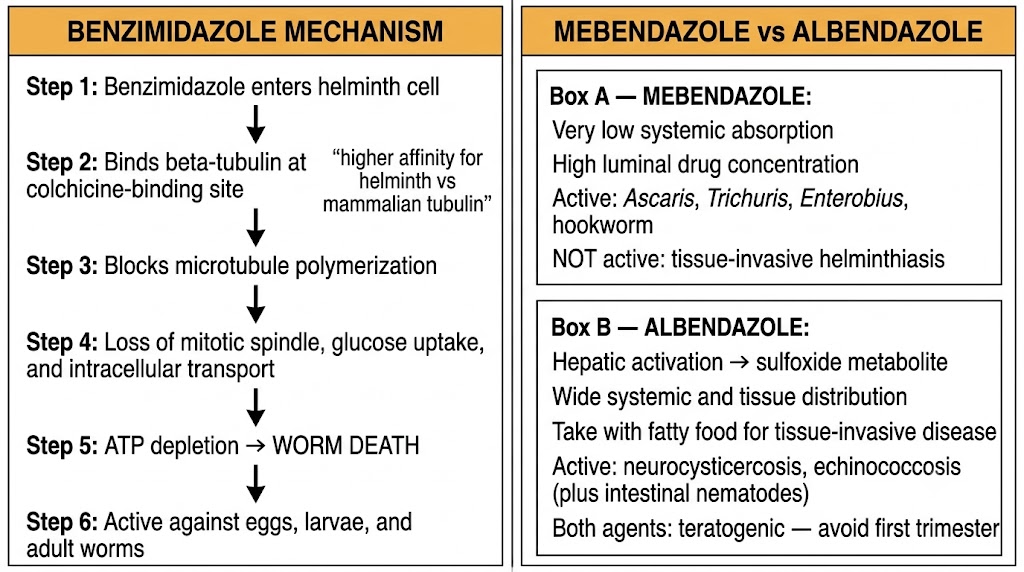
Two-panel diagram showing benzimidazole mechanism (beta-tubulin binding at colchicine-binding site blocking microtubule polymerization leading to ATP depletion and worm death) alongside mebendazole versus albendazole comparison by absorption and tissue activity.
Figure 1. Benzimidazole mechanism and mebendazole versus albendazole comparison. Generated with Gemini AI for educational use.
Benzimidazole Clinical Anchors

Mechanism: beta-tubulin binding at colchicine-binding site → microtubule disruption → adenosine triphosphate depletion → worm death. Mebendazole: minimal absorption → luminal nematodes only; no tissue-invasive activity. Albendazole: hepatic activation to sulfoxide → systemic distribution; take with fatty food for tissue-invasive disease. Neurocysticercosis: albendazole always combined with corticosteroid (mandatory) to prevent inflammatory cyst-death reaction. Both teratogenic: avoid first trimester.

Section 2
Ivermectin
Glutamate-gated chloride channel activation, broad spectrum from strongyloidiasis to onchocerciasis, and the Loa loa safety constraint

Ivermectin is a macrocyclic lactone derived from the soil bacterium Streptomyces avermitilis. It has become one of the most impactful antiparasitic drugs in history, forming the cornerstone of World Health Organization programs targeting onchocerciasis and lymphatic filariasis elimination. Its selective mechanism against invertebrates and wide therapeutic index in mammals underlie its versatility across nematodes, filarial worms, and ectoparasites.

Mechanism of Action and Selectivity

Ivermectin binds selectively to glutamate-gated chloride ion channels (GluCl channels) present in invertebrate nerve and muscle cells. Binding causes irreversible channel opening, increasing chloride ion permeability, hyperpolarizing the cell membrane, and producing flaccid paralysis and death of the organism. GluCl channels are absent in mammalian central nervous system cells. Under normal circumstances ivermectin also does not penetrate the mammalian blood-brain barrier because it is a substrate for the P-glycoprotein efflux pump encoded by the multidrug resistance 1 (MDR1) gene, which actively exports it from the central nervous system. In animals or rare humans with loss-of-function MDR1 mutations, or when P-glycoprotein inhibitors (such as ritonavir or verapamil) are co-administered, ivermectin can penetrate the central nervous system and cause neurotoxicity.

Spectrum — Nematodes and Filarial Infections

Ivermectin is the drug of choice for strongyloidiasis caused by Strongyloides stercoralis. In immunocompromised patients, Strongyloides can cause hyperinfection syndrome — massive autoinfection with filariform larvae crossing the gut wall, carrying enteric bacteria and causing gram-negative septicemia — which is fatal if untreated. Ivermectin is given until consecutive negative stool examinations confirm eradication in immunocompromised patients. Screening and empirical treatment for Strongyloides before starting corticosteroids or other immunosuppressive therapy is a critical safety practice in patients from endemic regions.

For onchocerciasis (river blindness) caused by Onchocerca volvulus, ivermectin is microfilaricidal — it kills the larval microfilariae but does not reliably kill adult worms at standard doses. Annual or semi-annual community-based mass treatment is the basis of the WHO African Programme for Onchocerciasis Control. For lymphatic filariasis caused by Wuchereria bancrofti or Brugia species, ivermectin combined with albendazole is the mass drug administration regimen used where onchocerciasis is co-endemic.

The Loa Loa Safety Constraint

In regions of Central Africa where Loa loa (African eye worm) is co-endemic with onchocerciasis, ivermectin administration carries a risk of fatal encephalopathy in individuals with very high Loa loa microfilarial densities. Rapid destruction of Loa loa microfilariae in central nervous system vessels causes a severe inflammatory encephalopathy. Pre-treatment assessment of Loa loa microfilarial burden is mandatory before ivermectin use in co-endemic regions. This constraint is operationally significant for mass drug administration programs in parts of Cameroon, the Democratic Republic of Congo, and neighboring countries.

Ivermectin Safety Cautions

Strongyloides hyperinfection: fatal without treatment; screen all patients from endemic regions before starting immunosuppression. Loa loa co-endemic areas: assess microfilarial burden before ivermectin — high-density Loa loa coinfection risks fatal encephalopathy. P-glycoprotein inhibitors (ritonavir, verapamil): increase central nervous system ivermectin penetration — use with caution if blood-brain barrier integrity is uncertain. Not recommended in children below 15 kg or in pregnancy (insufficient safety data) for routine indications.


Section 3
Praziquantel
Calcium influx and tegument disruption, broad trematode and cestode coverage, and the critical Fasciola exception

Praziquantel is the drug of choice for virtually all trematode (fluke) and cestode (tapeworm) infections in humans. Its breadth of activity across phylogenetically distinct parasites is explained by the shared feature of their tegument structure. Its excellent safety profile has made it essential to World Health Organization programs targeting schistosomiasis, clonorchiasis, taeniasis, and neurocysticercosis.

Mechanism of Action

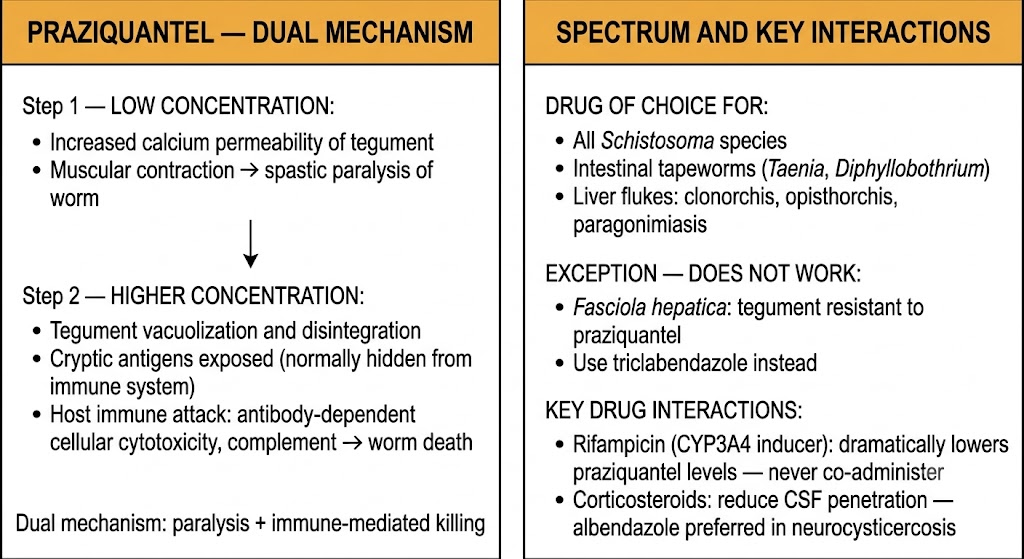
Praziquantel acts through two complementary mechanisms. At low concentrations it increases calcium permeability of the parasite tegument, causing muscular contraction and spastic paralysis of the worm. At higher concentrations it causes severe vacuolization and physical disintegration of the tegument, exposing cryptic antigens that are normally hidden from host immune recognition. Exposure of these antigens enables host immune effector mechanisms — antibody-dependent cellular cytotoxicity, complement — to attack and kill the worm. The dual mechanism of rapid paralysis followed by immune-mediated destruction accounts for praziquantel's lethal efficacy against adult worms.

Schistosomiasis and Liver Flukes

Praziquantel is the treatment of choice for all Schistosoma species, including Schistosoma mansoni, Schistosoma haematobium, and Schistosoma japonicum. Cure rates exceed 85 percent for most species with a single treatment course. Because praziquantel has limited activity against immature schistosomula, a second course given several weeks after the first substantially improves cure rates by catching maturing worms that were not susceptible at the time of initial treatment. Praziquantel is also first-line for opisthorchiasis (Opisthorchis viverrini, Opisthorchis felineus), clonorchiasis (Clonorchis sinensis), and paragonimiasis (Paragonimus westermani).

The critical exception is fascioliasis caused by Fasciola hepatica or Fasciola gigantica: the Fasciola tegument is inherently resistant to praziquantel, and the drug is ineffective against this fluke. Triclabendazole is the treatment of choice for fascioliasis and should not be substituted with praziquantel.

Cestodes and Neurocysticercosis

Praziquantel is effective against intestinal tapeworms including Taenia saginata (beef tapeworm), Taenia solium (pork tapeworm), and Diphyllobothrium latum (fish tapeworm). For neurocysticercosis, praziquantel is an alternative to albendazole, though albendazole is generally preferred because corticosteroids — mandatory co-treatment in neurocysticercosis — reduce praziquantel cerebrospinal fluid penetration by approximately half, while albendazole penetration is not similarly affected. When the combination of albendazole plus praziquantel is used for neurocysticercosis with multiple viable cysts, praziquantel augments rather than replaces albendazole.

Key Drug Interaction

Praziquantel is extensively metabolized by cytochrome P450 3A4 (CYP3A4). Rifampicin, a potent CYP3A4 inducer, dramatically reduces praziquantel plasma levels and must not be co-administered during schistosomiasis treatment. Corticosteroids also reduce praziquantel plasma concentrations, which is clinically relevant when both are used together in neurocysticercosis.

Two-panel diagram showing praziquantel dual mechanism (low concentration calcium influx causing spastic paralysis; higher concentration tegument disruption exposing cryptic antigens to host immune attack) and spectrum with Fasciola exception and key drug interactions.
Figure 2. Praziquantel mechanism, spectrum, and drug interactions. Generated with Gemini AI for educational use.
Praziquantel Clinical Anchors

Drug of choice for: all schistosomes, all intestinal tapeworms, clonorchis, opisthorchis, paragonimiasis. Exception: Fasciola hepatica — praziquantel inactive; use triclabendazole. Rifampicin reduces praziquantel levels dramatically via CYP3A4 induction — never co-administer. Corticosteroids reduce praziquantel cerebrospinal fluid levels — in neurocysticercosis, albendazole is preferred as the primary antiparasitic. Never treat purely calcified neurocysticercosis cysts (dead cysts — no benefit, only risk of inflammation). Second course of schistosomiasis treatment catches maturing schistosomula missed by first dose.


Section 4
Pyrantel Pamoate and Diethylcarbamazine
Nicotinic acetylcholine receptor activation for luminal nematodes and microfilaricidal therapy for lymphatic filariasis

Pyrantel pamoate and diethylcarbamazine occupy complementary niches in the antihelminthic armamentarium. Pyrantel is a luminal-acting neuromuscular blocker for common intestinal nematodes. Diethylcarbamazine (DEC) is the drug of choice for lymphatic filariasis and loiasis and is included in mass drug administration programs for filariasis elimination.

Pyrantel Pamoate

Pyrantel is a depolarizing neuromuscular blocking agent that acts as a nicotinic acetylcholine receptor (nAChR) agonist at helminth neuromuscular junctions. Persistent depolarization causes spastic paralysis and expulsion of the worm by normal intestinal peristalsis. Like mebendazole, pyrantel is poorly absorbed from the gastrointestinal tract, confining its activity to the intestinal lumen. It is active against Ascaris lumbricoides, hookworm species, and Enterobius vermicularis but has no activity against Trichuris trichiura, tapeworms, or tissue-invasive helminths. Pyrantel is considered safe in pregnancy given its minimal systemic absorption. It should not be combined with piperazine, which acts by gamma-aminobutyric acid (GABA)-mediated hyperpolarization producing flaccid paralysis — the opposing mechanisms (spastic versus flaccid paralysis) are pharmacologically antagonistic.

Diethylcarbamazine

Diethylcarbamazine acts by exposing microfilarial surface antigens that are normally masked from host immune recognition, enabling host immune effector mechanisms to destroy the microfilariae. It is predominantly microfilaricidal rather than active against adult worms. Diethylcarbamazine is the drug of choice for lymphatic filariasis when onchocerciasis is not co-endemic (where its use would cause severe Mazzotti reactions from dying Onchocerca volvulus microfilariae), for loiasis at low Loa loa microfilarial burden, and for tropical pulmonary eosinophilia. It is also used as prophylaxis for loiasis in residents of co-endemic regions.

The most clinically significant adverse effects of diethylcarbamazine are not direct drug toxicity but parasite-death reactions: fever, headache, arthralgia, urticaria, and lymphangitis from dying microfilariae. In patients with high Loa loa microfilarial burdens, diethylcarbamazine, like ivermectin, risks fatal encephalopathy and is contraindicated. Diethylcarbamazine is contraindicated in pregnancy.

Pyrantel and Diethylcarbamazine Anchors

Pyrantel: nicotinic acetylcholine receptor agonist → spastic paralysis → worm expulsion. Active against Ascaris, hookworm, pinworm; not Trichuris. Safe in pregnancy (minimal absorption). Do not combine with piperazine (antagonistic mechanisms). Diethylcarbamazine: microfilaricidal; first-line for lymphatic filariasis (where no onchocerciasis) and loiasis (low burden). Loa loa high burden: contraindicated — encephalopathy risk same as ivermectin. Mass drug administration for lymphatic filariasis: diethylcarbamazine plus albendazole where onchocerciasis absent; ivermectin plus albendazole where onchocerciasis co-endemic. Diethylcarbamazine contraindicated in pregnancy.


Section 5
Helminth Drug Resistance and Tissue-Invasive Helminthiasis
Benzimidazole resistance mechanisms, ivermectin resistance signals, eosinophilia as a prescribing guide, and the clinical framework for neurocysticercosis and echinococcosis

Drug resistance in helminths is an established veterinary problem and an emerging concern in human medicine, particularly as mass drug administration programs sustain selection pressure on the same drug classes used in livestock. Meanwhile, tissue-invasive helminthiasis requires integrating antiparasitic pharmacology with the clinical context of disease stage and location.

Benzimidazole Resistance

Resistance to benzimidazoles in helminths is mediated primarily by single-nucleotide polymorphisms in the beta-tubulin gene that alter the colchicine-binding site and reduce drug binding affinity without substantially impairing tubulin function. These mutations are now present in trichostrongylid nematodes of livestock on all inhabited continents. Surveillance for reduced post-treatment cure rates in human soil-transmitted helminthiasis programs, and molecular monitoring for beta-tubulin polymorphisms, are active priorities to detect emerging resistance before it becomes clinically significant.

Ivermectin Resistance

Sub-optimal microfilarial suppression after observed ivermectin treatment has been documented in Onchocerca volvulus in foci in West Africa, suggesting emerging reduced ivermectin susceptibility. Mechanisms include glutamate-gated chloride channel subunit mutations and upregulation of P-glycoprotein efflux. The development of macrofilaricidal agents — capable of killing adult worms rather than only microfilariae — is an active research priority to address this vulnerability.

Eosinophilia as a Prescribing Guide

Peripheral blood eosinophilia in a patient from a helminth-endemic region should prompt systematic helminth evaluation before initiation of immunosuppressive therapy. Tissue-invasive helminths — Strongyloides, Toxocara, filarial species, Trichinella — drive peripheral blood eosinophilia as a characteristic host response to the presence of helminth larvae in tissue. Corticosteroids administered to a patient with unrecognized Strongyloides stercoralis infection can precipitate hyperinfection syndrome with near-universal fatality. Serological testing for Strongyloides and empirical ivermectin treatment before immunosuppression is a standard safety practice in transplant, oncology, and rheumatology programs.

Neurocysticercosis and Echinococcosis — Clinical Framework

Neurocysticercosis management is governed by cyst viability. Viable parenchymal cysts and enhancing lesions benefit from antiparasitic therapy with albendazole (with or without praziquantel for multiple cysts) plus mandatory corticosteroids plus antiepileptic drugs if seizures are present. Purely calcified cysts are already dead — antiparasitic treatment provides no benefit and risks triggering inflammation around the calcification. Ventricular and subarachnoid neurocysticercosis require specialized neurosurgical co-management.

For cystic echinococcosis caused by Echinococcus granulosus, albendazole is used as perioperative cover for surgical or percutaneous aspiration procedures (puncture-aspiration-injection-reaspiration, or PAIR), reducing the risk of secondary seeding if cyst contents spill. For alveolar echinococcosis caused by Echinococcus multilocularis, which behaves more like an invasive malignancy, indefinite albendazole suppression is required for medically inoperable disease.

Resistance and Tissue Invasion — Key Points

Beta-tubulin codon 200 polymorphism: primary benzimidazole resistance marker; established in veterinary helminths; emerging concern in human programs. Ivermectin resistance signals: sub-optimal Onchocerca volvulus microfilarial suppression in West Africa after sustained mass treatment. Eosinophilia plus planned immunosuppression: test and treat for Strongyloides before starting steroids — hyperinfection is fatal if missed. Neurocysticercosis: viable cysts — treat with albendazole plus corticosteroid; calcified cysts — do not treat. Echinococcosis: albendazole as perioperative cover for all invasive procedures; indefinite suppression for inoperable alveolar echinococcosis.


Suggested References
Author / Organization Title Source
Lacey E The role of the cytoskeletal protein, tubulin, in the mode of action and mechanism of drug resistance to benzimidazoles Int J Parasitol. 1988;18(7):885-936
Brunton L, Knollmann B, Hilal-Dandan R, eds. Goodman & Gilman's The Pharmacological Basis of Therapeutics. 14th ed. Chapter 51: Chemotherapy of Helminth Infections McGraw-Hill; 2023
White AC Jr, Coyle CM, Rajshekhar V, et al. Diagnosis and treatment of neurocysticercosis: 2017 clinical practice guidelines by the Infectious Diseases Society of America and the American Society of Tropical Medicine and Hygiene Clin Infect Dis. 2018;66(8):e49-e75
Ottesen EA, Campbell WC Ivermectin in human medicine J Antimicrob Chemother. 1994;34(2):195-203
Boatin BA, Richards FO Jr Control of onchocerciasis Adv Parasitol. 2006;61:349-394
Pica-Mattoccia L, Cioli D Sex- and stage-related sensitivity of Schistosoma mansoni to in vivo and in vitro praziquantel treatment Int J Parasitol. 2004;34(4):527-533
Garcia HH, Evans CAW, Nash TE, et al. Current consensus guidelines for treatment of neurocysticercosis Clin Microbiol Rev. 2002;15(4):747-756
Aubry ML, Cowell P, Davey MJ, Shevde S Aspects of the pharmacology of a new anthelmintic: pyrantel Br J Pharmacol. 1970;38(2):332-344
Gyapong JO, Gyapong M, Yellu N, et al. Integration of control of neglected tropical diseases into health-care systems: challenges and opportunities Lancet. 2010;375(9709):160-165
Prichard RK, Basanez MG, Boatin BA, et al. A research agenda for helminth diseases of humans: intervention for control and elimination PLoS Negl Trop Dis. 2012;6(4):e1549
Churcher TS, Pion SD, Osei-Atweneboana MY, et al. Identifying sub-optimal responses to ivermectin in the treatment of river blindness Proc Natl Acad Sci USA. 2009;106(39):16716-16721
Brunetti E, Kern P, Vuitton DA; Writing Panel for the WHO-IWGE Expert consensus for the diagnosis and treatment of cystic and alveolar echinococcosis in humans Acta Trop. 2010;114(1):1-16