CHAPTER 38  ·  ANTIPARASITIC DRUGS
Section 1
Scabies
Permethrin, ivermectin, benzyl benzoate, and the management of crusted scabies

Scabies, caused by the mite Sarcoptes scabiei, exists in two clinically distinct forms requiring different treatment strategies: common scabies, found in immunocompetent individuals with a typical mite burden of ten to fifteen organisms, and crusted (Norwegian) scabies, a hyperinfestation state in immunocompromised or neurologically impaired patients where the mite burden can reach millions and topical therapy alone is inadequate.

Permethrin

Permethrin 5% cream is the first-line treatment for common scabies. Permethrin is a synthetic pyrethroid that acts by binding to voltage-gated sodium channels in the mite nervous system and prolonging their open state, causing repetitive neuronal firing, paralysis, and death. The cream is applied from the neck down, left on overnight, then washed off; a repeat application is needed to kill mites that hatched from eggs after the initial treatment to kill mites that hatched from eggs after the initial treatment, as permethrin is not reliably ovicidal. In infants, the application is extended to include the scalp and face, where the scabies mite can infest in this age group. Permethrin has very low dermal absorption and is considered safe in pregnancy and from two months of age.

Oral Ivermectin

Oral ivermectin is an effective alternative to permethrin for common scabies and is the preferred agent in institutional outbreak settings, where simultaneous oral treatment of all residents and staff is logistically superior to applying cream to all individuals simultaneously. A repeat dose is given about one week after the first to ensure eradication. Ivermectin is not recommended as first-line in pregnant women or children below 15 kg due to limited safety data.

Crusted Scabies

Crusted scabies occurs in patients with compromised immunity, neurological impairment, or extreme debility. The thick hyperkeratotic crust prevents adequate topical drug penetration, making permethrin alone insufficient. Standard management combines repeated courses of oral ivermectin with topical permethrin plus keratolytic agents to remove the crust and allow drug penetration. Strict contact precautions and simultaneous treatment of all close contacts are essential, as crusted scabies patients are highly contagious and a common source of institutional outbreaks.

Benzyl Benzoate

Benzyl benzoate 25% lotion is widely used in resource-limited settings as an alternative to permethrin. Its mechanism involves direct neurotoxicity to the mite. It is more irritating to the skin than permethrin and is considered safe from the second trimester of pregnancy.

Post-Treatment Itch and Permethrin Resistance

Pruritus typically persists for two to four weeks after successful scabies treatment, driven by ongoing delayed-type hypersensitivity to mite antigens, feces, and dead mite material remaining in the skin. Failure to counsel patients about this phenomenon leads to unnecessary retreatment. Permethrin resistance in Sarcoptes scabiei has been confirmed molecularly and is associated with mutations in the voltage-gated sodium channel gene analogous to the knockdown resistance (kdr) mutations seen in insect pests.
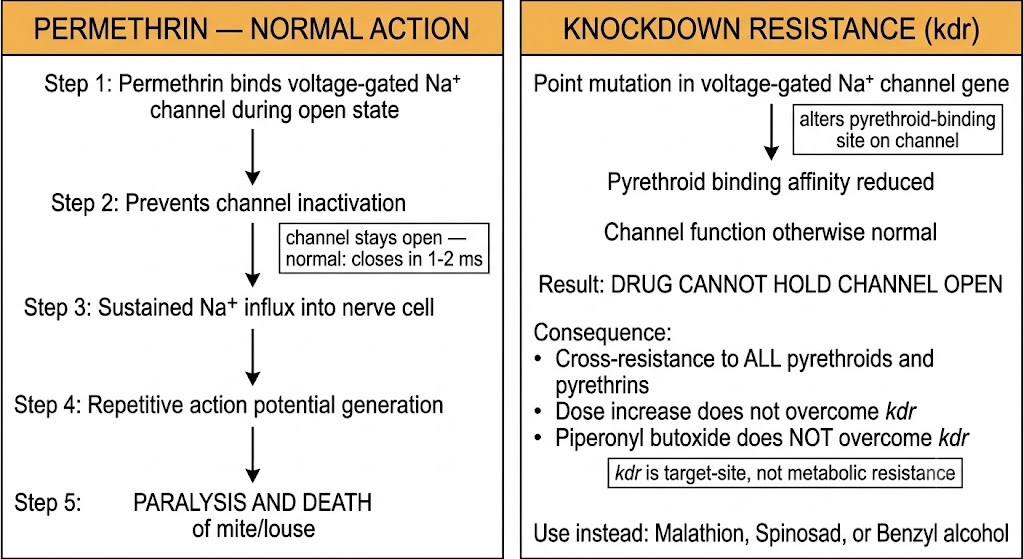
Two-panel diagram showing permethrin normal action (binding voltage-gated sodium channel, preventing inactivation, causing sustained sodium influx and repetitive action potentials leading to paralysis and death) versus knockdown resistance (point mutation reducing pyrethroid binding affinity, with cross-resistance to all pyrethroids and alternatives listed).
Figure 1. Permethrin mechanism of action and knockdown resistance. Generated with Gemini AI for educational use.
Scabies Treatment Anchors

Permethrin 5%: voltage-gated sodium channel blocker — repeat application at one week required (not ovicidal for eggs). Infants: apply to scalp and face. Safe in pregnancy. Crusted scabies: topical permethrin alone fails — combine with oral ivermectin and keratolytics; highly contagious. Post-treatment itch: normal for two to four weeks after successful treatment — do not retreat without confirming live mites. Permethrin resistance: confirmed; associated with voltage-gated sodium channel mutations (kdr). Benzyl benzoate: direct mite neurotoxicity; alternative in resource-limited settings.

Section 2
Pediculosis
Head, body, and pubic lice — agent selection, knockdown resistance, and the consequences of widespread pyrethroid resistance

Pediculosis refers to infestation by Pediculus humanus capitis (head lice), Pediculus humanus corporis (body lice), and Phthirus pubis (pubic lice). Treatment has been substantially complicated by widespread pyrethroid resistance, making systematic knowledge of alternative agents essential for effective management.

Permethrin and Knockdown Resistance

Permethrin 1% rinse has historically been the first-line treatment for head lice, but knockdown resistance (kdr) — specific point mutations in the voltage-gated sodium channel gene that reduce pyrethroid binding affinity — has reached high prevalence in head louse populations across much of North America, Europe, and Australia. Where kdr prevalence is high, permethrin should not be used as first-line therapy, as treatment failure rates are unacceptably high. Because kdr acts by target site modification, it confers cross-resistance to all pyrethrins and pyrethroids regardless of their specific structure; increasing the dose does not overcome it.

Alternative Agents

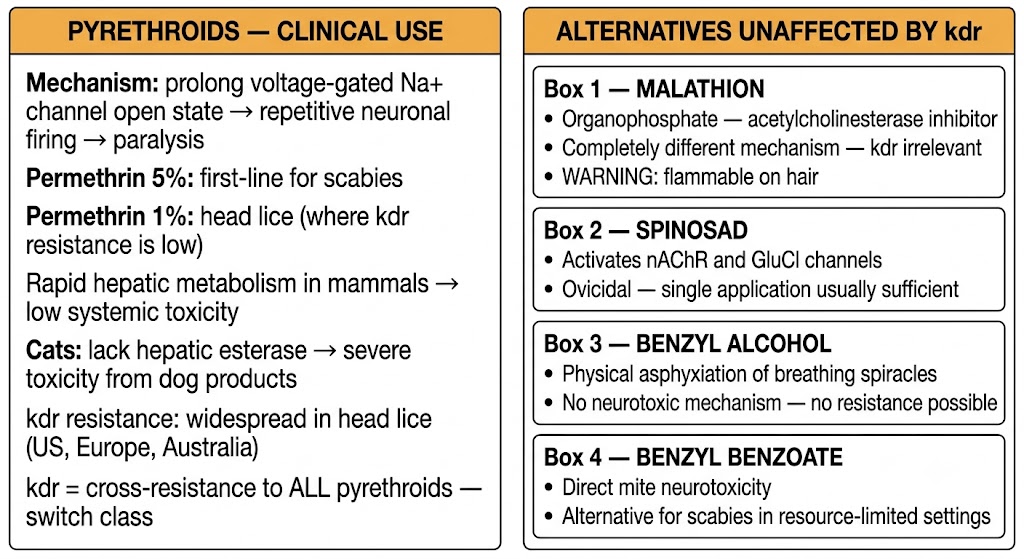
Malathion 0.5% lotion is an organophosphate cholinesterase inhibitor that retains full activity against kdr-resistant lice because its mechanism is entirely independent of sodium channel function. It inhibits acetylcholinesterase in the louse nervous system, causing accumulation of acetylcholine at cholinergic synapses and louse death. Malathion lotion is flammable during application — patients must avoid open flames and hair dryers while the product is on the hair. It is not recommended in young children or in pregnancy due to organophosphate systemic absorption concerns.

Spinosad 0.9% suspension acts by activating nicotinic acetylcholine receptors (nAChR) and glutamate-gated chloride channels in lice, causing neuromuscular hyperexcitation and death. Its distinct mechanism means it is fully active against kdr-resistant lice. Unlike permethrin, spinosad has ovicidal activity, so a single application is usually sufficient without a mandatory second dose. Benzyl alcohol 5% lotion kills lice by a physical mechanism — it asphyxiates lice by blocking their breathing spiracles — and carries no resistance risk whatsoever.

Oral ivermectin is an option for head lice refractory to topical agents, providing a systemic route that bypasses topical application entirely. Body lice infestation is treated primarily by environmental measures — discarding or hot-laundering infested clothing and bedding — because body lice live in clothing seams rather than on skin, and environmental decontamination is the key intervention.

Pediculosis Treatment Anchors

kdr resistance (voltage-gated sodium channel mutation): prevalent in head lice across US, Europe, Australia — permethrin often fails; do not repeat if first application fails. Malathion: acetylcholinesterase inhibitor; active against kdr lice; flammable — no flames or hair dryers during application. Spinosad: nicotinic acetylcholine receptor activation; kdr-resistant lice fully susceptible; ovicidal — single application often sufficient. Benzyl alcohol: physical asphyxiation of spiracles — no resistance risk. Body lice: environmental decontamination is primary treatment. Pubic lice: treat sexual partners simultaneously.


Section 3
Pyrethrins, Pyrethroids, and Knockdown Resistance
Natural versus synthetic compounds, Type I and Type II subclasses, and the molecular basis of target-site resistance

Pyrethrins are naturally occurring insecticidal compounds derived from Chrysanthemum flowers; pyrethroids are synthetic analogs engineered for greater stability and potency. Together they constitute the most widely used class of insecticides globally, with applications spanning medical ectoparasiticides, agricultural insecticides, and vector control programs.

Mechanism and Subclasses

Pyrethrins and pyrethroids bind to voltage-gated sodium channels in the neuronal axon membrane and prolong their open state after depolarization. Normally, voltage-gated sodium channels open briefly during an action potential and then rapidly inactivate; pyrethroid binding prevents inactivation, causing sustained sodium influx, repetitive action potential generation, and ultimately paralysis and death of the target organism. At therapeutic topical doses in humans, systemic toxicity is not a practical concern given low dermal absorption and rapid hepatic metabolism.

Pyrethroids are rapidly metabolized by mammalian hepatic esterases, limiting systemic accumulation at therapeutic topical doses. Cats lack this esterase activity, making permethrin-containing dog products severely toxic if applied to cats.

Knockdown Resistance — Molecular Basis

Knockdown resistance is the primary mechanism of pyrethroid resistance in insect and mite pests. Specific point mutations in the voltage-gated sodium channel gene alter the pyrethroid-binding site, reducing drug binding affinity without significantly impairing the channel's normal function. Because these are target site mutations, they confer cross-resistance to all pyrethrins and pyrethroids — the entire drug class is affected simultaneously. Agents acting through entirely different mechanisms (malathion via acetylcholinesterase inhibition, spinosad via nicotinic acetylcholine receptor and glutamate-gated chloride channel activation, benzyl alcohol via physical asphyxiation) are unaffected by knockdown resistance and retain full activity.

Piperonyl Butoxide — Synergist

Piperonyl butoxide is an esterase inhibitor combined with natural pyrethrins in many over-the-counter head lice formulations. By preventing metabolic degradation of pyrethrins in the louse, it potentiates pyrethrin activity. However, piperonyl butoxide does not overcome knockdown resistance because knockdown resistance acts at the target site (the sodium channel), not through metabolic degradation. In populations with high knockdown resistance prevalence, pyrethrin-piperonyl butoxide combinations are no more effective than pyrethrins alone.

Two-panel diagram showing pyrethroids clinical use (mechanism, permethrin indications, hepatic metabolism, cat toxicity, kdr resistance geography) and four alternatives unaffected by kdr: malathion, spinosad, benzyl alcohol, and benzyl benzoate.
Figure 2. Pyrethroid clinical use and alternatives unaffected by knockdown resistance. Generated with Gemini AI for educational use.
Pyrethroid Clinical Anchors

Mechanism: prolong voltage-gated sodium channel open state → repetitive firing → paralysis and death. kdr resistance: target-site sodium channel mutation; cross-resistance to ALL pyrethroids — use malathion, spinosad, or benzyl alcohol instead. Piperonyl butoxide potentiates pyrethrins but does not overcome kdr. Cats: severely toxic — lack esterase metabolism; never apply dog permethrin products to cats. Low dermal absorption in humans at therapeutic doses.


Section 4
Antiparasitic Therapy in Pregnancy
Preferred agents, trimester-specific considerations, and the principle that untreated parasitic infection often carries greater risk than the drug

Prescribing antiparasitic therapy during pregnancy requires careful balancing of the risk of untreated infection against the pharmacological risk of the drug. In many situations — particularly for malaria, schistosomiasis, and significant helminth infections — the risk of the untreated infection substantially outweighs the drug risk, and withholding treatment is the less safe choice.

Malaria in Pregnancy

Malaria in pregnancy causes maternal anemia, placental malaria, low birth weight, preterm delivery, and maternal death — treatment must never be withheld. In the second and third trimesters, artemisinin-based combination therapies are the treatment of choice for uncomplicated falciparum malaria. In the first trimester, quinine plus clindamycin is preferred because safety data on artemisinin-based combination therapies in early pregnancy, while increasingly reassuring, are less complete. For prophylaxis during pregnancy, chloroquine is safe throughout all trimesters for chloroquine-sensitive destinations; mefloquine is used from the second trimester for chloroquine-resistant destinations; atovaquone-proguanil and doxycycline are generally avoided.

Intestinal Helminthiasis and Schistosomiasis

Significant helminth infections during pregnancy are associated with maternal anemia, malnutrition, and intrauterine growth restriction, making treatment a net benefit in high-prevalence settings. Single-dose albendazole or mebendazole for soil-transmitted helminthiasis is recommended from the second trimester onward by the World Health Organization (WHO) in endemic regions; the teratogenic risk from a single dose is considered negligible against the established benefit. Both agents are avoided in the first trimester. Praziquantel for schistosomiasis is recommended throughout pregnancy, including the first trimester in high-transmission settings, because untreated schistosomiasis causes significant morbidity and the WHO includes praziquantel in preventive chemotherapy programs for pregnant women.

Ectoparasiticides and Toxoplasmosis

Permethrin 5% cream is the preferred treatment for scabies in pregnancy given its very low dermal absorption. Benzyl benzoate is an alternative from the second trimester. Lindane (gamma-hexachlorocyclohexane), once used for scabies and lice, is contraindicated in pregnancy due to significant central nervous system toxicity risk from dermal absorption and has been banned or restricted in many countries — it is no longer recommended for any indication in pregnancy or in children. Malathion is avoided in pregnancy as a precaution against organophosphate exposure.

For toxoplasmosis in pregnancy, spiramycin is used when maternal seroconversion is detected to reduce the risk of vertical transmission to the fetus. When fetal infection is confirmed by amniocentesis, pyrimethamine-sulfadiazine-folinic acid is used to treat the infected fetus; pyrimethamine is avoided in the first trimester due to its anti-folate teratogenic mechanism.

Drug Indication First Trimester Second / Third Trimester
Artemisinin-based combination therapy Falciparum malaria Quinine + clindamycin preferred Recommended — do not withhold
Chloroquine Malaria prophylaxis (sensitive areas) Safe throughout all trimesters Safe throughout all trimesters
Albendazole / Mebendazole Soil-transmitted helminths Avoid Single dose — WHO recommended
Praziquantel Schistosomiasis WHO recommends in high-transmission Safe — recommended
Permethrin 5% Scabies Safe (low absorption) Preferred agent
Diethylcarbamazine Lymphatic filariasis Contraindicated Contraindicated
Ivermectin Strongyloidiasis / scabies Avoid; use only if life-threatening Limited data; avoid elective use
Lindane Scabies / lice Contraindicated Contraindicated
Pregnancy Antiparasitic Anchors

Never withhold malaria treatment in pregnancy — maternal and fetal risk from untreated malaria far exceeds drug risk. Praziquantel: WHO recommends throughout pregnancy including first trimester in high-transmission settings. Albendazole and mebendazole: single-dose safe from second trimester. Diethylcarbamazine: absolutely contraindicated in pregnancy. Lindane: contraindicated in pregnancy and in children — banned in many countries. Permethrin 5%: preferred scabies agent throughout pregnancy. Spiramycin: reduces vertical toxoplasma transmission; does not treat established fetal infection.


Section 5
Drug Interactions, Organ Toxicity, and Monitoring
Hepatotoxicity, bone marrow suppression, neurotoxicity, and the key drug interactions across the antiparasitic pharmacopeia

The antiparasitic drug classes covered across this chapter span a broad toxicity range, from agents with essentially no systemic toxicity at standard doses — permethrin, single-dose benzimidazoles — to agents requiring active monitoring for serious organ toxicity. The clinically important interactions and toxicities share recognizable mechanisms that allow prediction from pharmacological principles.

Hepatotoxicity

Prolonged albendazole therapy for neurocysticercosis or echinococcosis causes transaminase elevation in a significant minority of patients, generally mild to moderate and reversible on dose reduction or discontinuation. Liver function monitoring during treatment cycles is standard practice. Benznidazole for Chagas disease also causes hepatotoxicity as a dose-limiting toxicity. Praziquantel is metabolized extensively by cytochrome P450 3A4 (CYP3A4) and should be used with caution in severe hepatic impairment.

Bone Marrow Suppression

Pyrimethamine causes dose-dependent megaloblastic anemia, leukopenia, and thrombocytopenia by inhibiting dihydrofolate reductase (DHFR) in human bone marrow precursors — making folinic acid co-administration mandatory, as covered in Module 2. Prolonged albendazole and benznidazole can also suppress bone marrow, requiring complete blood count monitoring during treatment. These are the principal agents in the antiparasitic pharmacopeia with significant myelosuppressive potential.

Neurotoxicity

Mefloquine neuropsychiatric toxicity — ranging from vivid dreams and anxiety to psychosis and seizures — is the most clinically important central nervous system adverse effect in the antiparasitic class, covered in Module 1. Ivermectin central nervous system toxicity occurs at therapeutic doses only when the blood-brain barrier is compromised or P-glycoprotein efflux is inhibited. Lindane causes central nervous system toxicity through gamma-aminobutyric acid-A (GABA-A) receptor antagonism, blocking inhibitory chloride channels; seizures have been reported, particularly in children, from dermal absorption — this is the basis for its contraindication in children and pregnancy.

Key Drug Interactions Across the Antiparasitic Classes

The most clinically significant interactions are: rifampicin reduces praziquantel plasma levels dramatically via CYP3A4 induction and must not be co-administered; corticosteroids reduce praziquantel cerebrospinal fluid penetration; metronidazole inhibits CYP2C9 and potentiates warfarin anticoagulation, requiring international normalized ratio (INR) monitoring; P-glycoprotein inhibitors (ritonavir, verapamil) increase ivermectin central nervous system penetration and should be used with caution when blood-brain barrier integrity is uncertain; mefloquine lowers seizure threshold and should not be combined with other agents that do the same; artemether-lumefantrine prolongs the corrected QT interval and should not be combined with other corrected QT-prolonging agents; pyrimethamine bone marrow toxicity is additive with other myelosuppressants.

Drug Interactions and Toxicity Monitoring Summary

Rifampicin + praziquantel: CYP3A4 induction dramatically lowers praziquantel levels — never co-administer. Metronidazole + warfarin: CYP2C9 inhibition — monitor INR. Ivermectin + P-glycoprotein inhibitors (ritonavir, verapamil): increased central nervous system penetration risk. Pyrimethamine: folinic acid mandatory; additive myelosuppression with other bone marrow suppressants. Mefloquine: seizure threshold lowered — avoid combinations with other seizure threshold-lowering agents. Lindane: GABA-A antagonist — central nervous system toxicity in children; banned in many countries. Corrected QT prolongation: quinoline antimalarials, lumefantrine, piperaquine — avoid co-administration with other corrected QT-prolonging drugs.


Suggested References
Author / Organization Title Source
Currie BJ, McCarthy JS Permethrin and ivermectin for scabies N Engl J Med. 2010;362(8):717-725
Romani L, Steer AC, Whitfeld MJ, Kaldor JM Prevalence of scabies and impetigo worldwide: a systematic review Lancet Infect Dis. 2015;15(8):960-967
Strong M, Johnstone P Interventions for treating scabies Cochrane Database Syst Rev. 2007;(3):CD000320
Frankowski BL, Bocchini JA Jr; Council on School Health and Committee on Infectious Diseases Head lice Pediatrics. 2010;126(2):392-403
Yoon KS, Previte DJ, Hodgdon HE, et al. Knockdown resistance allele frequencies in North American head louse populations J Med Entomol. 2014;51(2):450-457
Soderlund DM, Knipple DC The molecular biology of knockdown resistance to pyrethroid insecticides Insect Biochem Mol Biol. 2003;33(6):563-577
Williamson MS, Martinez-Torres D, Hick CA, Devonshire AL Identification of mutations in the housefly para-type sodium channel gene associated with knockdown resistance to pyrethroid insecticides Mol Gen Genet. 1996;252(1-2):51-60
World Health Organization WHO Guidelines for the Treatment of Malaria. 3rd ed. WHO; 2015
World Health Organization Preventive Chemotherapy in Human Helminthiasis: Coordinated Use of Anthelminthic Drugs in Control Interventions WHO; 2006
World Health Organization Guideline: Preventive Chemotherapy to Control Soil-Transmitted Helminth Infections in At-Risk Population Groups WHO; 2017
Brunton L, Knollmann B, Hilal-Dandan R, eds. Goodman & Gilman's The Pharmacological Basis of Therapeutics. 14th ed. Chapter 52: Antiparasitic Agents McGraw-Hill; 2023
Drugs for Parasitic Infections Treatment guidelines for parasitic infections The Medical Letter on Drugs and Therapeutics; 2013 special issue