Introduction to Medical Pharmacology
Second-Generation Antipsychotics: Core Agents
Chapter 16 · Module 3 of 6Section 1
What makes a second-generation antipsychotic atypical, and why the distinction matters clinically
Second-generation antipsychotics — also called atypical antipsychotics — are defined not by superior antipsychotic efficacy but by a lower tendency to produce motor side effects at clinically effective doses. The pharmacological basis for this reduced motor burden is their combined blockade of serotonin 5-HT2A receptors alongside dopamine D2 receptors, a mechanism that partially protects the nigrostriatal pathway from the full consequences of D2 blockade.
Serotonin 5-HT2A receptors are expressed on dopamine neurons in the nigrostriatal and mesocortical pathways, where serotonin acts to suppress dopamine release. When an antipsychotic blocks 5-HT2A receptors, it removes this serotonergic inhibition and allows dopamine to be released despite concurrent D2 blockade. In the striatum, this partially restored dopamine tone reduces the motor side effect burden that would otherwise result from selective D2 blockade. In the prefrontal cortex, the same effect partially supports the deficient mesocortical dopamine activity that underlies negative symptoms and cognitive deficits.
The higher the ratio of 5-HT2A blockade to D2 blockade, the lower the motor side effect burden — this is the pharmacological definition of atypicality. Agents such as clozapine and quetiapine have very high 5-HT2A to D2 ratios and produce minimal motor side effects even at doses that achieve full antipsychotic effect. Risperidone has a favorable ratio at lower doses but loses its atypical character at higher doses as D2 blockade dominates. Agents such as haloperidol have essentially no meaningful 5-HT2A activity, leaving D2 blockade unopposed in the striatum.
The reduction in motor side effects with second-generation antipsychotics comes at the cost of a different and clinically significant adverse effect profile. The agents with the most favorable motor profiles — clozapine and olanzapine — carry the highest risk of weight gain, glucose dysregulation, and dyslipidemia. These metabolic effects are driven primarily by histamine H1 blockade (appetite stimulation) and serotonin 5-HT2C blockade (impaired satiety signaling) rather than by the 5-HT2A mechanism responsible for reduced motor side effects. The Clinical Antipsychotic Trials of Intervention Effectiveness study, which compared multiple second-generation antipsychotics against perphenazine (a first-generation agent) in chronic schizophrenia, found that the second-generation agents were not categorically superior — olanzapine showed the longest time to discontinuation but also the highest metabolic burden, and perphenazine performed comparably to quetiapine, risperidone, and ziprasidone on the primary outcome.
Atypical means: Lower extrapyramidal symptom and tardive dyskinesia risk at therapeutic doses, achieved through serotonin 5-HT2A blockade that partially offsets nigrostriatal D2 blockade.
Atypical does not mean: Superior antipsychotic efficacy, fewer adverse effects overall, or a homogeneous drug class. The second-generation agents vary widely in receptor profiles, adverse effect patterns, and clinical niches. Treating them as a uniform group leads to poor prescribing decisions.
Section 2
Mechanism, superior efficacy in treatment-resistant schizophrenia, agranulocytosis, and the Risk Evaluation and Mitigation Strategy monitoring program
Clozapine occupies a unique position in antipsychotic pharmacology. It was the first drug recognized as atypical, it remains the only antipsychotic with demonstrated superior efficacy in treatment-resistant schizophrenia, and it carries an adverse effect burden — most critically agranulocytosis — that requires a mandatory national monitoring program before it can be dispensed. Understanding clozapine means understanding both why it is the most effective antipsychotic available and why it demands the most careful clinical management.
Clozapine's D2 receptor affinity is relatively modest compared with other antipsychotics, yet it is more effective than any other agent in treatment-resistant schizophrenia. This paradox — high efficacy with low D2 affinity — reflects the breadth and complexity of clozapine's receptor profile. It blocks D2, D4, D1, serotonin 5-HT2A, serotonin 5-HT2C, histamine H1, muscarinic M1, and alpha-1 adrenergic receptors simultaneously. No single receptor interaction accounts for its superior efficacy; the multi-receptor profile as a whole appears to be the active principle. Its low and rapidly dissociating D2 occupancy — approximately 40 to 60 percent at therapeutic doses, well below the 65 to 80 percent range required by other antipsychotics — also means it produces essentially no extrapyramidal symptoms and no elevation of prolactin.
Treatment-resistant schizophrenia is defined as failure of adequate symptom control despite two adequate antipsychotic trials at adequate doses for adequate durations. Approximately 20 to 30 percent of patients with schizophrenia meet this definition. Clozapine produces meaningful clinical response in approximately 30 to 60 percent of treatment-resistant patients — compared with near-zero response rates to further trials of standard antipsychotics in this population. No other antipsychotic, strategy, or combination has been shown to match these response rates.
Clozapine is also the only antipsychotic with a Food and Drug Administration indication specifically for reducing suicidal behavior in schizophrenia and schizoaffective disorder, supported by a large international trial showing reduced suicidality compared with olanzapine. Current guidelines recommend initiating clozapine after the second antipsychotic trial failure — not as a last resort after exhausting every other option. Delays beyond this threshold expose patients to continued psychosis, progressive functional decline, and suicide risk that clozapine could have reduced.
Clozapine causes agranulocytosis — defined as an absolute neutrophil count below 500 cells per microliter — in approximately 0.8 to 1 percent of patients. Agranulocytosis is idiosyncratic, not dose-dependent, and can be fatal if undetected. In the United States, clozapine is available only through the Clozapine Risk Evaluation and Mitigation Strategy program, which requires absolute neutrophil count monitoring before every dispensing: weekly for the first 6 months, every two weeks for months 6 to 12, then monthly thereafter. The drug is dispensed only when the count is confirmed adequate. This mandatory monitoring system means that agranulocytosis, when it develops, is almost always caught before it becomes life-threatening.
Benign ethnic neutropenia — a lower baseline absolute neutrophil count that occurs in individuals of African, Middle Eastern, and Afro-Caribbean ancestry without increased infection risk — is an important consideration. The Risk Evaluation and Mitigation Strategy program now includes adjusted monitoring thresholds for patients with benign ethnic neutropenia to prevent inappropriate clozapine discontinuation in this population.
Clozapine produces the most pronounced weight gain of any antipsychotic, averaging 4 to 5 kilograms in the first year with continued accumulation in susceptible patients. New-onset type 2 diabetes mellitus and diabetic ketoacidosis have been reported even in patients without prior metabolic disease. Sialorrhea — excessive salivation — occurs paradoxically despite clozapine's anticholinergic activity, because it acts as an agonist at muscarinic M4 receptors in the salivary glands. Dose-dependent seizure risk reaches approximately 5 percent at doses above 600 milligrams per day, making clozapine the highest seizure-risk antipsychotic; valproate is the preferred antiseizure drug adjunct when needed, because carbamazepine is contraindicated with clozapine due to additive bone marrow suppression. Orthostatic hypotension from alpha-1 blockade requires slow titration starting at 12.5 milligrams once or twice daily. Myocarditis — a rare but potentially fatal cardiac complication — occurs predominantly in the first 6 to 8 weeks and warrants baseline and early monitoring of troponin and C-reactive protein.
Agranulocytosis (0.8–1%): mandatory absolute neutrophil count monitoring via Risk Evaluation and Mitigation Strategy — weekly × 6 months, then biweekly, then monthly. Drug dispensed only with satisfactory count.
Metabolic syndrome: highest weight gain of any antipsychotic; new-onset diabetes mellitus and diabetic ketoacidosis possible even without prior metabolic disease.
Seizures: dose-dependent risk up to 5% at doses above 600 mg/day. Add valproate if needed — never carbamazepine.
Sialorrhea: paradoxical excessive salivation despite muscarinic M1 antagonism — from muscarinic M4 agonism in salivary glands.
Myocarditis: rare, first 6–8 weeks — monitor troponin and C-reactive protein.
Section 3
Broad receptor profile, robust antipsychotic efficacy, and the highest metabolic liability in the second-generation class after clozapine
Olanzapine is structurally related to clozapine and shares much of its broad receptor binding profile — including D2, serotonin 5-HT2A, serotonin 5-HT2C, histamine H1, muscarinic M1, and alpha-1 blockade. It lacks clozapine's agranulocytosis risk and does not require Risk Evaluation and Mitigation Strategy monitoring. Its D2 affinity is substantially higher than clozapine's, placing it in the moderate range with a favorable serotonin 5-HT2A to D2 ratio that produces low extrapyramidal symptom rates at standard doses.
Olanzapine has one of the most extensive clinical evidence bases in the second-generation class. In the Clinical Antipsychotic Trials of Intervention Effectiveness study it had the longest time to all-cause discontinuation of any agent studied — suggesting meaningful patient benefit — at the cost of the highest metabolic adverse effect burden in the trial. Food and Drug Administration-approved indications include schizophrenia (acute and maintenance), acute and maintenance treatment of manic episodes in bipolar I disorder, and bipolar depression in combination with fluoxetine (marketed as a fixed-dose combination product).
An intramuscular formulation of olanzapine is available for acute agitation. A critical safety rule applies to this formulation: intramuscular olanzapine must never be co-administered with intramuscular or intravenous benzodiazepines in the same session. Cases of severe respiratory depression and death have been attributed to this specific combination. This contraindication applies regardless of the clinical urgency of sedation.
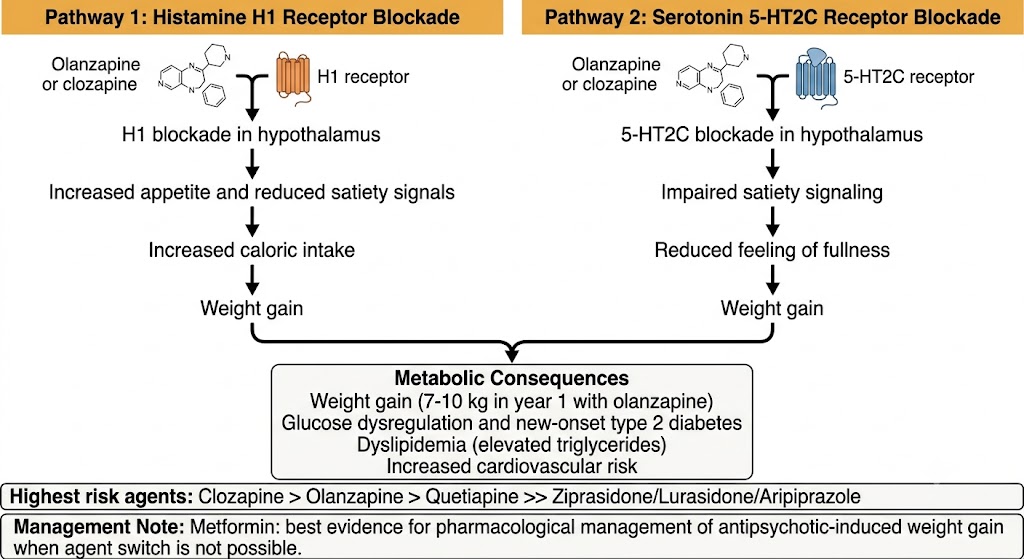
Olanzapine produces the most pronounced metabolic adverse effects of any second-generation antipsychotic outside of clozapine. Weight gain averaging 7 to 10 kilograms or more in the first year is common in susceptible patients, driven by combined histamine H1 blockade (appetite stimulation, reduced energy expenditure) and serotonin 5-HT2C blockade (impaired hypothalamic satiety signaling). Glucose dysregulation, new-onset type 2 diabetes, and dyslipidemia occur at rates substantially above baseline. Comprehensive metabolic monitoring — weight, fasting glucose, lipid panel, blood pressure — at baseline, 12 weeks, and annually is the standard of care.
When clinically significant weight gain develops on olanzapine and switching to a more metabolically favorable agent is not possible, metformin has the strongest evidence base as a pharmacological adjunct, producing mean weight reductions of 2 to 3 kilograms and improvements in insulin sensitivity in randomized trials. Switching to aripiprazole, lurasidone, or ziprasidone when the antipsychotic choice permits it is the most effective long-term metabolic strategy.
Olanzapine is metabolized primarily by cytochrome P450 1A2, the same enzyme induced by cigarette smoking. In heavy smokers, cytochrome P450 1A2 induction reduces olanzapine plasma levels by approximately 40 to 50 percent compared with non-smokers at the same dose. A patient stabilized at 20 milligrams per day while smoking heavily may be pharmacokinetically equivalent to a non-smoker on 10 to 12 milligrams per day. When a patient on olanzapine is admitted to a smoke-free inpatient unit and stops smoking, their plasma levels rise toward non-smoker pharmacokinetics — producing sedation, orthostatic hypotension, and metabolic worsening at previously well-tolerated doses. The converse — apparent loss of efficacy after discharge when heavy smoking resumes — is equally documented. Fluvoxamine, a potent cytochrome P450 1A2 inhibitor, substantially raises olanzapine levels and requires dose reduction.
Section 4
Fast D2 dissociation kinetics, potent H1 blockade, and one of the broadest approved indication ranges in psychopharmacology
Quetiapine is unusual among antipsychotics because its D2 receptor affinity is low and its binding to D2 receptors is transient — it dissociates rapidly, so D2 occupancy is highest shortly after a dose and falls substantially within hours. This rapid dissociation, combined with potent H1 and alpha-1 blockade at low doses and meaningful D2 occupancy only transiently at antipsychotic doses, explains both its remarkably low motor side effect burden and its wide range of approved and off-label uses.
At low doses — 25 to 100 milligrams — quetiapine's clinical effect is dominated by histamine H1 and alpha-1 adrenergic blockade, producing sedation and orthostatic hypotension with minimal antipsychotic activity. Antipsychotic effect requires doses of 400 to 800 milligrams per day in most patients, at which point transient peak D2 occupancy during the first few hours after each dose reaches the therapeutic range. Because D2 occupancy falls rapidly between doses, sustained nigrostriatal blockade — the driver of extrapyramidal symptoms — does not accumulate, and quetiapine at any approved dose produces essentially no extrapyramidal symptoms and no elevation of prolactin.
Quetiapine has one of the broadest approved indication ranges of any antipsychotic. Food and Drug Administration-approved indications include schizophrenia (acute and maintenance), bipolar I disorder mania (acute and maintenance), bipolar depression (as quetiapine extended-release), and as adjunctive therapy in major depressive disorder (as quetiapine extended-release). The approval for bipolar depression — one of the most difficult phases of bipolar disorder to treat — is supported by large randomized trials demonstrating superiority over placebo on depressive rating scales.
Off-label, quetiapine at low doses (25 to 100 milligrams) is widely used as a sleep aid and for anxiety in psychiatric populations, driven by its potent H1-mediated sedation. This off-label use carries the full metabolic and cardiac risks of the drug at any dose — these risks do not disappear at low doses merely because the antipsychotic effect is absent.
Quetiapine's metabolic adverse effects are intermediate — meaningful weight gain (averaging 2 to 3 kilograms at antipsychotic doses) and modest glucose dysregulation, less pronounced than olanzapine or clozapine but more than ziprasidone, lurasidone, or aripiprazole. Orthostatic hypotension from alpha-1 blockade is prominent during initiation and requires gradual dose titration starting at 25 to 50 milligrams twice daily, particularly in elderly patients.
Quetiapine is primarily metabolized by cytochrome P450 3A4, making it sensitive to strong inhibitors and inducers of this enzyme. Strong cytochrome P450 3A4 inhibitors — including azole antifungals and clarithromycin — raise quetiapine levels substantially and require dose reduction to approximately one-sixth of the standard dose during co-administration. Strong cytochrome P450 3A4 inducers — including carbamazepine and rifampin — can reduce quetiapine levels by up to 90 percent, potentially rendering standard doses subtherapeutic.
Quetiapine Advantages
Why Quetiapine Is Often Chosen
Quetiapine Cautions
Key Limitations and Risks
Section 5
A parent drug and its active metabolite: shared receptor pharmacology, dose-dependent extrapyramidal symptom risk, hyperprolactinemia, and the most developed long-acting injectable program in the class
Risperidone and paliperidone represent a parent drug and active metabolite pair with essentially identical receptor pharmacology but divergent pharmacokinetics. Risperidone is converted by cytochrome P450 2D6 to paliperidone (9-hydroxyrisperidone), which is itself an approved antipsychotic with renal rather than hepatic elimination. Understanding the two together clarifies both their shared clinical profile and the specific situations in which each is preferred.
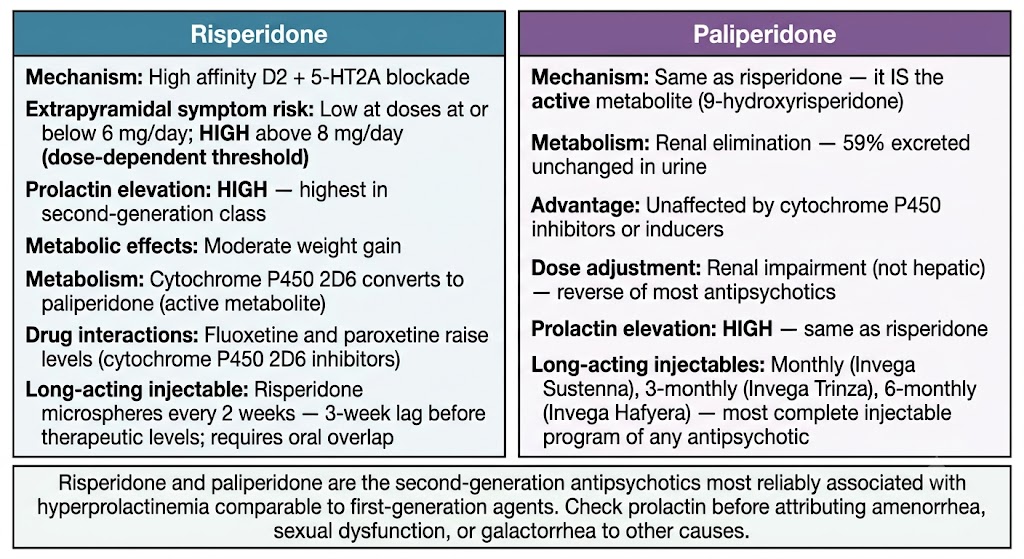
Risperidone has high affinity for both D2 and serotonin 5-HT2A receptors and a favorable serotonin 5-HT2A to D2 ratio at doses below approximately 6 to 8 milligrams per day, producing low extrapyramidal symptom rates comparable to other second-generation antipsychotics in this dose range. Above 8 milligrams per day, D2 occupancy crosses the threshold at which extrapyramidal symptoms emerge, and risperidone begins to produce parkinsonism and akathisia at rates approaching those of high-potency first-generation antipsychotics. Unlike olanzapine or quetiapine, risperidone lacks meaningful histamine H1 or anticholinergic activity to buffer this effect. Dose optimization is therefore particularly consequential for risperidone — doses above 6 milligrams per day offer diminishing antipsychotic returns with increasing motor side effect cost.
Risperidone is also the second-generation antipsychotic most consistently associated with hyperprolactinemia, elevating prolactin to a degree comparable to many first-generation agents. This reflects its relatively selective dopamine and serotonin receptor pharmacology without meaningful off-target receptor activity to moderate tuberoinfundibular D2 blockade. Prolactin elevation on risperidone is sustained, dose-dependent, and particularly important in younger patients where amenorrhea, sexual dysfunction, and effects on bone density have long-term implications.
Paliperidone undergoes minimal hepatic metabolism and is eliminated primarily unchanged in the urine — approximately 59 percent of a dose is excreted unchanged. This makes paliperidone the exception among antipsychotics: its plasma levels are largely unaffected by cytochrome P450 enzyme inhibitors or inducers, and dose adjustment is required for renal impairment rather than hepatic impairment. Its clinical profile mirrors risperidone's — equivalent hyperprolactinemia, equivalent extrapyramidal symptom risk at equivalent doses — but its pharmacokinetic predictability makes it preferable when cytochrome P450 2D6 drug interaction burden is a concern, such as in patients on strong cytochrome P450 2D6 inhibitors like fluoxetine or paroxetine.
Risperidone and paliperidone have the most fully developed long-acting injectable program of any antipsychotic. Risperidone microspheres are administered every two weeks but have a pharmacokinetic lag of approximately three weeks before therapeutic plasma levels are achieved — requiring oral risperidone supplementation during this period. Paliperidone palmitate is available in monthly, three-monthly, and six-monthly formulations, the last being the longest injection interval of any approved antipsychotic. The three-monthly and six-monthly formulations require prior stabilization on the monthly formulation before conversion. This hierarchy of injection intervals — from two weeks to six months — represents the most complete adherence-support system available for any single antipsychotic and trial data consistently demonstrate reduced hospitalization rates with long-acting injectable versus oral formulations in patients with documented adherence difficulties.
Section 6
Metabolic pathways, half-lives, and the most clinically consequential drug interactions for core second-generation agents
The core second-generation antipsychotics covered in this module differ substantially in their metabolic pathways and half-lives, and these differences translate directly into clinically important drug interaction profiles. The primary metabolic route of each agent determines which comedications require dose adjustment and which organ impairment states alter drug exposure.
Both clozapine and olanzapine are primarily metabolized by cytochrome P450 1A2, making them sensitive to the same enzyme inhibitors and inducers. Fluvoxamine — a potent cytochrome P450 1A2 inhibitor used for obsessive-compulsive disorder — raises clozapine plasma levels five to tenfold at standard doses, an interaction so dramatic that it has been deliberately exploited clinically: by adding fluvoxamine, clozapine can be maintained at lower doses that reduce agranulocytosis risk while retaining therapeutic plasma levels, but this requires careful plasma level monitoring and clozapine dose reduction to approximately 25 to 33 percent of the standard dose. Ciprofloxacin raises clozapine levels by approximately 60 percent and requires temporary dose reduction during antibiotic courses. Cigarette smoking induces cytochrome P450 1A2 and reduces both clozapine and olanzapine levels by 40 to 50 percent in heavy smokers — any change in smoking status mandates reassessment of the antipsychotic dose. Carbamazepine induces cytochrome P450 1A2 substantially and is contraindicated with clozapine because it also adds bone marrow suppression risk independently.
Quetiapine's exclusive dependence on cytochrome P450 3A4 creates large-magnitude drug interactions. Strong inhibitors — azole antifungals, clarithromycin, ritonavir — can raise quetiapine levels approximately fivefold and require dose reduction to one-sixth of the standard dose. Strong inducers — carbamazepine, rifampin, phenytoin, St. John's Wort — can reduce quetiapine levels by up to 90 percent, potentially rendering standard antipsychotic doses completely ineffective; if the combination cannot be avoided, quetiapine doses may need to increase fivefold, with a corresponding mandatory dose reduction when the inducer is stopped to avoid toxicity.
Risperidone is converted by cytochrome P450 2D6 to its active metabolite paliperidone. Strong cytochrome P450 2D6 inhibitors — fluoxetine, paroxetine, bupropion — impair this conversion, raising risperidone levels while reducing paliperidone; a dose reduction of approximately 50 percent should be considered when adding a strong inhibitor to established risperidone therapy. Because the combined receptor occupancy of risperidone plus paliperidone determines the clinical effect, cytochrome P450 2D6 phenotype (poor versus extensive metabolizer) also affects dose-response but less dramatically than for agents dependent on a single compound. Paliperidone itself bypasses cytochrome P450 2D6 entirely through renal clearance and is therefore unaffected by cytochrome P450 2D6 inhibitors.
All second-generation antipsychotics produce additive central nervous system depression when combined with benzodiazepines, opioids, or other sedating agents — requiring monitoring, particularly in elderly patients. The specific contraindication against combining intramuscular olanzapine with intramuscular or intravenous benzodiazepines in the same session remains absolute regardless of clinical urgency. Additive QTc prolongation is a lesser concern for clozapine, olanzapine, quetiapine, and risperidone than for thioridazine or ziprasidone, but is not zero — assess whenever a QTc-active comedication is prescribed.
| Author / Organization | Title | Source |
|---|---|---|
| Stahl SM | Stahl's Essential Psychopharmacology: Neuroscientific Basis and Practical Applications. 4th ed. | Cambridge University Press; 2013:129–237 |
| Seeman P | Atypical antipsychotics: mechanism of action | Can J Psychiatry. 2002;47(1):27–38 |
| Lieberman JA, Stroup TS, McEvoy JP, et al | Effectiveness of antipsychotic drugs in patients with chronic schizophrenia | N Engl J Med. 2005;353(12):1209–1223 |
| Kane J, Honigfeld G, Singer J, Meltzer H | Clozapine for the treatment-resistant schizophrenic: a double-blind comparison with chlorpromazine | Arch Gen Psychiatry. 1988;45(9):789–796 |
| Meltzer HY, Alphs L, Green AI, et al | Clozapine treatment for suicidality in schizophrenia: International Suicide Prevention Trial (InterSePT) | Arch Gen Psychiatry. 2003;60(1):82–91 |
| Citrome L | Clozapine for schizophrenia: life-threatening or life-saving treatment? | Curr Psychiatry. 2009;8(12):56–63 |
| Allison DB, Mentore JL, Heo M, et al | Antipsychotic-induced weight gain: a comprehensive research synthesis | Am J Psychiatry. 1999;156(11):1686–1696 |
| Fiedorowicz JG, Miller DD, Bishop JR, et al | Systematic review and meta-analysis of pharmacological interventions for weight gain from antipsychotics and mood stabilizers | Curr Psychiatry Rev. 2012;8(1):25–36 |
| Spina E, de Leon J | Metabolic drug interactions with newer antipsychotics: a comparative review | Basic Clin Pharmacol Toxicol. 2007;100(1):4–22 |
| Calabrese JR, Keck PE Jr, Macfadden W, et al | A randomized, double-blind, placebo-controlled trial of quetiapine in the treatment of bipolar I or II depression | Am J Psychiatry. 2005;162(7):1351–1360 |
| Kishimoto T, Robenzadeh A, Leucht C, et al | Long-acting injectable vs oral antipsychotics for relapse prevention in schizophrenia: a meta-analysis of randomized trials | Schizophr Bull. 2014;40(1):192–213 |