CHAPTER 16  ·  ANTIPSYCHOTIC DRUGS

Section 1

Partial D2 Agonism

A mechanistically distinct approach to antipsychotic action that stabilizes dopamine tone rather than blocking it completely

Aripiprazole, brexpiprazole, and cariprazine belong to a mechanistically distinct category within the second-generation antipsychotics. Rather than blocking the dopamine D2 receptor completely, they act as partial agonists — occupying the receptor and activating it to a degree that is less than full dopamine activation but more than zero. This intermediate activation produces opposite functional effects depending on whether the circuit they are acting in has too much or too little dopamine.
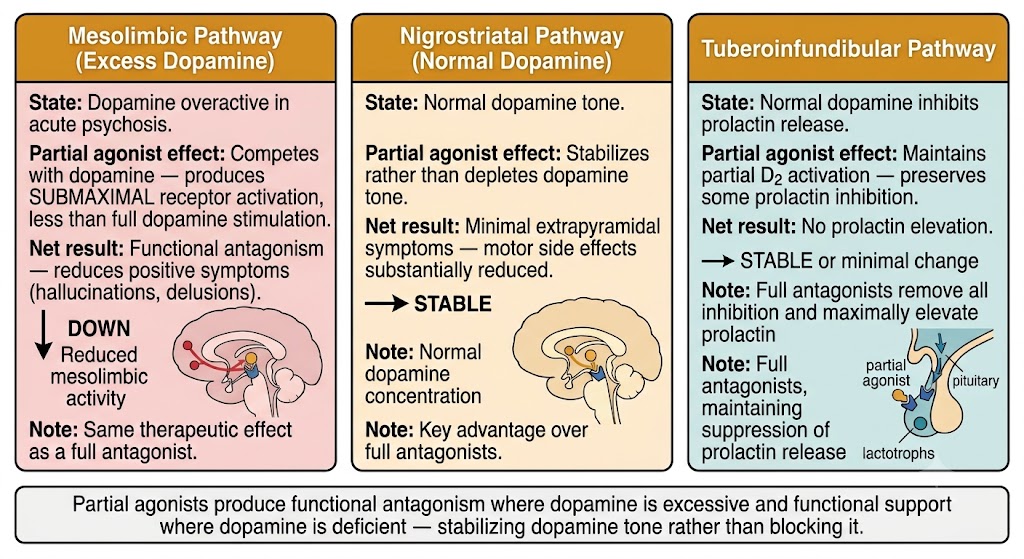
Three-panel diagram showing how partial D2 agonists produce different effects in three dopamine pathways: functional antagonism in the mesolimbic pathway reducing positive symptoms, dopamine tone stabilization in the nigrostriatal pathway minimizing extrapyramidal symptoms, and preservation of partial D2 activation in the tuberoinfundibular pathway preventing prolactin elevation.
Partial D2 agonists produce pathway-specific effects: functional antagonism where dopamine is excessive (mesolimbic), stabilization where dopamine is normal (nigrostriatal), and preserved prolactin inhibition (tuberoinfundibular). Figure generated by Gemini AI.
How Partial Agonism Works in Practice

In the mesolimbic pathway, where dopamine is in excess during acute psychosis, a partial agonist competes with dopamine for the D2 receptor. Because the partial agonist activates the receptor less than dopamine would, it reduces the net level of receptor activation — a functional antagonist effect that suppresses positive symptoms in the same way a full antagonist does, but through competition rather than complete blockade.

In the mesocortical pathway, where dopamine is deficient in schizophrenia, the partial agonist provides some residual receptor activation that a full antagonist would eliminate entirely. This partial support of an already-deficient pathway is the theoretical basis for the claim that partial agonists are less likely to worsen negative symptoms and cognitive function than full antagonists.

In the nigrostriatal pathway, partial agonism stabilizes rather than depletes dopamine tone, which substantially reduces the risk of extrapyramidal symptoms compared with full antagonists. In the tuberoinfundibular pathway, the partial agonist provides enough D2 activation to maintain partial inhibition of prolactin secretion — which is why partial agonists produce essentially no prolactin elevation, in contrast to full antagonists that remove all dopaminergic inhibition of prolactin release.

The Class Adverse Effect — Akathisia

Despite their favorable motor and hormonal profiles, partial agonists share one prominent adverse effect: akathisia occurs at meaningfully higher rates with aripiprazole and cariprazine than with quetiapine or clozapine, and at rates comparable to or exceeding low-dose risperidone. The mechanism is not fully established but may involve partial agonism in mesolimbic circuits rather than purely nigrostriatal activity. Management follows the same principles as for akathisia from any antipsychotic: dose reduction where feasible, propranolol for the subjective restlessness component, and short-term benzodiazepines.

Partial Agonist Profile — Class Summary

Extrapyramidal symptom risk: Substantially reduced — partial agonism stabilizes nigrostriatal dopamine tone rather than depleting it.

Prolactin elevation: Minimal to none — partial D2 activation maintains partial inhibition of prolactin release.

Metabolic effects: Favorable — low histamine H1 and serotonin 5-HT2C affinity means minimal weight gain and glucose dysregulation.

Primary adverse effect: Akathisia — the class-defining side effect, managed with propranolol or dose reduction.
Section 2

Aripiprazole

The first approved partial D2 agonist: broad indication range, favorable metabolic profile, and unique pharmacokinetics

Aripiprazole was the first partial D2 agonist approved for clinical use and remains the most widely prescribed agent in this mechanistic category. Its receptor profile combines partial D2 agonism with partial serotonin 5-HT1A agonism and antagonism at serotonin 5-HT2A receptors — a combination that contributes to its broad clinical utility across psychotic, mood, and anxiety-spectrum conditions. Its low affinity for histamine H1, muscarinic M1, and alpha-1 adrenergic receptors accounts directly for its favorable metabolic, sedation, and orthostatic profiles.

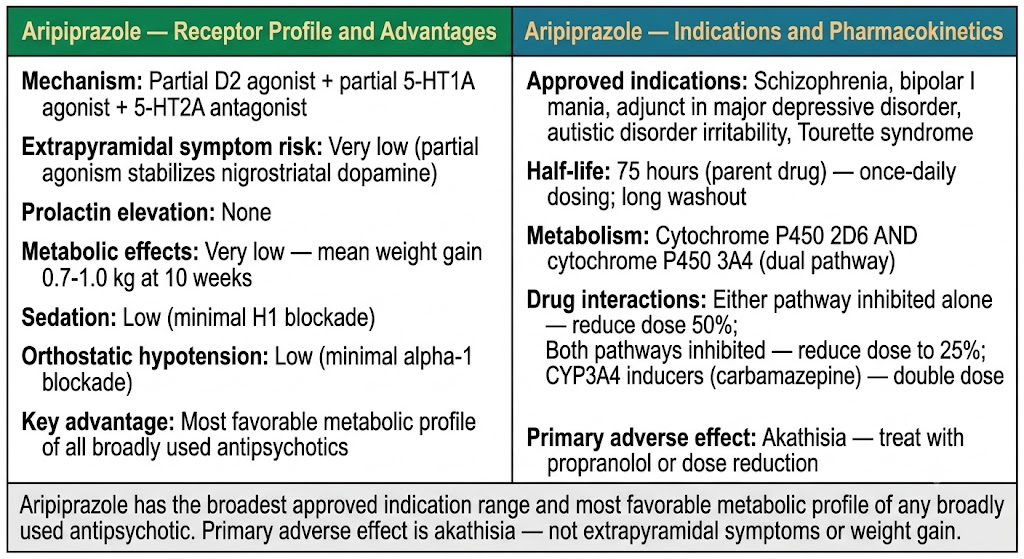
Two-panel diagram of aripiprazole showing receptor profile and advantages in the left panel (partial D2 and 5-HT1A agonism, very low extrapyramidal symptom risk, no prolactin elevation, very low metabolic effects) and indications and pharmacokinetics in the right panel (schizophrenia, bipolar mania, major depressive disorder adjunct, 75-hour half-life, dual cytochrome P450 2D6 and 3A4 metabolism with dose reduction rules, akathisia as primary adverse effect).
Aripiprazole: receptor profile, metabolic advantages, approved indications, and pharmacokinetic drug interaction rules. Figure generated by Gemini AI.
Approved Indications

Aripiprazole has one of the broadest Food and Drug Administration-approved indication ranges of any antipsychotic. Approved indications include schizophrenia (acute and maintenance), bipolar I disorder mania (acute and maintenance), adjunctive therapy in major depressive disorder, irritability associated with autistic disorder, and Tourette syndrome. Its approval as an adjunct in major depressive disorder is notable — it is one of very few antipsychotics approved for this indication, where its partial serotonin 5-HT1A agonism may contribute antidepressant-like effects at doses below those required for full antipsychotic effect.

Metabolic Profile

Aripiprazole has the most favorable metabolic profile among broadly used antipsychotics. Mean weight gain is approximately 0.7 to 1.0 kilograms at 10 weeks in clinical trials, with minimal effects on fasting glucose, lipids, or insulin sensitivity. This metabolic neutrality reflects its very low histamine H1 and serotonin 5-HT2C receptor affinity — the two receptor interactions most responsible for weight gain and glucose dysregulation with other antipsychotics. In clinical practice, aripiprazole is frequently added to regimens that include metabolically burdensome antipsychotics, particularly olanzapine or clozapine, where it may attenuate weight gain. Switching from olanzapine to aripiprazole produces meaningful reductions in weight, fasting glucose, and triglycerides in randomized trials while maintaining antipsychotic efficacy in most patients.

Pharmacokinetics and Drug Interactions

Aripiprazole is metabolized by both cytochrome P450 2D6 and cytochrome P450 3A4, with dehydro-aripiprazole as the principal active metabolite contributing approximately 40 percent of total pharmacological activity. The plasma half-life of approximately 75 hours makes aripiprazole one of the longest-acting oral antipsychotics, supporting once-daily dosing and producing a prolonged washout after discontinuation.

The dual metabolic pathway creates additive interaction risks. A strong inhibitor of cytochrome P450 2D6 alone (fluoxetine, paroxetine) or cytochrome P450 3A4 alone (itraconazole, ketoconazole) each warrant a 50 percent dose reduction. When both pathways are inhibited simultaneously, aripiprazole dose should be reduced to 25 percent of the original. Conversely, strong cytochrome P450 3A4 inducers such as carbamazepine reduce aripiprazole levels by approximately 70 percent, requiring dose doubling.

Long-Acting Injectable Formulations

Aripiprazole is available in monthly and extended-interval long-acting injectable formulations, offering one of the most flexible injection-interval options among second-generation antipsychotics. Monthly aripiprazole requires an initial oral overlap period. An extended-interval formulation (aripiprazole lauroxil) is available in 4-week, 6-week, and 8-week dosing intervals. A companion single-dose initiation injection combined with a single oral aripiprazole dose enables same-day initiation of the extended-interval formulation without a 21-day oral overlap period.


Section 3

Brexpiprazole and Cariprazine

Second-generation partial agonists with modified receptor selectivity profiles targeting specific clinical gaps

Brexpiprazole and cariprazine are partial D2 agonists that were developed after aripiprazole with modifications designed to address specific clinical limitations. Brexpiprazole was designed with lower intrinsic efficacy at D2 receptors than aripiprazole, aiming to reduce akathisia. Cariprazine was designed with preferential affinity for the D3 receptor over D2, targeting the motivational and reward deficits characteristic of the negative symptom domain of schizophrenia.

Brexpiprazole

Brexpiprazole is a partial D2 and D3 agonist with partial serotonin 5-HT1A agonism and antagonism at serotonin 5-HT2A and alpha-1 adrenergic receptors. Its D2 intrinsic efficacy is lower than aripiprazole's — approximately 20 percent relative to dopamine compared with aripiprazole's 25 to 30 percent. Clinical trial data suggest numerically lower akathisia rates than aripiprazole, though the difference is modest and individual patient predictors of which agent will be better tolerated remain unclear. Its metabolic profile is comparable to aripiprazole, with low histamine H1 and minimal anticholinergic activity. Food and Drug Administration-approved indications include schizophrenia and adjunctive treatment of major depressive disorder. Brexpiprazole's more pronounced alpha-1 adrenergic antagonism compared with aripiprazole produces greater orthostatic hypotension during initiation and requires gradual dose titration. Like aripiprazole, it is metabolized by cytochrome P450 2D6 and cytochrome P450 3A4 with a half-life of approximately 91 hours supporting once-daily dosing.

Cariprazine

Cariprazine is a partial D2 and D3 agonist with preferential affinity for the D3 receptor subtype over D2, distinguishing it pharmacologically from both aripiprazole and brexpiprazole. Its D3 to D2 affinity ratio is approximately 10 to 1 — making it the most D3-selective compound among approved antipsychotics. D3 receptors are concentrated in limbic structures, particularly the nucleus accumbens and ventral striatal regions, with limited dorsal striatal expression. This limbic predominance makes D3 partial agonism theoretically attractive for addressing motivational and reward deficits — avolition and anhedonia — without the degree of dorsal striatal D2 blockade that drives extrapyramidal symptoms.

The clinical evidence for cariprazine's benefit in negative symptoms is the most robust of any currently approved antipsychotic. A prospective randomized trial published in the Lancet in 2017 comparing cariprazine against risperidone specifically in patients with predominant negative symptoms demonstrated significantly greater improvement in negative symptom scores with cariprazine at all assessment points over 26 weeks — the strongest pharmacological evidence available for any agent specifically targeting primary negative symptoms. Cariprazine is also approved for schizophrenia (acute and maintenance), bipolar I mania, and bipolar depression.

The active metabolite of cariprazine — didesmethyl-cariprazine — has a half-life of 1 to 3 weeks and accumulates substantially during treatment. Steady state of this metabolite requires 4 to 8 weeks of continuous dosing, and it persists for weeks after cariprazine is stopped. This prolonged effective duration means that if intolerable akathisia or other adverse effects emerge, their resolution will be slower than expected. Akathisia at the higher approved doses (4.5 to 6 milligrams per day) is the most common reason for dose reduction or discontinuation in clinical trials.

Brexpiprazole

Key Distinguishing Features

  • Lower D2 intrinsic efficacy than aripiprazole — designed to reduce akathisia
  • More alpha-1 blockade than aripiprazole — greater orthostatic hypotension risk
  • Indications: schizophrenia, major depressive disorder adjunct
  • Half-life approximately 91 hours — once-daily dosing
  • Same cytochrome P450 2D6 + 3A4 drug interaction rules as aripiprazole

Cariprazine

Key Distinguishing Features

  • D3-preferential partial agonist — D3 to D2 affinity ratio 10:1
  • Strongest evidence for primary negative symptoms of any approved antipsychotic
  • Indications: schizophrenia, bipolar mania, bipolar depression, negative symptoms
  • Active metabolite half-life 1–3 weeks — very long effective duration
  • Akathisia at higher doses — most common reason for discontinuation

Section 4

Ziprasidone and Lurasidone

Full D2 antagonists with low metabolic liability, each requiring food co-administration and carrying distinct clinical considerations

Ziprasidone and lurasidone are full D2 antagonists rather than partial agonists, but they share a favorable metabolic profile that distinguishes them from olanzapine, quetiapine, and clozapine. Both require co-administration with food for adequate bioavailability — a pharmacokinetic requirement that functions as a clinical adherence variable and must be communicated explicitly to patients.

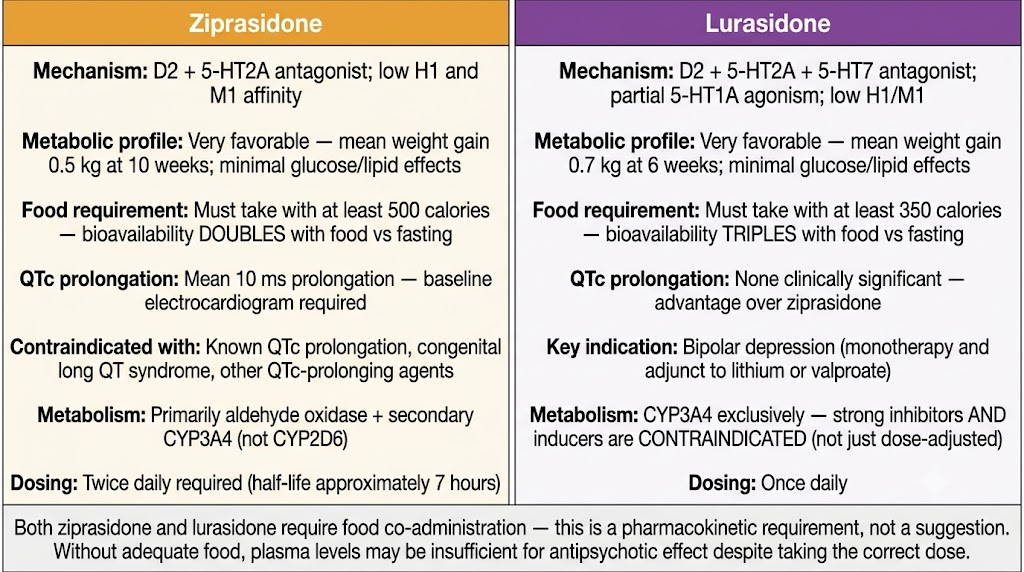
Two-panel comparison of ziprasidone and lurasidone showing both have very favorable metabolic profiles and require food co-administration; ziprasidone requires 500 calories (bioavailability doubles), causes QTc prolongation requiring a baseline electrocardiogram, and uses aldehyde oxidase and cytochrome P450 3A4 metabolism; lurasidone requires 350 calories (bioavailability triples), has no QTc effect, is approved for bipolar depression, and uses cytochrome P450 3A4 exclusively with strong inhibitors and inducers contraindicated.
Ziprasidone and lurasidone: metabolically favorable full antagonists requiring food co-administration, with distinct QTc and drug interaction profiles. Figure generated by Gemini AI.
Ziprasidone

Ziprasidone has high affinity for D2, serotonin 5-HT2A, serotonin 5-HT1A, and serotonin 5-HT1D receptors, and low affinity for histamine H1 and muscarinic M1 receptors. Its metabolic profile is among the most favorable of all approved full-antagonist antipsychotics — mean weight gain of approximately 0.5 kilograms at 10 weeks in clinical trials, with minimal effects on glucose and lipids, attributable directly to its very low histamine H1 and serotonin 5-HT2C affinity.

Ziprasidone's primary clinical limitation is QTc interval prolongation. It produces mean QTc prolongation of approximately 10 milliseconds at standard doses — greater than most other second-generation antipsychotics, though substantially less than thioridazine. This QTc effect makes ziprasidone contraindicated in patients with a history of QTc prolongation, congenital long QT syndrome, or those taking other QTc-prolonging agents. A baseline electrocardiogram is recommended before starting ziprasidone. In practice, serious cardiac arrhythmias at therapeutic doses are rare, but the prescribing caution has meaningfully constrained clinical uptake.

Ziprasidone's food dependency is pharmacokinetically important: oral bioavailability approximately doubles when taken with a meal of at least 500 calories compared with fasting. Patients who take ziprasidone without food may achieve plasma levels insufficient for antipsychotic effect — effectively receiving a lower functional dose than prescribed. Every patient on oral ziprasidone must be explicitly instructed to take it with food at every dose.

Lurasidone

Lurasidone has high affinity for D2, serotonin 5-HT2A, serotonin 5-HT7, and partial serotonin 5-HT1A agonism, and moderate affinity for alpha-2 adrenergic receptors. Its serotonin 5-HT7 antagonism is pharmacologically distinctive and may contribute to its antidepressant and pro-cognitive properties. Its low histamine H1 and muscarinic M1 affinity produces a favorable sedation, weight gain, and anticholinergic profile — among the most metabolically neutral full-antagonist antipsychotics available.

Lurasidone has the most extensively developed evidence base for bipolar depression of any agent in this module, and is Food and Drug Administration-approved for bipolar depression as both monotherapy and adjunctive therapy with lithium or valproate. This approval, combined with its favorable metabolic profile, makes lurasidone a frequent first-line choice in bipolar patients where long-term weight and metabolic management is a priority.

Like ziprasidone, lurasidone requires food co-administration — bioavailability increases approximately threefold when taken with at least 350 calories. Lurasidone is exclusively metabolized by cytochrome P450 3A4, and this single-enzyme dependence creates clinically important absolute contraindications: strong cytochrome P450 3A4 inhibitors (ketoconazole, clarithromycin, ritonavir) raise lurasidone levels to potentially toxic concentrations and are contraindicated; strong cytochrome P450 3A4 inducers (carbamazepine, rifampin, St. John's Wort) may render lurasidone completely subtherapeutic and are also contraindicated. Unlike most antipsychotics, lurasidone does not prolong the QTc interval to a clinically meaningful degree.

Food Dependency — A Pharmacokinetic Requirement, Not a Preference

Ziprasidone: Take with at least 500 calories. Bioavailability doubles with food. Without food, patients receive an effectively subtherapeutic dose despite taking the prescribed milligram amount.

Lurasidone: Take with at least 350 calories. Bioavailability triples with food. Same consequence — inadequate plasma levels without food.

When a patient on either agent appears to have reduced antipsychotic response, reassess food adherence before concluding the dose needs to be increased.


Section 5

Asenapine and Iloperidone

Two agents with distinctive pharmacological and pharmacokinetic properties that define their specific clinical roles

Asenapine and iloperidone are full D2 antagonist second-generation antipsychotics with receptor profiles and pharmacokinetic properties that distinguish them within the class. Neither is a first-line agent in typical clinical practice, but both occupy well-defined clinical niches determined by their unique features.

Asenapine — Sublingual Formulation Required

Asenapine has one of the broadest receptor binding profiles of any approved antipsychotic outside of clozapine, including high affinity for D2, D3, D4, serotonin 5-HT2A, serotonin 5-HT2C, serotonin 5-HT6, serotonin 5-HT7, alpha-1, alpha-2, and histamine H1 receptors. Its histamine H1 and serotonin 5-HT2C affinity produces meaningful weight gain — more than ziprasidone or lurasidone but substantially less than olanzapine or clozapine.

Asenapine's defining pharmacokinetic feature is its route of administration. Its oral bioavailability when swallowed is essentially zero because of extensive first-pass hepatic metabolism. It must be administered sublingually — placed under the tongue and allowed to dissolve completely without swallowing. Sublingual absorption through the buccal mucosa yields approximately 35 percent bioavailability. Patients must not eat or drink for 10 minutes after administration. Failure to follow this consistently results in therapeutic failure that may be misattributed to treatment resistance. A transdermal patch formulation is also approved for schizophrenia, providing an option for patients with adherence difficulties related to the sublingual requirement. Food and Drug Administration-approved indications include schizophrenia (acute and maintenance) and bipolar I mania. A reversible oral numbness of the tongue and mouth occurs in a minority of patients shortly after sublingual dosing — benign and transient, but patients should be warned to prevent premature discontinuation.

Iloperidone — Mandatory Slow Titration

Iloperidone has high affinity for D2, D3, serotonin 5-HT2A, and alpha-1 adrenergic receptors, with lower histamine H1 affinity. Its alpha-1 blockade is among the most pronounced of any second-generation antipsychotic, producing orthostatic hypotension severe enough to require mandatory slow titration: the approved initiation protocol starts at 1 milligram twice daily and increases by 2 milligrams per day increments over 7 days to reach the target dose. Failure to follow this titration schedule is associated with symptomatic orthostatic hypotension, syncope, and falls. Iloperidone produces modest QTc prolongation comparable to ziprasidone and requires a baseline electrocardiogram. Food and Drug Administration-approved indication is schizophrenia only.

Iloperidone is metabolized by cytochrome P450 2D6 and cytochrome P450 3A4, with the same dual-pathway drug interaction rules as aripiprazole: strong inhibitors of either pathway warrant a 50 percent dose reduction; cytochrome P450 2D6 poor metabolizers require equivalent dose reduction. Its clinical niche is narrow — its orthostatic hypotension burden and QTc liability limit broad use, and its efficacy does not clearly exceed other second-generation antipsychotics for any specific indication.

Asenapine

Key Clinical Points

  • Sublingual only — oral bioavailability essentially zero if swallowed
  • No food or drink for 10 minutes after sublingual dosing
  • Transdermal patch available for adherence challenges
  • Reversible oral numbness after sublingual dosing — warn patients
  • Indications: schizophrenia, bipolar I mania
  • Metabolized by cytochrome P450 1A2 — smoking and fluvoxamine interactions

Iloperidone

Key Clinical Points

  • Mandatory 7-day titration — start at 1 mg twice daily, increase 2 mg/day
  • Skipping titration risks symptomatic orthostatic hypotension and syncope
  • QTc prolongation — baseline electrocardiogram required
  • Indication: schizophrenia only
  • Cytochrome P450 2D6 + 3A4 metabolism — 50% dose reduction with strong inhibitors

Section 6

Pharmacokinetics and Key Drug Interactions

Comparative metabolic pathways, half-lives, food effects, and the most clinically consequential interactions for agents in this module

The newer second-generation antipsychotics in this module span a wide range of pharmacokinetic profiles — from aripiprazole's 75-hour half-life to ziprasidone's 7-hour half-life, and from aripiprazole's food independence to ziprasidone's and lurasidone's absolute requirement for food co-administration. These differences directly determine dosing frequency, ease of adherence, and the clinical consequences of missed doses or drug interactions.

Half-Lives and Dosing Frequency

Aripiprazole (approximately 75 hours) and brexpiprazole (approximately 91 hours) support once-daily dosing with a prolonged washout after discontinuation. Cariprazine's parent drug has a half-life of 2 to 4 days, but its major active metabolite accumulates over weeks — full metabolic steady state requires 4 to 8 weeks and the drug's clinical effect persists for weeks after stopping. Lurasidone (approximately 18 hours) supports once-daily dosing. Ziprasidone (approximately 7 hours) requires twice-daily dosing and is among the shortest-acting oral antipsychotics. Asenapine (approximately 24 hours) supports twice-daily sublingual dosing. Iloperidone (approximately 18 hours in cytochrome P450 2D6 extensive metabolizers, longer in poor metabolizers) supports twice-daily dosing.

Drug Interaction Rules by Metabolic Pathway

Aripiprazole and brexpiprazole share dual cytochrome P450 2D6 and cytochrome P450 3A4 metabolism with additive interaction risk: either pathway inhibited alone requires 50 percent dose reduction; both inhibited simultaneously requires reduction to 25 percent. Strong cytochrome P450 3A4 inducers require dose doubling for both agents.

Cariprazine depends primarily on cytochrome P450 3A4: strong inhibitors require halving the dose; strong inducers should generally be avoided because the level reduction may render cariprazine subtherapeutic and the long active metabolite half-life complicates dose adjustment.

Ziprasidone is metabolized primarily by aldehyde oxidase and secondarily by cytochrome P450 3A4, making it relatively insensitive to most cytochrome P450 inhibitors and inducers. Its primary drug interaction concern is pharmacodynamic: additive QTc prolongation with other QTc-active agents — fluoroquinolone antibiotics, azole antifungals, macrolides, antiarrhythmics, and methadone — requires careful cardiac risk assessment.

Lurasidone's exclusive cytochrome P450 3A4 dependence makes strong inhibitors and inducers absolute contraindications rather than dose-adjustment situations, because the magnitude of level change at either extreme is too large to reliably manage with dose modification.

Asenapine depends on cytochrome P450 1A2 and undergoes direct glucuronidation. Smoking reduces asenapine levels through cytochrome P450 1A2 induction; fluvoxamine raises levels substantially. Iloperidone follows the same dual cytochrome P450 2D6 and cytochrome P450 3A4 interaction rules as aripiprazole.

The Food Rule — Repeated Because It Matters

Ziprasidone and lurasidone both require food co-administration for adequate bioavailability. This is not a clinical recommendation — it is a pharmacokinetic requirement. A patient who takes either drug consistently without food is receiving a functionally subtherapeutic dose. If a patient on ziprasidone or lurasidone appears to have inadequate antipsychotic response, ask about food before escalating the dose. Reassess food adherence at every visit for patients on these agents.


Suggested References
Author / Organization Title Source
Stahl SM Stahl's Essential Psychopharmacology: Neuroscientific Basis and Practical Applications. 4th ed. Cambridge University Press; 2013:129–237
Berman RM, Marcus RN, Swanink R, et al The efficacy and safety of aripiprazole as adjunctive therapy in major depressive disorder: a multicenter, randomized, double-blind, placebo-controlled study J Clin Psychiatry. 2007;68(6):843–853
Allison DB, Mentore JL, Heo M, et al Antipsychotic-induced weight gain: a comprehensive research synthesis Am J Psychiatry. 1999;156(11):1686–1696
Spina E, de Leon J Metabolic drug interactions with newer antipsychotics: a comparative review Basic Clin Pharmacol Toxicol. 2007;100(1):4–22
Nemeth G, Laszlovszky I, Czobor P, et al Cariprazine versus risperidone monotherapy for treatment of predominant negative symptoms in patients with schizophrenia: a randomised, double-blind, controlled trial Lancet. 2017;389(10074):1103–1113
Glassman AH, Bigger JT Jr Antipsychotic drugs: prolonged QTc interval, torsade de pointes, and sudden death Am J Psychiatry. 2001;158(11):1774–1782
Loebel A, Cucchiaro J, Silva R, et al Lurasidone monotherapy in the treatment of bipolar I depression: a randomized, double-blind, placebo-controlled study Am J Psychiatry. 2014;171(2):160–168
Citrome L Lurasidone for schizophrenia: a review of the efficacy and safety profile for this newly approved second-generation antipsychotic Int J Clin Pract. 2011;65(2):189–210
Kane JM, Skuban A, Ouyang J, et al A multicenter, randomized, double-blind, controlled phase 3 trial of fixed-dose brexpiprazole for the treatment of adults with acute schizophrenia Schizophr Res. 2015;164(1–3):127–135
Meltzer HY, Massey BW The role of serotonin receptors in the action of atypical antipsychotic drugs Curr Opin Pharmacol. 2011;11(1):59–67