How Sodium Channel Blockers Work
Voltage-gated sodium channels open briefly when a neuron depolarizes, allowing sodium ions to rush in and generate an action potential. After opening, the channel rapidly inactivates — it enters a refractory state in which it cannot open again until the membrane repolarizes and the channel returns to its resting state. This cycle happens with every action potential.
Sodium channel blockers bind preferentially to the inactivated state of the channel. At low firing rates, channels spend most of their time in the resting state and are minimally affected. At the high firing rates characteristic of a seizure discharge, channels cycle rapidly through the inactivated state and accumulate drug binding. This is use-dependent blockade — the more a channel fires, the more drug binds, and the more its activity is suppressed.
The practical consequence is selectivity: sodium channel blockers suppress the abnormally high-frequency firing of seizure activity while leaving normally firing neurons relatively unaffected. This is why therapeutic doses can reduce seizures without producing general anesthesia.
Phenytoin, carbamazepine, and lamotrigine all work through sodium channel blockade. This shared mechanism explains why they have overlapping indications for focal and tonic-clonic seizures, and why none of them is effective for absence seizures — absence seizures are driven by thalamic calcium channel rhythms, not by high-frequency sodium channel firing. Giving any of these drugs to a patient with absence epilepsy can worsen seizure control.
Phenytoin and Fosphenytoin
Phenytoin has been in clinical use since 1938 and remains important pharmacologically because of its unusual kinetics and its high-yield adverse effect profile. Its mechanism is sodium channel blockade, and it is effective for focal seizures, focal to bilateral tonic-clonic seizures, and generalized tonic-clonic seizures.
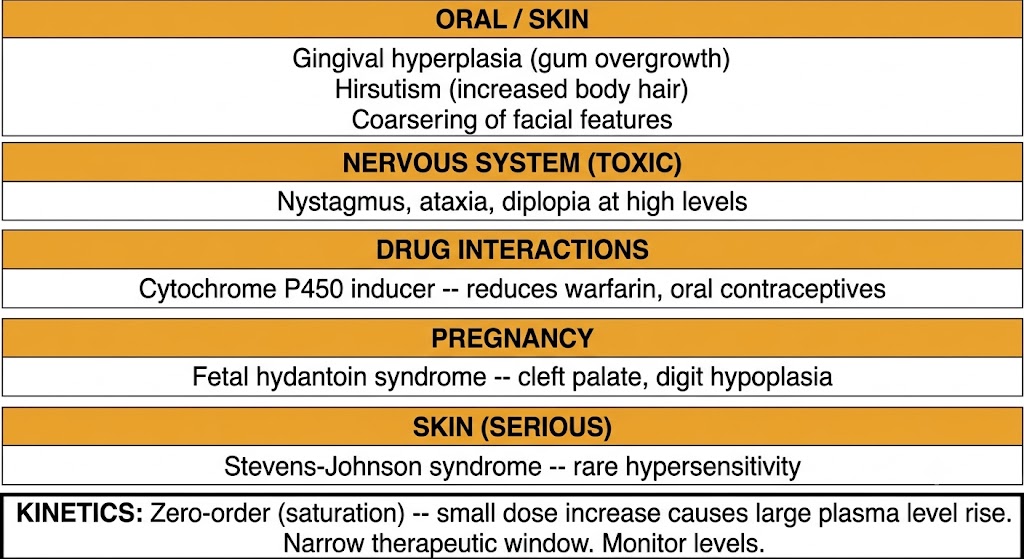
The most clinically significant pharmacokinetic feature of phenytoin is zero-order (saturation) kinetics at therapeutic doses. Most drugs are eliminated at a rate proportional to their concentration — double the dose, double the elimination rate. Phenytoin is different: at therapeutic concentrations, the hepatic enzymes responsible for its metabolism become saturated. Once saturation is reached, a small increase in dose produces a disproportionately large increase in plasma concentration. This makes dosing unpredictable and the therapeutic window narrow. Routine monitoring of plasma levels is required.
- Gingival hyperplasia — overgrowth of gum tissue; the most distinctive chronic effect
- Hirsutism — increased body hair growth
- Coarsening of facial features — thickening of skin and soft tissue
- Peripheral neuropathy — with long-term use
- Cerebellar signs — nystagmus, ataxia, and diplopia at toxic levels
- Stevens-Johnson syndrome — rare but serious hypersensitivity reaction
- Teratogenicity — fetal hydantoin syndrome (cleft palate, digit hypoplasia, growth restriction)
- Cytochrome P450 induction — broad drug interactions; reduces levels of warfarin, oral contraceptives, and many other drugs
Intravenous phenytoin carries serious cardiovascular risks — cardiac arrhythmia and hypotension — related to its propylene glycol vehicle and its direct cardiac membrane effects. It must be infused slowly, and cardiac monitoring is required. For this reason, fosphenytoin is preferred for intravenous use. Fosphenytoin is a water-soluble prodrug that is rapidly converted to phenytoin after administration; it lacks the propylene glycol vehicle and can be infused more rapidly and with less cardiovascular risk.
Carbamazepine and Oxcarbazepine
Carbamazepine is a first-line drug for focal-onset seizures and is also the drug of choice for trigeminal neuralgia — a severe facial pain syndrome caused by aberrant trigeminal nerve firing. This non-epilepsy indication reflects the drug's ability to suppress high-frequency neuronal discharge in peripheral as well as central neurons, and it is high-yield for examinations.
Carbamazepine has a pharmacokinetic property that sets it apart from other anti-seizure drugs: autoinduction. The drug induces its own metabolism through cytochrome P450 3A4 induction. When treatment begins, carbamazepine has a half-life of approximately 36 hours. Over the first several weeks of therapy, as autoinduction develops, the half-life shortens to 12 to 17 hours and plasma levels fall. Doses often need adjustment during the first month of treatment to maintain therapeutic levels.
- Aplastic anemia and agranulocytosis — rare but potentially fatal; complete blood count monitoring required
- Stevens-Johnson syndrome — strongly associated with the HLA-B*1502 allele (East Asian populations); genetic screening recommended before starting therapy in at-risk patients
- Teratogenicity — neural tube defects; avoid in pregnancy when possible
- Hyponatremia — syndrome of inappropriate antidiuretic hormone secretion-like effect; particularly relevant in elderly patients
- Sedation, dizziness, ataxia — dose-dependent central nervous system effects
- Diplopia and blurred vision — common at initiation
- Cytochrome P450 induction — broad drug interactions including reduced efficacy of oral contraceptives
Oxcarbazepine is a structural analog of carbamazepine with the same sodium channel mechanism and similar clinical indications. Its key advantages are a lower risk of aplastic anemia and agranulocytosis, no autoinduction, and fewer drug interactions overall. Its principal disadvantage is a higher rate of hyponatremia than carbamazepine. Oxcarbazepine is often preferred when carbamazepine's hematologic risks or drug interaction profile is a concern.
Lamotrigine
Lamotrigine is a broad-spectrum anti-seizure drug whose primary mechanism is sodium channel blockade, but unlike phenytoin and carbamazepine it also has efficacy against absence seizures, making it more versatile. It is effective for focal seizures, generalized tonic-clonic seizures, absence seizures, and the mixed seizure types seen in juvenile myoclonic epilepsy, though valproate remains preferred for juvenile myoclonic epilepsy.
Lamotrigine is metabolized primarily by hepatic glucuronidation (not cytochrome P450), which gives it fewer drug interactions than phenytoin or carbamazepine. However, this glucuronidation pathway creates one critical drug interaction: valproate inhibits lamotrigine glucuronidation, raising lamotrigine plasma levels two-fold. When lamotrigine is added to valproate, the starting dose must be halved and the titration rate slowed significantly.
Lamotrigine carries a significant risk of Stevens-Johnson syndrome — a severe, potentially life-threatening skin reaction involving epidermal detachment. Two factors dramatically increase this risk:
- Rapid dose titration — the starting dose must be low and increases must be gradual over weeks, not days
- Concurrent valproate — valproate raises lamotrigine levels by inhibiting its metabolism, doubling the Stevens-Johnson syndrome risk
Slow titration is not a preference — it is a safety requirement. Any rash that develops during lamotrigine titration must be evaluated urgently, as early Stevens-Johnson syndrome can be difficult to distinguish from a benign drug rash.
Among older anti-seizure drugs, lamotrigine has a relatively favorable profile in pregnancy compared to valproate and phenytoin, though no anti-seizure drug is without teratogenic risk. It is a preferred option when treatment during pregnancy cannot be avoided.
Drug Interactions and Clinical Selection
Phenytoin and carbamazepine are both potent inducers of hepatic cytochrome P450 enzymes, particularly cytochrome P450 3A4 and cytochrome P450 2C9. This creates broad drug interactions: they accelerate the metabolism of warfarin (reducing anticoagulant effect), oral contraceptives (reducing contraceptive efficacy), many antibiotics, immunosuppressants, and other anti-seizure drugs. Patients on either drug require review of their entire medication list for interaction risk.
Lamotrigine is not a cytochrome P450 inducer and has a substantially cleaner interaction profile. It is in turn affected by inducers: carbamazepine and phenytoin accelerate lamotrigine metabolism, requiring higher lamotrigine doses when used together.
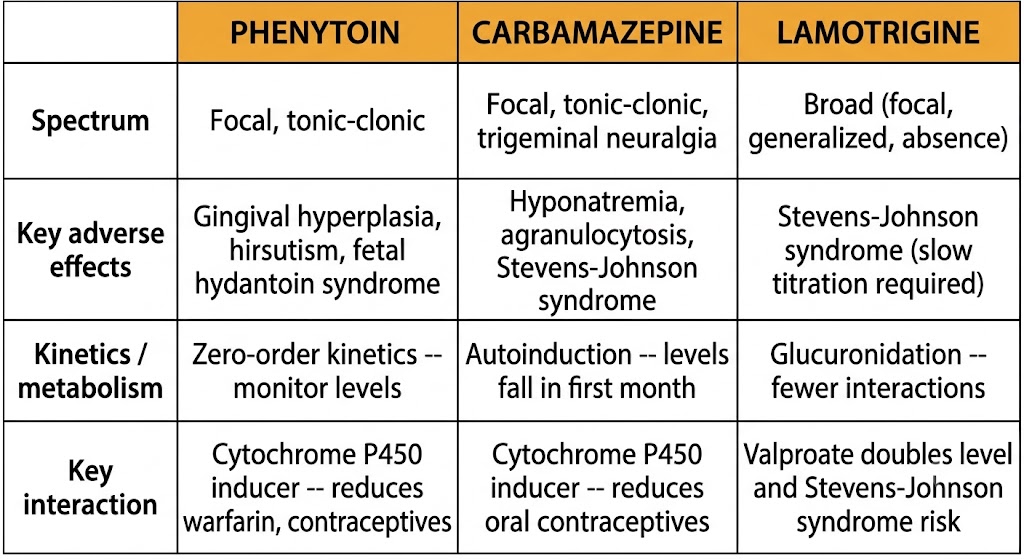
- Carbamazepine — first-line for focal seizures; also first-line for trigeminal neuralgia; avoid in absence and myoclonic epilepsy; monitor blood counts
- Phenytoin / fosphenytoin — use fosphenytoin for intravenous loading (status epilepticus second-line); phenytoin oral useful but complex kinetics require monitoring; avoid in absence epilepsy
- Lamotrigine — preferred when broad-spectrum coverage is needed with fewer interactions; preferred over valproate in women of childbearing potential; titrate slowly; halve dose when adding to valproate
- Oxcarbazepine — alternative to carbamazepine with lower hematologic risk; higher hyponatremia rate; useful when carbamazepine interactions are a problem