Mechanisms of Action
Valproate is pharmacologically unusual in that its broad clinical efficacy reflects at least three concurrent mechanisms rather than a single molecular target. This multi-mechanism profile is the reason it works across a wider range of seizure types than any other single agent in common use.
- Sodium channel blockade — reduces high-frequency neuronal firing, contributing to efficacy against focal and tonic-clonic seizures
- T-type calcium channel blockade — interrupts the thalamic rhythm that drives absence seizures, the same target as ethosuximide
- Gamma-aminobutyric acid transaminase inhibition — blocks the enzyme that breaks down gamma-aminobutyric acid, increasing inhibitory neurotransmitter levels throughout the brain
No other widely used anti-seizure drug combines all three of these mechanisms. The result is a drug that suppresses both the high-frequency discharge underlying focal and tonic-clonic seizures and the thalamic oscillation underlying absence seizures — while simultaneously enhancing inhibitory tone. This mechanistic breadth translates directly into clinical breadth.
Therapeutic Uses and Syndrome Coverage
Valproate has proven efficacy across virtually every seizure type, making it one of the most versatile anti-seizure drugs available. Its most important syndrome indication is juvenile myoclonic epilepsy, where it is the drug of first choice because it suppresses myoclonic jerks, generalized tonic-clonic seizures, and the absence seizures that often accompany this syndrome — three seizure types that no narrow-spectrum drug can cover simultaneously.
For childhood absence epilepsy, valproate is an appropriate first-line alternative when ethosuximide is not sufficient or when absence seizures coexist with other generalized seizure types. Ethosuximide is preferred for pure absence, but valproate's additional coverage against tonic-clonic seizures makes it the choice when the clinical picture is mixed.
- Juvenile myoclonic epilepsy — drug of first choice
- Generalized tonic-clonic seizures
- Absence seizures (especially mixed with other types)
- Myoclonic seizures
- Focal seizures (broad-spectrum coverage)
- Bipolar disorder — mood stabilizer, particularly for mania
- Migraine prophylaxis — reduces migraine frequency
These indications are high-yield because they appear in the context of teratogenicity counseling — valproate must be used with extreme caution in women of childbearing potential regardless of the indication.
Adverse Effects
Valproate carries two Food and Drug Administration black box warnings — for hepatotoxicity and for teratogenicity — that together make it one of the most carefully regulated anti-seizure drugs in clinical practice. Understanding both warnings is essential for appropriate prescribing.
Valproate can cause fatal hepatotoxicity, most commonly in children under two years of age and in patients receiving multiple anti-seizure drugs simultaneously. The risk is highest in this population and falls substantially in older children and adults on monotherapy. Liver function must be monitored, particularly in the first six months of treatment. Symptoms of hepatotoxicity — malaise, weakness, anorexia, jaundice — should prompt immediate evaluation.
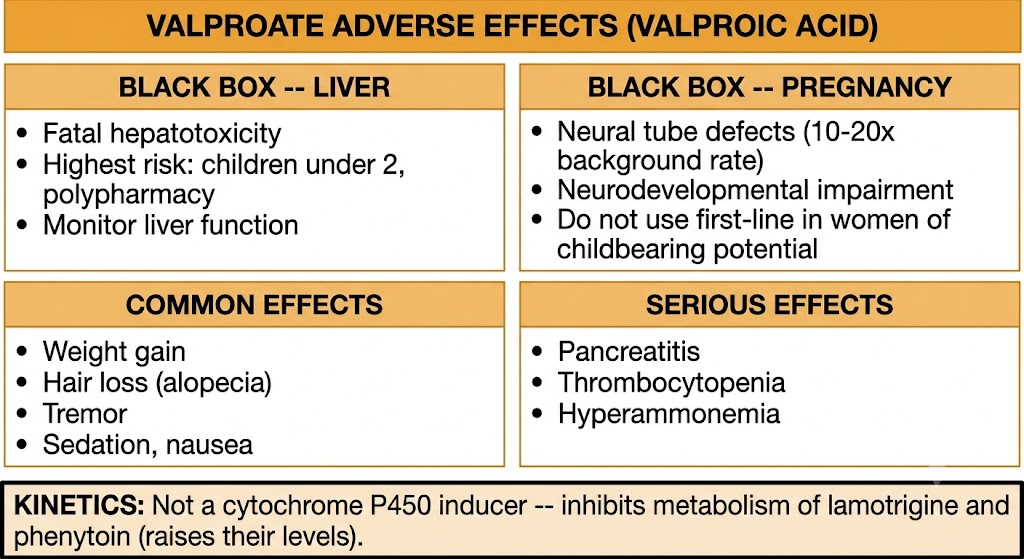
- Hepatotoxicity — black box; fatal cases reported; children under two at highest risk
- Pancreatitis — rare but potentially life-threatening
- Thrombocytopenia — platelet count monitoring required
- Weight gain — significant and often treatment-limiting
- Hair loss (alopecia) — reversible; zinc and selenium supplementation sometimes used
- Tremor — dose-dependent
- Sedation, nausea — particularly at initiation
- Hyperammonemia — can occur without liver function abnormalities
Teratogenicity
Valproate carries a black box warning for teratogenicity. Among all commonly used anti-seizure drugs, it has the highest risk of causing major congenital malformations and neurodevelopmental impairment in children exposed in utero. This distinction is not marginal — the teratogenic risk of valproate substantially exceeds that of lamotrigine, levetiracetam, and even carbamazepine and phenytoin in most registries.
Neural tube defects — spina bifida occurs in approximately 1 to 2 percent of valproate-exposed pregnancies, compared to a background rate of approximately 0.1 percent. This represents a ten- to twenty-fold increase in risk.
Neurodevelopmental effects — children exposed to valproate in utero have lower intelligence quotient scores and higher rates of autism spectrum disorder and attention deficit hyperactivity disorder compared to children exposed to other anti-seizure drugs. This cognitive effect is independent of the structural malformation risk and persists into childhood.
Other malformations — cardiac defects, cleft palate, limb abnormalities, and facial dysmorphism are also reported at increased rates.
Valproate should not be used as a first-line agent in women of childbearing potential unless alternative drugs have failed or are not tolerated. When it must be used, folic acid supplementation is mandatory — though supplementation reduces but does not eliminate the teratogenic risk.
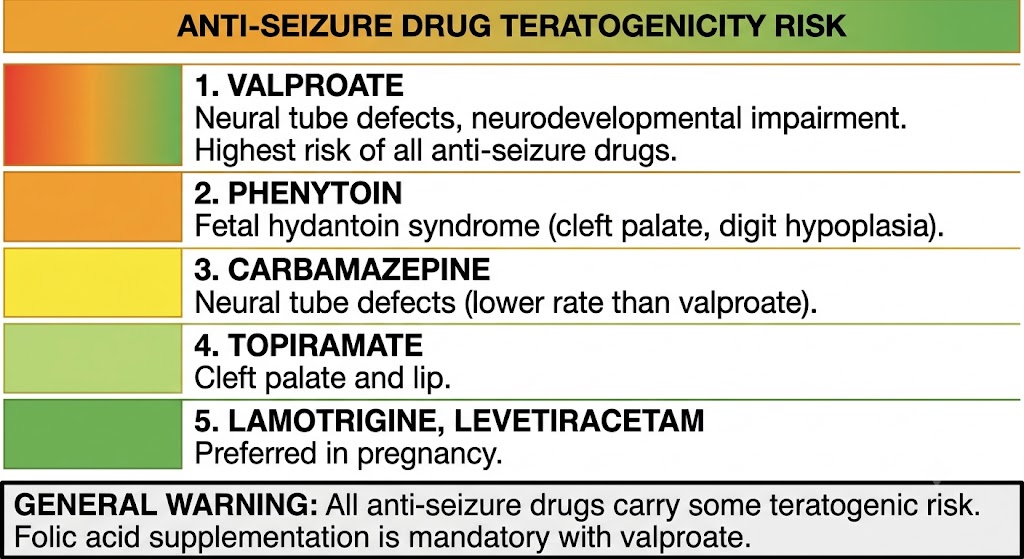
The teratogenicity ranking among commonly used anti-seizure drugs, from highest to lowest risk, places valproate first, followed by phenytoin (fetal hydantoin syndrome), carbamazepine (neural tube defects, lower rate than valproate), topiramate (cleft palate and lip), and then lamotrigine and levetiracetam at substantially lower risk. This ranking guides drug selection in women of childbearing potential — lamotrigine and levetiracetam are preferred when treatment cannot be avoided during pregnancy.
Drug Interactions
Unlike phenytoin and carbamazepine, valproate is not a cytochrome P450 inducer. Instead, it is a broad inhibitor of several metabolic pathways, which means it raises rather than lowers the levels of many co-administered drugs. The two most clinically important interactions are with lamotrigine and with phenytoin.
- Valproate + lamotrigine — valproate inhibits lamotrigine glucuronidation, doubling lamotrigine plasma levels and doubling Stevens-Johnson syndrome risk; lamotrigine dose must be halved and titration slowed when the two are combined
- Valproate + phenytoin — valproate displaces phenytoin from plasma protein binding, transiently raising free phenytoin levels; it also inhibits phenytoin metabolism; monitoring is required
- Enzyme inducers (carbamazepine, phenytoin, phenobarbital) — these drugs accelerate valproate metabolism, lowering valproate levels and potentially reducing seizure control; dose adjustment may be needed